

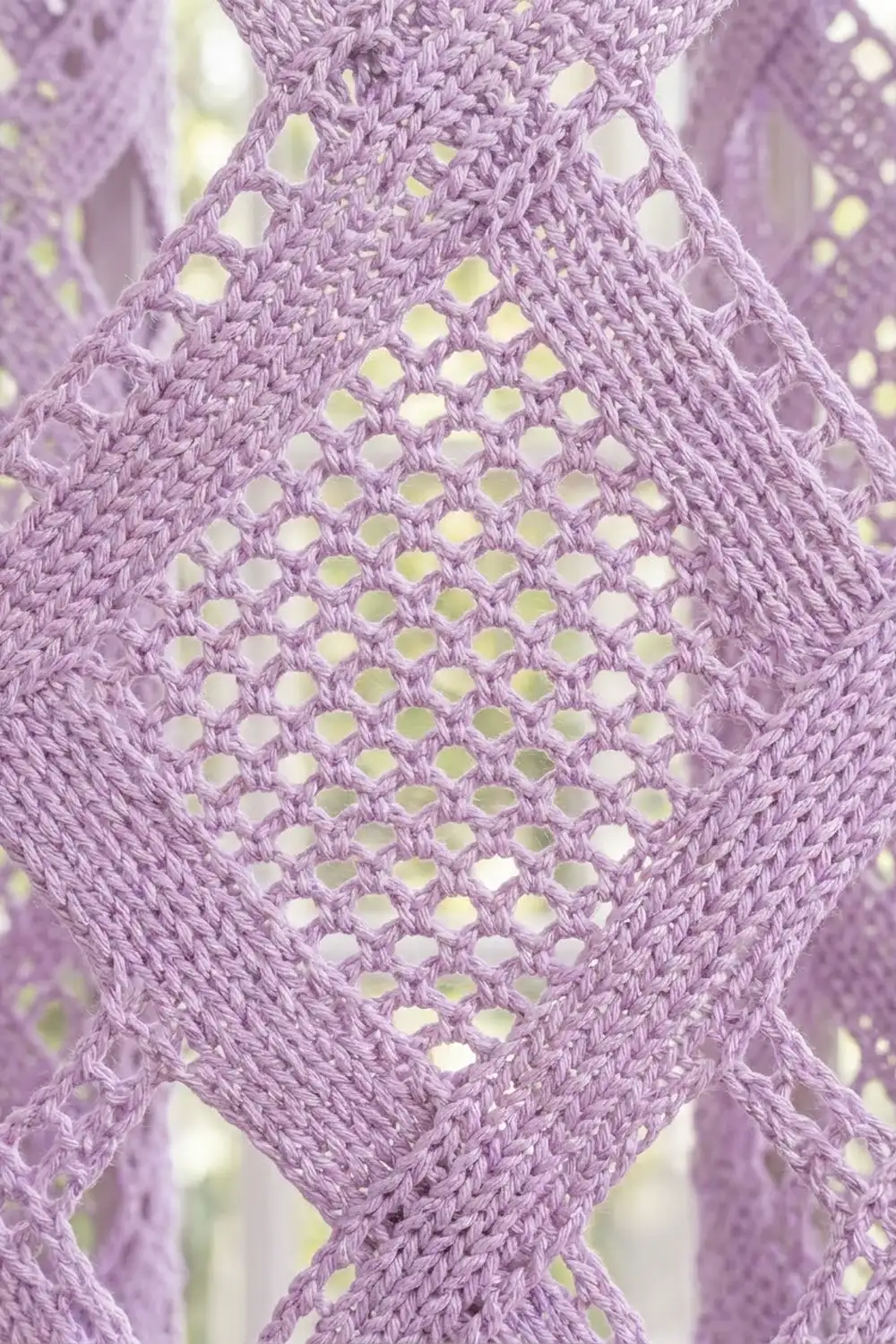
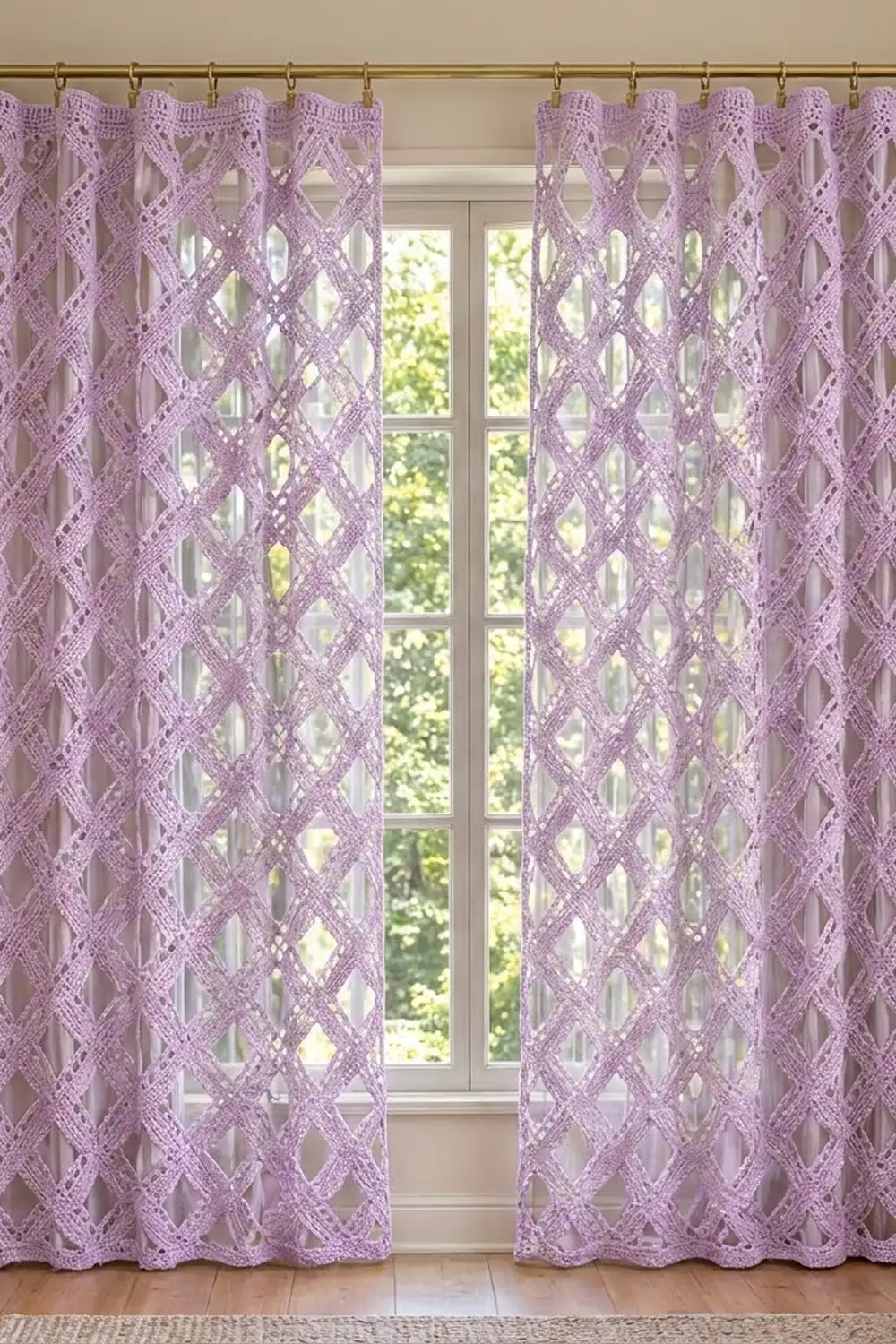
The Lilac Lattice Curtain Panel is a light, airy window covering. Solid diagonal bands cross over a delicate filet-mesh ground. Where the bands cross they make crisp X-shapes, and the spaces between them become diamond windows full of small square eyelets that filter daylight softly.
The panel is worked in one color, a soft lavender, so the texture stands out. The look is calm and a little vintage, and it suits bedrooms, reading corners and sunny living rooms. The pattern uses US crochet terms throughout.
One finished panel measures 27.4 in wide x 80.2 in long (69.6 cm x 203.7 cm) after blocking. For a pair like the one in the photo, make a second panel exactly the same way.
The panel is worked flat in one piece from the bottom up. You make two solid rows, then 12 repeats of a 16-row lattice, then two more solid rows. A 5-row single crochet header goes along the top, and 2 rounds of single crochet border finish all four edges.
Finished Size and Construction
- Finished size: 27.4 in x 80.2 in (69.6 cm x 203.7 cm)
- Skill level: Intermediate (easy stitches, but you need to keep careful count)
- Terminology: US crochet terms
- Yarn weight: DK (#3), cotton or cotton blend
- Hook: 4.0 mm (G-6)
- Number of pieces: 1 panel (make 2 for a pair)
- Layout: Single rectangle, worked in rows
- Body size (before header and border): 26.6 in x 78.4 in (67.6 cm x 199.1 cm)
- Size before border (body + header): 26.6 in x 79.4 in (67.6 cm x 201.7 cm)
- Border depth: 0.4 in (1.0 cm) on each edge
Materials
Yarn: Choose a smooth DK cotton or cotton blend with good stitch definition. Cotton hangs straight and shows the eyelets clearly. Avoid fuzzy yarns, because they blur the mesh.
- Lavender: 400 g / about 920 m per panel (800 g / about 1,840 m for a pair)
Tools:
- 4.0 mm (G-6) crochet hook
- Tapestry needle
- Stitch markers (at least 8)
- Measuring tape
- Rust-proof blocking pins and a large blocking area (or a clean floor with towels)
- 9 curtain clip rings per panel
The yarn quantities include a margin of roughly 10–15%. That covers your gauge swatch and small tension differences.
Abbreviations (US Terms)
- ch – chain
- sc – single crochet
- dc – double crochet
- sk – skip
- st(s) – stitch(es)
- sp – space
- RS / WS – right side / wrong side
Special terms (filet cells):
- Post: The dc that starts and ends each cell. Every row begins with ch 3, which counts as the first post.
- Block (B): Dc in the next st, dc in the next st. This makes 2 sts and gives a solid cell.
- Mesh (M): Ch 1, sk the next st, dc in the next st. This makes 2 sts and gives an open eyelet.
- When you work a Block over a Mesh, put the first dc into the ch-1 sp.
- Each ch-1 counts as 1 stitch, so every row has 1 post + (66 cells x 2) = 133 sts.
Gauge and Checkpoints
Gauge: 20 sts and 10 rows = 4 in (10.2 cm) in filet pattern. For the sc header and border, the gauge is 20 sc and 20 rows = 4 in (10.2 cm). Each dc row is 0.4 in (1.0 cm) tall, and each sc row is 0.2 in (0.5 cm) tall.
Test swatch: Ch 35. Row 1: Dc in the 4th ch from hook and in each ch across (33 dc). Row 2: Ch 3, dc in each st across. Rows 3–18: Work Lattice Rows 1–16 once, as one repeat with no edge cells. Block the swatch. It should measure 6.6 in x 7.2 in (16.8 cm x 18.3 cm).
- Too big: Go down one hook size (3.75 mm).
- Too small: Go up one hook size (4.5 mm).
- Width right but height off: Change how far you pull up the dc loop rather than changing hooks.
Checkpoints on the panel:
- After Row 2: width 26.6 in (67.6 cm)
- After Row 18 (first lattice repeat): height 7.2 in (18.3 cm)
- After Row 196: height 78.4 in (199.1 cm)
- After the header: height 79.4 in (201.7 cm)
- After the border: 27.4 in x 80.2 in (69.6 cm x 203.7 cm)
Panel Body
Each row is: ch 3 (post), 1 edge Block, the 16-cell lattice repeat 4 times, then 1 edge Block. Work the last dc of each row into the top of the turning ch-3. Each lattice row is symmetrical within its repeat, so you read it the same way on RS and WS rows.
Foundation: Ch 135.
Row 1 (RS): Dc in the 4th ch from hook (the skipped ch counts as the first dc) and in each ch across. Turn. (133 sts)
Row 2: Ch 3, dc in each st across. Turn. (133 sts = 66 Blocks)
Checkpoint: the width is 26.6 in (67.6 cm).
The 16-Row Lattice Repeat
Start every row with ch 3 and 1 edge Block. Work the bracketed repeat 4 times, then finish with 1 edge Block. Turn. Every row has 133 sts.
- Lattice Row 1: [B2, M12, B2]
- Lattice Row 2: [M1, B2, M10, B2, M1]
- Lattice Row 3: [M2, B2, M8, B2, M2]
- Lattice Row 4: [M3, B2, M6, B2, M3]
- Lattice Row 5: [M4, B2, M4, B2, M4]
- Lattice Row 6: [M5, B2, M2, B2, M5]
- Lattice Row 7: [M6, B4, M6]
- Lattice Row 8 (crossing): [M7, B2, M7]
- Lattice Row 9: [M6, B4, M6]
- Lattice Row 10: [M5, B2, M2, B2, M5]
- Lattice Row 11: [M4, B2, M4, B2, M4]
- Lattice Row 12: [M3, B2, M6, B2, M3]
- Lattice Row 13: [M2, B2, M8, B2, M2]
- Lattice Row 14: [M1, B2, M10, B2, M1]
- Lattice Row 15: [B2, M12, B2]
- Lattice Row 16 (crossing): [B1, M14, B1]
Each repeat adds up to 16 cells. With the 2 edge cells, every row has 66 cells.
How the lattice forms: One band moves 1 cell to the right on every row, and the mirrored band moves 1 cell to the left. They meet at Lattice Row 8 in the middle of each repeat. At Lattice Row 16, the halves of neighboring repeats meet across the repeat boundary (B1 + B1). Both meetings make X-shaped crossings. Each diamond window is 16 cells wide and 16 rows tall, or 6.4 in x 6.4 in (16.3 cm x 16.3 cm) before hanging.
Rows 3–194: Work Lattice Rows 1–16 twelve times (192 rows). After the first repeat (Row 18), the height is 7.2 in (18.3 cm). Place a marker at the end of every repeat so you can count repeats easily.
Row 195: Ch 3, dc in each st across, putting a dc into each ch-1 sp. Turn. (133 sts)
Row 196: Ch 3, dc in each st across. Do not fasten off. (133 sts)
Checkpoint: the body is 26.6 in x 78.4 in (67.6 cm x 199.1 cm).
Top Header
The header is a firm solid band that holds the clip rings without stretching the mesh.
Header Row 1: Ch 1, sc in each st across. Turn. (133 sc)
Header Rows 2–5: Ch 1, sc in each sc across. Turn. (133 sc each row)
The header is 5 rows x 0.2 in = 1.0 in (2.5 cm) deep. Checkpoint: the panel now measures 26.6 in x 79.4 in (67.6 cm x 201.7 cm). Do not fasten off, because the border starts here.
Border
Border gauge: 5 sc per inch (2.0 cm), the same as the body width gauge. That means the counts below match the panel’s real measurements.
Round 1 (RS): Ch 1. Along the top, sc in each st across, working 3 sc in the first and last sts (the corners). On the side edge, work 395 sc evenly along the row-ends:
- 2 sc in each dc row-end for Rows 196 down to 2 (390 sc)
- 1 sc in the end of Row 1 (1 sc)
- 1 sc in the end of each of Header Rows 1–4 (4 sc)
You skip the Header Row 5 end and use only 1 sc at Row 1 because the corner sc groups already cover those row-ends. Along the bottom, sc in each of the 133 foundation ch loops, working 3 sc in the first and last loops. Work the second side the same as the first. Join with a sl st to the first sc.
Count per side, from corner center to corner center inclusive:
- Top and bottom: 1 + 1 + 131 + 1 + 1 = 135 sc
- Sides: 1 + 1 + 395 + 1 + 1 = 399 sc
- Round total: (2 x 133) + (2 x 395) + (4 x 2 corner extras) = 1,064 sc
Round 2: Ch 1, sc in each sc around, working 3 sc in each corner center sc. Join and fasten off.
- Top and bottom: 137 sc
- Sides: 401 sc
- Round total: 1,064 + 8 = 1,072 sc
Why the math works:
- Width: The top’s 133 sts already include the corner sts, so each round adds 2 sts per side, which is 0.4 in (1.0 cm). 137 ÷ 5 = 27.4 in (69.6 cm), which equals 26.6 in plus 2 border depths of 0.4 in.
- Length: The side starts at 395 rather than 397 because the corner groups sit on the end rows. 401 ÷ 5 = 80.2 in (203.7 cm), which equals 79.4 in plus 0.8 in (2.0 cm).
Checkpoint after Round 1: 27.0 in x 79.8 in (68.6 cm x 202.7 cm).
Final Blocking
- Weave in all ends along the solid bands, never through the mesh.
- Soak the panel in cool water with a little wool wash for 15 minutes.
- Press out the water gently. Roll the panel in towels and do not wring it.
- Lay it flat on a large blocking surface.
- Pin the corners to 27.4 in x 80.2 in (69.6 cm x 203.7 cm).
- Pin along each edge every 4 in (10.2 cm), keeping the edges straight.
- Line up the diamonds so the bands run at even diagonals and the crossings stack vertically.
- Let it dry completely, about 24–48 hours.
- Attach 9 clip rings evenly to the header: the first and last 0.5 in (1.3 cm) from the corners, and the rest about 3.3 in (8.4 cm) apart.
Final Quality-Control Checklist
- Every row has 133 sts and 66 cells.
- There are 12 full lattice repeats, and each diamond lines up with the one below it.
- The crossings form clean X-shapes at Lattice Rows 8 and 16.
- The edge Blocks make a straight solid column on both sides.
- The header is 5 sc rows deep and 133 sts wide.
- Border Round 2 has 137 sc on the top and bottom and 401 sc on each side.
- The panel blocks to 27.4 in x 80.2 in (69.6 cm x 203.7 cm).
- All ends are hidden in the solid areas.
- For a pair, both panels match in length within 0.5 in (1.3 cm).
Troubleshooting
The bands drift or the diamonds look lopsided. Check for a missed or extra cell. Count each row against the bracket list, and use markers at the start of each repeat.
The row has 132 or 134 sts. You probably missed the last dc in the turning ch-3, or you worked into the first post. Rip back to the row with the error and rework it.
The mesh looks slanted. Your ch-1 spaces are too tight. Loosen the chain slightly or go up half a hook size for the chains only.
The panel is too short. Add one more 16-row repeat, which adds 6.4 in (16.3 cm). Then add 32 sc to each side in Border Round 1.
The header ripples. You worked extra sc. Recount to 133.
The border flares. Your sides have more than 395 sc. Count again and space the sts evenly.
The panel stretches after hanging. Cotton relaxes over time. Re-block it, or use one more clip ring to spread the weight.
Care
Hand wash or machine wash on a cold delicate cycle inside a mesh bag. Dry flat, and re-block if the diamonds lose their shape. Avoid long periods in harsh direct sun to keep the lavender from fading.
Final Notes
The measurement chain is simple. A gauge of 20 sts and 10 rows to 4 in (10.2 cm) gives a 133-st body that is 26.6 in (67.6 cm) wide. 196 rows make it 78.4 in (199.1 cm) long. The 5-row header brings it to 79.4 in (201.7 cm). The 2-round border brings it to 27.4 in x 80.2 in (69.6 cm x 203.7 cm). Check each step as you go and the panel will hang straight, even and light-filled. Make a second one for a matching pair.
Happy crocheting!