

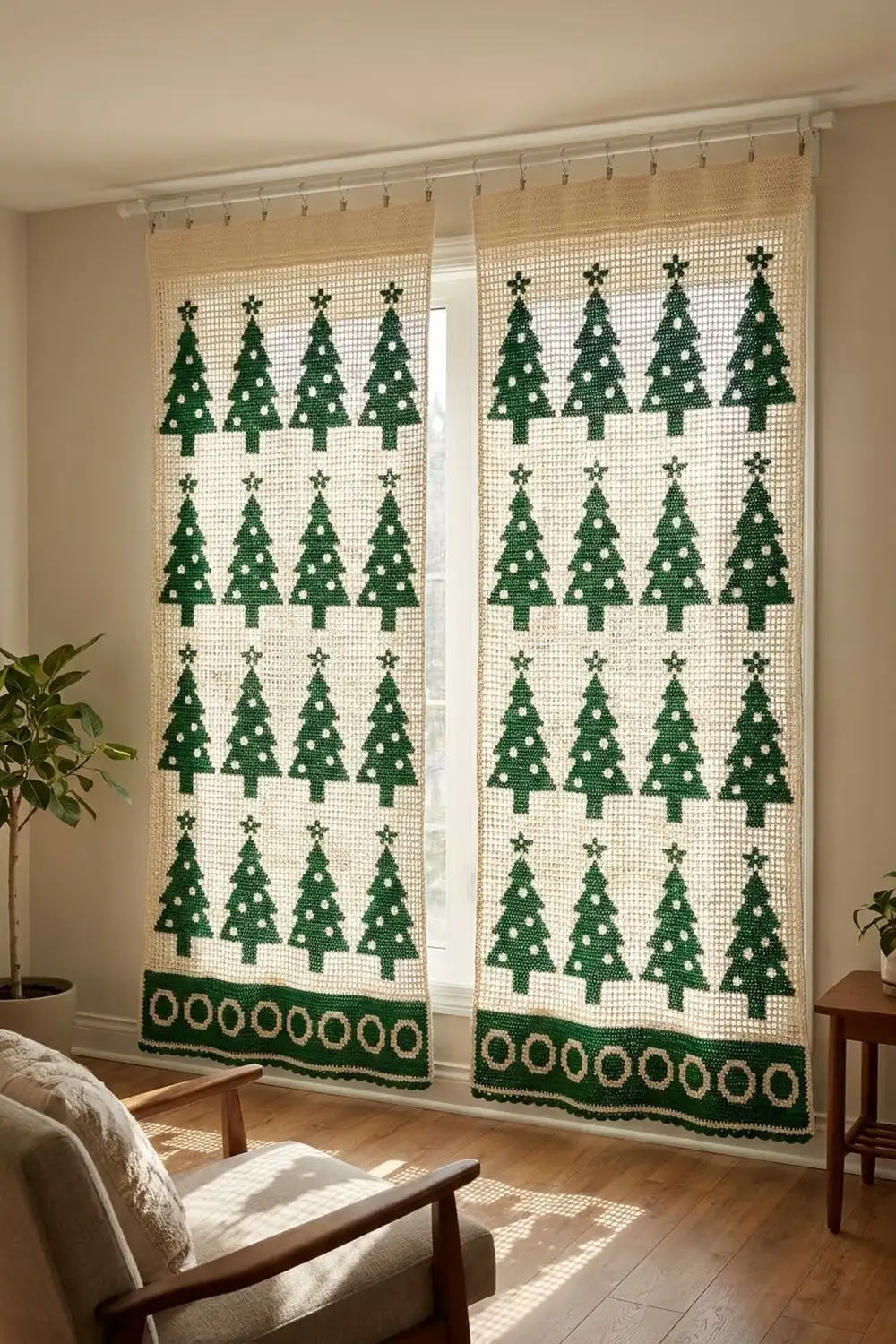
The Evergreen Window curtain is a festive take on classic filet crochet. Solid forest-green Christmas trees stand in neat rows on a light cream mesh, and each tree carries a few cream “ornament” dots and a small cross-shaped star. A solid green band with linked cream rings runs along the bottom, finished with a small green scallop edge.
The palette is just two colors: cream for the open mesh and heading, and deep forest green for the trees and band. When it hangs in a window, light comes through the mesh and the trees stand out clearly from inside and outside.
This pattern uses US crochet terms. Each finished panel measures 35 in (88.9 cm) wide by 77 in (195.6 cm) long after border and blocking. The photo shows a pair, so you make two identical panels. They hang side by side and are not joined.
Each panel is worked as one piece from the bottom up. You start with the ring band, then work six tree repeats (four trees across), add a solid cream heading, and finish with a two-round border and a green scallop along the bottom edge.
Finished Size and Construction
- Finished size (one panel): 35 in x 77 in (88.9 cm x 195.6 cm)
- Skill level: Intermediate (filet crochet plus simple colorwork)
- Terminology: US
- Yarn weight: DK / light (#3) cotton
- Hook: 4.0 mm (G-6)
- Number of pieces: 2 separate panels, each worked in one piece
- Layout per panel: 4 trees across x 6 trees down (24 trees)
- Piece size before border: 34 in x 75.5 in (86.4 cm x 191.8 cm), which is 68 meshes x 151 rows
- Border depth: 0.5 in (1.3 cm) on the sides and top; 1 in (2.5 cm) at the bottom, including the scallops
Materials
Choose a smooth, mercerized or combed cotton in DK weight, about 125 m per 50 g. Cotton holds the square mesh shape, drapes well, and stands up to washing and sunlight better than acrylic.
Yarn for the pair (two panels):
- Cream (main color, MC): 900 g / 2,250 m (18 balls of 50 g / 125 m)
- Forest green (contrast color, CC): 600 g / 1,500 m (12 balls of 50 g / 125 m)
For one panel only, halve these amounts: 450 g / 1,125 m cream and 300 g / 750 m green. The quantities include a margin of about 15 to 20 percent for the gauge swatch, tails, and small tension differences.
Tools:
- 4.0 mm (G-6) crochet hook
- 4 small yarn bobbins (for the green tree sections)
- Tapestry needle
- Stitch markers
- Measuring tape
- Blocking mats or a large clean surface, and rust-proof pins
- Spray bottle
- 18 curtain hooks or clip rings per panel
Abbreviations (US Terms)
- ch = chain
- sc = single crochet
- dc = double crochet
- sl st = slip stitch
- st(s) = stitch(es)
- sp = space
- MC = main color (cream)
- CC = contrast color (green)
Filet terms used in this pattern:
- Mesh: one square unit, 3 sts wide, that shares its edge dc with the next mesh. A row of W meshes has (3 x W) + 1 sts.
- Space (S): ch 2, skip the next 2 sts (or the ch-2 sp), dc in next dc.
- Block (B): dc in each of the next 3 sts. Over a space, work 2 dc in the ch-2 sp, then dc in the next dc.
- G = green block, C = cream block, S = cream space.
- Beginning a row: ch 3 (counts as dc) if the first mesh is a block; ch 5 (counts as dc + ch 2) if the first mesh is a space. Work the last dc of each row into the 3rd ch of the turning chain.
Special technique – carried-color filet:
Change color on the last yarn over of the stitch before the new color. Inside every green section, lay the cream strand along the top of the row below and work the green dc over it. This hides the cream and keeps it ready for each cream dot. Each tree uses its own green bobbin. If the next row’s green section starts at or inside the previous one, carry the green along the top of the green block below, where the solid block hides the strand. If the green section starts farther out, cut the green with a 4 in (10.2 cm) tail and rejoin it at the new spot.
Gauge and Checkpoints
Gauge: 12 meshes and 12 rows = 6 in (15.2 cm) in filet mesh. One mesh is 0.5 in (1.3 cm) square.
Test one piece first. Before starting a full panel, crochet a one-tree swatch. With CC, ch 54.
- Row 1: Dc in 4th ch from hook and each ch across (52 sts = 17 blocks).
- Rows 2 to 4: Work the band from Rows 2 to 4 below, repeating the 4-mesh motif 4 times and ending with 1 G.
- Row 5: 17 G.
- Rows 6 to 29: Work Tree Rows 1 to 24 once.
Swatch checkpoint: 8.5 in (21.6 cm) wide x 14.5 in (36.8 cm) tall after light blocking.
Panel checkpoints:
- After Row 5 (band): 2.5 in (6.4 cm) tall and 34 in (86.4 cm) wide
- After Row 29 (first tree repeat): 14.5 in (36.8 cm)
- After Row 77 (three repeats): 38.5 in (97.8 cm)
- After Row 149 (six repeats): 74.5 in (189.2 cm)
- After Row 151 (heading): 75.5 in (191.8 cm)
If your swatch is too big, go down 0.5 mm in hook size. If it is too small, go up 0.5 mm. If the width is right but the rows are short, pull each dc loop slightly taller instead of changing hooks. Being off by just 1 mesh per 6 in adds up to more than 2 in (5.1 cm) across the panel, so measure the swatch carefully.
Bottom Ring Band
With CC, ch 207.
Row 1 (CC): Dc in 4th ch from hook and each ch across, turn. (205 sts = 68 G)
From Row 2 on, carry the color not in use inside the dc across the whole band row.
Row 2: Ch 3, G, C, C, G 17 times, turn. (68 meshes: 34 G + 34 C; 205 sts)
Row 3: Ch 3, C, G, G, C 17 times, turn. (68 meshes: 34 G + 34 C; 205 sts)
Row 4: Repeat Row 2. (205 sts)
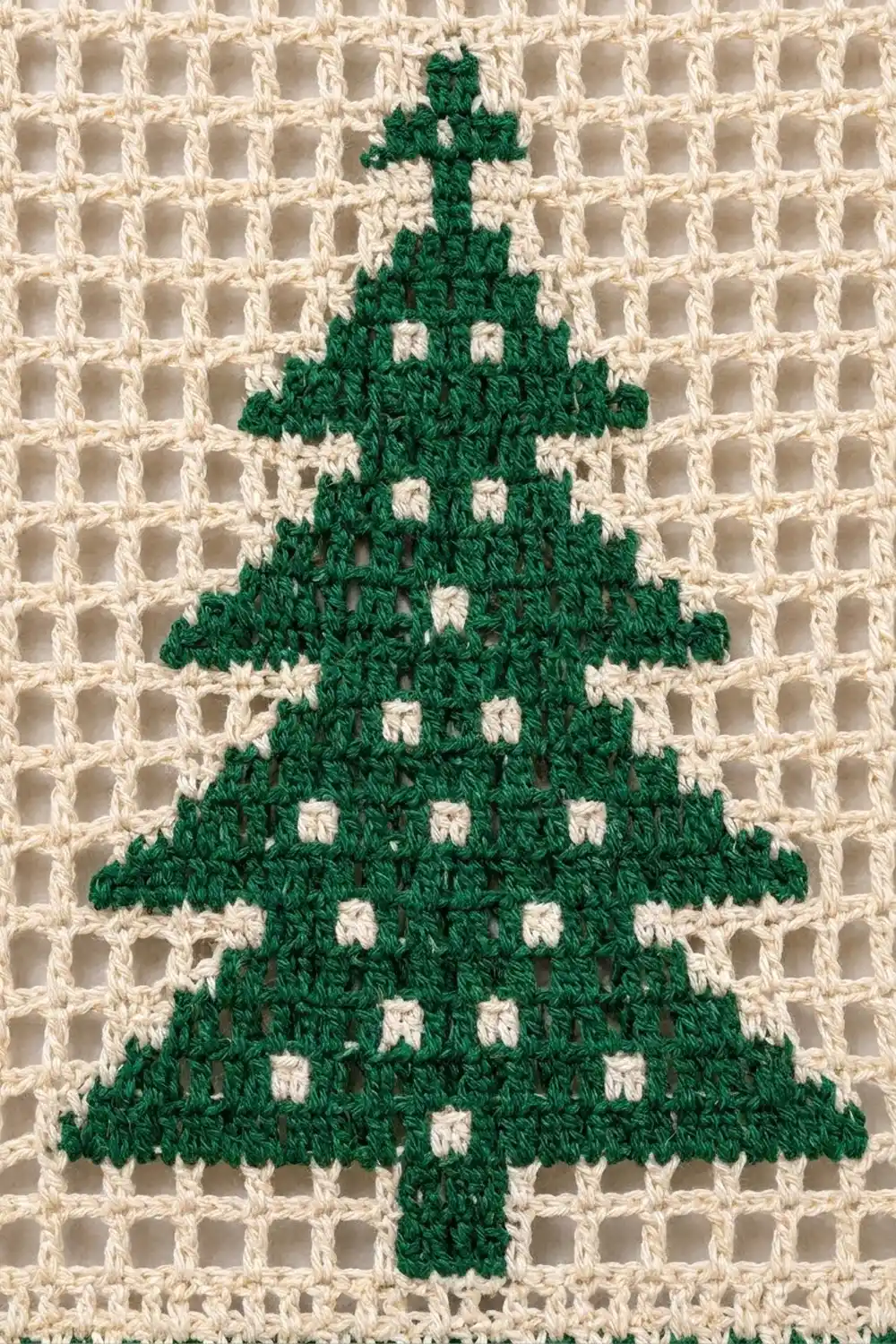
The cream blocks in Rows 2 to 4 form linked rings, each with a 2-block green center in Row 3.
Row 5 (CC): Ch 3, 68 G, turn. (205 sts) Cut CC, leaving a tail to weave in. Continue with MC.
Tree Section
Each tree row below is written for one 17-mesh tree repeat. Work the repeat 4 times across every row (68 meshes, 205 sts). Panel Row 6 is Tree Row 1. The tree is symmetrical, so the same sequence works on right-side and wrong-side rows.
- Tree Row 1: S17
- Tree Row 2: S17
- Tree Row 3 (trunk): S8, G1, S8
- Tree Row 4: S8, G1, S8
- Tree Row 5 (bottom tier): S1, G15, S1
- Tree Row 6: S2, G2, C1, G3, C1, G3, C1, G2, S2
- Tree Row 7: S3, G11, S3
- Tree Row 8: S4, G2, C1, G3, C1, G2, S4
- Tree Row 9: S5, G7, S5
- Tree Row 10: S6, G5, S6
- Tree Row 11 (middle tier): S3, G11, S3
- Tree Row 12: S4, G2, C1, G3, C1, G2, S4
- Tree Row 13: S5, G3, C1, G3, S5
- Tree Row 14: S6, G5, S6
- Tree Row 15 (top tier): S5, G7, S5
- Tree Row 16: S6, G2, C1, G2, S6
- Tree Row 17: S7, G3, S7
- Tree Row 18: S8, G1, S8
- Tree Row 19 (star): S8, G1, S8
- Tree Row 20: S7, G3, S7
- Tree Row 21: S8, G1, S8
- Tree Rows 22 to 24: S17
Every tree row has 17 meshes per repeat, so each panel row has 68 meshes and 205 sts. Each tier narrows by exactly 1 mesh on each side per row, which creates the stepped triangle edge seen in the photo. Each tree has 115 solid meshes: 106 green blocks and 9 cream ornament dots.
Cut and rejoin green at the start of Tree Rows 3, 5, 11, 15, and 20, where the tree widens. On all other rows, carry the green bobbin.
Panel Rows 6 to 149: Work Tree Rows 1 to 24 six times in total. (144 rows; 24 trees)
Top Heading
Row 150 (MC): Ch 3, 68 B, turn. (205 sts)
Row 151 (MC): Ch 3, 68 B. (205 sts) Fasten off.
Size check: 34 in x 75.5 in (86.4 cm x 191.8 cm) before the border.
Make All Pieces
Make 2 identical panels. Each panel holds 24 trees in this layout:
T T T T
T T T T
T T T T
T T T T
T T T T
T T T T
=======  ring band
Per panel: 24 trees, 1 ring band, 1 heading. For the pair: 48 trees, 2 bands, 2 headings. The panels are not joined; they hang side by side.
Border
Border gauge: Each sc round adds about 0.25 in (0.6 cm). Along the top and bottom, work 1 sc per st (about 6 sc per inch). Along the sides, work 2 sc per dc row-end (4 sc per inch).
Round 1 (MC): Join MC in the last st of Row 151 (top right corner). Ch 1, sc in each st across the top (205 sc), ch 1 for the corner. Work 2 sc in each row-end down the side (302 sc), ch 1. Sc in each foundation ch across the bottom (205 sc), ch 1. Work 2 sc in each row-end up the second side (302 sc), ch 1, sl st to first sc. Fasten off.
Counts, not including the 4 corner ch-1 sps: 205 top, 302 per side, 205 bottom (1,014 sc).
Round 2 (CC): Join CC in any corner ch-1 sp. Work (sc, ch 1, sc) in each corner ch-1 sp and sc in each sc around. Sl st to first sc. Do not fasten off.
Counts, each side including its own 2 corner sc: 207 top, 304 per side, 207 bottom (1,022 sc, plus 4 corner ch-1 sps).
Row 3 (CC, bottom scallop only): Sl st along the edge to the bottom right corner sc and sl st in it. Then work over the 205 sc between the two bottom corner sc: sc in first sc, skip 1 sc, 3 dc in next sc, skip 1 sc, sc in next sc 51 times. Sl st in the corner sc. Fasten off. (51 scallops)
Why the math works: The panel is 205 sts across, so Round 1 gives exactly 205 sc on the top and bottom. The sides have 151 rows at 2 sc each, which is 302 sc. Round 2 adds only its corner sc: 205 + 2 = 207, and 302 + 2 = 304. The scallop row needs 1 + 4n sts: 1 + (4 x 51) = 205, which is exactly the bottom count between the corners. The edge ends cleanly with no extra or missing stitches.
Final Blocking
- Weave in all ends inside solid green or cream blocks, never across open mesh.
- Soak the panel in cool water for 15 minutes. Press out the water; do not wring.
- Roll the panel in towels to remove excess moisture.
- Lay the panel flat on mats or a sheet. Pin the bottom edge straight to 35 in (88.9 cm).
- Pin the sides straight and square to 77 in (195.6 cm), with a pin every 4 in (10.2 cm).
- Pin the top edge to 35 in (88.9 cm), then check that both diagonals match.
- Smooth the mesh so each space looks square, 0.5 in (1.3 cm) on each side.
- Let it dry completely, then repeat for the second panel.
- Clip hooks through the heading every 4 meshes, 2 in (5.1 cm) apart, for 18 hooks per panel.
Final Quality-Control Checklist
- Each panel measures 35 in x 77 in (88.9 cm x 195.6 cm).
- The two panels match in length within 0.5 in (1.3 cm).
- Every row has 68 meshes, and no tree is shifted sideways.
- Each tree has 9 cream dots and a cross-shaped star.
- The ring band shows 17 complete rings.
- No green strands show across open spaces.
- The bottom has 51 even scallops.
- All ends are hidden inside solid blocks.
Troubleshooting
Trees lean or drift sideways: You probably missed or added a mesh. Count the meshes in each repeat (17) on every tree row.
Spaces look tall and narrow: Your chains are too tight. Loosen the ch-2 or go up 0.5 mm.
Cream shows through the green: Keep the carried strand flat on top of the row below and tug it gently every few stitches.
Edges wave after the border: There are too many sc on the sides. Work exactly 2 sc per row-end.
Panel is shorter than the checkpoint: Pull each dc loop a little taller before finishing it.
Bottom pulls in: Work the scallops more loosely, or use a hook 0.5 mm larger for Row 3.
Care
Hand wash, or machine wash cold on a gentle cycle in a mesh bag, then reshape and dry flat. Don’t hang the panels up while they are wet, because cotton mesh can stretch lengthwise.
Final Notes
The whole curtain depends on one chain of measurements. One mesh is 0.5 in (1.3 cm). Seventeen meshes make one 8.5 in (21.6 cm) tree repeat, and four repeats give a 34 in (86.4 cm) panel. Twenty-four rows make a 12 in (30.5 cm) tree repeat, and six repeats plus the band and heading give 75.5 in (191.8 cm). The border brings each panel to 35 in x 77 in (88.9 cm x 195.6 cm). Check your gauge early and count meshes often, and the two panels will hang as a matching pair.
Happy crocheting!