

This curtain panel looks like a wall of wisteria in full bloom. A deep purple scalloped header hangs from curtain rings, and 25 flower strands fall from it. Each strand has a dark purple stem, a tip of small round buds that shade from dark to medium purple, a cluster of soft lilac and pale lavender blossoms with cream centers, and dusty blue lace leaves along the upper stem.
The palette is cottage-garden romantic: two purples for structure, two pale lilacs for the flowers, periwinkle blue for the leaves, and a touch of cream. Hung over a glazed door or window, light shows through the gaps between strands.
This pattern uses US crochet terms. One finished panel measures 24.2 in (61.5 cm) wide and 48 in (121.9 cm) long from the top edge of the header to the tip of the longest strand. The hanging loops add a little above that.
You work the header flat in rows. Next you crochet each strand from the bud tip upward, then make the flowers and leaves separately and sew them on. Each strand is joined to a set point on the header scallops. The pattern makes one panel. For a pair on double doors, like in the photo, make two identical panels.
Finished Size and Construction
- Finished size: 24.2 in (61.5 cm) wide x 48 in (121.9 cm) long
- Skill level: Intermediate (simple stitches, lots of repetition, careful finishing)
- Terminology: US
- Yarn weight: DK (weight 3) cotton or cotton blend
- Hook: 4.0 mm (G-6)
- Number of pieces: 1 header, 25 strands, 200 flowers, 75 leaves
- Layout: 25 strands in one row along the header, alternating long and short
- Header size: 24.2 in (61.5 cm) wide x 3 in (7.6 cm) deep to the scallop points
- Size before edging: 24.2 in (61.5 cm) x 3 in (7.6 cm)
- Edging depth: 1 side round of sc plus hanging loops about 0.75 in (1.9 cm) tall
Materials
Pick a smooth, mercerized DK cotton. It shows the petals and lace leaves clearly and hangs without stretching. The amounts below assume skeins of 50 g = 110 m (120 yd).
- Medium purple (header and upper buds): 100 g / 220 m
- Dark purple (stems and tip buds): 100 g / 220 m
- Lilac (flowers): 100 g / 220 m
- Light lavender (flowers): 100 g / 220 m
- Dusty blue (leaves): 100 g / 220 m
- Cream (flower centers): 50 g / 110 m
These amounts include a comfortable margin, so tension differences won’t leave you short.
Tools:
- 4.0 mm (G-6) crochet hook
- Tapestry needle
- 25+ locking stitch markers
- Measuring tape
- Blocking mat and rust-proof pins
- Spray bottle
- 12 curtain rings or clip rings
Abbreviations (US Terms)
- ch: chain
- sl st: slip stitch
- sc: single crochet
- hdc: half double crochet
- dc: double crochet
- sk: skip
- st(s): stitch(es)
- sp: space
- rep: repeat
Special stitches
- 3-dc bobble: (Yarn over, insert hook in indicated st, pull up a loop, yarn over, draw through 2 loops) 3 times in the same st. Yarn over and draw through all 4 loops on the hook.
- Bud: Ch 3, 3-dc bobble in 3rd ch from hook, sl st in same ch. You get a small round ball sitting right at the end of the stem.
Gauge and Checkpoints
Gauge: 20 sc = 4 in (10.2 cm). In the header, 1 sc row = 0.25 in (0.6 cm) and 1 dc row = 0.5 in (1.3 cm). Chain gauge: 5 ch = 1 in (2.5 cm).
Before you commit to the whole panel, make a test piece of each type: work Rows 1-2 of the header, one complete Strand A stem, one flower, and one leaf.
Checkpoints:
- Header Row 1 (121 sc): 24.2 in (61.5 cm) wide
- Header Row 5: 2 in (5.1 cm) deep
- Header Row 6: 3 in (7.6 cm) deep at the scallop points
- Bud section (36 ch): 7.2 in (18.3 cm)
- Flower: 1.25 in (3.2 cm) across
- Leaf: 2.25 in (5.7 cm) long x 1 in (2.5 cm) wide
If your piece is too big, drop to a 3.5 mm hook. If your piece is too small, go up to a 4.5 mm hook. Your chain gauge matters most for the strands. If 5 ch measures more or less than 1 in (2.5 cm), adjust your chain tension until it matches, or the panel length will be off.
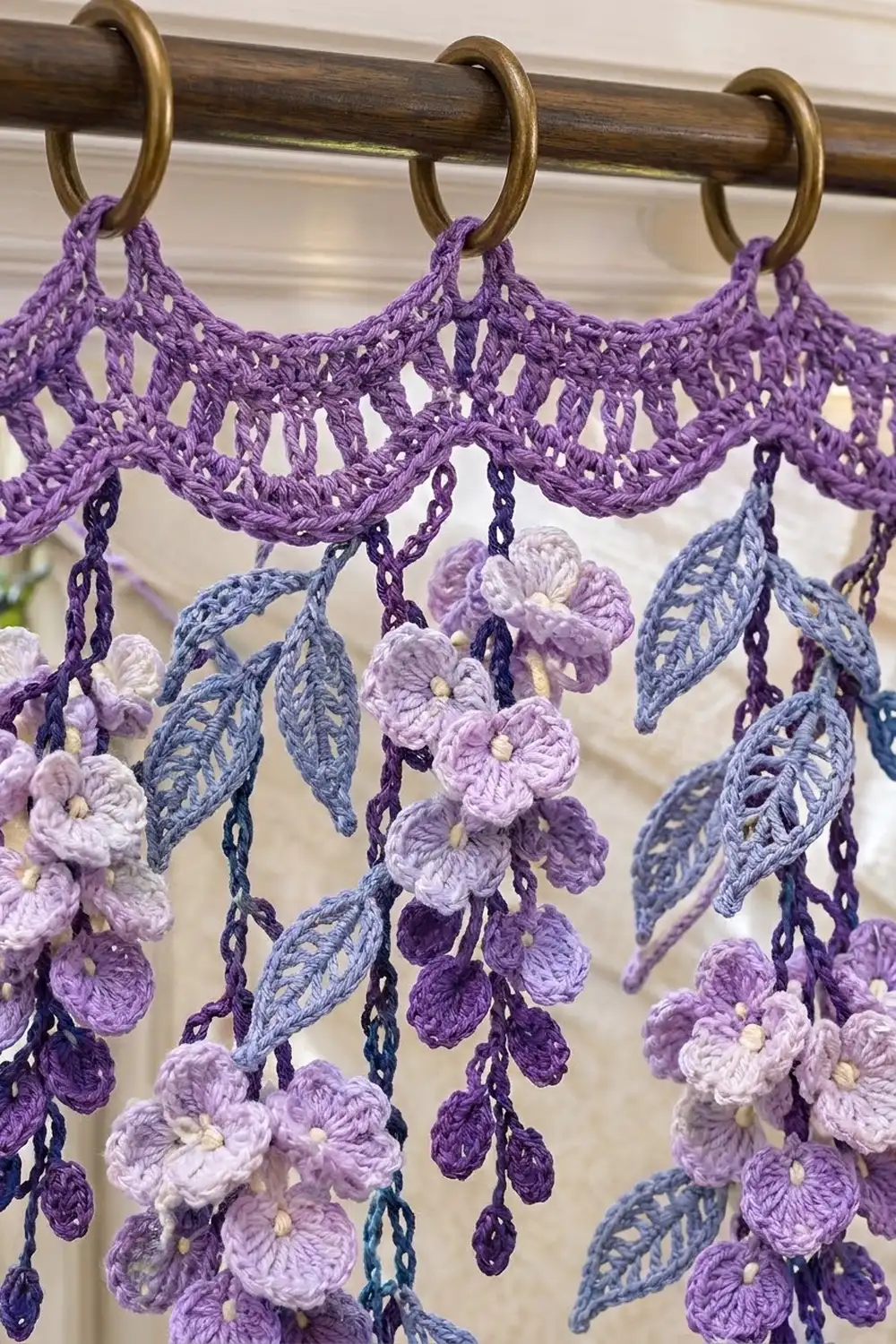
Header
Use medium purple. Row 1 is the top edge, and the scallops in Row 6 hang downward.
Row 1: Ch 122, sc in 2nd ch from hook and in each ch across, turn. (121 sc)
Row 2: Ch 3 (counts as dc), dc in each st across, turn. (121 dc)
Row 3 (mesh): Ch 4 (counts as dc + ch 1), sk next st, dc in next st, ch 1, sk next st, dc in next st; rep from * across, turn. (61 dc, 60 ch-1 sps)*
Row 4 (conversion row): Ch 1, sc in each dc and in each ch-1 sp across, turn. (61 sc in dc + 60 sc in sps = 121 sc)
Row 5: Ch 3 (counts as dc), dc in each st across, turn. (121 dc)
Checkpoint: 24.2 in (61.5 cm) wide x 2 in (5.1 cm) deep.
Row 6 (scallops): Ch 1, sc in first st, sk 4 sts, 9 dc in next st, sk 4 sts, sc in next st; rep from * 11 more times. (12 shells of 9 dc + 13 sc = 121 sts)*
Fasten off. The valley sc are stitches 1, 11, 21, and so on up to 121. The shell centers (5th dc of each shell) are the lowest points.
Checkpoint: 3 in (7.6 cm) deep at the scallop points.
Strands
All strands start at the bud tip and are worked upward as one chain. Leave a 6 in (15.2 cm) tail at the start for weaving in.
Strand A (long, make 12)
Tip: With dark purple, ch 3, 3-dc bobble in 3rd ch from hook, sl st in same ch. (1 bud)
Dark bud section: Ch 3, Bud; rep from * 5 more times. (7 dark buds total, 18 stem ch = 3.6 in / 9.1 cm)*
Change to medium purple.
Medium bud section: Ch 3, Bud; rep from * 5 more times. (6 medium buds, 18 stem ch = 3.6 in / 9.1 cm)*
Change to dark purple.
Checkpoint: bud section is 36 stem ch = 7.2 in (18.3 cm).
Flower zone: Ch 40. (8 in / 20.3 cm) Mark every 5th ch with a stitch marker so you have 8 marked points.
Upper stem: Ch 149. (29.8 in / 75.7 cm) Mark ch 20, ch 45, and ch 70 of the upper stem as leaf points. Do not fasten off. Leave the loop on a marker so you can join it later.
Strand A total: 36 + 40 + 149 = 225 ch = 45 in (114.3 cm).
Strand B (short, make 13)
Work the tip, dark bud section, medium bud section, and flower zone exactly as for Strand A.
Upper stem: Ch 124. (24.8 in / 63.0 cm) Mark leaf points at ch 20, 45, and 70.
Strand B total: 36 + 40 + 124 = 200 ch = 40 in (101.6 cm).
Flowers (make 200)
Rnd 1: In lilac or light lavender, make a magic ring, ch 1, 8 sc in ring, join with sl st to first sc. (8 sc)
Rnd 2: In next st work (sl st, ch 2, 2 dc); in next st work (2 dc, ch 2, sl st); rep from * 3 more times. (4 petals, 16 dc)*
Fasten off and leave a 10 in (25.4 cm) tail for sewing. Pull the ring closed tightly. With cream, work a 2-wrap French knot in the center.
Checkpoint: 1.25 in (3.2 cm) across.
Leaves (make 75)
Foundation: With dusty blue, ch 12.
Side 1: Sl st in 2nd ch from hook, sc in next ch, hdc in next ch, dc in next ch, ch 1, sk next ch, dc in next ch, ch 1, sk next ch, dc in next ch, hdc in next ch, sc in next ch, (sc, ch 2, sc) in last ch for the point.
Side 2: Work along the other side of the foundation ch: sc in next ch, hdc in next ch, dc in next ch, ch 1, sk next ch, dc in next ch, ch 1, sk next ch, dc in next ch, hdc in next ch, sc in next ch, sl st in last ch.
Stalk: Ch 3. Fasten off and leave a 10 in (25.4 cm) tail.
The two ch-1 spaces on each side make the open vein pattern, and the foundation chain becomes a raised center rib.
Checkpoint: 2.25 in (5.7 cm) long x 1 in (2.5 cm) wide.
Make All Pieces
| Piece | Quantity | Color |
|---|---|---|
| Header | 1 | Medium purple |
| Strand A | 12 | Dark purple + medium purple |
| Strand B | 13 | Dark purple + medium purple |
| Flowers | 100 | Lilac |
| Flowers | 100 | Light lavender |
| Leaves | 75 | Dusty blue |
| Flower centers | 200 French knots | Cream |
Sewing the flowers on: Sew 8 flowers to each strand, one at each marked point in the flower zone. Alternate lilac and light lavender, and alternate the front and back of the stem. Tilt each flower slightly downward. Tuck the lowest flower close to the top medium bud so the cluster tapers smoothly into the buds.
Sewing the leaves on: Sew 3 leaves to each strand at the leaf points. Stitch through the stalk only, so the leaf angles outward and down. Alternate sides.
Layout grid (front view; A = Strand A at a shell center, B = Strand B at a valley sc):
B A B A B A B A B A B A B A B A B A B A B A B A B
1 2 3 4 5 6 7 8 9 ...                          25
Joining
Lay the header flat with the right side facing you and the scallops pointing down.
Method: Pick up the live loop at the top of a strand and insert your hook from front to back through the joining stitch on the header. Yarn over and draw through as a sl st, then work 1 more sl st in the same st. Fasten off and weave in the end along the stem.
Stitch-to-stitch logic:
- Strand B joins in valley sc 1, 11, 21, … 121. (13 joins)
- Strand A joins in the 5th dc of each shell. (12 joins)
Since valleys and shell centers alternate every 5 sts, the strands are spaced 1 in (2.5 cm) apart across the full 24.2 in (61.5 cm). That gives 25 strands in all.
Tension advice: Make the joining sl sts at normal tension. Pulling them tight puckers the scallops, and working them loosely makes the strand twist and droop at the header.
Size checkpoint: Hang the panel and measure. Strand A tips should hang 48 in (121.9 cm) below the top edge (3 in + 45 in). Strand B tips should hang about 42 in (106.7 cm) below it (2 in + 40 in). Together they make the staggered hem.
Header Edging and Hanging Loops
Edging gauge: Use the same 20 sc = 4 in (10.2 cm). On side edges, work 1 sc per sc row and 2 sc per dc row.
Side edges: Join medium purple at the top corner of one short side. Work down the side: 1 sc in Row 1, 2 sc in Row 2, 2 sc in Row 3, 1 sc in Row 4, 2 sc in Row 5, 1 sc in the end sc of Row 6. (9 sc per side) Fasten off and repeat on the other side.
Hanging loops: Join medium purple in the first ch of the foundation (the back of Row 1). Ch 1, sc in same ch, ch 8, sk 9 ch, sc in next ch; rep from * 11 more times. (13 sc + 12 ch-8 loops)* Fasten off.
Why the math works: The foundation edge has 121 sts, which is 12 x 10 + 1. The loop repeat covers 10 sts and the scallop repeat in Row 6 also covers 10 sts. So each loop anchor sits directly above a valley sc, at stitches 1, 11, 21, … 121. The rings carry the weight right above the Strand B joins, and the scallops between them drape evenly. The 9 side sc match the header’s 6 rows (3 sc rows x 1 + 3 dc rows x 2 = 9), so the side edges lie flat.
Slip a curtain ring through each of the 12 loops.
Final Blocking
- Before you add the strands, wet block the header. Soak it in cool water, roll it in a towel, and press out the water.
- Pin the header to 24.2 in (61.5 cm) x 3 in (7.6 cm). Pin each shell into a smooth arc and open the mesh row.
- Steam the flowers lightly from above without touching them, then shape each petal with your fingers.
- Spray the leaves with water, pin them flat to 2.25 in (5.7 cm) long, and open the eyelets.
- Let everything dry completely.
- After joining, hang the panel and let it settle for 24 hours. Mist any twisted stems and straighten them by hand.
Final Quality-Control Checklist
- Header is 24.2 in (61.5 cm) wide with 12 even scallops
- 25 strands, alternating A and B, spaced 1 in (2.5 cm) apart
- Each strand has 13 buds (7 dark, 6 medium), 8 flowers, and 3 leaves
- All 200 flowers have cream centers
- Longest tips are at 48 in (121.9 cm)
- All ends are woven along stems, with no tails showing
- All 12 hanging loops are anchored above valleys
Troubleshooting
- Header ruffles: Your dc rows are too loose. Go down a hook size for Rows 2-5.
- Strands twist: This is normal for long chains. Mist the stems and hang them, or chain through the back bump.
- Buds look flat: Pull the bobble’s final yarn over snug before you make the sl st.
- Strands too long: Remove chains from the upper stem only, so the flower zone and leaf points stay where they are.
- Flowers cup or flip: Sew them through the center and one petal so they stay angled.
- Panel tips uneven: Check your chain gauge and recount the upper stem chains.
Care
Hand wash in cool water with mild soap, press out the water in a towel, and dry flat with the strands untangled. Don’t wring or tumble dry the panel.
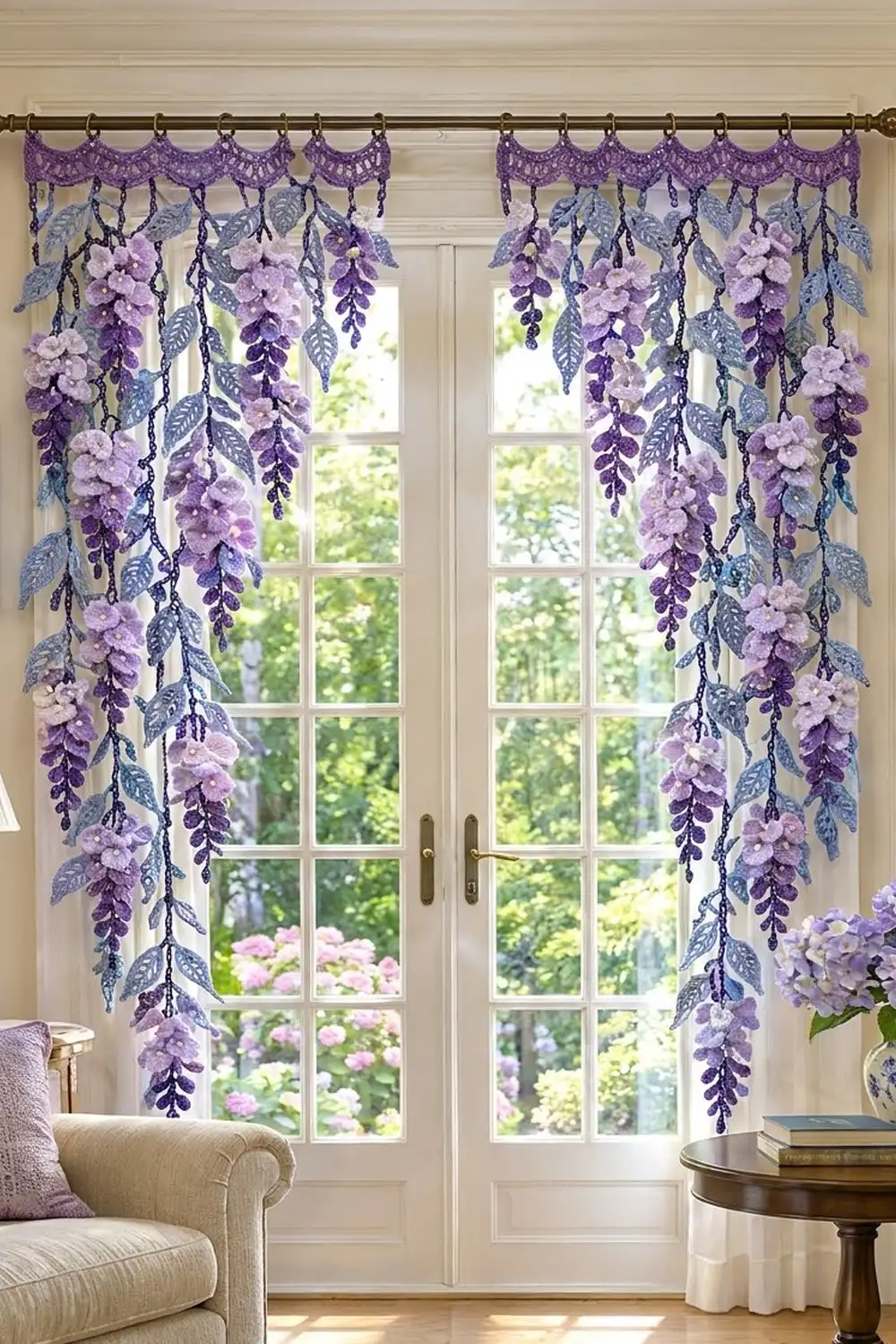
Final Notes
The measurements build on each other. The 20 sc = 4 in (10.2 cm) gauge gives a 24.2 in (61.5 cm) header that is 3 in (7.6 cm) deep. The 5 ch = 1 in (2.5 cm) chain gauge makes Strand A 45 in (114.3 cm) and Strand B 40 in (101.6 cm). Each strand hangs from its joining point, so the finished panel is 48 in (121.9 cm) long with a soft staggered hem. If you check each link in that chain as you go, your panel will come out the right size.
Happy crocheting!