

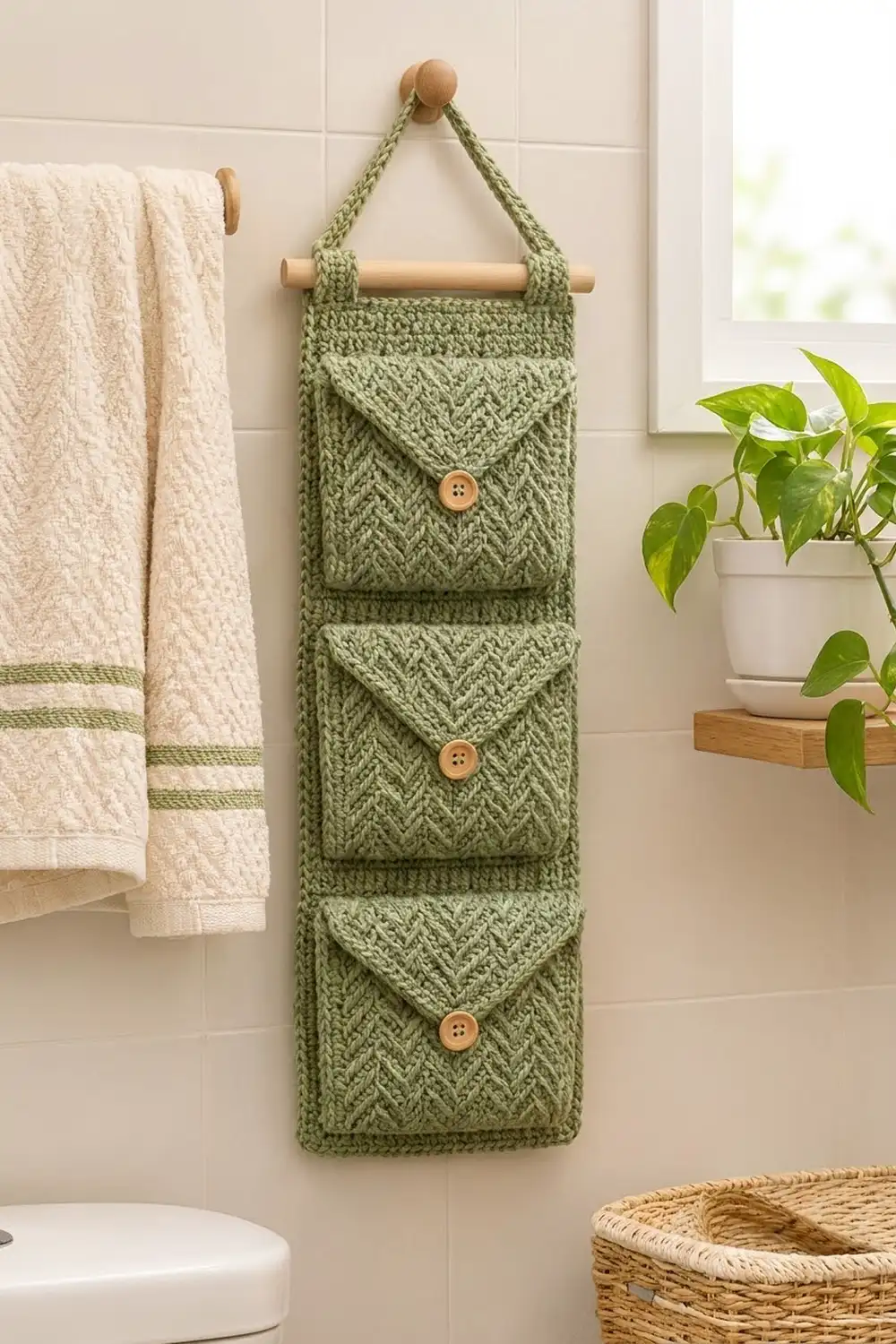
This hanging organizer has three envelope-style pockets on a long backing panel. Each pocket has a pointed flap, and the tip of each flap fastens over a wooden button. Hang it in a bathroom for small towels and toiletries, or by a door for mail, keys and sunglasses.
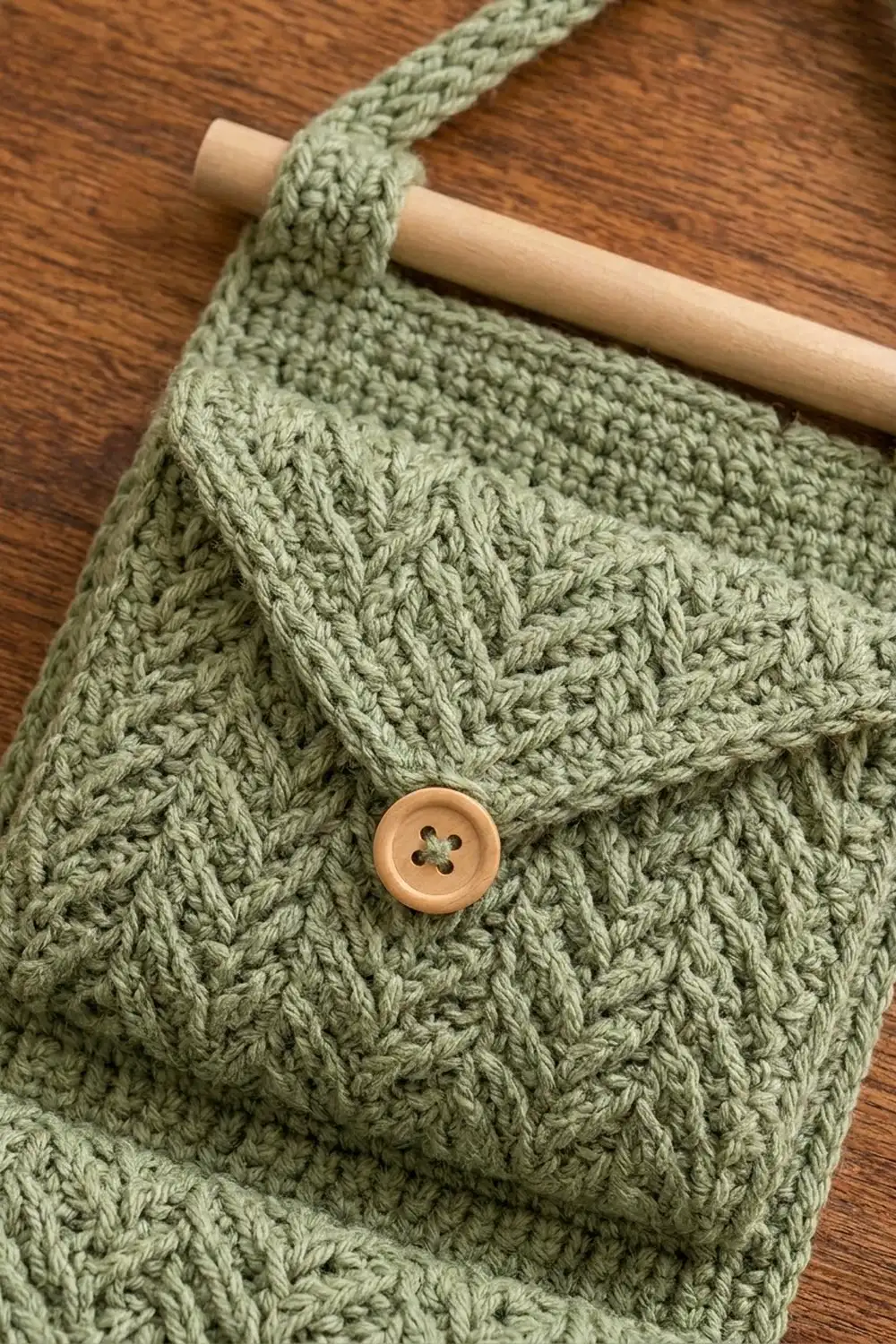
The sample is one sage green worsted yarn. Every piece is worked in herringbone half double crochet, a dense, slightly slanted stitch that looks woven and holds its shape on the wall. Buttons and the dowel are natural wood, which keeps the style calm and simple.
This pattern uses US crochet terms. The finished organizer is 9 in (22.9 cm) wide and 23 in (58.4 cm) tall, not counting the hanging strap. With the strap, the hanging triangle adds about 6 in (15.2 cm) above the dowel.
Construction overview: You will make one backing panel, three pockets with an edging round, three triangular flaps with a button loop, and one strap. The pockets and flaps are sewn to the panel. Then a two-round border goes around the panel, and the strap attaches the dowel at the top.
Finished Size and Construction
- Finished size: 9 in × 23 in (22.9 cm × 58.4 cm)
- Skill level: Easy+ (shaping, edging, sewing)
- Terminology: US crochet terms
- Yarn weight: Worsted (#4)
- Hook: 5.0 mm (H-8)
- Number of pieces: 8 crocheted pieces (1 backing, 3 pockets, 3 flaps, 1 strap)
- Layout: 3 pockets stacked vertically on one panel
- Pocket size with edging: 7.5 in × 6.5 in (19.1 cm × 16.5 cm)
- Flap size with edging: 7.5 in (19.1 cm) wide × about 2.9 in (7.4 cm) deep
- Backing size before border: 8 in × 22 in (20.3 cm × 55.9 cm)
- Border depth: 0.5 in (1.3 cm) on each side
Materials
Yarn: Use a smooth worsted weight yarn in cotton, a cotton blend or acrylic. Cotton is a good choice for a bathroom because it stays firm and washes well. Pick a light-to-mid color so the herringbone texture shows.
- Sage green: 250 g / about 450 m (about 492 yd), based on a yarn with 180 m per 100 g
Approximate use per piece:
– Backing panel: 105 g / 189 m
– Each pocket: 25 g / 45 m
– Each flap: 6 g / 11 m
– Strap: 8 g / 14 m
These quantities include a margin of about 20% for your gauge swatch, sewing tails and tension differences.
Tools:
– 5.0 mm (H-8) crochet hook
– Tapestry needle
– 3 wooden buttons, 0.75 in (1.9 cm)
– Wooden dowel, 12 in (30.5 cm) long, 3/8 in (1.0 cm) diameter
– Locking stitch markers or pins
– Measuring tape
– Blocking mat and rustproof pins
– Spray bottle
Abbreviations (US Terms)
- ch – chain
- sl st – slip stitch
- sc – single crochet
- hdc – half double crochet
- HBhdc – herringbone half double crochet (see below)
- HBhdc3tog – herringbone hdc 3 together (see below)
- hdc4tog – half double crochet 4 together
- st(s) – stitch(es)
- sp – space
- RS – right side
Herringbone half double crochet (HBhdc): Yarn over, insert hook in the stitch, yarn over and pull the loop through the stitch and the first loop on the hook (2 loops left), yarn over and pull through both loops.
HBhdc3tog: [Yarn over, insert hook in next st, yarn over and pull up a loop] 3 times (7 loops on hook), yarn over and pull through all 7 loops. This takes away 2 stitches.
hdc4tog: [Yarn over, insert hook in next st, yarn over and pull up a loop] 4 times (9 loops on hook), yarn over and pull through all loops.
Turning chains: Ch 2 at the start of an HBhdc row and ch 1 at the start of an sc row. Neither one counts as a stitch.
Gauge and Checkpoints
Gauge: 16 sts and 12 rows = 4 in (10.2 cm) in HBhdc, which is 4 sts and 3 rows per inch. In sc edging, 4 sc = 1 in (2.5 cm).
Make one pocket first and use it as your gauge test. It is small and uses the same stitch as every other piece.
Pocket checkpoints:
– After Row 1: 28 sts, 7 in (17.8 cm) wide
– After Row 18: 6 in (15.2 cm) tall
– After edging: 7.5 in × 6.5 in (19.1 cm × 16.5 cm)
Backing checkpoints:
– After Row 1: 32 sts, 8 in (20.3 cm) wide
– After Row 33: 11 in (27.9 cm) tall
– After Row 66: 22 in (55.9 cm) tall
Flap checkpoint: After Row 8, the flap is about 2.7 in (6.9 cm) from the straight edge to the point.
If your pieces are too big, go down a hook size (4.5 mm). If they are too small, go up a hook size (5.5 mm). Row height matters as much as width here. If your width matches but your rows are taller, try holding the yarn a little tighter as you pull through the first loop of each HBhdc.
Backing Panel (make 1)
Ch 34.
Row 1 (RS): HBhdc in 3rd ch from hook and in each ch across. Turn. (32 sts; the 2 skipped ch do not count)
Rows 2–66: Ch 2, HBhdc in each st across. Turn. (32 sts in each row)
Measure: 8 in × 22 in (20.3 cm × 55.9 cm). Fasten off and weave in the ends. The border is worked later, after the pockets are attached.
Pocket (make 3)
Ch 30.
Row 1 (RS): HBhdc in 3rd ch from hook and in each ch across. Turn. (28 sts)
Rows 2–18: Ch 2, HBhdc in each st across. Turn. (28 sts in each row)
After Row 18, do not fasten off. Ch 1 and turn so the RS faces you for the edging.
Edging Round: Work 28 sc across the top edge (1 sc in each st). Ch 1 for the corner. Work 24 sc down the side, evenly along the row ends (4 sc for every 3 rows). Ch 1 for the corner. Work 28 sc along the bottom (1 sc in each foundation ch). Ch 1 for the corner. Work 24 sc up the second side. Ch 1 for the corner, then sl st to the first sc.
Count: 28 + 24 + 28 + 24 = 104 sc, plus 4 corner ch-1 sps.
Fasten off and leave an 18 in (45.7 cm) tail for sewing. The pocket should measure 7.5 in × 6.5 in (19.1 cm × 16.5 cm).
Envelope Flap (make 3)
Work the flap from its straight top edge down to the point.
Ch 30.
Row 1 (RS): HBhdc in 3rd ch from hook and in each ch across. Turn. (28 sts)
Row 2: Ch 1, HBhdc3tog, HBhdc in next 22 sts, HBhdc3tog. Turn. (24 sts)
Row 3: Ch 1, HBhdc3tog, HBhdc in next 18 sts, HBhdc3tog. Turn. (20 sts)
Row 4: Ch 1, HBhdc3tog, HBhdc in next 14 sts, HBhdc3tog. Turn. (16 sts)
Row 5: Ch 1, HBhdc3tog, HBhdc in next 10 sts, HBhdc3tog. Turn. (12 sts)
Row 6: Ch 1, HBhdc3tog, HBhdc in next 6 sts, HBhdc3tog. Turn. (8 sts)
Row 7: Ch 1, HBhdc3tog, HBhdc in next 2 sts, HBhdc3tog. Turn. (4 sts)
Row 8: Ch 1, hdc4tog. (1 st, the point)
Each row from Row 2 to Row 7 loses 4 stitches, 2 at each end. That gives the flap clean, straight diagonal sides.
Edging Round: Ch 1. Work (sc, ch 6, sc) in the point stitch to make the button loop. Work 16 sc evenly up the first diagonal edge (about 2 sc per row end). Ch 1 for the corner. Work 28 sc across the foundation edge. Ch 1 for the corner. Work 16 sc evenly down the second diagonal edge, then sl st to the first sc.
Count: 2 + 16 + 28 + 16 = 62 sc, plus 2 corner ch-1 sps and 1 ch-6 loop.
Fasten off and leave an 18 in (45.7 cm) tail. The flap is 7.5 in (19.1 cm) wide, the same as the pocket, and about 2.9 in (7.4 cm) deep without the loop.
Hanging Strap (make 1)
Ch 73.
Row 1: Sc in 2nd ch from hook and in each ch across. Turn. (72 sc)
Rows 2–3: Ch 1, sc in each st across. Turn. (72 sc)
Fasten off and leave a 12 in (30.5 cm) tail at each end. The strap should be 18 in (45.7 cm) long and 0.75 in (1.9 cm) wide.
Make All Pieces
Everything is sage green:
– 1 backing panel (32 sts × 66 rows)
– 3 pockets (28 sts × 18 rows + edging)
– 3 flaps (8 rows + edging)
– 1 strap (72 sc × 3 rows)
Layout grid (front view, top to bottom):
        /\        strap
   ===========    dowel
 +-------------+
 |  [ FLAP 1 ] |
 |  [POCKET 1] |
 |  [ FLAP 2 ] |
 |  [POCKET 2] |
 |  [ FLAP 3 ] |
 |  [POCKET 3] |
 +-------------+  backing panel
Joining
Lay the backing flat with the RS up. All positions below are measured from the top edge of the backing before the border is added.
Pocket placement:
– Pocket 1: top edge 1.25 in (3.2 cm) below the panel’s top
– Pocket 2: top edge 8.25 in (21.0 cm) below the panel’s top
– Pocket 3: top edge 15.25 in (38.7 cm) below the panel’s top; its bottom lands at 21.75 in (55.2 cm), which is 0.25 in (0.6 cm) above the panel’s bottom edge
Each pocket is 7.5 in (19.1 cm) wide on an 8 in (20.3 cm) panel, so center it with 0.25 in (0.6 cm) of panel showing on each side. Pin it in place.
Sewing the pockets: Use the pocket’s tail to whipstitch down one side, across the bottom and up the other side. Leave the top open. Go through the back loop of each edging sc and then into the backing fabric right under it.
The stitch counts line up. Each pocket side has 24 sc over 6 in (15.2 cm), and the panel has 18 rows over that same height. Take 4 stitches for every 3 backing rows. Across the bottom, sew the pocket’s 28 sc to the backing’s middle 28 stitch columns (columns 3–30).
Sewing the flaps: Place each flap with its straight edge exactly on the top edge of its pocket. The point should hang down over the pocket front. Whipstitch the 28 sc of the flap’s straight edge to the backing, 1 sc to 1 backing stitch, along that same line.
Buttons: Fold each flap down and mark where the ch-6 loop reaches on the pocket, about 2.5 in (6.4 cm) below the pocket’s top edge, in the center. Sew a button there through the pocket front only, so the pocket stays usable.
Tension: Sew firmly enough that the pieces lie flat, but don’t pull the stitches tight. Overly tight seams pucker the backing.
Size checkpoint: The backing should still measure 8 in × 22 in (20.3 cm × 55.9 cm). If it has narrowed, loosen the side seams.
Border
Border gauge: 4 sc = 1 in (2.5 cm). Each round adds about 0.25 in (0.6 cm) on every side. In this border, the per-side counts do not include the corners. Corners are separate ch-1 spaces.
Round 1: With the RS facing, join yarn at the top right corner. Ch 1. Work 32 sc across the top (1 per st). Ch 1. Work 88 sc down the side (4 sc for every 3 rows: 66 ÷ 3 × 4 = 88). Ch 1. Work 32 sc across the bottom (1 per foundation ch). Ch 1. Work 88 sc up the second side. Ch 1, then sl st to the first sc.
– Per side: 32 / 88 / 32 / 88
– Total: 240 sc + 4 ch-1 sps
Round 2: Ch 1. Sc in each sc, and work (sc, ch 1, sc) in each corner ch-1 sp. Sl st to the first sc.
– Per side: 34 / 90 / 34 / 90
– Total: 248 sc + 4 ch-1 sps
Fasten off.
Why the math works: The HBhdc fabric has 4 sts and 3 rows per inch, and sc edging has 4 sts per inch. Working 1 sc per stitch on the top and bottom, and 4 sc per 3 rows on the sides, matches both edges. The border lies flat without ruffling or cupping.
Two rounds add 0.5 in (1.3 cm) per side. The width goes from 8 in to 9 in (20.3 cm to 22.9 cm), and the height goes from 22 in to 23 in (55.9 cm to 58.4 cm).
Attaching the strap and dowel: Center the dowel just above the top border. About 1.5 in (3.8 cm) of dowel should stick out on each side. Wrap one strap end from front to back around the dowel, directly above the panel’s top corner. Then sew it to the back of the border, about 1 in (2.5 cm) down. Repeat with the other end, making sure the strap isn’t twisted. The rest of the strap forms a triangle about 6 in (15.2 cm) tall.
Final Blocking
- Take the dowel out, or leave the top section off the mat.
- Lay the organizer face up on the blocking mat.
- Pin it to 9 in × 23 in (22.9 cm × 58.4 cm), checking that the corners are square.
- Pin each flap so its point is centered over its button.
- Spray lightly until damp, not soaked.
- Smooth the pocket fronts flat with your palm.
- Let it dry completely before you unpin it and hang it.
Final Quality-Control Checklist
- Backing measures 9 in × 23 in (22.9 cm × 58.4 cm)
- All three pockets are 7.5 in (19.1 cm) wide and evenly centered
- Gaps between pockets are equal, about 0.5 in (1.3 cm)
- Flap straight edges line up exactly with the pocket tops
- Each ch-6 loop fits snugly over its button
- Border counts are 34 / 90 / 34 / 90 in Round 2
- Strap is not twisted and the dowel hangs level
- All ends are woven in on the back
Troubleshooting
Flap sides look stepped: Make sure you used HBhdc3tog at both ends, not skipped stitches.
Flap is narrower than the pocket: Your flap edging is too tight. Redo the edging round more loosely or with a 5.5 mm hook.
Border ruffles on the sides: You have too many sc. Work 3 sc per 3 rows for a few sections.
Border cups on the sides: You have too few sc. Check that you worked 88 per side in Round 1.
Pocket sags open: Sew the sides more closely, catching every edging sc.
Button loop too loose: Rework the point with ch 5 instead of ch 6.
Organizer tilts: Re-sew one strap end so both ends are the same length.
Care
Hand wash in cool water with mild soap. Press out water in a towel and lay flat to dry. Remove the dowel before washing.
Final Notes
The measurement chain is simple: gauge of 16 sts and 12 rows = 4 in (10.2 cm), then a 7.5 in × 6.5 in (19.1 cm × 16.5 cm) pocket, then a 7.5 in (19.1 cm) wide flap. The backing is 8 in × 22 in (20.3 cm × 55.9 cm) before the border and 9 in × 23 in (22.9 cm × 58.4 cm) after it. If you check each piece at its checkpoint, everything will fit together without adjustments.
Happy crocheting!