

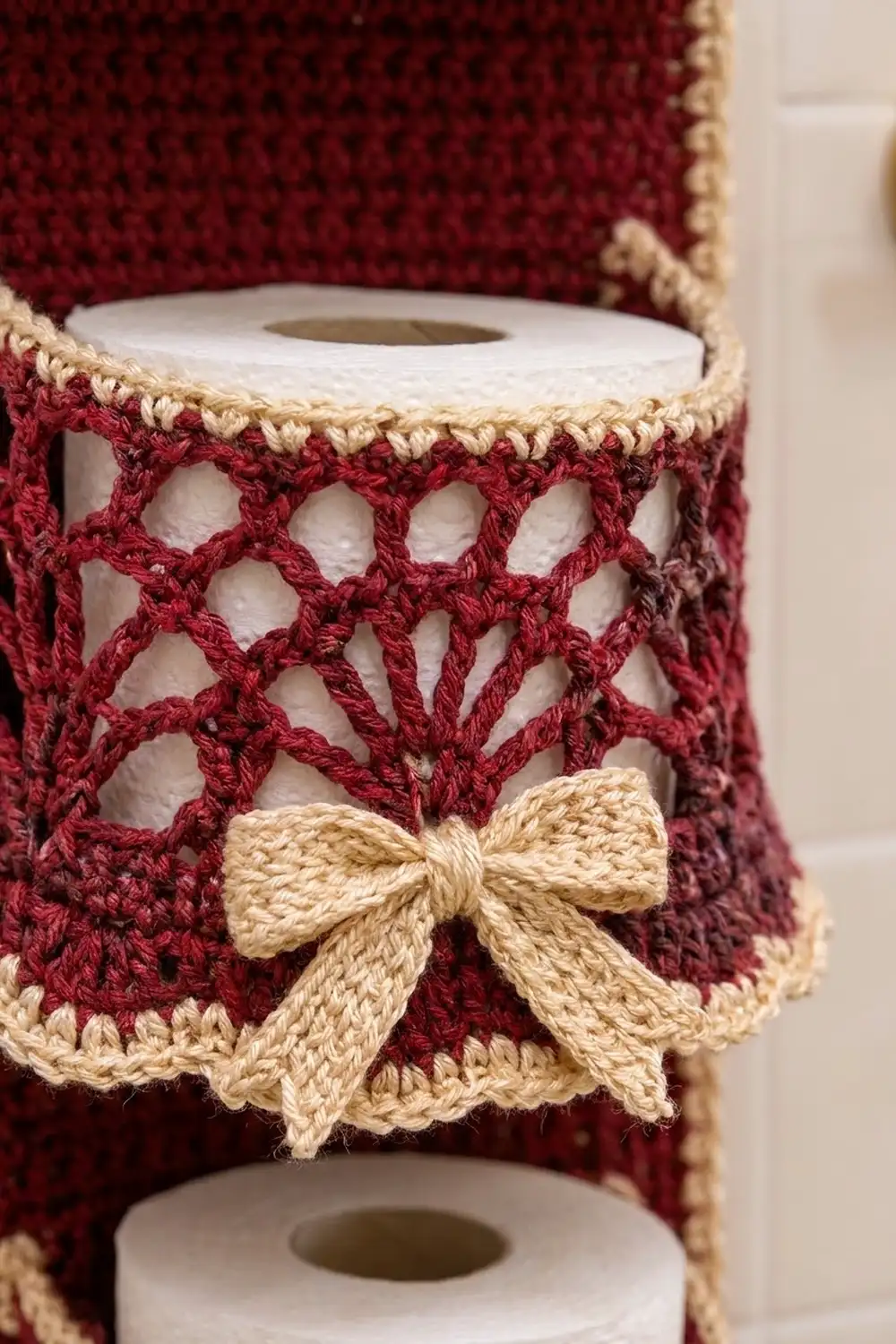
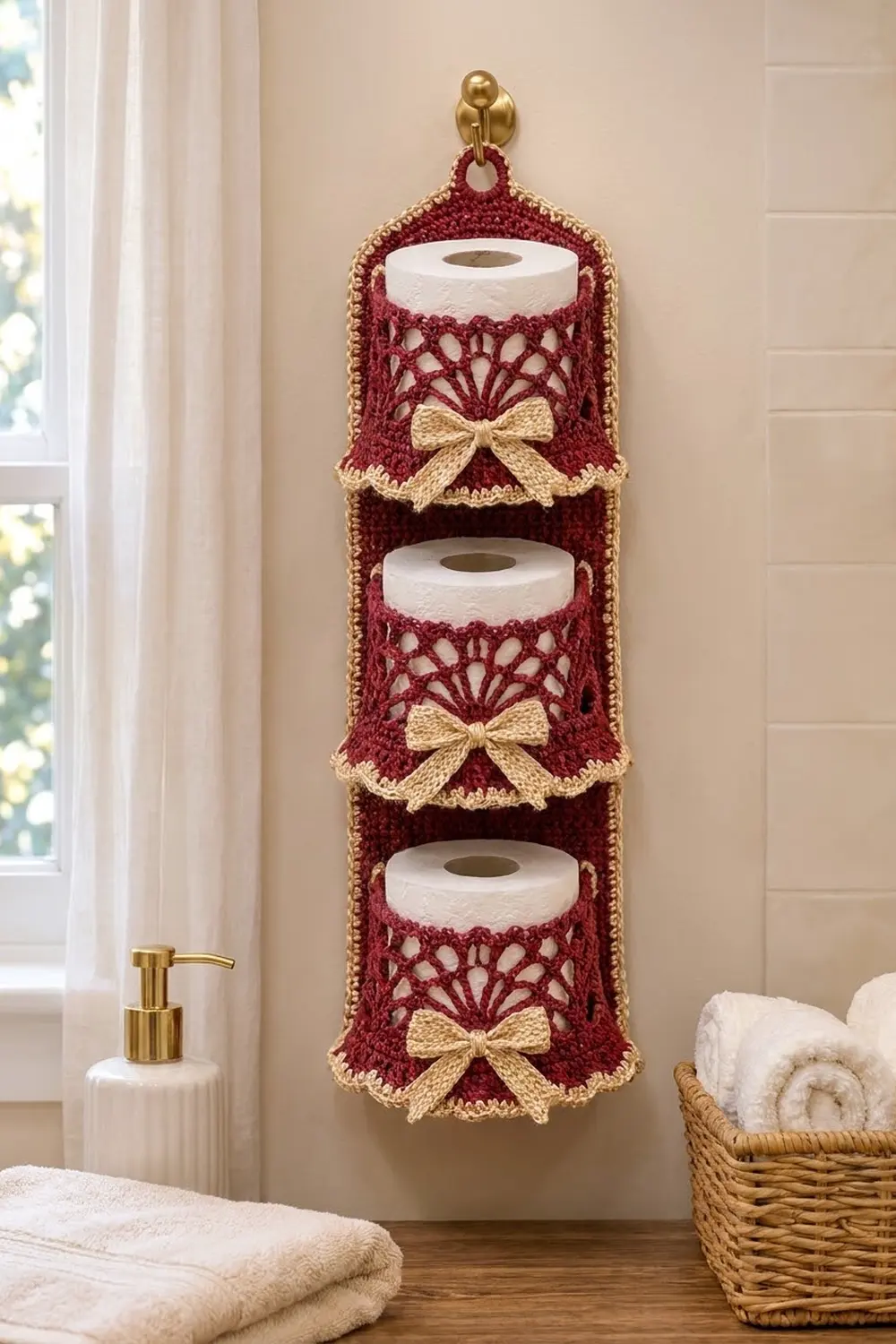
The Holly Lace Tower is a slim organizer that hangs on the wall and holds three toilet paper rolls in a vertical stack. A long burgundy back panel has a rounded top and a small hanging loop. Three lacy pockets shaped like cups are sewn to the panel. Each pocket has a flared skirt with scalloped edges and a cream bow.
The colors are classic holiday ones. The panel and pockets are deep burgundy, and every edge, scallop and bow is warm cream. The lace is a simple fan-and-mesh design. Each roll shows softly through the openings, and the solid bands keep the pocket firm.
This pattern uses US crochet terms. The finished panel measures 5.8 in (14.7 cm) wide and 22.1 in (56.1 cm) long. A 1 in (2.5 cm) hanging loop sits on top, so the full hanging length is 23.1 in (58.7 cm). Each pocket is 4.5 in (11.4 cm) across and 4 in (10.2 cm) tall.
Construction is simple. First you crochet the back panel in rows and add a cream border of two rounds. Each pocket starts with a flat round base and rises in lace rounds. A skirt is then worked into the unused front loops of the base. You make three small bows separately and sew them on. Last, you sew the pockets to the panel.
Finished Size and Construction
- Finished panel size: 5.8 x 22.1 in (14.7 x 56.1 cm), plus a 1 in (2.5 cm) loop
- Skill level: Intermediate
- Terminology: US crochet terms
- Yarn weight: Worsted (#4 medium)
- Hook: 4.0 mm (G-6)
- Number of pieces: 7 main pieces (1 back panel, 3 pockets, 3 bows), joined into one holder
- Layout: 3 pockets stacked vertically on 1 panel
- Pocket size: 4.5 in (11.4 cm) diameter x 4 in (10.2 cm) tall
- Panel size before border: 5 x 21.3 in (12.7 x 54.1 cm)
- Border depth: 0.4 in (1.0 cm) per side
Materials
Choose a smooth worsted yarn in cotton or a cotton-acrylic blend. Cotton makes crisp lace and helps the pockets keep their shape. Avoid fuzzy yarns, which blur the fans and mesh.
- Burgundy: 200 g, about 400 m (worsted, about 200 m per 100 g)
- Cream: 70 g, about 140 m
These amounts include a margin of about 10-15% for swatching and small differences in tension.
Tools:
- 4.0 mm (G-6) crochet hook
- Tapestry needle
- Stitch markers (at least 6)
- Scissors
- Measuring tape
- Rust-proof pins and a blocking mat
- Spray bottle
- Optional: a toilet paper roll to test the pocket fit
Abbreviations (US Terms)
- ch – chain
- sl st – slip stitch
- sc – single crochet
- dc – double crochet
- tr – treble crochet
- sc2tog – single crochet 2 together
- rev sc – reverse single crochet (crab stitch)
- BLO / FLO – back loop only / front loop only
- st(s) – stitch(es)
- sp – space
- sk – skip
Special stitch – Fan: (tr, ch 1) 4 times, then tr, all in the same st. One fan = 5 tr and 4 ch-1 sps.
Reverse single crochet: Work from left to right (right to left if you are left-handed). Insert the hook in the next st to the right, yarn over and pull up a loop, then yarn over and pull through both loops.
Gauge and Checkpoints
Gauge: 16 sc x 18 rows = 4 in (10.2 cm) in sc rows.
Make one pocket first. It tests your dc base, your lace and your trim all at once. It also shows right away whether a roll will fit.
Checkpoints:
- Pocket base after Rnd 1: 1.2 in (3.0 cm) across
- Pocket base after Rnd 2: 2.3 in (5.8 cm)
- Pocket base after Rnd 3: 3.4 in (8.6 cm)
- Pocket base after Rnd 4: 4.5 in (11.4 cm)
- Pocket wall after Rnd 10: about 3.3 in (8.4 cm) tall
- Finished pocket: 4 in (10.2 cm) tall
- Panel after Row 18: 4 in (10.2 cm) long
- Panel after Row 90: 20 in (50.8 cm) long and 5 in (12.7 cm) wide
If your base is too big, go down to a 3.75 mm hook. If it is too small, go up to a 4.5 mm hook. A base under 4.25 in (10.8 cm) is too tight for a standard roll. A base over 4.75 in (12.1 cm) looks slack. If you change hooks, check your panel gauge again with the new hook.
Back Panel
Use burgundy.
Foundation: Ch 21.
Row 1: Sc in 2nd ch from hook and in each ch across. (20 sts)
Rows 2-90: Ch 1, turn, sc in each st across. (20 sts)
Checkpoint: 20 in (50.8 cm) long and 5 in (12.7 cm) wide.
Rounded top:
- Row 91: Ch 1, turn, sc2tog, sc in next 16 sts, sc2tog. (18 sts)
- Row 92: Ch 1, turn, sc in each st across. (18 sts)
- Row 93: Ch 1, turn, sc2tog, sc in next 14 sts, sc2tog. (16 sts)
- Row 94: Ch 1, turn, sc2tog, sc in next 12 sts, sc2tog. (14 sts)
- Row 95: Ch 1, turn, sc2tog, sc in next 10 sts, sc2tog. (12 sts)
- Row 96: Ch 1, turn, sc2tog, sc in next 8 sts, sc2tog. (10 sts)
Fasten off. The panel now measures 5 x 21.3 in (12.7 x 54.1 cm). It ends in a gentle arch with a flat top of 10 sts.
Pocket (Make 3)
Base
Use burgundy. Join each round with a sl st to the first st. The ch 3 counts as the first dc.
- Rnd 1: Magic ring, ch 3, 11 dc in ring. (12 sts)
- Rnd 2: Ch 3, dc in same st, 2 dc in each st around. (24 sts)
- Rnd 3: Ch 3, dc in same st, dc in next st, 2 dc in next st, dc in next st 11 times. (36 sts)
- Rnd 4: Ch 3, dc in same st, dc in next 2 sts, 2 dc in next st, dc in next 2 sts 11 times. (48 sts)
Checkpoint: the base lies flat and measures 4.5 in (11.4 cm) across.
Walls
- Rnd 5: Ch 1, sc in BLO of each st around. (48 sc) The unused front loops form a ridge. You will work the skirt there later.
- Rnd 6: Ch 1, sc in each st around. (48 sc)
- Rnd 7 (fans): Ch 4 (counts as first tr), (ch 1, tr) 4 times in same st, sk 3 sts, sc in next st, sk 3 sts, Fan in next st, sk 3 sts, sc in next st, sk 3 sts 5 times. Join to top of ch-4. (6 fans and 6 sc; 24 ch-1 sps)
- Rnd 8: Sl st into first ch-1 sp, ch 1, sc in same sp, (ch 3, sc in next ch-1 sp) 3 times, ch 3, sc in first ch-1 sp of next fan, (ch 3, sc in next ch-1 sp) 3 times 5 times, ch 3. Join to first sc. (24 sc, 24 ch-3 loops)
- Rnd 9: Sl st into first ch-3 loop, ch 1, sc in same loop, ch 4, sc in next loop 23 times, ch 4. Join. (24 ch-4 loops)
- Rnd 10: Sl st into first ch-4 loop, ch 1, sc in same loop, ch 4, sc in next loop 23 times, ch 4. Join. (24 ch-4 loops)
- Rnd 11: Sl st into first ch-4 loop, ch 1, 2 sc in each ch-4 loop around. (24 loops x 2 = 48 sc)
- Rnd 12: Ch 1, sc in each st around, and change to cream on the final join. (48 sc)
- Rnd 13 (cream): Ch 1, rev sc in each st around. Join. (48 rev sc)
Fasten off. The fans rise from the solid band, and the mesh opens above them, just under the cream rim.
Skirt
Hold the pocket upside down. Join burgundy in any unused front loop of Rnd 4.
- Rnd S1: Ch 3 (counts as dc), dc in same loop, dc in next loop, 2 dc in next loop, dc in next loop 23 times. Join. (48 loops worked + 24 increases = 72 sts)
- Rnd S2: Ch 1, sc in each st around, and change to cream on the final join. (72 sc)
- Rnd S3 (cream): Ch 1, sc in first st, sk 2 sts, 5 dc in next st, sk 2 sts, sc in next st 11 times, sk 2 sts, 5 dc in next st, sk 2 sts. Join to first sc. (12 scallops)
Each scallop repeat uses 6 sts, and 12 x 6 = 72, so the scallops close evenly. Fasten off. The skirt flares out and down around the base and is about 1 in (2.5 cm) deep.
Bow (Make 3)
Use cream.
Bow body: Ch 19. Row 1: Sc in 2nd ch from hook and in each ch across. (18 sts) Rows 2-4: Ch 1, turn, sc across. (18 sts) The piece measures 4.5 x 0.9 in (11.4 x 2.3 cm). Bring both short ends to the center back, overlap them slightly and stitch them in place.
Tails (make 2): Ch 9. Row 1: Sc in 2nd ch from hook and in each ch across. (8 sts) Row 2: Ch 1, turn, sc across. (8 sts) Each tail is 2 in (5.1 cm) long. To angle the end of each tail, fold one corner under and tack it down.
Center wrap: Ch 6. Row 1: Sc in 2nd ch from hook and in each ch across. (5 sts) Row 2: Ch 1, turn, sc across. (5 sts)
Lay the two tails behind the bow body in an upside-down V. Wrap the center piece around all the layers to pinch the middle, then sew its ends together at the back. The finished bow is about 2.25 in (5.7 cm) wide.
Make All Pieces
- Burgundy: 1 back panel and 3 pocket bodies, including skirt rounds S1-S2
- Cream: 3 pocket rims (Rnd 13), 3 scallop rounds (S3), 3 bows (each with 1 body, 2 tails and 1 wrap) and the panel border
Layout (front view, top to bottom):
        [ hanging loop ]
        [  rounded top ]   Rows 91-96
        [   Pocket 3   ]   base at Row 63, rim at Row 81
        [   Pocket 2   ]   base at Row 34, rim at Row 52
        [   Pocket 1   ]   base at Row 5,  rim at Row 23
        [ bottom edge  ]   Row 1
Each pocket covers 18 panel rows. At 18 rows per 4 in, that matches its 4 in (10.2 cm) height. The 11 open rows between one rim and the next base leave room to lift a roll in and out. The skirt of the pocket above hangs partly into that gap.
Border (Back Panel)
Add the border before you sew on the pockets.
Border gauge: 16 sc = 4 in (10.2 cm) along every edge, the same as the panel. Along the row-ends, work 8 sc for every 9 rows, because 18 rows also measure 4 in (10.2 cm).
Rnd 1 (cream): Join at the bottom right corner, along the foundation chain.
- Bottom edge: 3 sc in first ch, sc in each of next 18 ch, 3 sc in last ch. (24 sts, including both corners)
- Left side, Rows 1-90: Sc in next 8 row-ends, sk 1 row-end 10 times. (80 sts)
- Left arch, Rows 91-96: 8 sc spaced evenly along the shaped edge. (8 sts)
- Top: Sc in each of the 10 sts. (10 sts)
- Right arch: 8 sc spaced evenly. (8 sts)
- Right side: Sc in next 8 row-ends, sk 1 row-end 10 times. (80 sts)
Join. Total: 24 + 80 + 8 + 10 + 8 + 80 = 210 sts.
Rnd 2 (cream): Ch 1, rev sc in each st around. Join. (210 sts) Fasten off.
Why the math works: Each side is 90 rows, or 20 in (50.8 cm). At 16 sts per 4 in, 20 in needs exactly 80 sc, and 90 x 8/9 = 80. The bottom has 20 foundation chains, and the 4 extra stitches keep the corners flat. The arch gets 8 sc over 6 row-ends because the decreases make that edge slanted and longer.
Hanging loop: Join burgundy in the 5th st across the top on Rnd 2. Ch 16, then sl st in the same st. Work 24 sc into the ch-16 loop and sl st at the base. Fasten off. The loop is about 1 in (2.5 cm) tall.
Joining
Sew each pocket to the panel with whipstitch, using burgundy yarn and a tapestry needle.
- On the back of the pocket, mark 16 of the 48 sts. That is one third of the way around, about 4.7 in (11.9 cm) of base edge.
- Pin the marked base edge (the Rnd 5 ridge) straight across the panel at the base row listed in the layout. Center it from side to side, leaving 2 panel sts free on each side.
- Whipstitch those 16 base sts to 16 panel sts, one to one.
- Pin the matching 16 sts of Rnd 12 at the listed rim row and whipstitch them the same way.
- Leave the lace sides free so the front of the pocket stays rounded.
Tension: Sew with even, relaxed stitches that match the fabric. Tight seams make the panel pucker.
Sew a bow to the front center of each pocket, just above the skirt, with the tails hanging over the scallops.
Checkpoint: The panel still measures 5.8 in (14.7 cm) wide and 22.1 in (56.1 cm) long. Each pocket sticks out about 3.5 in (8.9 cm) from the panel.
Final Blocking
- Lightly mist the whole holder with water.
- Lay the panel flat, right side up, and pin it to 5.8 x 22.1 in (14.7 x 56.1 cm).
- Pin the point of each scallop outward so the skirts sit evenly.
- Slide a roll into each pocket to hold its shape while it dries.
- Fluff each bow and pin the tails into a neat V.
- Let everything dry completely, then remove the pins.
Final Quality-Control Checklist
- The panel is 5.8 in (14.7 cm) wide along its full length.
- Border Rnd 1 has 210 sts and lies flat.
- Each pocket has 6 fans, 24 mesh loops and a rim of 48 sts.
- Each skirt has 12 even scallops.
- The pockets are centered and level.
- The bows are centered and sewn on securely.
- The loop is centered and firmly attached.
- All ends are woven in.
Troubleshooting
- The pocket is too tight for a roll: The base is under 4.25 in (10.8 cm). Remake it with a larger hook.
- The fans lean or bunch: Make sure you skip exactly 3 sts on each side of every sc.
- The mesh rounds drift: Always sl st into the first loop before the ch 1.
- The skirt cups instead of flaring: Make sure S1 has 72 sts.
- The panel edges wave: There are too many border sts on the sides. Recheck the ratio of 8 sts per 9 rows.
- A pocket sags: Add a short vertical seam at each side of the sewn area.
Care
Hand wash in cool water and roll the holder in a towel to remove extra water. Dry it flat with rolls inside the pockets, and do not tumble dry.
Final Notes
Each measurement leads to the next. A base of 4.5 in (11.4 cm) gives a pocket of 48 sts that holds a standard roll. A panel of 20 sts and 96 rows measures 5 x 21.3 in (12.7 x 54.1 cm). The border of 210 sts brings it to 5.8 x 22.1 in (14.7 x 56.1 cm). Spacing the pockets every 18 rows keeps all three rolls evenly stacked. If you check each measurement as you go, the holder will hang straight and look neat.
Happy crocheting!