

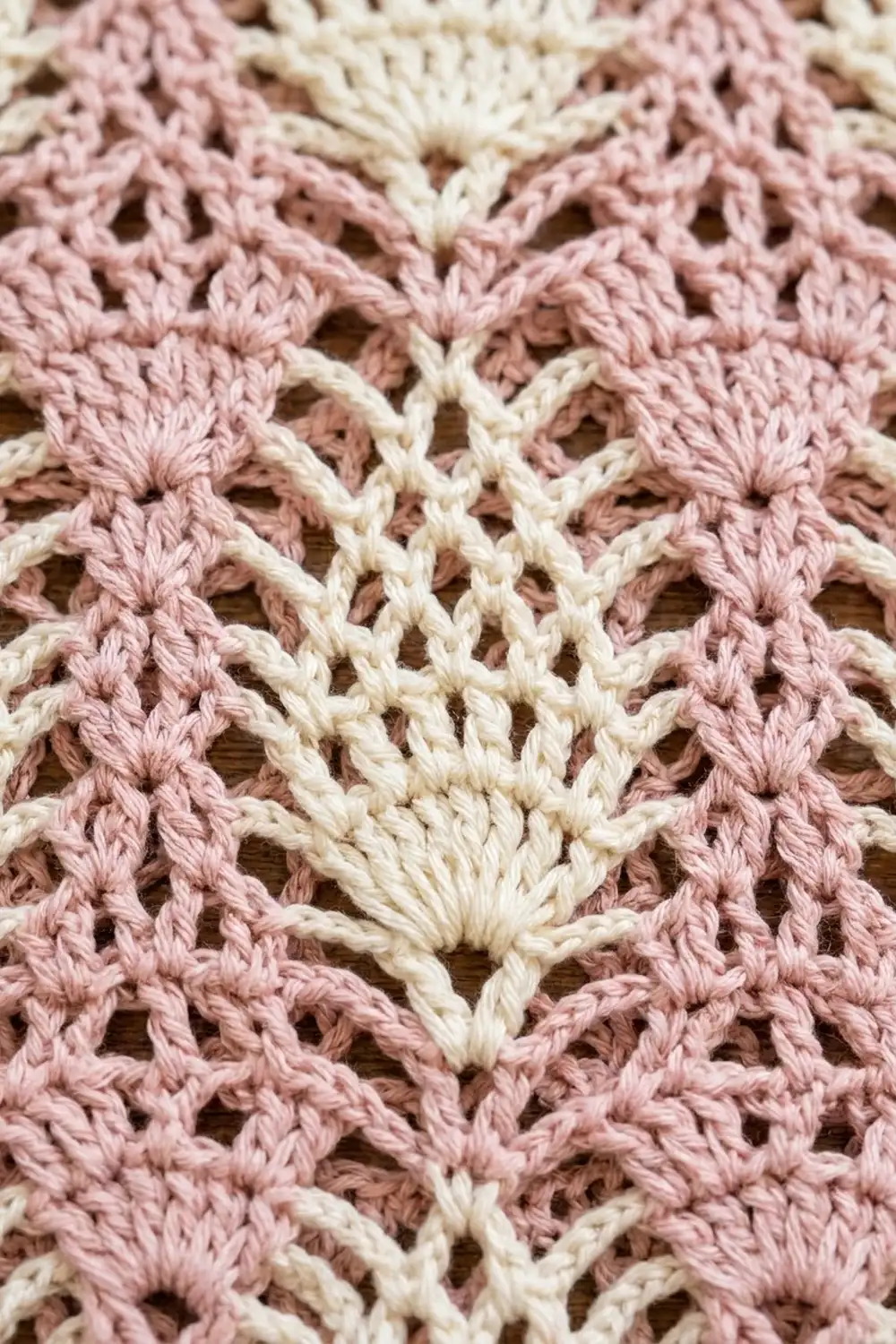
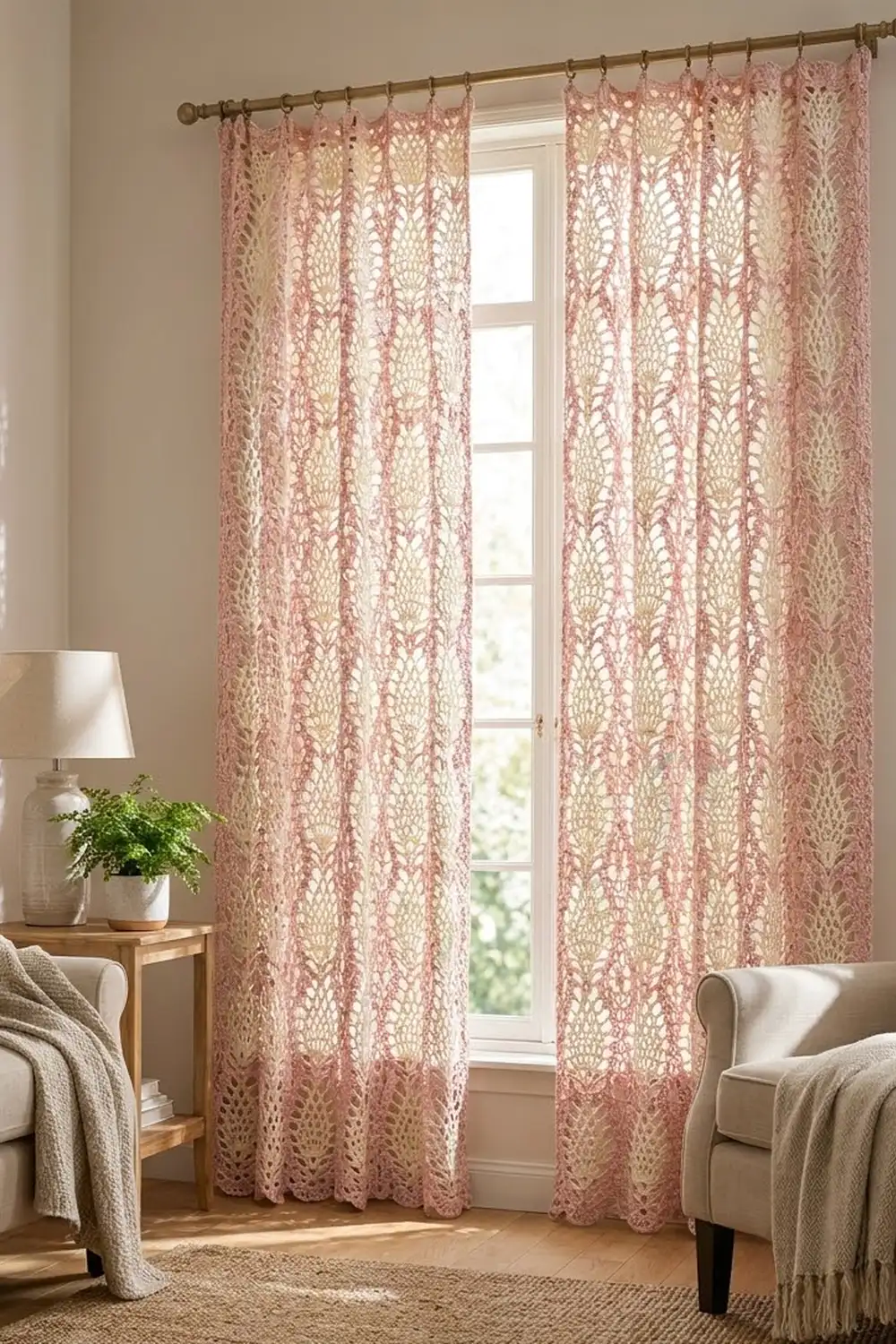
The Rosewater panel is a long lace curtain made of tall cream pineapples stacked in neat vertical columns. Dusty-pink shell columns and pink chain arches frame each pineapple, so the cream motifs show up clearly against the window light.
The palette is two soft colors, dusty rose and warm cream. The style is vintage cottage lace, but the layout is clean and orderly. The bottom edge is scalloped, with one scallop per pineapple column. The top has 12 round chain tabs that slide straight onto a curtain rod.
This pattern uses US crochet terms. One finished panel measures 34 in (86.4 cm) wide and 76 in (193.0 cm) long, including tabs. Most windows need a pair, so make a second identical panel if you want two.
The panel is one single piece worked flat in rows from the bottom up. You start with a pink foundation row. Then you work 16 tiers of pineapples using intarsia: pink bobbins for the shell columns and cream bobbins for the pineapples. A pink top band with tabs, a scalloped bottom edge, and a side edging finish the panel.
Finished Size and Construction
- Finished size: 34 in x 76 in (86.4 cm x 193.0 cm), including tabs
- Skill level: Experienced (lace plus intarsia bobbins)
- Terminology: US
- Yarn weight: DK cotton (weight 3)
- Hook: 4.0 mm (G-6)
- Number of pieces: 1
- Layout: 8 pineapple columns x 16 tiers, between 9 pink shell columns
- Pattern repeat: 4 in (10.2 cm) wide x 4.5 in (11.4 cm) tall
- Size before border: 33 in x 72.25 in (83.8 cm x 183.5 cm)
- Border depth: side edging 0.5 in (1.3 cm) per side; bottom scallops 1 in (2.5 cm); top band 0.75 in (1.9 cm) plus tabs 2 in (5.1 cm)
Materials
Choose a smooth mercerized or combed DK cotton. Cotton holds the pineapple shape, blocks crisply, and washes well. Avoid fuzzy yarns because they blur the chain loops.
- Pink (dusty rose): 300 g, about 690 m (755 yd)
- Cream: 250 g, about 575 m (629 yd)
These amounts assume 50 g balls of about 115 m (126 yd). They include a margin of roughly 15% for swatching and weaving in. Double them for a pair.
Tools
- 4.0 mm (G-6) hook
- 4.5 mm (7) hook for the foundation chain (optional)
- 17 yarn bobbins (9 pink, 8 cream)
- Tapestry needle
- Locking stitch markers
- Scissors and tape measure
- Blocking mats, rust-proof pins, and a spray bottle
Abbreviations (US Terms)
- ch – chain
- sl st – slip stitch
- sc – single crochet
- dc – double crochet
- tr – treble crochet
- sp(s) – space(s)
- st(s) – stitch(es)
- sk – skip
- RS / WS – right side / wrong side
Special stitches
- Tr shell: (2 tr, ch 2, 2 tr) in the same st or sp.
- Shell: (2 dc, ch 2, 2 dc) in the same sp.
- Fan: (tr, ch 1) 8 times, then tr, all in the same st. That makes 9 tr and 8 ch-1 sps.
- Arm: the pink chain that bridges a shell and a pineapple. Its length changes from row to row.
- Intarsia change: drop the old color at the back of the work and pick up the new color for the next st or chain. Twist the two yarns once at each change to avoid holes.
Gauge and Checkpoints
Gauge: 18 sc = 4 in (10.2 cm) in the foundation row. One pattern repeat, from shell center to shell center, is 4 in (10.2 cm) wide. One tier of 9 rows is 4.5 in (11.4 cm) tall after blocking.
Test a swatch before you commit to 145 stitches. With pink, ch 56. Sc in the 2nd ch from the hook and in each ch across: 55 sc. Work Tier 1 below with 3 pineapples and 4 shell columns, then wet-block the swatch.
Swatch checkpoints
- Foundation row: 55 sc = 12.25 in (31.1 cm)
- Each repeat: 4 in (10.2 cm) wide
- Swatch height: 4.75 in (12.1 cm), which is the foundation row plus one tier
If your repeat is over 4.25 in (10.8 cm), go down half a hook size. If it is under 3.75 in (9.5 cm), go up half a size. Any error is multiplied by 8 across the panel, so fix it now.
Panel checkpoints (blocked or gently pinned)
- Foundation row: 145 sc = 32.25 in (81.9 cm)
- After Tier 1: 33 in (83.8 cm) wide across the outer shells; 4.75 in (12.1 cm) tall
- After Tier 4: 18.25 in (46.4 cm) tall
- After Tier 8: 36.25 in (92.1 cm) tall
- After Tier 12: 54.25 in (137.8 cm) tall
- After Tier 16: 72.25 in (183.5 cm) tall
Foundation
With pink and the larger hook, ch 146. Switch to the 4.0 mm hook.
Foundation row: Sc in 2nd ch from hook and in each ch across. Turn. (145 sc)
The count is 18 x 8 + 1. Shells go in every 18th st: sts 1, 19, 37, and so on. Fans go in sts 10, 28, 46, and so on, centered between the shells.
Pineapple Tiers
Wind 9 pink bobbins and 8 cream bobbins. The yarn attached to the foundation becomes the first pink bobbin. Each pink bobbin works one shell column plus the arms on both sides of it. Each cream bobbin works one pineapple. Every color change happens where an arm meets a pineapple, so each bobbin stays in its own vertical lane.
Each tier has 9 rows. Because 9 is odd, Row 1 is a RS row in odd tiers and a WS row in even tiers. The lace looks the same from both sides, so just keep going.
Row 1 (fan row)
Tier 1: With pink, ch 4 (counts as tr), (tr, ch 2, 2 tr) in first st, ch 4, sk 8 sts. With cream, work a Fan in next st. With a new pink bobbin, ch 4, sk 8 sts, Tr shell in next st, ch 4, sk 8 sts. Repeat from * 6 more times. With cream, Fan in next st. With the last pink bobbin, ch 4, sk 8 sts, Tr shell in last st. Turn.
Tiers 2–16: Work Row 1 the same way, with two changes. Place each Tr shell in the ch-2 sp of the shell below, and place each Fan in the single cream tip sc. Don’t skip any sts; the arms pass over the arms below.
Count: 9 Tr shells, 8 Fans (72 cream tr), and 16 arms of ch 4.
Rows 2–9 (pineapple rows)
Every row: Ch 3 (counts as dc), (dc, ch 2, 2 dc) in ch-2 sp of first shell, then work an arm. With cream, work the pineapple section for that row. With pink, work an arm, a Shell in ch-2 sp of next shell, and another arm. Repeat from * 6 more times. Work the last pineapple section. With pink, work an arm and a Shell in ch-2 sp of last shell. Turn.
Pineapple sections (cream, per pineapple):
- Row 2: Sc in first ch-1 sp of Fan, (ch 3, sc in next ch-1 sp) 7 times. (8 sc, 7 ch-3 loops)
- Row 3: Sc in first ch-3 loop, (ch 3, sc in next loop) 6 times. (7 sc, 6 loops)
- Row 4: Sc in first loop, (ch 3, sc in next loop) 5 times. (6 sc, 5 loops)
- Row 5: Same, 4 times. (5 sc, 4 loops)
- Row 6: Same, 3 times. (4 sc, 3 loops)
- Row 7: Same, 2 times. (3 sc, 2 loops)
- Row 8: Sc in first loop, ch 3, sc in last loop. (2 sc, 1 loop)
- Row 9: Sc in the single loop. (1 sc, the tip)
Each row works one sc into every loop of the row below, so it always has one fewer loop. That is what tapers the pineapple to a point.
Arm lengths (pink):
| Rows | Arm |
|---|---|
| 2–3 | ch 3 |
| 4–5 | ch 4 |
| 6–7 | ch 5 |
| 8–9 | ch 6 |
The arms grow as the pineapple narrows, so the panel stays the same width. The longer pink arms form the pink arches around the upper half of each pineapple.
Count after each row: 9 shells, 16 arms, and 8 pineapples with the cream counts above.
Repeat Rows 1–9 until you have 16 tiers, checking the panel checkpoints as you go. After Tier 16, cut all the cream bobbins. Cut all the pink bobbins except the one at the edge where the next row starts.
Border
The border has three parts: the top band and tabs, the bottom scallops, and the side edging. All three are pink.
Border gauge: 4.5 sc per inch (18 sc = 4 in / 10.2 cm), the same as the foundation.
Top Band and Tabs
Row T1: Ch 1. Across the edge shell: sc in each of first 2 dc, sc in ch-2 sp, sc in each of next 2 dc (5 sc). 6 sc in arm ch-6 sp, sc in tip sc, 6 sc in next arm ch-6 sp, 5 sc across next shell as before. Repeat from * 7 more times. Turn. (149 sc)
Row T2: Ch 3 (counts as dc), dc in each st across. Turn. (149 dc)
Row T3 (tabs): Ch 1, sc in first 6 sts, (ch 16, sk 5 sts, sc in next 7 sts) 11 times, ch 16, sk 5 sts, sc in last 6 sts. Turn. (89 sc, 12 ch-16 loops)
Row T4: Ch 1, sc in each sc and 20 sc in each ch-16 loop. Fasten off. (89 + 240 = 329 sc)
Why it works: 149 is 8 repeats of 18 sc, plus 5 sc for the last shell. At 4.5 sc per inch, that is 33 in (83.8 cm), which matches the body. The foundation has only 145 sts because the edge shells flare out past it, and the top band fills in those flares. In T3, 6 + (11 x 12) + 5 + 6 = 149. The tabs sit 12 sts apart, about 2.7 in (6.9 cm). Working 20 sc over 16 chains keeps each loop round and firm.
Bottom Scallops
With RS facing, join pink in the first free loop at the bottom of the foundation chain.
Row B1: Ch 1, sc in first loop, (ch 3, sk 2 loops, sc in next loop) 48 times. Turn. (49 sc, 48 ch-3 sps)
Row B2: Ch 1. Sc in next ch-3 sp, (5 dc in next ch-3 sp) 4 times, sc in next ch-3 sp. Repeat from * 7 more times. Fasten off. (8 scallops; 16 sc + 160 dc = 176 sts)
Why it works: 1 + (48 x 3) = 145, so B1 uses every foundation loop. Six ch-3 sps cover 18 loops, which is exactly one pattern repeat. That puts each scallop crest under a pineapple and each valley under a shell column.
Side Edging
Work each long side separately. With RS facing, join pink at the bottom corner.
Row S1: Ch 1 and sc evenly up the side:
- 1 sc in the end of B2, 1 in B1, and 1 in the foundation row
- 20 sc per tier: 4 sc around the end of Row 1 and 2 sc around the end of each of Rows 2–9
- 1 sc in T1, 2 in T2, 1 in T3, and 1 in T4
Turn. (3 + 320 + 5 = 328 sc)
Row S2: Ch 1, sc in each sc. Fasten off. (328 sc)
Repeat on the other side.
Why it works: At the border gauge, 20 sc fill a 4.5 in (11.4 cm) tier, so the side lies flat with no ruffling or pulling. The two rows add 0.5 in (1.3 cm) per side, bringing the width from 33 in (83.8 cm) to 34 in (86.4 cm).
Final Blocking
- Weave in all ends inside the shells and solid stitches, never across open loops.
- Soak the panel in cool water for 15 minutes. Press out the water without wringing.
- Roll the panel in towels to remove excess moisture.
- Lay it on mats, one section at a time if your space is small. Pin the side edges straight first, 34 in (86.4 cm) apart.
- Pin the length to 76 in (193.0 cm) including tabs. The body alone should measure 72.25 in (183.5 cm).
- Open each pineapple loop and pin each scallop crest.
- Pin each tab into a round loop.
- Let the panel dry completely before you unpin it.
Final Quality-Control Checklist
- 16 tiers, with 8 pineapples per tier, each tapering to a single tip sc
- 9 straight pink shell columns with no drift
- No pink showing inside the pineapples
- 8 bottom scallops, with the crests under the pineapples
- 12 evenly spaced tabs
- 328 sc on each side edge
- Width 34 in (86.4 cm), length 76 in (193.0 cm)
- All ends hidden in solid stitches
Troubleshooting
Holes at color changes: Twist the two yarns once at every change.
Pineapples lean sideways: You missed a loop. Recount the cream sc against the list.
Panel narrows at the pineapple tips: The arms are tight or too short. Check the arm table and chain more loosely.
Bottom edge ruffles: The foundation chain was too tight. Use the larger hook next time, or work B1 loosely.
Bobbins tangle: Alternate the direction you turn the work at the end of each row so the twists cancel out.
Sides wave: Your side sc count is off. Rework S1 with exactly 20 sc per tier.
Care
Hand wash, or machine wash cold on a gentle cycle in a mesh bag, then lay flat or re-pin to dry. Do not tumble dry, because heat shrinks cotton lace.
Final Notes
The measurement chain is simple. 18 sc = 4 in (10.2 cm), so one repeat is 4 in (10.2 cm) and eight repeats make a 33 in (83.8 cm) body. Each tier is 4.5 in (11.4 cm), so 16 tiers plus the foundation reach 72.25 in (183.5 cm). The top band, scallops, and tabs bring the length to 76 in (193.0 cm), and the side edging brings the width to 34 in (86.4 cm). Check the swatch and each tier, and the panel will hang straight.
Happy crocheting!