
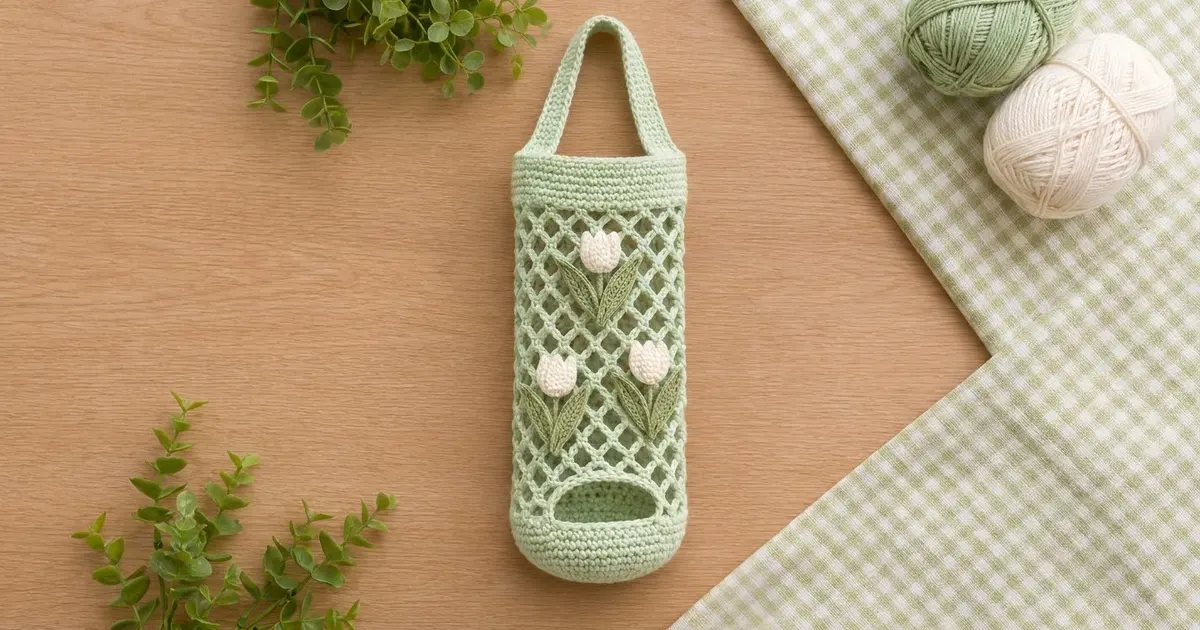
This grocery bag holder is a sage green cylinder with a solid single crochet base, an open diamond mesh body, a solid top band and a flat hanging strap. Three small cream tulips with moss green stems and leaves are sewn to the front. An opening near the bottom lets you pull bags out one at a time.
The colors are soft and suit a kitchen: light sage for the body and strap, cream for the tulip heads, and a deeper moss green for the stems and leaves. The style is simple cottage decor. It looks neat hanging from a cabinet knob or a hook inside a pantry door.
This pattern uses US crochet terms. The finished body measures 15 in (38.1 cm) tall and 7.5 in (19.1 cm) wide when flattened. With the strap, it hangs about 19 in (48.3 cm) from the top of the loop to the base.
Construction is simple. First you work the base as a flat circle and turn it up into solid sides. Next you work a few rows back and forth to leave the front opening. Then you work 18 rounds of chain mesh and finish with a solid band. The strap and tulips are made separately and sewn on.
Finished Size and Construction
- Finished size: 7.5 in (19.1 cm) flat width x 15 in (38.1 cm) body height
- Circumference: 15 in (38.1 cm)
- Skill level: Easy to intermediate
- Terminology: US
- Yarn weight: Worsted (#4) cotton
- Hook: 4.5 mm (US 7)
- Number of pieces: Body, strap and 3 tulip appliqués (each made from 1 head, 1 stem and 2 leaves)
- Layout: One tulip high and centered, two tulips side by side lower down, all on the front
- Piece sizes: strap 1.75 x 14.5 in (4.4 x 36.8 cm); tulip motif about 2.75 x 3.5 in (7.0 x 8.9 cm)
- Size before top band: 13.2 in (33.5 cm) tall
- Top band depth: 1.8 in (4.6 cm)
Materials
Choose a smooth worsted weight cotton or cotton blend. Cotton holds its shape, doesn’t stretch much under the weight of the bags, and washes well. Acrylic works, but the mesh will sag more.
- Sage (main color): 120 g / 205 m
- Cream (tulip heads): 10 g / 17 m
- Moss green (stems and leaves): 15 g / 26 m
These amounts include about 20 percent extra for gauge swatches and differences in tension.
Tools:
- 4.5 mm (US 7) crochet hook
- Tapestry needle
- 4 locking stitch markers
- Rustproof pins
- Scissors
- Measuring tape
Abbreviations (US Terms)
- ch – chain
- sl st – slip stitch
- sc – single crochet
- hdc – half double crochet
- dc – double crochet
- tr – treble crochet
- sk – skip
- st(s) – stitch(es)
- BLO – back loop only
- MR – magic ring
- ch-5 loop – the space under a chain-5
Special stitch – surface slip stitch: Hold the yarn behind the work. Insert the hook from the front between stitches, pull up a loop, and pull it through the loop on the hook. Repeat to draw a line on the surface.
Gauge and Checkpoints
Gauge: 16 sc and 18 rows = 4 in (10.2 cm) in sc.
Test your gauge with the strap first. It is small, uses the main color, and is worked in plain sc. After 18 rows, the strap should be 4 in (10.2 cm) long and 1.25 in (3.2 cm) wide.
Checkpoints:
- After Round 10, the base is 4.8 in (12.2 cm) across.
- After Round 22, the solid lower section is 2.7 in (6.9 cm) tall, measured from the fold of the base.
- The opening is 4.5 in (11.4 cm) wide and 1.1 in (2.8 cm) tall.
- Every 6 mesh rounds measure about 3.5 in (8.9 cm) with light downward tension. All 18 mesh rounds measure 10.5 in (26.7 cm).
- After the top band, the body is 15 in (38.1 cm) tall.
If your base is too big, go down one hook size. If it is too small, go up one hook size. Don’t change the stitch counts, because the mesh and band depend on exactly 60 stitches.
Body
Work in joined rounds. Join each round with a sl st to the first sc, then ch 1 to start the next round. The ch 1 does not count as a stitch.
Base
With Sage:
Round 1: 6 sc in MR. (6)
Round 2: 2 sc in each st around. (12)
Round 3: sc 1, 2 sc in next 6 times. (18)
Round 4: sc 2, 2 sc in next 6 times. (24)
Round 5: sc 3, 2 sc in next 6 times. (30)
Round 6: sc 4, 2 sc in next 6 times. (36)
Round 7: sc 5, 2 sc in next 6 times. (42)
Round 8: sc 6, 2 sc in next 6 times. (48)
Round 9: sc 7, 2 sc in next 6 times. (54)
Round 10: sc 8, 2 sc in next 6 times. (60)
Checkpoint: the base lies flat and measures 4.8 in (12.2 cm) across.
Solid Sides
Round 11: sc in BLO of each st around. (60) This makes the fold where the base turns up.
Rounds 12–15: sc in each st around. (60)
Front Opening
To make the opening, work 5 rows over 42 stitches and leave 18 stitches unworked at the front.
Row 16: ch 1, sc in each of the first 42 sts, turn. Leave the remaining 18 sts unworked. (42)
Rows 17–19: ch 1, sc in each st across, turn. (42)
Row 20: ch 1, sc in each st across, ch 18, sl st to the first sc of this row. (42 sc + 18 ch)
The chain crosses the gap and joins the work back into a round.
Round 21: ch 1, turn, sc in each of the 42 sc and in each of the 18 ch. (42 + 18 = 60)
Round 22: ch 1, sc in each st around. (60) Don’t turn from here on.
Checkpoint: the opening is 4.5 in (11.4 cm) wide, the solid section is 2.7 in (6.9 cm) tall, and the flat width is 7.5 in (19.1 cm).
Diamond Mesh
Round 23: ch 1, sc in the first st, ch 5, sk 3 sts, sc in next st 14 times, ch 5, sk 3 sts, sl st to the first sc. (15 ch-5 loops)
Check the math: the first sc plus 14 repeats of 4 stitches uses 57 stitches. The last ch 5 skips the final 3. That covers all 60.
Rounds 24–40: sl st in each of the first 3 ch, ch 1, sc in the same loop, ch 5, sc in next ch-5 loop 14 times, ch 5, sl st to the first sc. (15 ch-5 loops)
Each sc lands in the middle of a loop below it. This shifts the loops over and makes the diamond pattern. You will have 18 mesh rounds in total.
Checkpoint: the mesh measures 10.5 in (26.7 cm) with light downward tension, and the body measures 13.2 in (33.5 cm) from the fold to the top.
Make All Pieces
Strap (make 1, Sage)
Foundation: ch 6.
Row 1: sc in 2nd ch from hook and in each ch across, turn. (5)
Rows 2–63: ch 1, sc in each st across, turn. (5)
Before the edging, the strap measures 1.25 x 14 in (3.2 x 35.6 cm).
Edging round: ch 1, 3 sc in the first st, sc in each of the next 3 sts, 3 sc in the last st (9 sts across the end). Work 1 sc in each row end down the side (63). Rotate. Work 3 sc in the first foundation ch, sc in each of the next 3 ch, 3 sc in the last ch (9). Work 1 sc in each row end up the second side (63). Sl st to the first sc. (9 + 63 + 9 + 63 = 144)
The 3-sc groups round off the ends. Finished strap: 1.75 x 14.5 in (4.4 x 36.8 cm).
Tulip Head (make 3, Cream)
Foundation: ch 4.
Row 1: sc in 2nd ch from hook and in each ch across, turn. (3)
Row 2: ch 1, 2 sc in first st, sc 1, 2 sc in last st, turn. (5)
Row 3: ch 1, 2 sc in first st, sc 3, 2 sc in last st, turn. (7)
Rows 4–6: ch 1, sc in each st across, turn. (7)
Row 7 (petal points): ch 1, sl st in st 1, (hdc, dc, hdc) in st 2, sl st in st 3, (dc, tr, dc) in st 4, sl st in st 5, (hdc, dc, hdc) in st 6, sl st in st 7. (13 sts: 4 sl st + 9 petal sts)
The tr makes the center petal the tallest. Fasten off with a long tail. The head measures 1.75 x 1.6 in (4.4 x 4.1 cm).
Stem (make 3, Moss)
Ch 9, sl st in 2nd ch from hook and in each ch across. (8 sl st) Fasten off with a tail. Length: 2 in (5.1 cm).
Leaf (make 6, Moss)
Foundation: ch 10.
Work along one side of the chain, starting in the 2nd ch from the hook: sl st, sc, hdc, dc in each of the next 3 ch, hdc, sc, then 3 sc in the last ch. (8 sts + 3 sc)
Rotate and work along the other side of the foundation chain: sc, hdc, dc in each of the next 3 ch, hdc, sc, then sl st in the tip ch (the same ch that holds the first sl st). (7 sts + 1 sl st) Ch 2 and sl st in the same ch to make a point.
Total: 19 sts plus a ch-2 point. The leaf measures 2.25 in (5.7 cm) long.
Vein (optional): With Sage, work a line of surface slip stitches along the foundation chain from the base to just short of the tip.
Piece Count by Color
- Sage: 1 body, 1 strap
- Cream: 3 tulip heads
- Moss: 3 stems, 6 leaves
Tulip Layout (front of body, above the opening)
[ top band                         ]
[ mesh     .   TULIP A   .         ]
[ mesh     .      |      .         ]
[ mesh  TULIP B   .   TULIP C      ]
[ mesh     |      .      |         ]
[ solid    [  opening  ]           ]
Center Tulip A from side to side, with its head 2 in (5.1 cm) below the band. Place Tulips B and C 1.5 in (3.8 cm) apart, with their leaf bases 1 in (2.5 cm) above the top edge of the opening.
Joining
Assemble Each Tulip
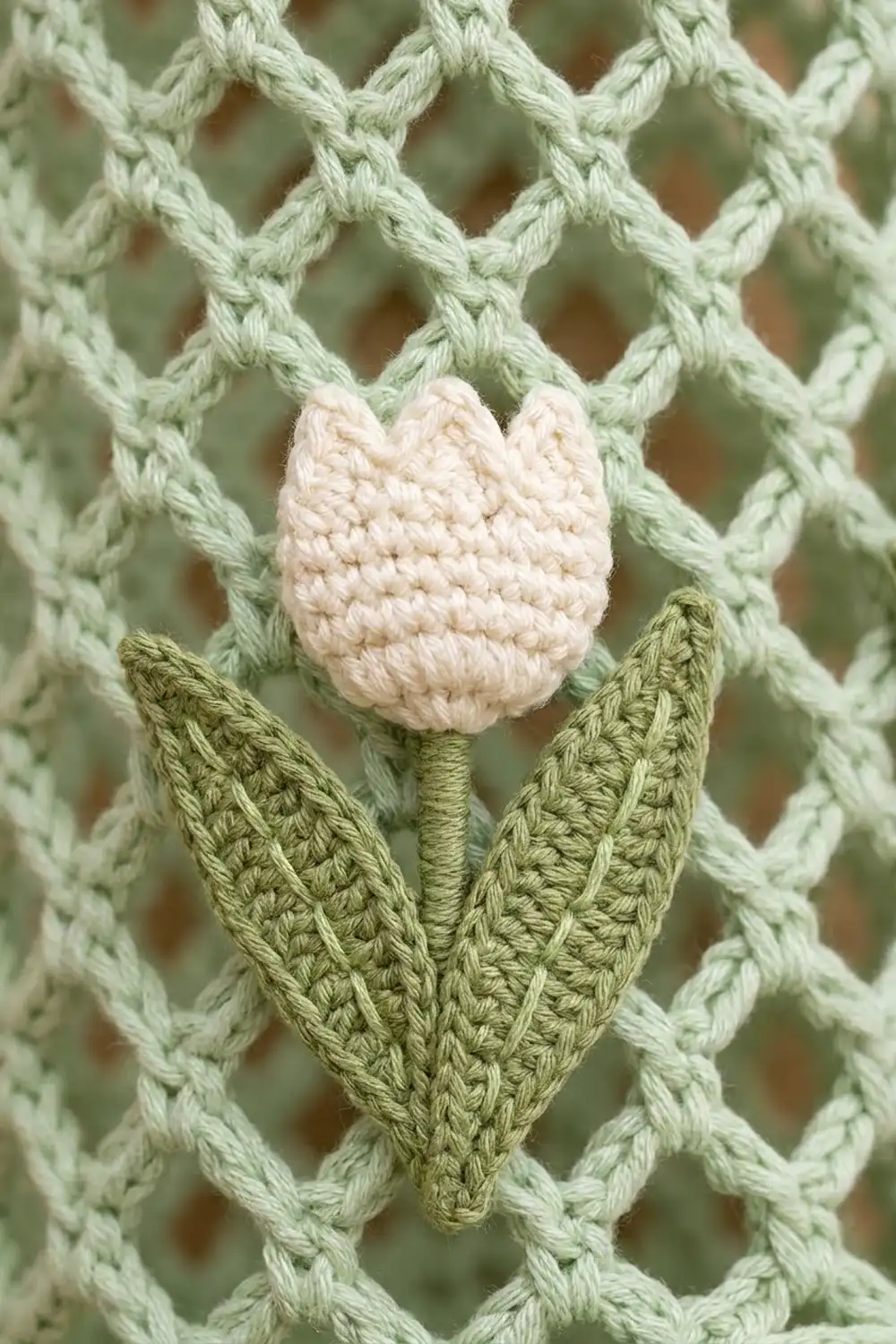
Tuck the top 0.25 in (0.6 cm) of a stem behind the base of a tulip head and whipstitch it in place. Place one leaf on each side of the stem near its base, angled outward. Sew each leaf down along its center line with the Moss tail. Each finished motif measures about 2.75 x 3.5 in (7.0 x 8.9 cm).
Attach the Tulips
Flatten the body with the opening centered on the front. Slip a piece of cardboard inside so you don’t sew through both layers. Pin the tulips in place following the layout.
Whipstitch around the edges of each tulip head and leaf. Catch a mesh bar or knot wherever the edge crosses one. Keep the stitches snug but not tight, because pulling hard gathers the mesh and puckers the front.
Attach the Strap
Keep the body flat with the opening centered on the front, so the strap ends land at the two side folds. Overlap 1.5 in (3.8 cm) of each strap end inside the top band at each side fold. Make sure the strap is not twisted.
Whipstitch around all edges of each overlapped end. Then sew a line of stitches across the middle of each end for extra strength. The weight of the bags pulls on these seams, so sew them firmly.
Checkpoint: about 11.5 in (29.2 cm) of the strap stays free. It forms a loop that rises about 4 in (10.2 cm) above the band.
Border
On this bag holder, the border is the solid top band plus one round of sc around the opening.
Border gauge: the same as the body, 16 sc and 18 rows = 4 in (10.2 cm).
Top Band
Round 41: sl st in each of the first 3 ch, ch 1, 4 sc in each ch-5 loop around. (15 loops x 4 sc = 60)
Rounds 42–48: ch 1, sc in each st around. (60)
Fasten off and weave in the end. The band is 8 rounds deep, or 1.8 in (4.6 cm).
Why the math works: Round 23 used 4 stitches per loop (1 sc + 3 skipped). Working 4 sc into each of the 15 loops gives back 60 stitches, the same count as the base. This keeps the band the same width as the base, so the body hangs as a straight tube.
Opening Edging
Join Sage at a lower corner of the opening. Work 1 sc in each of the 18 unworked sts of Round 15. Work 1 sc in each of the 5 row ends up the side. Work 1 sc in each of the 18 chs along the underside of the chain across the top of the opening. Work 1 sc in each of the 5 row ends down the other side. Sl st to join. (18 + 5 + 18 + 5 = 46)
The edging doesn’t make the holder any wider. It just firms up the edge so the bags slide out easily.
Final Blocking
- Soak the finished holder in cool water and gently squeeze out the extra water. Don’t wring it.
- Roll it in a towel to remove more water.
- Stuff the body with a rolled towel, or slide it over a tall container about 4.8 in (12.2 cm) wide.
- Gently pull the mesh downward until it measures 10.5 in (26.7 cm). Check that the diamonds line up in straight vertical rows.
- Pin the tulip petals and leaf tips flat.
- Lay the strap flat and straighten it to 14.5 in (36.8 cm).
- Let everything dry completely before removing the pins.
Final Quality-Control Checklist
- The base lies flat with no ripples, and the fold at Round 11 is crisp.
- Rounds 11–15, 21–22 and 41–48 each have 60 sts.
- Every mesh round has exactly 15 ch-5 loops.
- The opening is centered on the front and measures 4.5 x 1.1 in (11.4 x 2.8 cm).
- The tulips are sewn only through the front layer.
- The strap is not twisted, and each end is firmly sewn with a 1.5 in (3.8 cm) overlap.
- The body is 15 in (38.1 cm) tall and 7.5 in (19.1 cm) wide when flat.
Troubleshooting
Base cups or ruffles: Check your increase counts. A base that cups usually has too few increases, and one that ruffles has too many. Your tension may also be too tight or too loose. Change the hook, not the stitch count.
Mesh twists to one side: Make sure you sl st across exactly 3 ch at the start of every round. This keeps each round starting in the center of a loop.
Mesh is too short: Cotton relaxes when blocked. If the mesh is still short after blocking, add 1 or 2 mesh rounds. Each one adds about 0.58 in (1.5 cm).
Top band flares: Work the band with a hook one size smaller.
Opening gapes: Work the opening edging more firmly, or sk 1 st at each upper corner.
Strap stretches: Sew a strip of cotton twill tape to the back of the strap.
Care
Hand wash in cool water and lay flat to dry. Reshape the mesh while it is damp.

Final Notes
Here is how the measurements add up. A 4.8 in (12.2 cm) base with 60 stitches gives a 15 in (38.1 cm) circumference and a 7.5 in (19.1 cm) flat width. Twelve solid rounds add 2.7 in (6.9 cm). Eighteen mesh rounds add 10.5 in (26.7 cm). The 8-round band adds 1.8 in (4.6 cm), for a 15 in (38.1 cm) body. If each checkpoint matches, the finished holder will too.
Happy crocheting!