

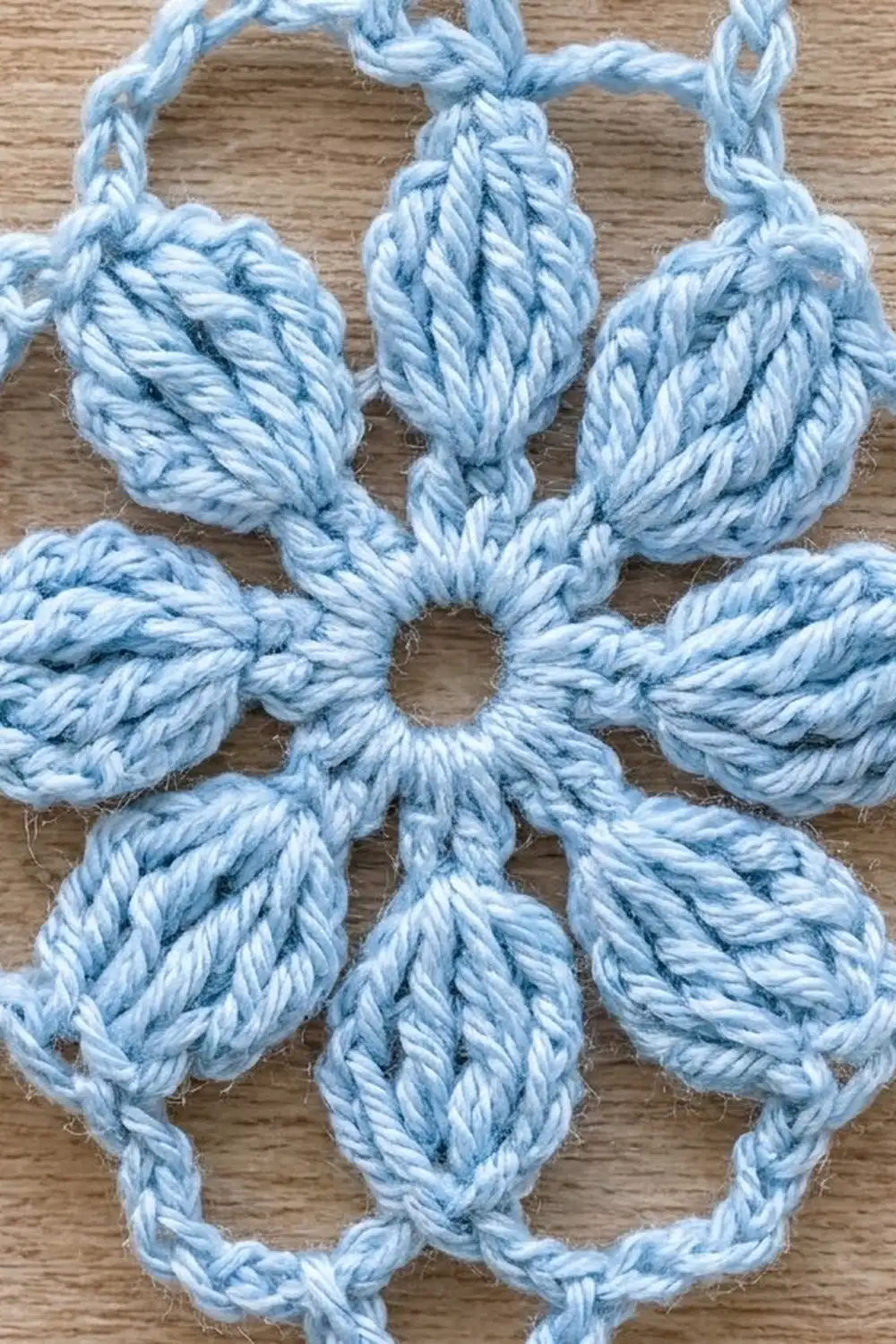
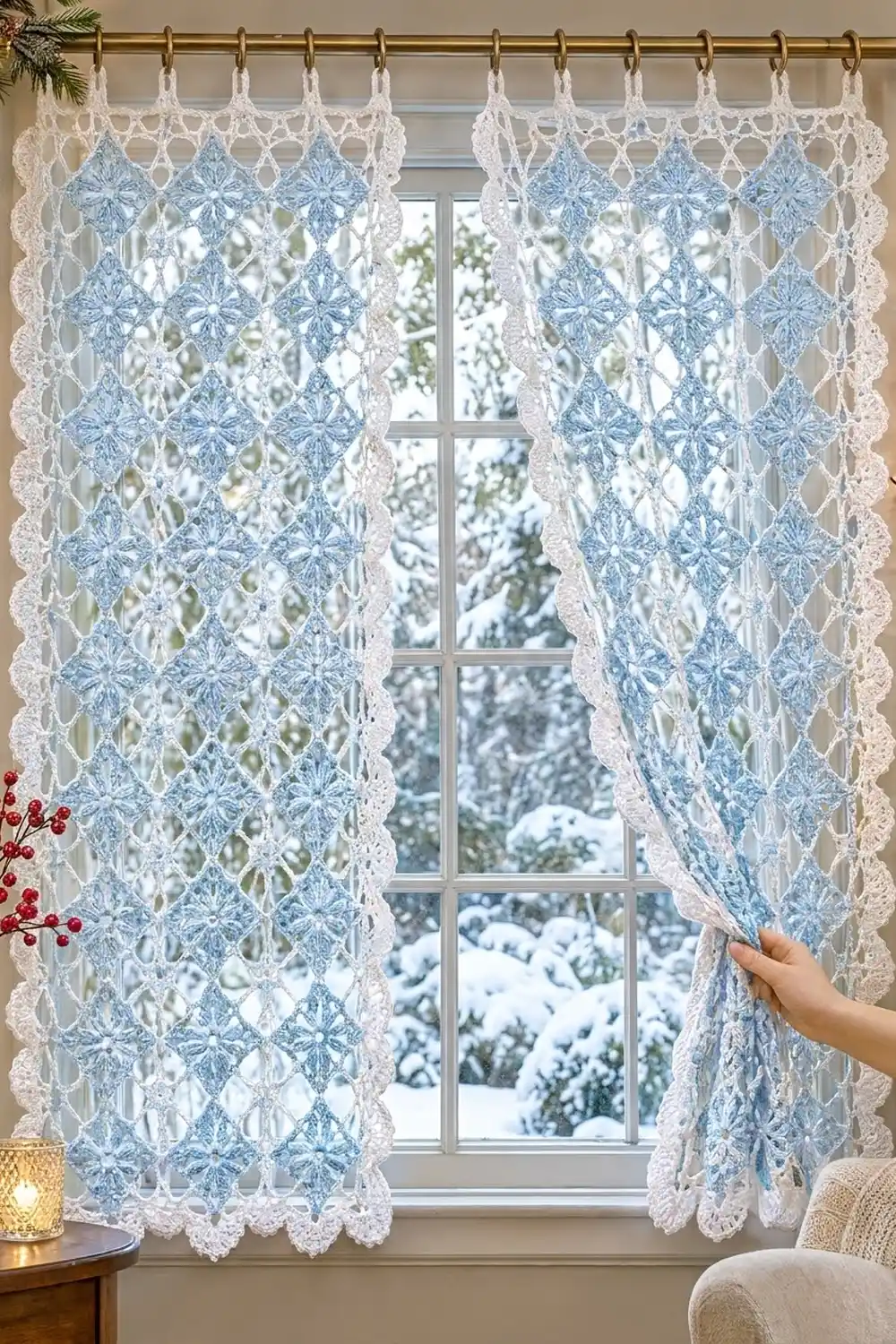
Frosted Window is a pair of lace curtain panels made from small square blocks. Each block has a light blue flower set on point. The flower has eight puffy cluster petals around an open center and is framed by a chain-lace diamond with pointed tips. White mesh fills the four corners of each block and squares it off. Once the blocks are joined, the blue diamonds float on white lace and light comes through every opening.
The colors are soft and wintry: one light ice blue and one clean white. A white scalloped border runs along three sides of each panel. The top edge has a firm white band with six hanging loops that slide straight onto a curtain rod.
This pattern uses US crochet terms. Each finished panel measures 21.5 in wide x 61.25 in long (54.6 cm x 155.6 cm), not counting the hanging loops.
The construction is simple and repetitive. You crochet 96 identical 5 in (12.7 cm) blocks in the round, 48 for each panel. You join each set of 48 with slip stitches into a grid 4 blocks wide and 12 blocks long. Then you work a two-round border and a row of hanging loops on each panel.
Finished Size and Construction
- Finished panel size: 21.5 x 61.25 in (54.6 x 155.6 cm), plus loops
- Skill level: Intermediate
- Terminology: US
- Yarn weight: Fingering (#1) mercerized cotton
- Hook: 2.75 mm (C-2)
- Number of pieces: 96 blocks (48 per panel)
- Layout per panel: 4 blocks wide x 12 blocks long
- Block size: 5 x 5 in (12.7 x 12.7 cm), 39 sts per side
- Panel size before border: 20 x 60 in (50.8 x 152.4 cm)
- Border depth: 0.75 in (1.9 cm) on the sides and bottom; 0.5 in (1.3 cm) top band
- Hanging loops: 6 per panel, each hanging about 1.5 in (3.8 cm)
Materials
Choose a smooth mercerized cotton or cotton blend in fingering weight. Cotton keeps the stitches crisp and hangs straight in a window. Avoid fuzzy yarns, which blur the lace and catch on the rod.
- Color A, light ice blue: 520 g, about 1,770 m (260 g per panel)
- Color B, white: 560 g, about 1,905 m (280 g per panel)
These amounts assume about 3.4 m per gram and include a margin of about 10 percent for gauge differences and swatching.
Tools:
- 2.75 mm (C-2) crochet hook
- Tapestry needle
- Stitch markers
- Blocking mats and rustproof pins
- Spray bottle
- Measuring tape
Abbreviations (US Terms)
- ch: chain
- sl st: slip stitch
- sc: single crochet
- hdc: half double crochet
- dc: double crochet
- tr: treble crochet
- dtr: double treble crochet
- sk: skip
- sp(s): space(s)
- st(s): stitch(es)
- RS / WS: right side / wrong side
4-tr cluster (4-tr cl): *Yo twice, insert hook in the given sp, pull up a loop, (yo, pull through 2 loops) twice; repeat from * 3 more times in the same sp, yo, pull through all 5 loops on hook.
Beginning cluster (beg cl): Ch 4, then work 3 partial tr the same way, yo, pull through all 4 loops on hook.
V-stitch (V-st): (st, ch 2, st) in the same sp. The round tells you which stitch to use.
Gauge and Checkpoints
Make one complete block before anything else and block it lightly. Gauge decides whether 4 blocks really add up to 20 in (50.8 cm).
- After Rnd 3: the flower measures 2.25 in (5.7 cm) across.
- After Rnd 5: the blue square measures 3 in (7.6 cm) per side and 4.25 in (10.8 cm) from tip to tip.
- After Rnd 8: the block measures 5 x 5 in (12.7 x 12.7 cm) with 39 sts per side, so 39 sts = 5 in (12.7 cm).
If your block is larger than 5.25 in (13.3 cm), go down a hook size. If it is smaller than 4.75 in (12.1 cm), go up a hook size. You can fix differences of up to 0.125 in (0.3 cm) when blocking.
Block Pattern
Blue Flower and Diamond (Color A)
Rnd 1: With A, ch 4, sl st to first ch to form a ring. Ch 3 (counts as dc), 15 dc in ring, sl st to top of ch-3. (16 dc)
Rnd 2: Ch 1, sc in same st, ch 3, sk 1, *sc in next dc, ch 3, sk 1; rep from * 6 more times, sl st to first sc. (8 sc, 8 ch-3 sps)
Rnd 3: Sl st into first ch-3 sp, beg cl in same sp, ch 5, *4-tr cl in next ch-3 sp, ch 5; rep from * 6 more times, sl st to top of beg cl. (8 petals, 8 ch-5 sps)
Checkpoint: 2.25 in (5.7 cm) across.
Rnd 4: Ch 1. The beg cl is your first corner petal. *(Sc, ch 7, sc) in top of corner petal, ch 5, sc in next ch-5 sp, ch 5, sc in top of next petal, ch 5, sc in next ch-5 sp, ch 5; rep from * 3 more times, sl st to first sc. (20 sc, 16 ch-5 loops, 4 ch-7 corner loops)
Every other petal is now a corner, and the petals in between sit at the middle of each side.
Rnd 5: Sl st into ch-7 corner loop. Ch 3 (counts as dc), (2 dc, ch 3, 3 dc) in same loop, ch 4, sc in next ch-5 loop, (ch 5, sc in next ch-5 loop) 3 times, ch 4, (3 dc, ch 3, 3 dc) in next ch-7 loop; rep from * 3 more times, ending last rep at *, sl st to top of ch-3. Fasten off A. (24 dc, 16 sc, 4 ch-3 tips, 8 ch-4 sps, 12 ch-5 sps)
Each side now has 5 spaces in this order: ch-4, three ch-5, ch-4. The (3 dc, ch 3, 3 dc) groups form the pointed diamond tips.
Checkpoint: 3 in (7.6 cm) per side, 4.25 in (10.8 cm) from tip to tip.
White Squaring Rounds (Color B)
These rounds turn the square by 45 degrees. Each blue tip becomes the middle of a new side, and the new corners are built over the middle ch-5 sp of each blue side.
Rnd 6: Join B in any ch-3 tip. Ch 1, *sc in tip sp, ch 5, sc in next ch-4 sp, ch 5, dc in next ch-5 sp, ch 5, (2 dtr, ch 5, 2 dtr) in next (middle) ch-5 sp, ch 5, dc in next ch-5 sp, ch 5, sc in next ch-4 sp, ch 5; rep from * 3 more times, sl st to first sc. (36 sts: 12 sc, 8 dc, 16 dtr; 24 side ch-5 sps, 4 corner ch-5 sps)
The stitches get taller from sc at the tips to dtr at the new corners, which fills the corner triangles. Each new side has 6 ch-5 sps between corners.
Rnd 7: Sl st across to the next corner ch-5 sp. Ch 4 (counts as tr), (tr, ch 3, 2 tr) in same sp, ch 1, tr V-st in next sp, ch 1, dc V-st in next sp, ch 1, hdc V-st in next sp, ch 1, hdc V-st in next sp, ch 1, dc V-st in next sp, ch 1, tr V-st in next sp, ch 1, (2 tr, ch 3, 2 tr) in corner sp; rep from * 3 more times, ending last rep at *, sl st to top of ch-4. (64 sts: 16 corner tr and 24 V-sts; 24 ch-2 sps, 28 ch-1 sps, 4 ch-3 corners)
Between corner ch-3 sps, each side has 35 positions: 2 tr + 7 ch-1 + 6 V-sts of 4 positions each (24) + 2 tr = 35.
Rnd 8 (conversion round): Ch 1. Along each side, sc in each st, 2 sc in each ch-2 sp and 1 sc in each ch-1 sp. Work 3 sc in each corner ch-3 sp. Sl st to first sc and fasten off.
Count: 140 side sc worked 1 per existing position (35 x 4) + 12 corner sc (3 x 4) = 152 sc.
The middle sc of each corner group is the corner st. Each side has 39 sts including both corner sts: 1 + 1 + 35 + 1 + 1 = 39.
Checkpoint: 5 x 5 in (12.7 x 12.7 cm).
Make All Pieces
- Panel 1: 48 blocks
- Panel 2: 48 blocks
- Total: 96 blocks, each with Rnds 1–5 in A and Rnds 6–8 in B
Layout per panel (A = one block, rows top to bottom):
Row 1:  A A A A
Row 2:  A A A A
Row 3:  A A A A
 ...    (repeat)
Row 12: A A A A
Weave in ends as you finish each block. Block the blocks lightly in batches so every one starts at 5 in (12.7 cm).
Joining
Join with B using a slip stitch seam. Hold two blocks with WS together and RS facing you. Work 1 sl st through the back loop of the front block and the front loop of the back block. Match stitch to stitch, 39 sts to 39 sts, and corner st to corner st.
- Join the blocks into 4 vertical strips of 12 blocks each. Carry each seam straight on from one block to the next without cutting the yarn.
- Join the 4 strips with 3 long seams. At each intersection, sl st through both corner sts and carry on.
Keep your tension loose and even. A tight seam pulls the panel narrower and puckers the lace. The seam should stretch as much as the blocks do.
The seams add no stitches. Each block keeps its own 39 sts per side, including its corner sts.
Size checkpoint: each panel measures 20 x 60 in (50.8 x 152.4 cm).
Border
Border gauge: 39 sts = 5 in (12.7 cm), about 7.8 sts per inch (2.54 cm).
Starting count per panel:
- Short sides: 4 blocks x 39 = 156 sts (20 in / 50.8 cm)
- Long sides: 12 blocks x 39 = 468 sts (60 in / 152.4 cm)
Each of the panel’s 4 outer corner sts is shared by a short side and a long side. Total edge sts: (2 x 156) + (2 x 468) – 4 = 1,244.
Rnd 1: With RS facing, join B in the top right corner st. Ch 1, (sc, ch 2, sc) in corner st, sc in each st to next corner st, (sc, ch 2, sc) in corner st; continue around, sl st to first sc.
Count: 1,244 sc worked 1 per existing st + 4 extra sc (1 per corner) = 1,248 sc, plus 4 ch-2 corner sps.
Between corner sps, each short side has 156 sc and each long side has 468 sc.
Rnd 2: Sl st into the corner sp at the start of the top edge. Ch 1, (sc, ch 3, sc) in same sp.
- Top edge: dc in each of next 156 sc.
- Corner: (sc, ch 3, sc) in corner sp.
- Long side: [sk 1, 5 dc in next sc, sk 1, sc in next sc] 117 times.
- Corner: (sc, ch 3, sc) in corner sp.
- Bottom edge: [sk 1, 5 dc in next sc, sk 1, sc in next sc] 39 times.
- Corner: (sc, ch 3, sc) in corner sp.
- Long side: [sk 1, 5 dc in next sc, sk 1, sc in next sc] 117 times.
Sl st to first sc. Do not fasten off.
Count: 156 dc along the top; 273 scallops (39 + 117 + 117) with 273 sc between them; 8 corner sc and 4 ch-3 corners.
Why the math works: each scallop uses exactly 4 sts. The bottom has 156 / 4 = 39 scallops and each long side has 468 / 4 = 117 scallops, with nothing left over. Both numbers come straight from 39 sts per block, so the scallops line up evenly with the seams.
Hanging loop row: Sl st into first top dc and ch 1. Working across the 156 top dc, place a loop on dc 1, 32, 63, 94, 125 and 156. The loops are 31 sts apart (155 / 5 = 31).
To make each loop, work (sc, ch 24, sl st in that same sc), then work 30 sc over the ch-24 loop to make it firm. Sc in each dc between the loops.
Count: 156 sc along the top, plus 6 loops covered with 30 sc each. Fasten off. Repeat the border and loops on the second panel.
Final Blocking
- Weave in any remaining ends along the seams, never through the open lace.
- Hand wash the panel in cool water with mild soap. Press the water out in a towel; do not wring.
- Lay the panel flat on the mats, RS up.
- Pin the straight edges first, to 21.5 x 61.25 in (54.6 x 155.6 cm).
- Check that every seam runs straight, and pin each block intersection.
- Pin each scallop on the long sides and bottom so it opens into a rounded arch.
- Spray lightly if needed and let the panel dry completely, 24 to 48 hours.
- Unpin and repeat with the second panel.
Final Quality-Control Checklist
- Every block measures 5 in (12.7 cm) and has 39 sts per side.
- Each blue diamond has 8 petals and 4 pointed tips.
- Every blue tip touches the middle of a white side.
- Seams lie flat, with no puckers or gaps.
- Each panel measured 20 x 60 in (50.8 x 152.4 cm) before the border.
- There are 39 scallops along the bottom and 117 along each long side.
- Six firm loops are spaced evenly across the top.
- Both panels finish at 21.5 x 61.25 in (54.6 x 155.6 cm).
- All ends are woven in and trimmed.
Troubleshooting
Petals look flat or lopsided. Pull each partial tr up to full height before you close the cluster.
White corners don’t make a square. Your dtr may be too short. Pull up longer loops, or pin the corners out when blocking.
Block is wavy. The chain spaces are too long for your tension. Use ch-4 instead of ch-5 in Rnd 6.
Block cups. The chains are too tight. Go up a hook size for Rnds 6–7 only.
Panel is narrower than 20 in (50.8 cm). The joining seams are too tight. Take them out and rejoin with a larger hook.
Scallops don’t fit. Recount Rnd 1. There must be exactly 156 sts between corners on each short side and 468 on each long side.
Loops stretch out. Work the 30 covering sc more tightly.
Care
Hand wash in cool water, lay flat to dry, and pin back into shape if needed. Hang the panels again only once they are completely dry.
Final Notes
The measurement chain is simple. A 2.25 in (5.7 cm) flower grows into a 3 in (7.6 cm) blue square. Three white rounds turn it into a 5 in (12.7 cm) block with 39 sts per side. Four blocks make 20 in (50.8 cm) across, and twelve make 60 in (152.4 cm) down. The border adds 0.75 in (1.9 cm) on each side and at the bottom and 0.5 in (1.3 cm) at the top, for a finished panel of 21.5 x 61.25 in (54.6 x 155.6 cm).
Check your first block carefully, and the other 95 blocks and both panels will come out right.
Happy crocheting!