

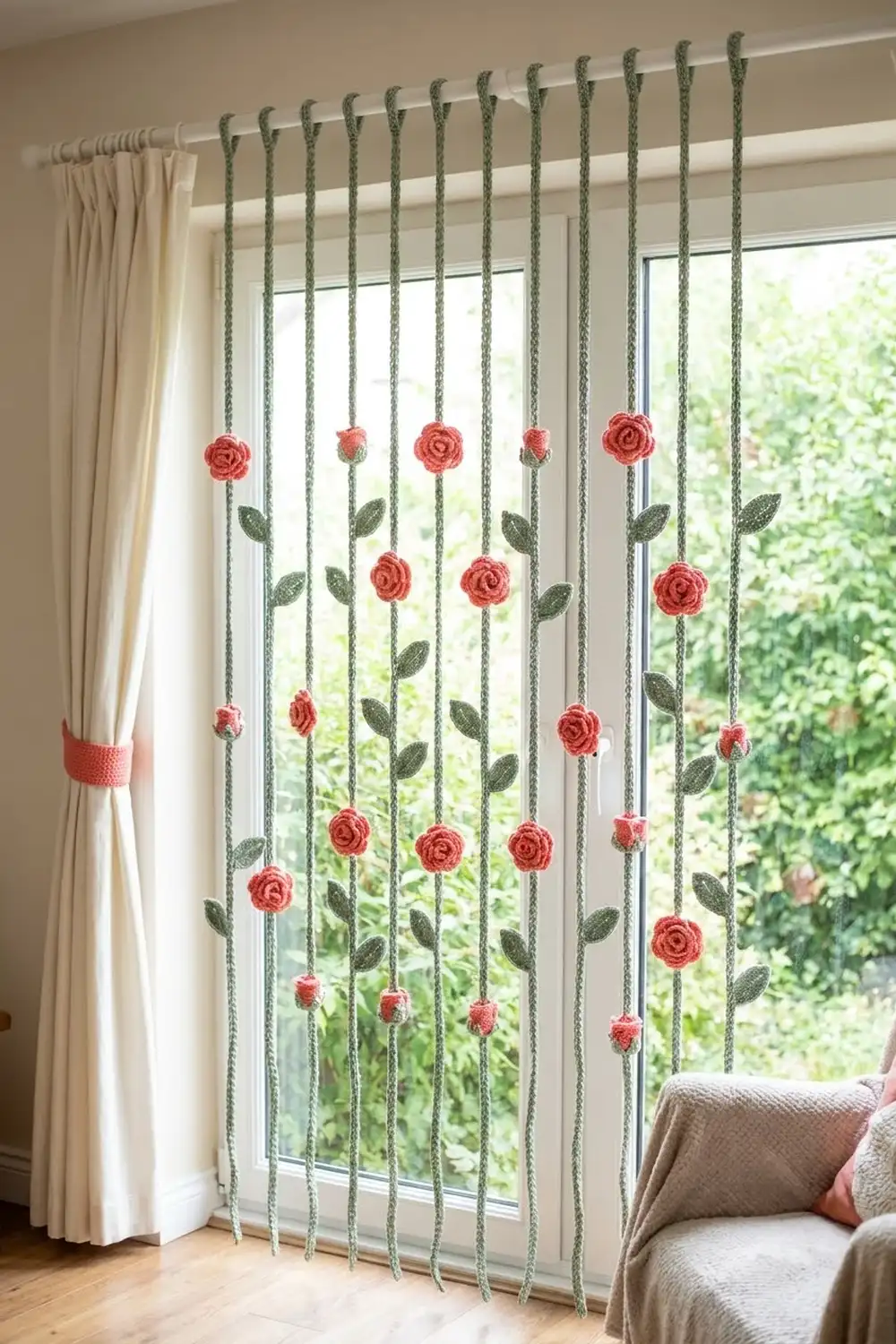
This strand curtain brings a climbing rose vine to your window. Twelve separate sage-green cords hang side by side from a curtain rod. Each cord carries open coral roses, closed coral rosebuds and pairs of pointed sage leaves, spaced evenly from top to bottom.
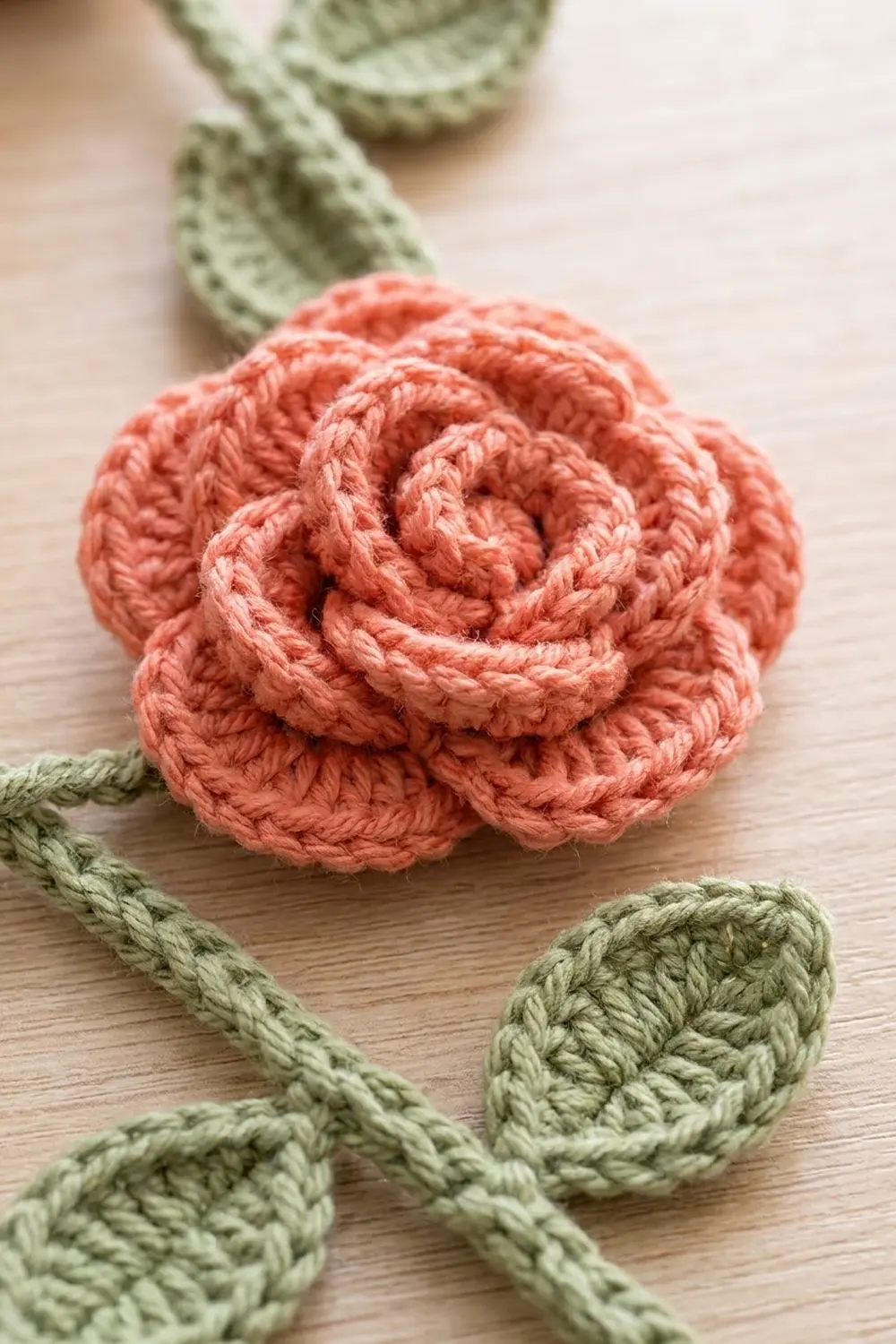
The palette uses just two colors: warm coral for the flowers and soft sage green for the stems and leaves. The style is cottage-romantic but airy, so light still comes through. Each open rose has a swirled, ruffled center ringed by two layers of five rounded petals. Each bud is a small cup with six petals folded inward.
This pattern uses US crochet terms. Each strand hangs 60 in (152.4 cm) below the rod. Twelve strands spaced 4 in (10.2 cm) apart cover 44 in (111.8 cm).
Construction is modular. You crochet a slip-stitch cord for each stem and make the roses, buds and leaves separately. Then you sew them to the cord at marked stitches and finish a reinforced loop that slides over the rod.
Finished Size and Construction
- Finished size: 44 in (111.8 cm) wide x 60 in (152.4 cm) drop
- Skill level: Advanced beginner
- Terminology: US terms
- Yarn weight: Worsted (#4) cotton
- Hook: 4.0 mm (G-6)
- Number of pieces: 12 separate strands, not joined to each other, with 84 flowers and 144 leaves sewn on
- Layout: 12 strands in one row, alternating Strand A and Strand B
- Piece size: cord 1/4 in (0.6 cm) thick, 60 in (152.4 cm) below the loop; roses 3.5 in (8.9 cm) wide
- Size before border: 264-stitch cord, 66 in (167.6 cm) long
- Border depth: a 6 in (15.2 cm) loop, which lies 3 in (7.6 cm) deep when folded over the rod
Materials
Choose a smooth combed or mercerized cotton in worsted weight, about 170 m per 100 g. Cotton holds petal shapes, stretches very little under its own weight and handles sunlight well.
- Coral (roses and buds): 550 g, about 935 m
- Sage green (stems and leaves): 450 g, about 765 m
These quantities include a margin of about 15%.
Tools:
- 4.0 mm (G-6) crochet hook
- Tapestry needle
- 20 locking stitch markers
- Measuring tape
- Coral scrap yarn for stuffing the buds
- Blocking mat and rustproof pins
- Spray bottle
Abbreviations (US Terms)
- ch: chain
- sl st: slip stitch
- sc: single crochet
- hdc: half double crochet
- dc: double crochet
- tr: treble crochet
- MR: magic ring
- FLO / BLO: front loop only / back loop only
- st(s): stitch(es)
Special stitch – back-bump slip stitch: Turn the chain over, insert the hook under the small bump on the back of the chain and slip stitch. This makes a firm, round cord with a neat chain braid on the front.
Gauge and Checkpoints
Cord gauge is 16 back-bump sl sts = 4 in (10.2 cm), measured flat without stretching.
Before you commit to twelve strands, make one test set: a 40-chain cord swatch, one rose, one bud and one leaf. Check each piece against these sizes:
- Cord: 16 sts = 4 in (10.2 cm)
- Rose after Rnd 3: 1.5 in (3.8 cm) across
- Finished rose: 3.5 in (8.9 cm) across
- Finished bud: 1.5 in (3.8 cm) tall, 1.25 in (3.2 cm) wide
- Finished leaf: 2 in (5.1 cm) long, 1.25 in (3.2 cm) wide
If your pieces come out too big, go down 0.5 mm. If they’re too small, go up 0.5 mm. The cord matters most, because all spacing is counted in stitches. If you can’t match cord gauge, keep the stitch counts and accept a slightly different drop. You can also change the foundation chain in steps of 4 stitches, which is 1 in (2.5 cm).
Stem Cord (make 12)
With sage green:
Foundation: Ch 265.
Row 1: Sl st in the back bump of the 2nd ch from hook and in the back bump of each ch across. (264 sl sts)
Don’t fasten off. The cord should measure 66 in (167.6 cm).
Stitch 1 is the bottom end and stitch 264 is the top end, next to your hook. Stitches 241–264 will become the hanging loop. Stitch 240 is the “loop join.” It’s the zero point for every placement measurement.
Open Rose (make 42)
With coral:
Rnd 1: MR, 10 sc in ring, sl st to first sc. Pull the ring tight. (10 sc)
Rnd 2 (center ruffle): Working in FLO of Rnd 1, (sl st, ch 2, 2 dc, ch 2, sl st) in next st; repeat from * around. (10 tiny petals)
Rnd 3: Working in the free BLO of Rnd 1, behind the ruffle: 2 sc in each st around, sl st to first sc. (20 sc)
Checkpoint: the rose should be 1.5 in (3.8 cm) across.
Rnd 4 (inner petals): Working in FLO of Rnd 3, sl st in next st, hdc in next st, 3 dc in next st, hdc in next st; repeat from * 4 more times. (5 petals, 5 sts each; 20 sts used)
Rnd 5: Working in the free BLO of Rnd 3, behind the inner petals: 2 sc in each st around, sl st to first sc. (40 sc)
Rnd 6 (outer petals): Working in FLO of Rnd 5, sl st in next st, hdc in next st, 2 dc in next st, 2 tr in each of next 2 sts, 2 dc in next st, hdc in next st, sl st in next st; repeat from * 4 more times. (5 petals, 10 sts each; 40 sts used, 8 per repeat)
Fasten off, leaving a 12 in (30.5 cm) tail. Twist the Rnd 2 ruffle clockwise with your fingers to create the swirled center.
Rosebud (make 42)
With coral:
Rnd 1: MR, 6 sc in ring, sl st to first sc. (6 sc)
Rnd 2: 2 sc in each st around. (12 sc)
Rnd 3: Sc in next st, 2 sc in next st; repeat from * around. (18 sc)
Rnds 4–6: Sc in each st around. (18 sc)
Rnd 7 (petals): Sl st in next st, 5 hdc in next st, skip next st; repeat from * 5 more times. (6 petals; 18 sts used, 3 per repeat)
Fasten off, leaving a 12 in (30.5 cm) tail. Stuff a small ball of coral scrap into the cup. Fold three alternating petals inward, fold the other three over them and tack the tips. The bud should measure 1.5 in (3.8 cm) tall.
Leaf (make 144)
With sage green:
Foundation: Ch 9.
Rnd 1: Sc in 2nd ch from hook, hdc in next ch, dc in each of next 3 ch, hdc in next ch, sc in next ch, (sc, ch 2, sc) in last ch for the tip. Rotate and work along the bottom loops of the foundation: sc in next ch, hdc in next ch, dc in each of next 3 ch, hdc in next ch, sc in next ch, sl st to first sc. (16 sts plus ch-2 tip)
Fasten off, leaving an 8 in (20.3 cm) tail at the base. The foundation chain becomes the center vein and the ch-2 makes the point.
Make All Pieces
Quantities by color:
- Sage green: 12 cords and 144 leaves (12 per strand)
- Coral: 42 roses and 42 buds
Strand versions:
- Strand A (make 6): 4 roses, 3 buds, 6 leaf pairs
- Strand B (make 6): 3 roses, 4 buds, 6 leaf pairs
Placement, counted down from the loop join (st 240):
- Strand A flowers: 24th, 56th, 88th, 120th, 152nd, 184th and 216th st below the join. That’s 6, 14, 22, 30, 38, 46 and 54 in (15.2, 35.6, 55.9, 76.2, 96.5, 116.8 and 137.2 cm). The order is rose, bud, rose, bud, rose, bud, rose.
- Strand A leaf pairs: 40th, 72nd, 104th, 136th, 168th and 200th st. That’s 10, 18, 26, 34, 42 and 50 in (25.4, 45.7, 66.0, 86.4, 106.7 and 127.0 cm).
- Strand B flowers: 40th, 72nd, 104th, 136th, 168th, 200th and 232nd st. That’s 10, 18, 26, 34, 42, 50 and 58 in (25.4, 45.7, 66.0, 86.4, 106.7, 127.0 and 147.3 cm). The order is bud, rose, bud, rose, bud, rose, bud.
- Strand B leaf pairs: 56th, 88th, 120th, 152nd, 184th and 216th st.
Every 32 sts equals 8 in (20.3 cm), so flowers are evenly spaced, and each strand’s flowers line up with its neighbors’ leaves.
Layout grid (left to right, viewed from the room):
| A | B | A | B | A | B | A | B | A | B | A | B |
  1   2   3   4   5   6   7   8   9  10  11  12
Joining Motifs to the Stems
Lay one cord flat and mark its placement stitches, counting down from st 240. Count twice. A single missed stitch shifts everything by 1/4 in (0.6 cm).
Roses: Center the back of Rnd 1 over the marker. With the coral tail, sew through Rnds 3 and 5 into the cord, covering 3 sts above and 3 below the marker, a 1.5 in (3.8 cm) anchor. Always go through the middle of a sl st, never between stitches, so the rose can’t rotate.
Buds: Place the bud base on the marked stitch with the tip pointing up and slightly outward. Sew Rnds 1–2 to the cord over 4 sts.
Leaves: Place one leaf on each side of the marker, directly opposite each other, with the tips angled down and out at about 45 degrees. Sew each leaf base (the last foundation ch) to the cord with 3 small stitches.
Tension: Sew firmly but not tightly. Tight sewing gathers the cord and shortens the strand.
Size checkpoint: After sewing, the cord should still measure 60 in (152.4 cm) from the loop join to the bottom end.
Border: Top Hanging Loop
For this curtain, the “border” is the reinforced loop at the top of each strand. It carries the full weight of the strand.
Border gauge: 4 sc = 1 in (2.5 cm), matching the cord gauge.
Fold: With your hook still in st 264, fold the end down and sl st into st 240. This closes a ring of 24 sts (sts 241–264) that measures 6 in (15.2 cm) around.
Rnd 1: Ch 1. Working in the top loops of each loop st, sc in each of the 24 sts, sl st to first sc. (24 sc: 12 on the front side, 12 on the back side)
Fasten off and weave the end through the loop join.
Why the math works: One sc per cord stitch keeps the loop at exactly 24 sts, or 6 in (15.2 cm), so it neither flares nor tightens. It fits rods up to 1.75 in (4.4 cm) across with room to slide. With 12 sts on each side, the loop stays centered on the rod and the strand hangs straight.
Bottom end: Weave the starting tail up through the last 4 sts to keep the tip neat.
Final Blocking
- Lay each strand on the mat and check that it’s 60 in (152.4 cm) from the loop join.
- Mist the roses until damp, not soaked.
- Cup the outer petals and pin each rose to 3.5 in (8.9 cm) across.
- Pinch the leaf tips to points and pin them at 45 degrees.
- Press each bud into a closed oval.
- Let everything dry for about 12 hours.
- Hang the strands in A/B order, spaced 4 in (10.2 cm) apart.
Final Quality-Control Checklist
- All 12 cords have 264 sts and hang 60 in (152.4 cm)
- Each loop has 24 sc and measures 6 in (15.2 cm) around
- Strand A has 4 roses, 3 buds and 12 leaves; Strand B has 3 roses, 4 buds and 12 leaves
- Flowers are every 32 sts, or 8 in (20.3 cm)
- Roses measure 3.5 in (8.9 cm) with swirled centers
- Bud petals are tacked closed
- Leaves sit in opposite pairs, tips down
- No tails show on the front
Troubleshooting
- Cord spirals: Work only into the back bumps, and steam the cord lightly while it hangs.
- Petals ruffle too much: Go down 0.5 mm for Rnds 4–6.
- Rose looks flat: Make sure Rnds 3 and 5 are worked in the back loops behind the petals.
- Bud gapes open: Add stuffing and tack the petal tips to each other.
- Strand shortened after sewing: Loosen the stitches and re-measure from st 240.
- Strand hangs crooked: Recount the loop. It should be exactly 24 sts.
Care
Hand wash in cool water with mild soap, roll the strands in a towel and dry flat. Reshape the petals while damp.
Final Notes
Everything follows one measurement chain. 16 sts equals 4 in (10.2 cm), so 264 sts make a 66 in (167.6 cm) cord. Of those, 24 sts form a 6 in (15.2 cm) loop and 240 sts form a 60 in (152.4 cm) drop. Motifs sit every 32 sts, or 8 in (20.3 cm). Twelve strands at 4 in (10.2 cm) intervals span 44 in (111.8 cm). Get the cord gauge right and everything else will follow.
Happy crocheting!