
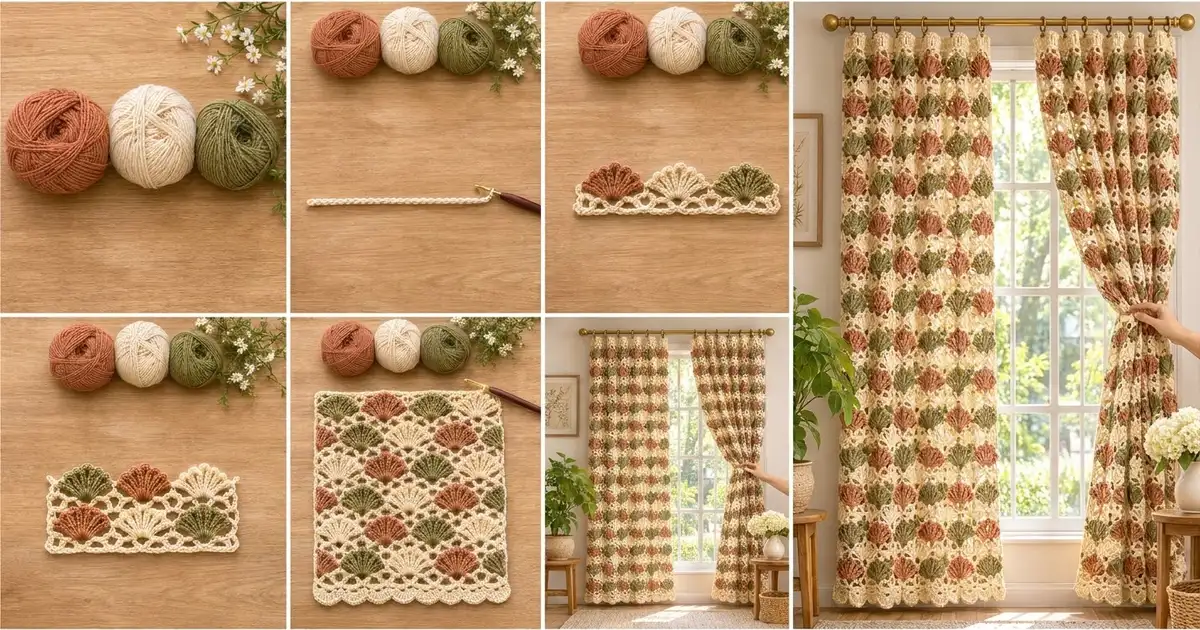
The Terracotta Meadow curtain panel is an airy lace fabric of small fans set into an open cream mesh. Each fan is nine double crochets fanned out from a single chain loop. The fans sit in staggered rows, so every fan nests between the two fans below it.
The palette is warm and earthy: a cream base with fans rotating through terracotta, sage green and cream. The look is cottage-style and relaxed, and daylight comes through the mesh.
This pattern uses US crochet terms. One finished panel measures 42.25 in wide x 82 in long (107.3 cm x 208.3 cm), including the border. The photo shows a matching pair, so make two identical panels for a window.
The panel is worked flat in one piece, from the bottom up, in a 6-row repeat: a fan row, two mesh rows, a second fan row offset by half a repeat, and two more mesh rows. Contrast colors are carried inside the fan rows, so you only have a few ends to weave in. A two-round border finishes the panel: firm single crochet along the top and sides, and scallops along the bottom.
Finished Size and Construction
- Finished size: 42.25 in x 82 in (107.3 cm x 208.3 cm) per panel
- Skill level: Intermediate (carried-color fan rows)
- Terminology: US
- Yarn weight: Worsted (#4)
- Hook: 5.0 mm (US H-8)
- Number of pieces: 1 per panel, worked in one piece (make 2 for a pair; the panels are not joined)
- Layout: 41 mesh loops wide; 21 fans in A-rows, 20 fans plus 2 half fans in B-rows; 40 fan rows in total
- Piece size before border: 41.25 in x 80.5 in (104.8 cm x 204.5 cm)
- Border depth: 0.5 in (1.3 cm) on the top and sides; 1 in (2.5 cm) along the scalloped bottom
Materials
Choose a smooth worsted cotton or cotton blend. Cotton drapes well, holds the fan shapes, and resists stretching at curtain length. The quantities below assume 100 g balls of about 180 m (197 yd).
For one panel:
- Cream (main color): 700 g, 1260 m (1378 yd)
- Terracotta: 300 g, 540 m (591 yd)
- Sage green: 300 g, 540 m (591 yd)
For a pair, double every amount.
Tools:
- 5.0 mm (US H-8) hook
- Stitch markers
- Tapestry needle
- Scissors
- Measuring tape
- Blocking mats or a large clean surface, plus rust-proof pins
- 11 curtain clip rings (or similar) for hanging
All quantities include a margin of about 15% to cover the gauge swatch, carried strands and small differences in tension.
Abbreviations (US Terms)
- ch – chain
- sl st – slip stitch
- sc – single crochet
- dc – double crochet
- sp – space
- sk – skip
- tch – turning chain
- st(s) – stitch(es)
Fan: 9 dc worked into the same ch-5 sp. The 5th dc is the center of the fan.
Half fan: 5 dc worked into the same sc at a side edge. The beginning ch-3 counts as the first dc.
Carrying colors: In fan rows, lay any color you are not using along the top of the row below and work every sc and dc over it, so the strand ends up enclosed inside the stitches. To change color, start the last stitch in the old color and finish its final yarn over in the new color.
Gauge and Checkpoints
Gauge: 5 ch-5 loops = 5 in (12.7 cm) wide; one 6-row repeat (Rows 2–7) = 4 in (10.2 cm) tall, after light blocking.
Test swatch: Ch 38. Work Rows 1–13 below, using these repeat counts: Row 2, repeat 3 times; Rows 3 and 6, repeat 4 times; Row 5, repeat 4 times. This gives 9 loops. A-rows have 5 fans, and B-rows have 4 fans plus 2 half fans. Block the swatch. It should measure 9.25 in x 8.5 in (23.5 cm x 21.6 cm).
- Swatch too big: go down to a 4.5 mm hook.
- Swatch too small: go up to a 5.5 mm hook.
- Width correct but height off: check how tall your dc are. Pull up the first loop of each dc to the same height every time, and don’t tighten your chains to make up for it.
Panel checkpoints (measure flat and unstretched):
- After Row 1: 41.25 in (104.8 cm) wide
- After 5 repeats (Row 31): 20.5 in (52.1 cm) long
- After 10 repeats (Row 61): 40.5 in (102.9 cm)
- After 15 repeats (Row 91): 60.5 in (153.7 cm)
- After 20 repeats (Row 121): 80.5 in (204.5 cm)
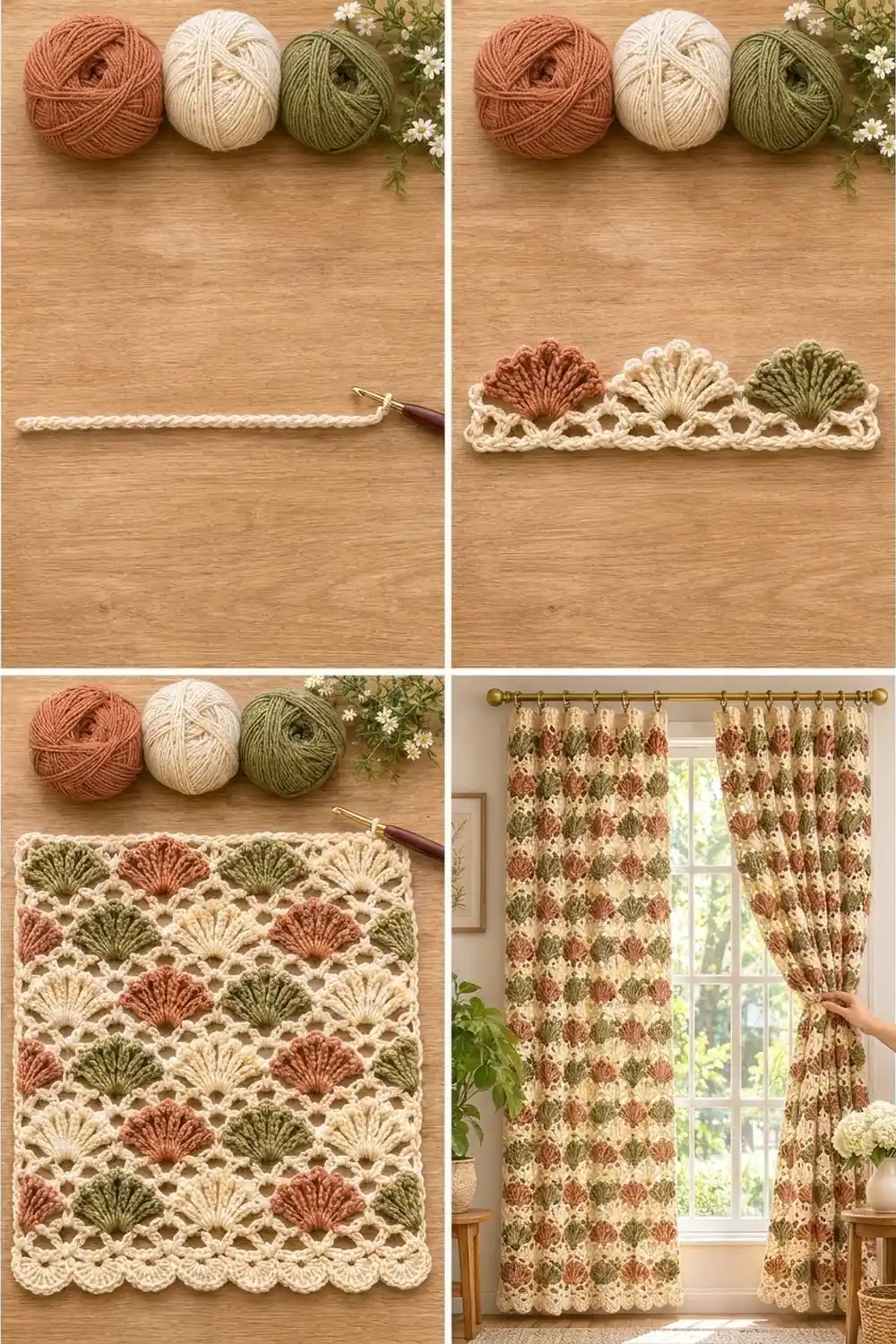
Panel Pattern
With cream, ch 166 (4 per loop x 41 loops, plus 2).
Row 1 (mesh): Sc in 2nd ch from hook, ch 5, sk 3 ch, sc in next ch; repeat from * across. Turn.
(42 sc, 41 ch-5 loops)*
Fan Row A
Row 2: Join terracotta and sage green, and lay both along the top of Row 1 so you can carry them. Using the first color of the rotation (below), ch 3 (counts as dc) and work 8 dc in the first ch-5 sp. Change to cream, sc in next sp. Change to the next color in the rotation, 9 dc in next sp. Repeat from * to * 18 more times (19 times in total). Work sc in cream in the next sp. With the last fan color, work 8 dc in the last sp and dc in the last sc. Turn.
(21 fans and 20 sc = 209 sts)
Color rotation, A-rows: sage, terracotta, cream, repeated. This gives 7 fans of each color.
Mesh Rows
Drop the contrast colors at the side edge. They stay there until the next fan row.
Row 3 (anchored mesh, cream): Ch 1, sc in first dc, ch 3, sc in 5th dc of the same fan. Ch 5, sc in next sc, ch 5, sc in 5th dc of next fan. Repeat from * to * 20 times in total. Ch 3, sc in top of tch. Turn.
(43 sc; 40 ch-5 loops plus 2 edge ch-3 loops = 42 loops)
Row 4 (plain mesh): Ch 1, sc in first ch-3 sp, ch 5, sc in next sp; repeat from * across, ending with sc in the last ch-3 sp. Turn.
(42 sc, 41 ch-5 loops)*
Row 4 brings the loops back over the same positions as Row 1. That is why Row 5 can place its fans between the Row 2 fans.
Fan Row B
Row 5: Pick up the carried strands. With terracotta, ch 3 (counts as dc) and work 4 dc in the first sc (half fan). Change to cream, sc in next sp. Change to the next color, 9 dc in next sp. Change to cream, sc in next sp. Repeat from * to * 20 times in total. With terracotta, work 5 dc in the last sc (half fan). Turn.
(2 half fans, 20 fans, 21 sc = 211 sts)
Color rotation, B-rows: terracotta (half fan), then cream, sage, terracotta, repeated. Both half fans come out terracotta.
Row 6 (anchored mesh, cream): Ch 1, sc in first dc, ch 3, sc in next sc. Ch 5, sc in 5th dc of next fan, ch 5, sc in next sc. Repeat from * to * 20 times in total. Ch 3, sc in top of tch. Turn.
(43 sc, 42 loops)
Row 7 (plain mesh): Work as Row 4.
(42 sc, 41 ch-5 loops)
Rows 8–121: Repeat Rows 2–7 nineteen more times, for 20 repeats in total. Do not fasten off cream. Cut the contrast colors, leaving 6 in (15.2 cm) tails at the side edge.
Fan rows always begin on the edge where the carried strands are waiting. This works because three rows lie between each pair of fan rows. Keep the strands slightly loose as they travel up the side, each about 2 in (5.1 cm). The border will cover them.
Border
Border gauge: 4 sc = 1 in (2.5 cm). Every count below matches the panel’s own dimensions at this gauge.
Round 1 (cream, sc): Keep the cream loop from the end of Row 121 on your hook. Ch 1 and work across the top edge first, then down the side, along the bottom, and up the other side.
- Top edge (Row 121): Sc in the first sc, 3 sc in each ch-5 loop, sc in each of the 40 interior sc, sc in the last sc = 165 sc.
- Each side edge: Work 2 sc for Row 1. Then, for each repeat, work 4 sc around the end of each fan row and 2 sc around the end of each mesh row. That is 16 sc per repeat, so 2 + (20 x 16) = 322 sc.
- Bottom edge: Sc in the free loop of each foundation ch, skipping the turning ch = 165 sc.
- Corners: Work ch 2 between sides at each corner. The ch-2 sps are not counted in the side counts.
Sl st to the first sc. (974 sc and 4 ch-2 corner sps)
Why the math works: The top has 41 loops at 3 sc each plus 42 anchor sc: 123 + 42 = 165. The bottom has 166 ch minus the turning ch = 165. At 4 sc per inch, 165 sc = 41.25 in, which is exactly the panel width. On the sides, 16 sc per 4 in repeat is 4 sc per inch, and 322 sc = 80.5 in, which is exactly the panel length. The edges therefore stay flat, without ruffling or pulling in.
Round 2: Ch 1.
- Top and sides: Sc in each st, so 165 sc on the top and 322 sc on each side. Work 3 sc in each top corner ch-2 sp. These corner groups are not counted in the side totals.
- Bottom corner: At the first bottom corner, work 1 sc in the ch-2 sp.
- Bottom (scallops): Sc in the first st, sk 1, 5 dc in next st, sk 1, sc in next st; repeat from * across = 41 scallops*. This uses 1 + (41 x 4) = 165 sts, so each scallop sits under one mesh loop column.
- Last corner: Work 1 sc in the last ch-2 sp.
Sl st to the first sc. Fasten off and weave in all ends, working the carried-strand tails into the side border.
Final Blocking
- Soak the panel in cool water for 15 minutes. Press out the water. Do not wring it.
- Roll it in towels to remove excess moisture.
- Lay it flat and pat it out to 42.25 in x 82 in (107.3 cm x 208.3 cm).
- Pin the side edges straight, every 4 in (10.2 cm).
- Open each fan into an even half-circle, and pin the point of each bottom scallop.
- Leave the panel to dry completely. A pinned cotton panel can take 24–48 hours.
- Unpin it and hang it straight away so the weight of the panel settles the drape.
Clip on 11 rings along the top edge. Place them 16 sts (4 in / 10.2 cm) apart, starting with the 3rd st, so the last ring lands on the 163rd st.
Final Quality-Control Checklist
- A-rows have 21 fans, and B-rows have 20 fans plus 2 half fans.
- Every mesh row has 41 ch-5 loops (plain) or 42 loops (anchored).
- No carried strand shows as a loose float across an open mesh loop.
- The side edges are straight and the same length: 322 sc each.
- The top edge has 165 sc and lies flat.
- There are 41 bottom scallops, evenly spaced.
- The color rotation is consistent in every fan row.
- The finished size is 42.25 in x 82 in (107.3 cm x 208.3 cm).
Troubleshooting
- Fans cup or pucker: The carried strands are too tight. Spread the fan along the strand before you work the next sc.
- Contrast color shows through the cream fans: Keep the carried strands at the back of the stitch, and use a slightly firmer dc.
- The panel slants or narrows: Count the loops in each mesh row, because a missed edge ch-3 is the usual cause.
- Sides wave after the border: Reduce to 3 sc at the fan-row ends for that section, or rework it.
- The top edge flares: Work Round 2 of the top edge with a 4.5 mm hook.
- The panel is shorter than the checkpoint: Add one repeat before the border, which adds 4 in (10.2 cm). Add 16 sc to each side in Round 1.
Care
Hand wash or machine wash cool on a gentle cycle inside a mesh bag. Reshape and dry flat or hung over a rod, never in a dryer.
Final Notes
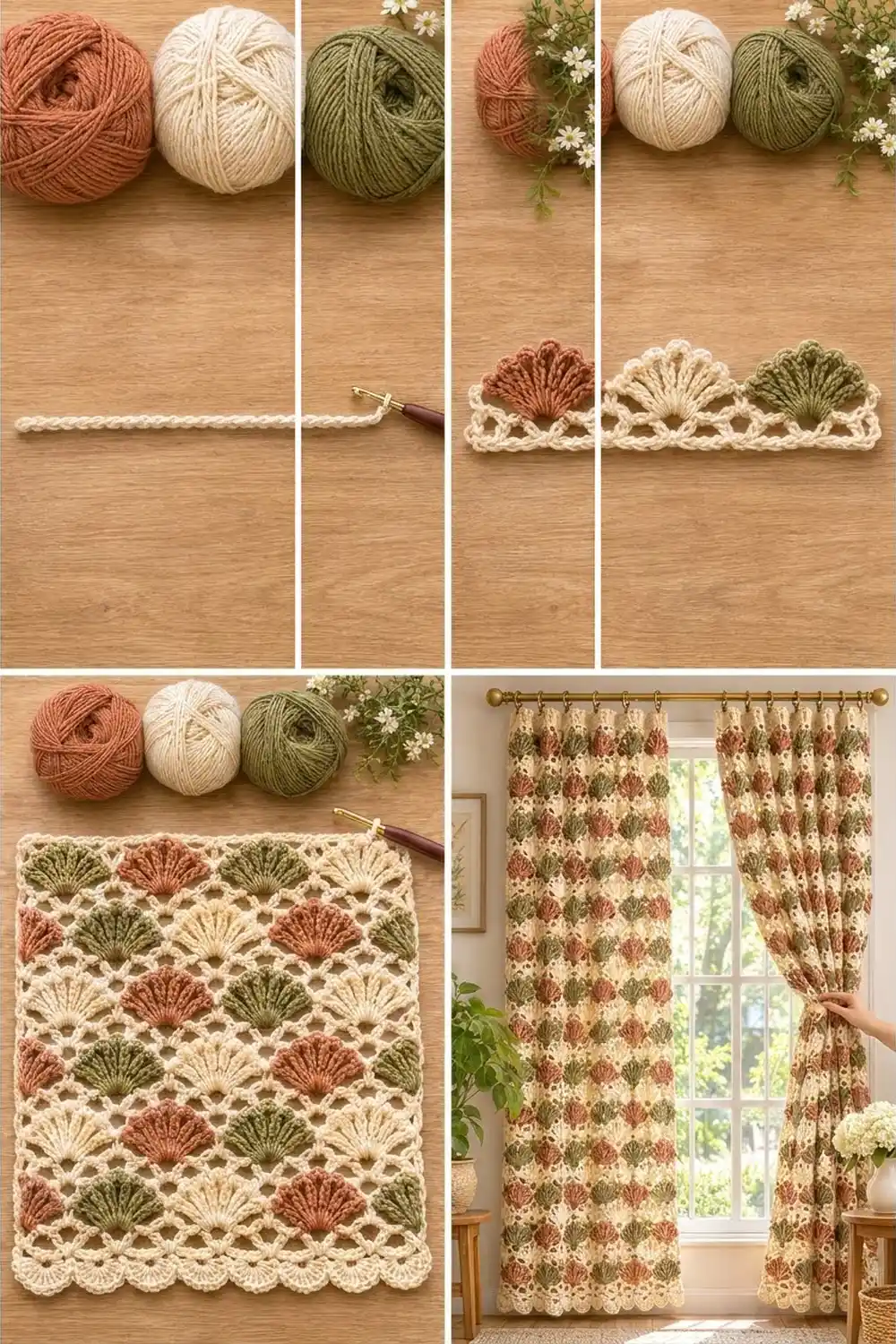
Everything in this panel follows from one measurement chain. One ch-5 loop is 1 in (2.5 cm), and one 6-row repeat is 4 in (10.2 cm). From there, 41 loops give 41.25 in (104.8 cm), and Row 1 plus 20 repeats give 80.5 in (204.5 cm). The border is 165 sc across and 322 sc down each side at 4 sc per inch, with 41 scallops along the bottom. That brings the panel to 42.25 in x 82 in (107.3 cm x 208.3 cm). If you check your swatch, count the loops in each mesh row and measure at each checkpoint, the finished panel will hang square. Make a second panel for a matching pair.
Happy crocheting!