

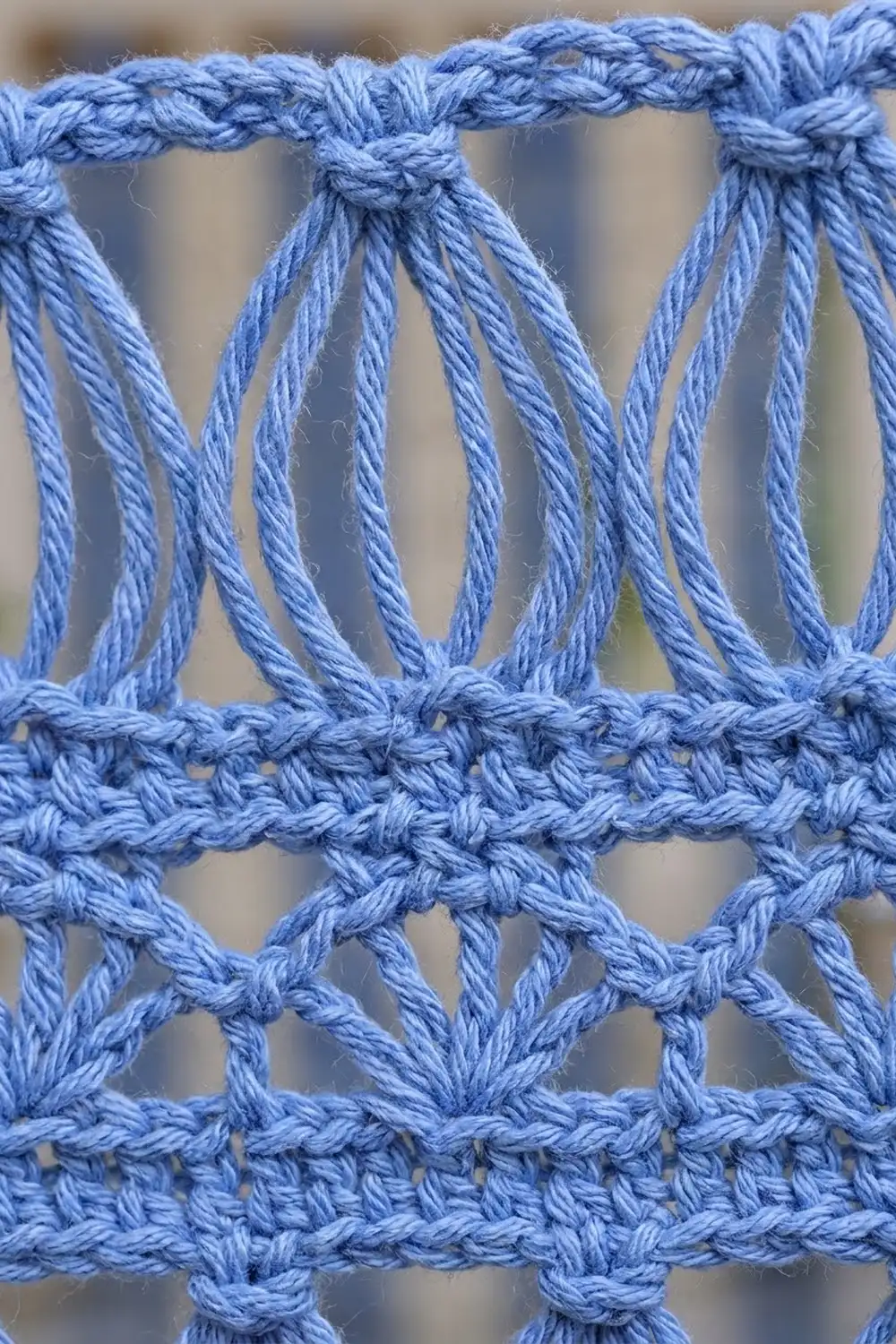
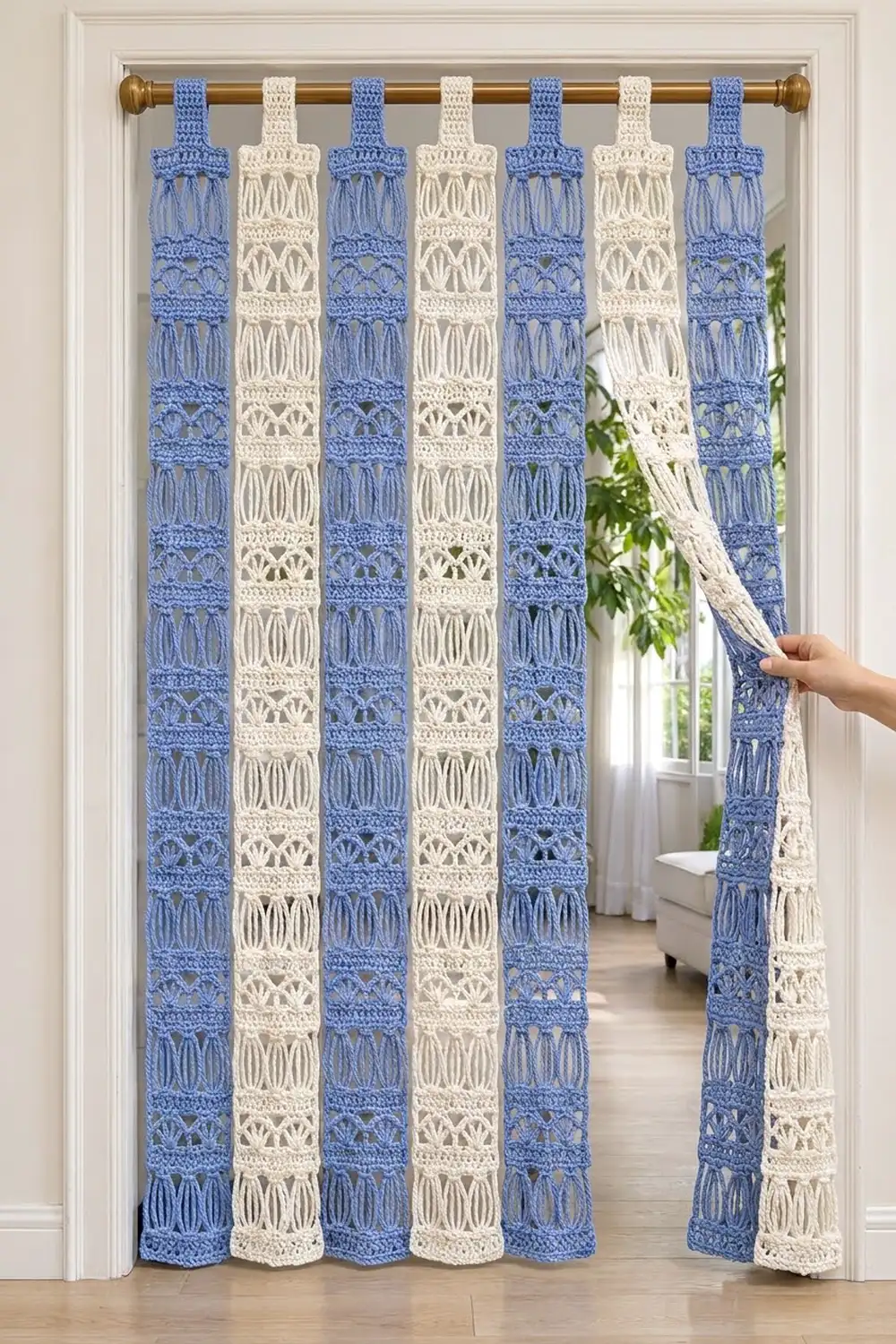
This airy door curtain is made of seven long lace strips. Four are soft periwinkle blue and three are creamy ivory, and they hang in alternating order from a curtain rod. Each strip repeats the same rhythm: rows of tall broomstick-lace loops gathered into tulip shapes, a firm band of single and double crochet, and a row of small shell fans.
The strips are not sewn together. Each one hangs from its own tab loop, so the curtain moves easily and lets you walk through the doorway without pulling the panels aside. The look is light, fresh and a little coastal, and it suits a doorway, a pantry opening or a wide window.
The pattern is written in US crochet terms. Each finished strip measures 5.4 in (13.7 cm) wide by 77 in (195.6 cm) long. With the tab, it hangs 80 in (203.2 cm) from the rod. Seven strips with 1 in (2.5 cm) gaps between them fill 43.8 in (111.3 cm) of rod.
Construction is simple. You work each strip flat from the bottom up on 25 stitches, crochet a tab on the top edge, sew the tab into a loop, add one round of border, and block. Then you thread all seven strips onto the rod.
Finished Size and Construction
- Finished strip size: 5.4 in × 77 in (13.7 cm × 195.6 cm)
- Hanging drop including tab: 80 in (203.2 cm)
- Skill level: Intermediate (broomstick lace)
- Terminology: US
- Yarn weight: DK cotton (weight 3)
- Hook: 4.0 mm (G-6)
- Number of pieces: 7 strips (4 blue, 3 cream)
- Layout: 7 strips in one row on the rod, B-C-B-C-B-C-B, with 1 in (2.5 cm) gaps
- Strip size before border: 5 in × 76.6 in (12.7 cm × 194.6 cm)
- Border depth: 0.2 in (0.5 cm), one round of single crochet
Materials
Use a smooth mercerized or soft cotton DK. Cotton holds the broomstick loops open and does not stretch much under its own weight, which matters on a strip this long. Avoid fuzzy yarns, because they hide the loop clusters. This pattern assumes 50 g balls of about 114 m (125 yd).
- Color A, periwinkle blue: 550 g / 1,254 m (1,375 yd), 11 balls, for 4 strips
- Color B, cream: 450 g / 1,026 m (1,125 yd), 9 balls, for 3 strips
Each strip uses about 125 g. These quantities include a safety margin of about 10–20%.
Tools:
– 4.0 mm (G-6) crochet hook
– 3/4 in (1.9 cm) wooden dowel or a 19 mm knitting needle, used as the broomstick
– Tapestry needle
– Stitch markers
– Rust-proof pins and blocking mats
– Measuring tape
– Curtain rod, at least 44 in (111.8 cm) of usable length and up to 1.5 in (3.8 cm) diameter
Abbreviations (US Terms)
- ch – chain
- sc – single crochet
- dc – double crochet
- sk – skip
- st(s) – stitch(es)
- BLO – back loop only
- FLO – front loop only
- RS / WS – right side / wrong side
Special stitches
Broomstick loop row: Do not turn. Pull the loop on your hook up long and slip it onto the dowel. That loop is the first loop. Working from left to right (right to left if you are left-handed), insert the hook into the next st, pull up a loop, stretch it and slip it onto the dowel. Repeat across.
Broomstick closing row (5-loop group): Insert the hook through the first 5 loops together and slide them off the dowel. Yarn over, pull through, ch 1 (this ch does not count as a stitch), then work 5 sc into the center of the group. For each following group, insert the hook through the next 5 loops and work 5 sc into the center.
Fan: 5 dc in the same st.
Half fan: 3 dc in the same st. At the start of a row, ch 3 counts as the first dc.
Gauge and Checkpoints
Gauge: 20 sc and 20 rows = 4 in (10.2 cm) in sc. Each sc row is 0.2 in (0.5 cm) tall. One broomstick pair (loop row plus closing row) is 1 in (2.5 cm) tall. One full 8-row pattern repeat is 3 in (7.6 cm) tall.
Test one piece first. Start your first strip and stop after Row 10. Treat this first section as your swatch.
- After Row 2: 5 in (12.7 cm) wide, 0.4 in (1.0 cm) tall
- After Row 10 (one repeat): 5 in (12.7 cm) wide, 3.4 in (8.6 cm) tall
- After 5 repeats: 15.4 in (39.1 cm) tall
- After 10 repeats: 30.4 in (77.2 cm) tall
- After 25 repeats: 75.4 in (191.5 cm) tall
- Body complete: 76.6 in (194.6 cm) tall
If your strip is too wide (more than 5.2 in / 13.2 cm), go down to a 3.75 mm hook. If it is too narrow (less than 4.8 in / 12.2 cm), go up to a 4.5 mm hook.
If the broomstick bands are much shorter than 1 in (2.5 cm), switch to a thicker dowel. If they are much taller, switch to a thinner one.
Lay the strip flat to measure it. Never measure a long strip while it hangs, because cotton lengthens under its own weight.
Strip Pattern (Make 7)
The pattern is worked on 25 sts throughout. The st count never changes.
Row 1 (WS): Ch 26. Sc in 2nd ch from hook and in each ch across. (25 sc)
Row 2 (RS): Ch 1, turn. Sc in each st across. (25 sc)
You are now at the left edge with the RS facing, which is where the loop row starts.
Row 3 (RS, broomstick loop row): Do not turn. Pull up the loop on your hook and place it on the dowel. Working left to right, pull up a loop in each of the next 24 sts. (25 loops on the dowel)
Keep each loop snug around the dowel so every loop is the same height.
Row 4 (RS, closing row): Working right to left, insert the hook through the first 5 loops and slide them off the dowel. Yo, pull through, ch 1, then work 5 sc into the center of the group. Work the next 5 loops together and put 5 sc in the group; repeat from * 3 more times. (5 groups, 25 sc)
Gathering 5 loops with 5 sc pinches the tops together. The loop bases stay spread across 5 sts below, so each group forms a teardrop or tulip shape.
Row 5 (WS): Ch 1, turn. Sc in each st across. (25 sc)
Row 6 (RS): Ch 3 (counts as dc), turn. Dc in each of the next 24 sts. (25 dc)
Row 7 (WS): Ch 1, turn. Sc in each st across. (25 sc)
Row 8 (RS, fan row): Ch 3 (counts as dc), turn, and work 2 dc in the first st (half fan). Sk 2 sts, sc in next st, sk 2 sts, fan in next st; repeat from * 2 more times. Sk 2 sts, sc in next st, sk 2 sts, half fan in the last st. (3 fans, 2 half fans, 4 sc)
Fan-row stitch check: The row has 3 dc + (3 × [1 sc + 5 dc]) + 1 sc + 3 dc = 3 + 18 + 1 + 3 = 25 sts. It uses 25 sts of Row 7: 1 + (3 × 6) + 6 = 25.
Row 9 (WS): Ch 1, turn. Sc in each st across, working into every dc and every sc. (25 sc)
Row 10 (RS): Ch 3 (counts as dc), turn. Dc in each of the next 24 sts. (25 dc)
Row 10 ends at the left edge with the RS facing, ready for the next loop row.
Rows 11–202: Repeat Rows 3–10 another 24 times, for 25 repeats in total. The strip should now measure 75.4 in (191.5 cm).
Final band: Work Rows 3–5 once more, for 205 rows in total. This finishes the strip with a row of tulip loops and one sc row on top. Do not fasten off yet.
Body check: 5 in × 76.6 in (12.7 cm × 194.6 cm). Height chain: 0.4 in (Rows 1–2) + 75 in (25 repeats) + 1.2 in (final band) = 76.6 in (1.0 cm + 190.5 cm + 3.0 cm, which comes to 194.6 cm when you convert the total directly).
Hanging Tab
The tab is worked in BLO so that the front loops of the top row stay free for the border.
Tab Row 1 (RS): Fasten off. With the RS facing, count 8 sts in from the right edge of the top row and join yarn in BLO of the 9th st. Sc in BLO of that st and the next 8 sts. (9 sc, leaving 8 unworked sts on each side: 8 + 9 + 8 = 25)
Tab Rows 2–30: Ch 1, turn. Sc in each st across. (9 sc)
The tab measures 1.8 in × 6 in (4.6 cm × 15.2 cm). Fasten off and leave a 16 in (40.6 cm) tail.
Make All Pieces
- Color A (blue): 4 strips, each with tab
- Color B (cream): 3 strips, each with tab
Hanging layout on the rod, viewed from the front, with 1 in (2.5 cm) gaps:
[ A ] [ B ] [ A ] [ B ] [ A ] [ B ] [ A ]
  1     2     3     4     5     6     7
The strips alone total 7 × 5.4 in = 37.8 in (96.0 cm). With 6 gaps of 1 in (2.5 cm), the hanging width is 43.8 in (111.3 cm).
Joining: Tab Loops
The strips are not seamed to each other. The only joining is closing each tab into a rod loop.
- Fold: Fold the tab toward the WS so that its last row lies flat against the WS of the strip, directly over the 9 tab-base sts.
- Sew stitch to stitch: Use the tail to whipstitch each of the 9 sts of Tab Row 30 to one of the 9 matching sts of the final body Row 5 on the WS. Work through the back bumps, matching them 1:1.
- Tension: Sew firmly, but don’t tighten the seam so much that it puckers. Nothing from the seam should show on the RS.
- Size check: The loop stands about 3 in (7.6 cm) tall and has an inner circumference of about 5.5 in (14.0 cm). That fits rods up to 1.5 in (3.8 cm) across.
Weave in the ends.
Border
Border gauge: 5 sc per inch (5 sc per 2.5 cm) along every edge, which is the same as the body gauge. Matching the gauge keeps the edges from flaring or pulling in.
Side-edge spacing per row (for one 8-row repeat):
| Rows | Sc along side |
|---|---|
| Rows 3–4 (broomstick pair) | 5 sc |
| Each sc row (Rows 5, 7, 9) | 1 sc each |
| Each dc row (Rows 6, 10) | 2 sc each |
| Fan row (Row 8) | 3 sc |
One repeat therefore takes 5 + 1 + 2 + 1 + 3 + 1 + 2 = 15 sc. That matches 3 in × 5 sc per inch.
Border Round (RS): With the RS facing, join yarn at the top right corner st, the first st of the top row, working into FLO across the top.
- Top edge: 3 sc in the corner st, then sc in FLO of the next 23 sts, then 3 sc in the last st (the corner).
- Left side: 383 sc evenly down the row ends.
- Bottom edge: 3 sc in the corner (first foundation ch), sc in each of the next 23 foundation chs, then 3 sc in the last ch (the corner).
- Right side: 383 sc evenly up the row ends.
Sl st to the first sc and fasten off.
Left-side count: 2 (Rows 1–2) + (25 × 15) + 6 (final band: 5 + 1) = 383 sc. Including both corner centers, each side has 385 sts, which matches 77 in × 5 sc per inch.
Top and bottom count: 23 sc between the corners. Including both corner centers, each edge has 25 sts, which matches the body width with no added stitches.
Round total: 23 + 383 + 23 + 383 + (4 corners × 3) = 824 sc
Why the math works: The 3-sc corners are the only extra stitches, and they are added only at the four corners. Each straight edge gets exactly its body count, so the border adds 0.2 in (0.5 cm) on every edge. The width becomes 5.4 in (13.7 cm) and the length becomes 77 in (195.6 cm).
Final Blocking
- Soak each strip in cool water with a little wool or cotton wash for 15 minutes.
- Press the water out gently. Roll the strip in a towel and press again. Do not wring it.
- Pin it flat in sections to 5.4 in (13.7 cm) wide. Move down the strip as each section dries if your mats are short.
- Pin each broomstick group open so the loops fan out evenly into tulip shapes.
- Ease each fan open and keep the half fans straight along the edges.
- Check the length: 77 in (195.6 cm) without the tab.
- Let it dry completely, then hang it on the rod for 24 hours to settle.
Final Quality-Control Checklist
- Each strip has 25 sts in every row, and every broomstick row has 5 groups of 5 loops.
- Each strip has 26 broomstick bands in total.
- Every fan row has 3 full fans plus a half fan at each edge.
- Each strip measures 5.4 in × 77 in (13.7 cm × 195.6 cm) after blocking.
- All seven strips are the same length, within 0.5 in (1.3 cm).
- The tabs are centered with 8 sts on each side, and the seams are invisible from the RS.
- The border has 824 sc and its corners lie flat.
- The strips hang in the order A-B-A-B-A-B-A.
Troubleshooting
Loops vary in height: Pull every loop all the way to the dowel before you slide it on. Keep the dowel steady, for example tucked under your arm.
Groups twist or lean: Insert the hook through all 5 loops in the same direction, front to back, and keep them in order.
Strip narrows over time: You are probably dropping a st at the row ends. Place a marker in the first and last sts and count to 25 every few rows.
Fans ripple: Your dc tension is loose. Try a 3.75 mm hook for the fan row only.
Border flares: Too many sc on the sides. Recount against the side-edge spacing table.
Strips grow after hanging: This is normal for cotton. Re-block, and let each strip dry hanging from the rod before you trim the lengths to match.
Care
Hand-wash in cool water or machine-wash on a gentle cycle inside a mesh bag, then reshape and dry flat. Do not tumble dry, because heat and agitation stretch the long strips.
Final Notes
The measurement chain runs from a 20-sc gauge to a 25-st, 5 in (12.7 cm) strip. Each 8-row repeat adds 3 in (7.6 cm), and 25 repeats plus the base rows and final band make a 76.6 in (194.6 cm) body. The border brings each strip to 5.4 in × 77 in (13.7 cm × 195.6 cm), and the tab adds 3 in (7.6 cm), for an 80 in (203.2 cm) drop. Seven strips with 1 in (2.5 cm) gaps fill 43.8 in (111.3 cm) of rod. If you check your measurements at each stage, all seven strips will hang at the same length.
Happy crocheting!