

This airy door curtain is made of seven lacy hanging strands. Each strand is a column of chain ovals pinched together at small round knots. The strands alternate warm mustard and soft cream, so the doorway glows in daylight but you can still see through it. It works well in a bohemian, farmhouse, or summery interior.
The strands are not sewn or crocheted to each other. Each one hangs independently from a curtain rod by its own top loop, so you can push them aside easily, wash them one at a time, and space them to suit your door.
Each strand measures about 3 in (7.6 cm) wide and about 74 1/4 in (188.6 cm) long from the bottom bar to the top knot. The hanging loop adds about 3 in (7.6 cm) of drop below the rod, for a total of about 77 1/4 in (196.2 cm). With seven strands and 2 in (5.1 cm) gaps between them, the curtain spans about 33 in (83.8 cm).
Each strand is worked in just two rounds that travel around its outline. Round 1 builds the lattice with single chain arms and small chain-ring nodes. Round 2 traces the same path a second time, which doubles every arm and builds each node into a firm knot. All terms are US crochet terms.
Finished Size and Construction
- Strand size: 3 in (7.6 cm) wide × 74 1/4 in (188.6 cm) long, plus a 3 in (7.6 cm) hanging-loop drop
- Total curtain span: about 33 in (83.8 cm) with 2 in (5.1 cm) gaps
- Skill level: Easy
- Terminology: US
- Yarn weight: Medium #4 (aran) cotton or cotton blend
- Hook: 5.5 mm (I-9)
- Number of pieces: 7 separate strands (4 mustard, 3 cream)
- Layout: one row of strands hanging side by side from a rod, not joined to each other
- Piece size before the doubling round: the same 3 in × 74 1/4 in (7.6 × 188.6 cm), but limp and single-stranded
- Doubling round: adds no width or length; it only adds a second chain beside each arm and thickens the knots
Materials
Yarn: Choose a smooth, slightly twisted aran-weight cotton or cotton blend at about 170 m per 100 g. Cotton holds the oval shapes better than acrylic, and it won’t cling or pill as people brush past it.
- Mustard: 150 g (255 m)
- Cream: 120 g (204 m)
One strand uses about 46 m (about 27 g). These quantities include a generous margin, because chain gauge varies a lot from one crocheter to the next.
Tools:
- 5.5 mm (I-9) crochet hook
- Yarn needle
- Scissors
- Tape measure
- 4 locking stitch markers
- Curtain rod at least 36 in (91.4 cm) long and no more than 1 1/4 in (3.2 cm) thick, with brackets
- Spray bottle and a few binder clips for blocking
Abbreviations (US Terms)
- ch – chain
- sl st – slip stitch
- sc – single crochet
- rep – repeat
- Node – special stitch (see below)
Node (special stitch): Ch 3, sl st in the 3rd ch from the hook. This makes a tiny closed ring at that point in the chain. Keep chaining from the base of the ring.
Node names used in this pattern:
- BL and BR are the bottom-left and bottom-right corners.
- C1–C16 are the center nodes, counted from the bottom.
- L1–L16 and R1–R16 are the left and right side nodes.
- T is the top node.
Gauge and Checkpoints
Chain gauge: 3 ch = 1 in (2.5 cm), measured on a relaxed chain lying flat. To check it, chain 30. That chain should measure 10 in (25.4 cm).
Test one strand first. Work Round 1 only as far as C3, then lay the piece flat and check:
- Bottom bar: BL to BR, measured across the outer edges of the nodes, is 3 in (7.6 cm).
- Each arm: 8 ch, about 2.7 in (6.9 cm) long.
- Bottom bar to C1: 2 1/4 in (5.7 cm) vertically.
- C1 to C2: 4 1/2 in (11.4 cm).
- Bottom bar to C3: 11 1/4 in (28.6 cm).
- Width at the side nodes: L1 to R1 is 3 in (7.6 cm), once the right side is worked.
Too big? Use a 5 mm (H-8) hook.
Too small? Use a 6 mm (J-10) hook.
Don’t change the chain counts. The 8-ch arm is what gives the oval its shape.
Changing the length: each repeat adds 4 1/2 in (11.4 cm). Remove one repeat to shorten the strand by that amount. Each repeat removed takes 2 arms off each side.
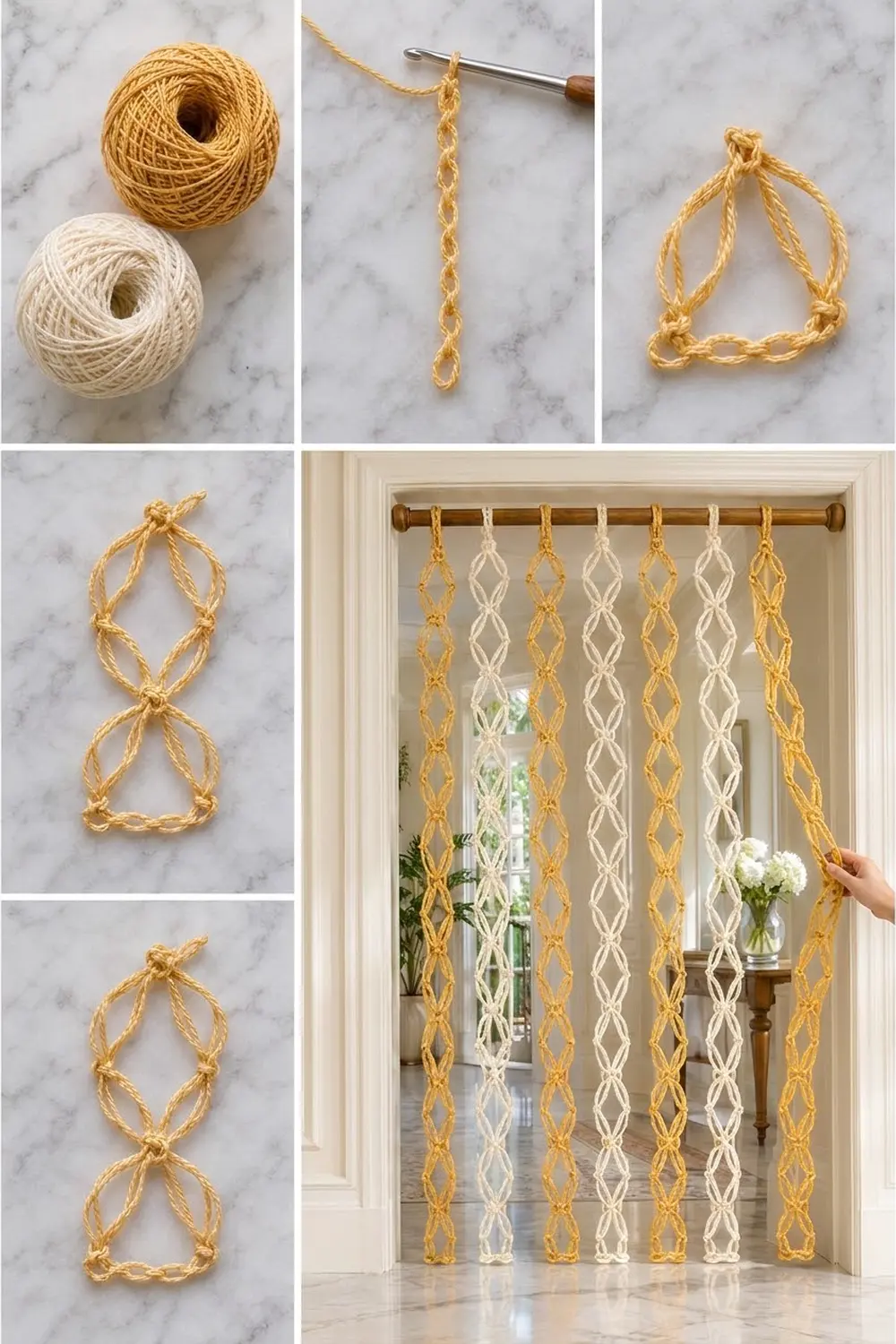
Strand Pattern (Make 7)
Round 1: Building the Lattice
Leave a 6 in (15.2 cm) tail.
Start: Ch 3, sl st in the first ch to form a ring. This ring is BL.
Up the left side:
- Ch 8, Node. This is C1.
- Ch 8, Node (side node L), ch 8, Node (center node C). Rep from * 16 times in total. The first rep makes L1 and C2. Each later rep makes the next L and C. On the 16th rep, the second Node is T instead of a center node.
Check: you now have 33 arms (1 + 16 × 2) and 34 nodes: BL, C1–C16, L1–L16, and T.
Lay the work flat. Every L node should sit on the left and every C node on the center line. Place a marker in C1 and another in C16.
Hanging loop: Ch 18, sl st in the T ring.
Down the right side:
- Ch 8, Node (side node R), ch 8, sc in the ring of the matching C node. Rep from * 16 times in total. The first rep makes R16 and joins at C16. The last rep makes R1 and joins at C1.
- Ch 8, Node. This is BR.
Check: 33 arms on the right side, 17 new nodes (R1–R16 and BR), and 16 center joins.
Before each center join, make sure the chain isn’t twisted. The right arms should mirror the left arms and form an oval.
Bottom bar: Ch 8, sl st in the BL ring.
Round 1 totals:
- 66 arms of 8 ch each (528 ch)
- 51 nodes (153 ch)
- An 18-ch hanging loop and an 8-ch bottom bar, for 707 ch in all
- 16 sc joins
At this stage each node is a small ring and each center ring has 1 sc in it. The strand looks like stacked ovals but is still loose and single-stranded.
Making All the Strands
- Mustard: 4 strands
- Cream: 3 strands
Work Round 1 and the doubling round (below) on each strand before starting the next. That way every strand is fully finished and comparable.
Layout, as seen from the room side:
| M | C | M | C | M | C | M |
  1   2   3   4   5   6   7
M = mustard, C = cream. The two outer strands are mustard.
Hanging (Joining to the Rod)
The strands are never joined to each other. The only connection is the rod, which runs through each strand’s hanging loop.
Method:
- Take the rod down from its brackets.
- Thread each strand’s doubled hanging loop onto the rod in layout order, so the loop sits around the rod and the T knot hangs just below it.
Why it works: The loop is 18 ch around, which is 6 in (15.2 cm) in circumference. Folded over the rod, it hangs about 3 in (7.6 cm) deep. That’s loose enough to slide over a rod up to 1 1/4 in (3.2 cm) thick, but snug enough to keep each strand in place.
Spacing: Leave 2 in (5.1 cm) of clear space between neighboring strands at the rod.
Size checkpoint:
- 7 strands × 3 in = 21 in (53.3 cm)
- 6 gaps × 2 in = 12 in (30.5 cm)
- Total span: 33 in (83.8 cm)
If your doorway is wider, widen the gaps evenly rather than adding chains to the strands.
Tension advice: Hang the rod level. Don’t pull the strands taut. They should drape from their own weight, with the bottom bars sitting at the same height.
Doubling Round (Round 2: Border Trace)
This round works as the strand’s outline border. It follows the exact path of Round 1, laying a second chain beside each arm and building each node into a knot.
Gauge for this round: Same as Round 1, 3 ch = 1 in (2.5 cm). Chain at the same tension so the second strand lies parallel instead of bowing away from the first.
Round 2:
Do not turn.
- Work 2 sc in the BL ring.
- Left side: Ch 8, 2 sc in the next ring. Rep from * 33 times, working into C1, L1, C2, L2, and so on through L16, ending in T.
- Lay each new 8-ch beside the matching Round 1 arm, on the same side of the work, so the two chains run side by side.
- Hanging loop: Ch 18, sl st in the T ring. This doubles the hanging loop.
- Right side: Ch 8, 2 sc in the next ring. Rep from * 33 times, working into R16, C16, R15, C15, and so on through R1 and C1, ending in BR.
- Bottom bar: Ch 8, sl st in the BL ring.
Fasten off.
Counts per side:
- Left side: 33 arms × 8 ch = 264 ch, plus 33 rings × 2 sc = 66 sc
- Right side: 33 arms × 8 ch = 264 ch, plus 33 rings × 2 sc = 66 sc
- Bottom: 8 ch, plus 2 sc in BL at the start
- Top: 18 ch
- Round 2 totals: 554 ch and 134 sc
Why the math works: Every Round 2 chain matches its Round 1 partner exactly (8 to 8, 18 to 18, 8 to 8). So both strands are the same length and lie flat together without puckering, and the strand keeps the same 3 in × 74 1/4 in (7.6 × 188.6 cm) size.
Each center node gets 2 sc on the way up and 2 sc on the way down, which adds up to 5 sc including the Round 1 join. That makes the center knots round and prominent. Side and corner nodes each get 2 sc, so they stay smaller, as they look in the finished strand.
Finishing: Weave each tail through 2 or 3 nearby sc in a node, then back through the same stitches. Trim the end close.
Final Blocking
- Hang each finished strand from a hook or door frame.
- Mist it lightly until damp, not dripping.
- Clip 2 binder clips to the bottom bar for light weight.
- Gently shape each oval with your fingers. The paired arms should lie side by side and every center knot should sit on the center line.
- Measure while it’s still damp. Width at the side nodes should be 3 in (7.6 cm), and length from bar to T should be 74 1/4 in (188.6 cm).
- Let it dry fully, about 24 hours, then remove the clips.
- Hang the strands on the rod in layout order.
Final Quality-Control Checklist
- 7 strands: 4 mustard, 3 cream, with mustard on both ends
- Each strand has 16 center knots, 16 pairs of side knots, a bottom bar, and a top knot
- Every arm is doubled, with 8 ch in each chain
- No twisted arms or crossed ovals
- All strands within 1 in (2.5 cm) of each other in length
- Hanging loops doubled and sliding freely on the rod
- Tails woven in securely
Troubleshooting
Ovals look lopsided. One side probably has an arm with the wrong count. Recount that section; every arm is 8 ch.
Strand twists when hanging. A chain was twisted before a center join. Undo back to that join and rejoin with the chain lying flat.
Second chains bow away from the first. You’re chaining Round 2 more loosely than Round 1. Tighten your tension, or go down 0.5 mm for Round 2 only.
Strands are uneven in length. Gauge drifted between strands. Block the shorter strand with slightly more weight. If the difference is more than 2 in (5.1 cm), rework it.
Hanging loop too tight for the rod. Rework both loop chains with 21 ch instead of 18. That gives a 7 in (17.8 cm) circumference.
Care
Hand wash each strand separately in cool water with a mild detergent and roll it in a towel. Dry it hanging, with light weight on the bottom bar so it keeps its length.
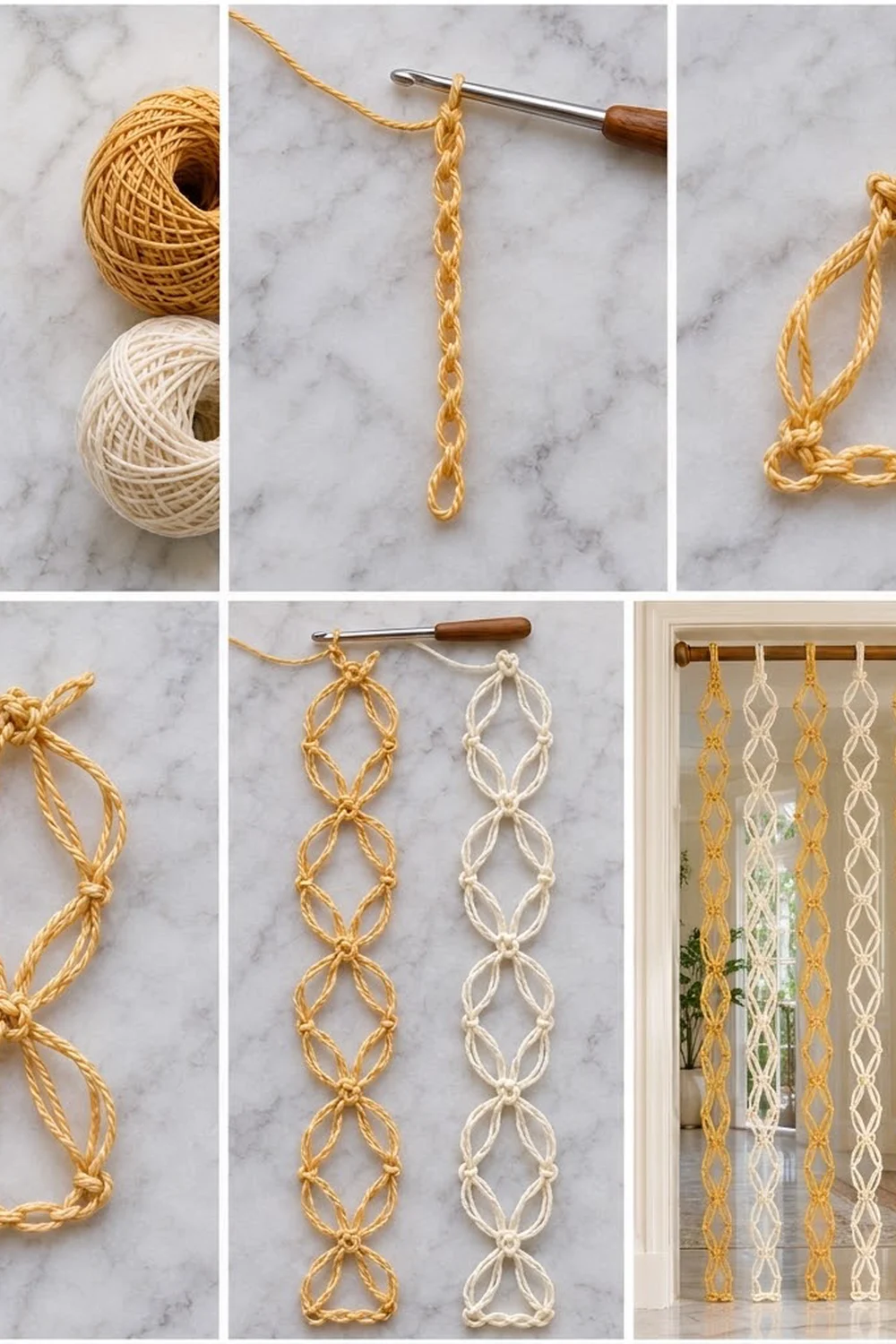
Final Notes
The measurement chain is simple:
- 3 ch = 1 in (2.5 cm).
- An 8-ch arm makes a 4 1/2 in (11.4 cm) oval repeat and a 3 in (7.6 cm) wide strand.
- 16 repeats plus the base triangle and top give a strand 74 1/4 in (188.6 cm) long.
- 7 strands with 2 in (5.1 cm) gaps span 33 in (83.8 cm).
Check your gauge on the first strand and everything else follows.
Happy crocheting!