
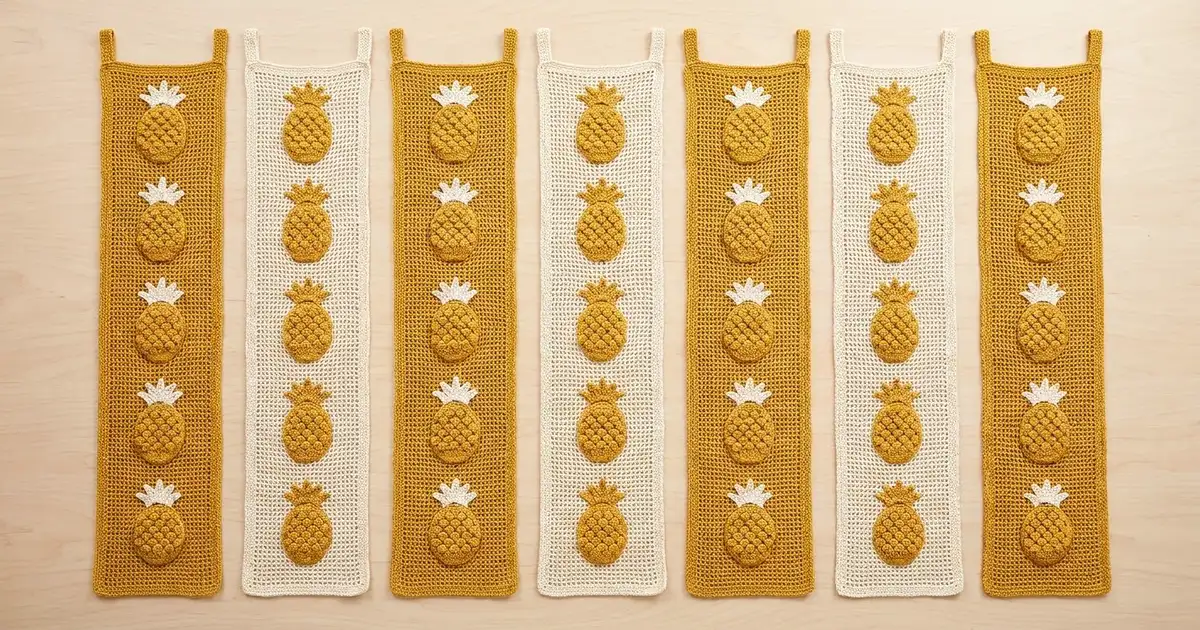
This door curtain is made of seven narrow filet mesh strips that hang side by side from a rod. Each strip has a column of six textured pineapples. The curtain looks like a bright grid of fruit but still lets light and air through.
The strips alternate mustard gold and cream. Every pineapple body is mustard, worked in staggered fan shells that look like pineapple scales. Every crown is cream with five pointed leaves. On mustard strips the body blends in and the crown stands out. On cream strips it’s the other way around.
The pattern uses US crochet terms. Each finished strip measures 6.2 in (15.7 cm) wide by 74.0 in (188.0 cm) long, plus hanging tabs. Seven strips laid edge to edge measure 43.4 in (110.2 cm) wide. That covers a standard 36 in (91.4 cm) doorway with some overlap onto the frame.
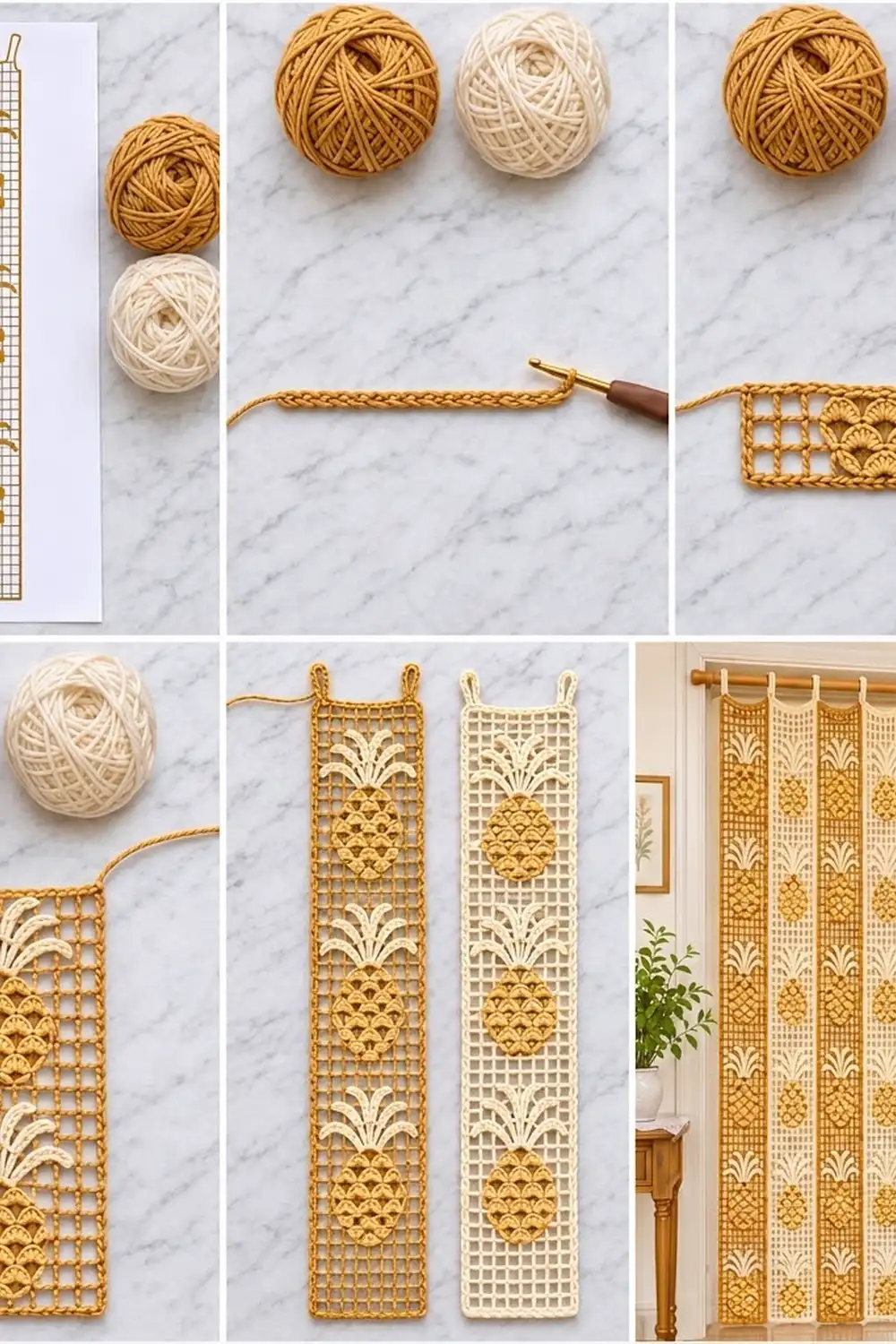
The construction is simple. Crochet each mesh strip in rows, add a two-round single crochet border, then work two tabs at the top. Make the pineapple bodies and crowns separately and sew them on. The strips are never joined to each other, so people can walk through easily.
Finished Size and Construction
- Strip size: 6.2 in (15.7 cm) x 74.0 in (188.0 cm)
- Drop from rod: about 75.7 in (192.3 cm) including tab loops
- Skill level: Intermediate
- Terminology: US
- Yarn weight: DK (light, #3) cotton
- Hook: 4.0 mm (G-6)
- Number of pieces: 7 strips, 42 pineapple bodies, 42 crowns
- Layout: 7 strips in one row, alternating colors, not joined
- Strip size before border: 5.4 in (13.7 cm) x 73.2 in (185.9 cm)
- Border depth: 0.4 in (1.0 cm) per side, 2 rounds
- Pineapple size: 3.8 in (9.7 cm) wide x 6.5 in (16.5 cm) tall
Materials
Choose a smooth mercerized or combed cotton in DK weight. Cotton keeps the mesh square, doesn’t stretch much under its own weight, and shows the shell texture clearly. Avoid acrylic for a curtain this long because it can grow several inches over time.
- Mustard: 850 g / 1955 m (17 balls of 50 g / 115 m) for 4 strips and all 42 pineapple bodies
- Cream: 550 g / 1265 m (11 balls of 50 g / 115 m) for 3 strips and all 42 crowns
Quantities include about 10% extra for swatching and weaving in ends.
Tools:
– 4.0 mm (G-6) crochet hook
– Tapestry needle
– Locking stitch markers
– Rust-proof pins and a blocking surface
– Measuring tape
– Curtain rod up to 1 in (2.5 cm) in diameter
Abbreviations (US Terms)
- ch: chain
- sl st: slip stitch
- sc: single crochet
- hdc: half double crochet
- dc: double crochet
- sk: skip
- sp: space
- st(s): stitch(es)
- RS / WS: right side / wrong side
Special stitches:
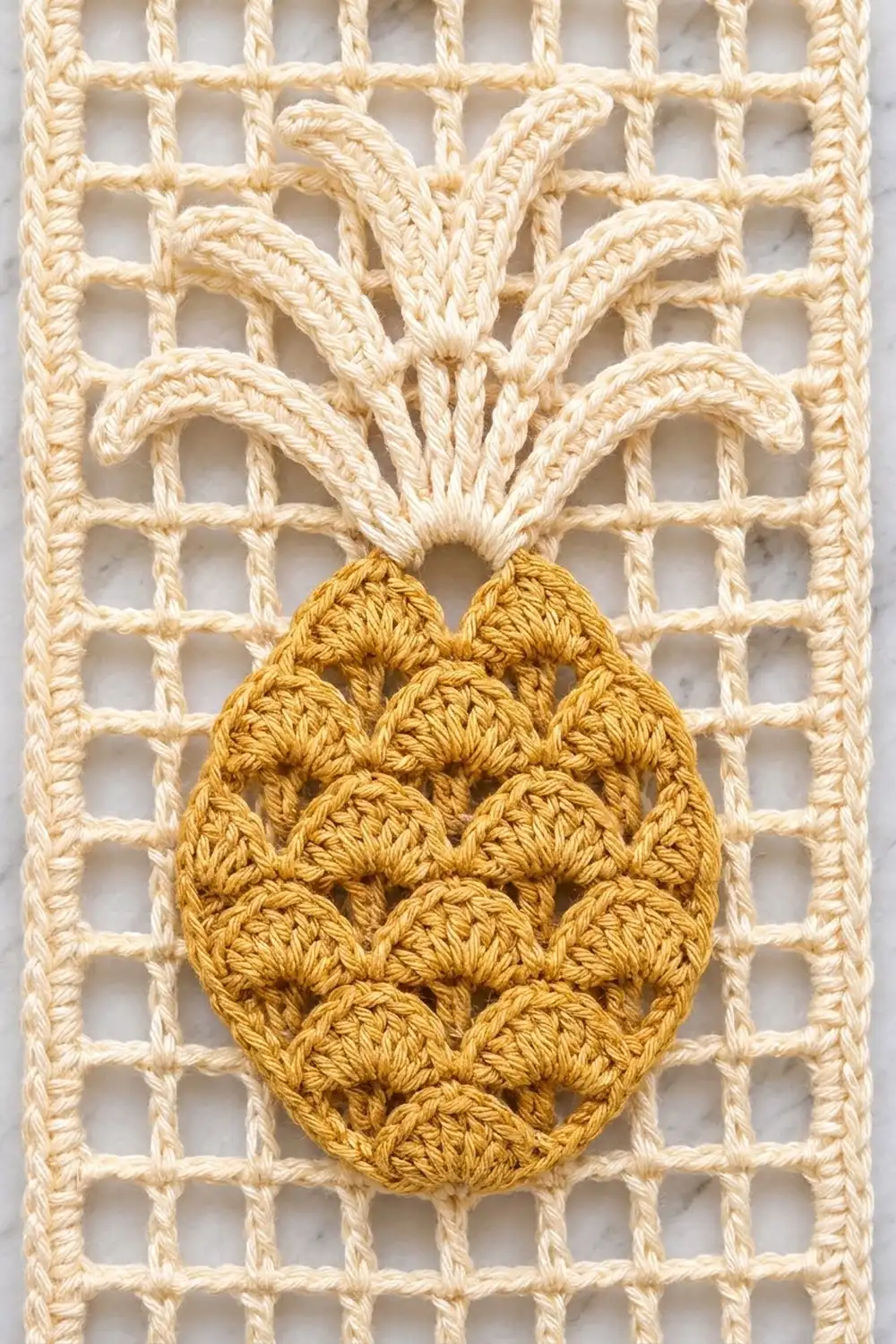
– Shell: 5 dc in the same st. The 3rd dc is the center dc.
– Mesh: ch 2, sk 2 sts (or one ch-2 sp), dc in next st.
Gauge and Checkpoints
Mesh gauge: 5 meshes and 5 rows = 3 in (7.6 cm) square. One mesh = 0.6 in (1.5 cm) each way.
Stitch gauge: 5 dc = 1 in (2.5 cm).
Test one piece first. Work Rows 1–10 of the first strip and measure before you continue.
- After Row 10: 5.4 in (13.7 cm) wide x 6.0 in (15.2 cm) tall.
- After Row 122: 5.4 in (13.7 cm) x 73.2 in (185.9 cm), measured lying flat without stretching.
- After the border: 6.2 in (15.7 cm) x 74.0 in (188.0 cm).
- One pineapple body: 3.8 in (9.7 cm) wide x 4.0 in (10.2 cm) tall.
If your swatch is too big, go down half a hook size. If it’s too small, go up half a size. If the width is right but the rows are short, pull each dc loop up a little taller instead of changing hooks. Over 122 rows, an error of only 0.05 in (0.1 cm) per row changes the length by 6.1 in (15.5 cm), so check the length every 20 rows.
Mesh Strip (make 4 in mustard, 3 in cream)
Foundation: Ch 32.
Row 1 (RS): Dc in 8th ch from hook (the skipped ch count as dc, ch 2 and 2 skipped ch), [ch 2, sk 2 ch, dc in next ch] 8 times. Turn. (9 meshes, 10 dc posts)
Row 2: Ch 5 (counts as dc and ch 2), sk first ch-2 sp, dc in next dc, [ch 2, dc in next dc] 7 times, ch 2, dc in 3rd ch of turning ch. Turn. (9 meshes, 10 dc posts)
Rows 3–122: Repeat Row 2. (9 meshes in every row)
Check that the strip measures 73.2 in (185.9 cm) before you fasten off. If you plan to start the border in the same color right away, don’t fasten off. Just ch 1 and begin Border Round 1.
Pineapple placement zones: Rows 1–2 are the bottom margin. Rows 3–122 form 6 repeats of 20 rows, each 12 in (30.5 cm) tall. Place a stitch marker at the start of Rows 3, 23, 43, 63, 83 and 103. Each marker is the bottom of one pineapple zone.
Pineapple Body (make 42 in mustard)
The body is worked flat in rows of staggered shells. The rows widen from 2 shells to 3, stay the same for a few rows, then narrow again to make an oval.
Foundation: Ch 14.
Row 1 (RS): Sc in 2nd ch from hook, [sk 2 ch, shell in next ch, sk 2 ch, sc in next ch] twice. Turn. (2 shells, 3 sc = 13 sts)
Row 2 (increase): Ch 3 (counts as dc), 4 dc in first sc, sc in center dc of next shell, shell in next sc, sc in center dc of next shell, 5 dc in last sc. Turn. (3 shells, 2 sc = 17 sts)
Row 3 (increase): Ch 3 (counts as dc), 2 dc in first dc, [sc in center dc of next shell, shell in next sc] twice, sc in center dc of last shell, 3 dc in top of turning ch. Turn. (2 shells, 2 half shells, 3 sc = 19 sts)
Row 4: Ch 1, sc in first dc, [shell in next sc, sc in center dc of next shell] twice, shell in next sc, sc in top of turning ch. Turn. (3 shells, 4 sc = 19 sts)
Row 5: Ch 3 (counts as dc), 2 dc in first sc, [sc in center dc of next shell, shell in next sc] twice, sc in center dc of last shell, 3 dc in last sc. Turn. (2 shells, 2 half shells, 3 sc = 19 sts)
Row 6: Repeat Row 4. (19 sts)
Row 7 (decrease): Sl st in first sc and next 2 dc, ch 1, sc in center dc of first shell, [shell in next sc, sc in center dc of next shell] twice. Turn, leaving the remaining sts unworked. (2 shells, 3 sc = 13 sts)
Row 8 (decrease): Sl st in first sc and next 2 dc, ch 1, sc in center dc of first shell, shell in next sc, sc in center dc of next shell. (1 shell, 2 sc = 7 sts)
Fasten off, leaving a 24 in (61.0 cm) tail for sewing.
Checkpoint: 3.8 in (9.7 cm) wide across Rows 3–6 and 4.0 in (10.2 cm) tall. The fans sit in offset rows, like pineapple scales.
Pineapple Crown (make 42 in cream)
Foundation: Ch 10.
Row 1: Sc in 2nd ch from hook and in each ch across. Do not turn. (9 sc)
Row 2 (leaves): Work back along the top of Row 1, starting from the last sc made:
– Sl st in sc 1. Short leaf: ch 8, sl st in 2nd ch from hook, sc in next 2 ch, hdc in next 2 ch, dc in next 2 ch. (7 sts)
– Sl st in sc 2 and sc 3. Medium leaf: ch 10, sl st in 2nd ch from hook, sc in next 2 ch, hdc in next 3 ch, dc in next 3 ch. (9 sts)
– Sl st in sc 4 and sc 5. Tall leaf: ch 13, sl st in 2nd ch from hook, sc in next 3 ch, hdc in next 4 ch, dc in next 4 ch. (12 sts)
– Sl st in sc 6 and sc 7. Medium leaf.
– Sl st in sc 8 and sc 9. Short leaf. Sl st in base of short leaf.
Fasten off with a 16 in (40.6 cm) tail. (5 leaves on a 9-sc base)
Checkpoint: The tall leaf measures about 3.0 in (7.6 cm). When the leaves are fanned out, the crown is about 3.5 in (8.9 cm) across the leaf tips.
Make All Pieces
- Mustard: 4 strips, 42 pineapple bodies
- Cream: 3 strips, 42 crowns
Layout (left to right, as hung):
| M | C | M | C | M | C | M |
  1   2   3   4   5   6   7
M = mustard strip, C = cream strip
Each strip: 6 pineapples stacked in one column
Joining: Appliqués and Hanging
The strips are not sewn to each other. In this pattern, joining means sewing the appliqués onto each strip. Each strip gets its own border (below), and the tabs come after that.
Sewing the crowns: Center one crown across the width of the strip. Place its base 5.3 in (13.5 cm) above a zone marker, which is just under 9 rows. Fan out the leaves: tall leaf straight up, medium leaves tilted about 30 degrees, short leaves about 60 degrees. Pin each leaf tip. Whipstitch the base, then run small stitches up the back of each leaf, catching only the dc posts of the mesh.
Sewing the bodies: Place the body so its Row 1 edge sits 3 rows (1.8 in / 4.6 cm) above the zone marker. Row 8 should then cover the crown base by 0.5 in (1.3 cm). Each side of the body sits about 0.8 in (2.0 cm) in from the mesh edge. Whipstitch around the outer edge, working into every edge st of the body and the nearest mesh post or chain. Keep your stitches snug but not tight, so the mesh stays flat under the body and doesn’t pucker.
Checkpoint: Each pineapple is 6.5 in (16.5 cm) tall. The gap from the top of one pineapple to the bottom of the next is 5.5 in (14.0 cm). The column should run straight down the center of the strip.
Border
Border gauge: 5 sc = 1 in (2.5 cm). Each round adds 0.2 in (0.5 cm).
Work the border in the same color as the strip. Each strip gets its own border because the strips are never joined. A corner group is 3 sc in one st, and its middle sc is the corner st. “Between corners” counts leave out the corner sts. “Per side” counts include both corners.
Round 1 (RS): Ch 1. Along the top: 3 sc in first dc, [2 sc in ch-2 sp, sc in next dc] 8 times, 2 sc in last ch-2 sp, 3 sc in last st. Down the side: 3 sc in each row-end for all 122 rows. Along the bottom: 3 sc in the corner st, then 2 sc in each ch-2 sp and 1 sc in the foundation ch at the base of each dc across, then 3 sc in the last corner. Up the side: 3 sc in each row-end. Sl st to first sc.
– Top and bottom: 28 sc between corners, 30 per side
– Long sides: 368 sc between corners (366 row-end sc plus 1 from each corner group), 370 per side
– Total: 4 + 28 + 28 + 368 + 368 = 796 sts
Round 2: Ch 1, sc in each sc around, working 3 sc in each corner st. Sl st to first sc.
– Top and bottom: 30 between corners, 32 per side
– Long sides: 370 between corners, 372 per side
– Total: 4 + 30 + 30 + 370 + 370 = 804 sts
Why the math works: One mesh is 0.6 in (1.5 cm) wide and holds 3 sts (2 ch plus 1 dc). You work 3 sc per mesh across the ends and 3 sc per row-end down the sides. That keeps the border close to 5 sc per inch on every edge, so it doesn’t ruffle or pull. The 3-sc corner groups add the 2 extra sts per round that each corner needs to lie flat.
Checkpoint: 6.2 in (15.7 cm) x 74.0 in (188.0 cm).
Hanging tabs: With RS facing, join yarn in the 2nd st of the top edge (the first st after the corner). Sc in the same st and next 4 sts. (5 sc) Rows 2–20: Ch 1, turn, sc in each sc. (5 sc) Fasten off with a long tail. Make a second tab over sts 27–31 of the top edge. Fold each tab to the WS and sew Row 20 behind the top mesh row, overlapping 0.6 in (1.5 cm). Each tab is 1 in (2.5 cm) wide and 4.0 in (10.2 cm) long. It forms a loop that rises 1.7 in (4.3 cm) above the strip.
Final Blocking
- Weave in all ends through the dc posts so they hide in the mesh.
- Soak each strip in cool water for 15 minutes, then press out the water in a towel. Do not wring.
- Lay the strip flat, RS up. If your surface is too short, block it in two halves.
- Pin the long edges straight at 6.2 in (15.7 cm) wide, with a pin every 6 in (15.2 cm).
- Ease the length to 74.0 in (188.0 cm). Don’t stretch it longer, because cotton relaxes when it hangs.
- Square up the meshes with your fingers and puff up the shells on each pineapple body.
- Fan the crown leaves into place and pin each tip.
- Let it dry completely before unpinning.
Final Quality-Control Checklist
- Every strip has 9 meshes across and 122 rows.
- Border Round 2 has 804 sts, with 32 sts on each short side.
- All strips measure 6.2 in (15.7 cm) x 74.0 in (188.0 cm), within 0.5 in (1.3 cm).
- Each strip has six pineapples, at the same heights on all 7 strips.
- Every body has 8 rows and every crown has 5 leaves.
- The tabs are level and the same length on every strip.
- The colors alternate M, C, M, C, M, C, M on the rod.
Troubleshooting
- Meshes look like tall rectangles: Your dc are too tall. Pull the loops up less or go down half a hook size.
- Strip twists or leans: You may be skipping the turning-chain dc at the row ends. Check that every row has 10 dc posts.
- Border ruffles: You have extra sc. Recount 3 per row-end and 28 between corners on each short edge.
- Border pulls the edge in: You have too few sc, or your tension is tight. Keep the count and loosen your grip.
- Pineapple body cups: Rows 2–3 were worked too tightly. Block it flat, or rework those rows with looser dc.
- Pineapples don’t line up across strips: Measure placement from the zone markers instead of by eye.
- Strips grow after hanging: Take them down, re-wet them, block to length and hang again. Use 100% cotton next time.
Care
Hand wash in cool water with mild soap and dry flat, reshaping the pineapples as they dry. Don’t tumble dry, because heat and the strips’ own weight can stretch them.
Final Notes
Here is the measurement chain. Each mesh is 0.6 in (1.5 cm), so 9 meshes make 5.4 in (13.7 cm) across and 122 rows make 73.2 in (185.9 cm) long. The two-round border adds 0.4 in (1.0 cm) per side, for a 6.2 in (15.7 cm) x 74.0 in (188.0 cm) strip. Six 12 in (30.5 cm) zones hold six 6.5 in (16.5 cm) pineapples, and seven strips cover 43.4 in (110.2 cm). Check your gauge, count your meshes and measure every 20 rows, and your curtain will hang straight and even.
Happy crocheting!