
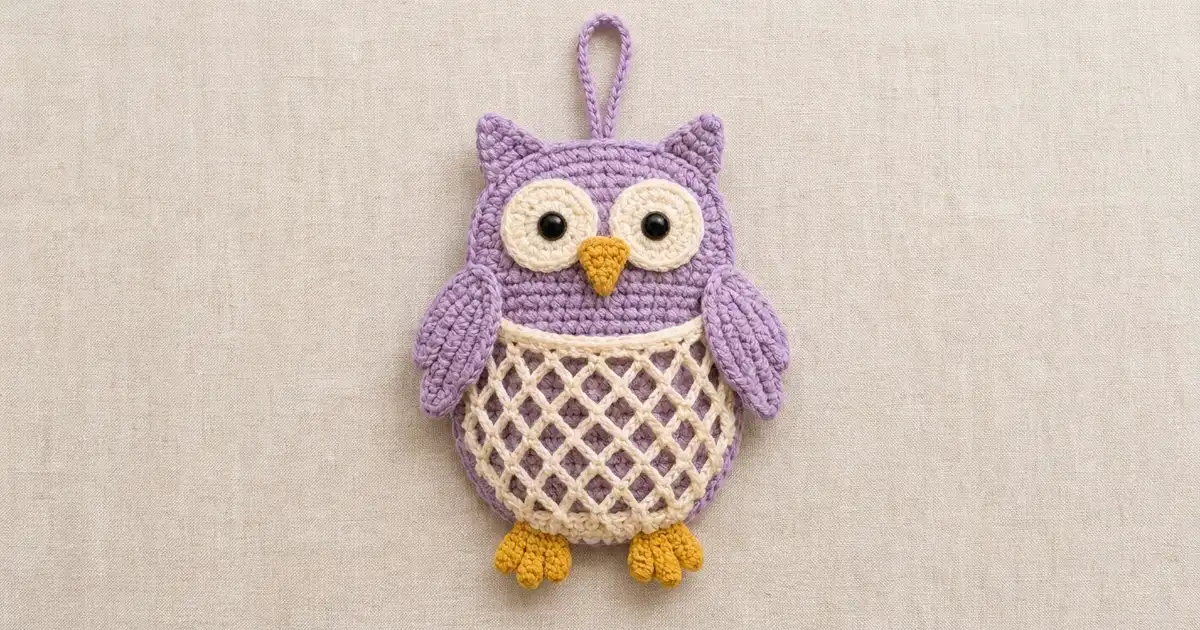
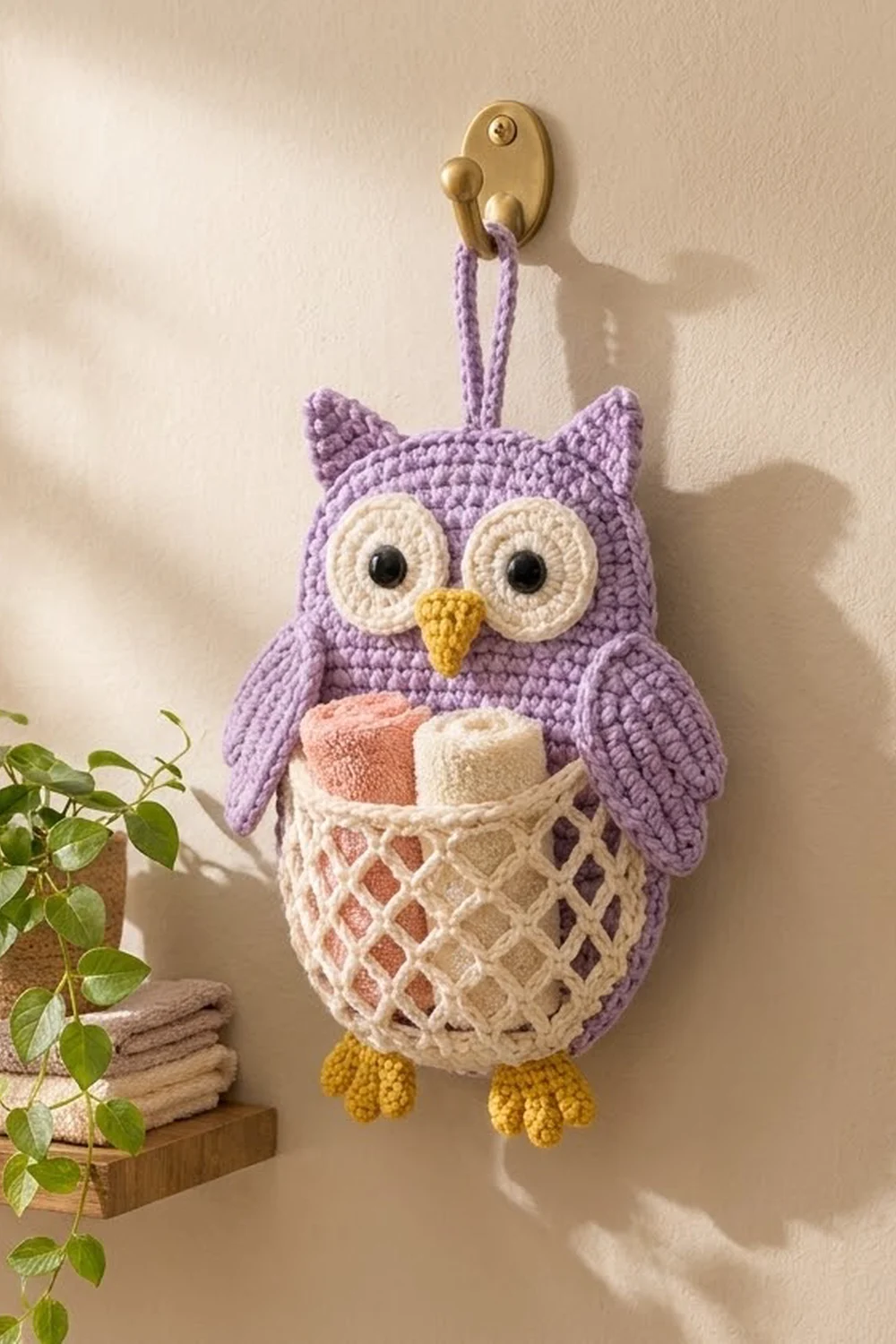
This cheerful owl hangs on a hook and holds small things like rolled washcloths, hair ties, or little treasures. It has a flat lavender body with two pointed ears, big cream eyes, and a mustard beak. An open cream mesh pocket covers the lower half of the body.
The colors are soft and calm: lavender, cream, and mustard, with black safety eyes. Leaf-shaped wings with feather tips sit over the pocket sides, and two three-toed feet peek out below the body.
This pattern uses US crochet terms. The finished owl is about 9 in (22.9 cm) wide across the wings and 9 in (22.9 cm) tall from ear tips to toes. The loop adds 2.5 in (6.4 cm), so the total hanging height is about 11.5 in (29.2 cm).
You make each part separately. The body is a single crochet circle with the ears worked onto its edge, the small parts are appliqués, and the mesh pocket is worked from the top down. Then you sew it all together and finish the body with a slip stitch edge.
Finished Size and Construction
- Finished size: 9 in (22.9 cm) wide x 9 in (22.9 cm) tall, plus a 2.5 in (6.4 cm) loop
- Skill level: Easy to intermediate
- Terminology: US terms
- Yarn weight: Worsted (#4), cotton recommended
- Hook: 4.0 mm (G-6)
- Number of pieces: 10 parts sewn into one item: body with ears, 2 eyes, beak, 2 wings, 2 feet, pocket, loop
- Layout: Appliqué parts on the front; feet and loop on the back
- Body circle size: 7 in (17.8 cm) across
- Size before border: 7 in (17.8 cm) circle; about 8 in (20.3 cm) tall including the ears
- Border depth: about 1/8 in (0.3 cm), one slip stitch round
Materials
Use a smooth worsted-weight cotton or cotton blend. Cotton keeps its shape in damp bathrooms and shows the stitch texture clearly.
- Lavender: 40 g (70 m): body, ears, wings, loop
- Cream: 25 g (45 m): eyes, pocket
- Mustard: 5 g (10 m): beak, feet
These amounts include a margin of about 15% for swatching and sewing tails.
Tools:
– 4.0 mm (G-6) hook
– Two 12 mm black safety eyes
– Tapestry needle
– 6 locking stitch markers
– Sewing pins
– Scissors
– Measuring tape
– Optional: a 7 in (17.8 cm) felt circle to cover the back
Abbreviations (US Terms)
- ch: chain
- sl st: slip stitch
- sc: single crochet
- hdc: half double crochet
- dc: double crochet
- sc2tog: single crochet 2 together
- st(s): stitch(es)
- sp: space
Special stitch: Point. Work (sc, hdc, ch 2, hdc, sc) all in the same stitch.
Gauge and Checkpoints
Gauge: 16 sc and 18 rows = 4 in (10.2 cm).
Mesh gauge: one ch-5 loop is about 1 in (2.5 cm) wide, and one mesh row is about 0.6 in (1.5 cm) tall.
Make the body first. It is your gauge test, and every other part is sized to fit it.
Body diameter checkpoints:
– After Rnd 4 (24 sts): 1.75 in (4.4 cm)
– After Rnd 8 (48 sts): 3.5 in (8.9 cm)
– After Rnd 12 (72 sts): 5.25 in (13.3 cm)
– After Rnd 16 (96 sts): 7 in (17.8 cm)
If the circle is too big, change to a 3.75 mm hook. If it is too small, change to a 4.5 mm hook. Cupping means your tension is too tight, and ruffling means it is too loose. Correct this by Rnd 8.
Body (Lavender)
Work in joined rounds. The ch 1 at the start of each round does not count as a stitch. Join each round with a sl st to the first sc.
Rnd 1: Magic ring, ch 1, 6 sc in ring, join. (6 sts)
Rnd 2: Ch 1, 2 sc in each st, join. (12 sts)
Rnd 3: Ch 1, sc 1, 2 sc in next 6 times, join. (18 sts)
Rnd 4: Ch 1, sc 2, 2 sc in next 6 times, join. (24 sts)
Rnd 5: Ch 1, sc 1, 2 sc in next, sc 3, 2 sc in next 5 times, sc 2, join. (30 sts)
Rnd 6: Ch 1, sc 4, 2 sc in next 6 times, join. (36 sts)
Rnd 7: Ch 1, sc 2, 2 sc in next, sc 5, 2 sc in next 5 times, sc 3, join. (42 sts)
Rnd 8: Ch 1, sc 6, 2 sc in next 6 times, join. (48 sts)
Rnd 9: Ch 1, sc 3, 2 sc in next, sc 7, 2 sc in next 5 times, sc 4, join. (54 sts)
Rnd 10: Ch 1, sc 8, 2 sc in next 6 times, join. (60 sts)
Rnd 11: Ch 1, sc 4, 2 sc in next, sc 9, 2 sc in next 5 times, sc 5, join. (66 sts)
Rnd 12: Ch 1, sc 10, 2 sc in next 6 times, join. (72 sts)
Rnd 13: Ch 1, sc 5, 2 sc in next, sc 11, 2 sc in next 5 times, sc 6, join. (78 sts)
Rnd 14: Ch 1, sc 12, 2 sc in next 6 times, join. (84 sts)
Rnd 15: Ch 1, sc 6, 2 sc in next, sc 13, 2 sc in next 5 times, sc 7, join. (90 sts)
Rnd 16: Ch 1, sc 14, 2 sc in next 6 times, join. (96 sts)
Fasten off. Staggering the increases keeps the circle round instead of hexagonal.
Ears (worked onto the body)
Lay the circle flat with the joining seam at the bottom. Put a marker in the top-center stitch of Rnd 16. On each side of the marker, skip 6 sts, then work an ear over the next 8 sts. This leaves 13 sts between the ears (6 + the marked st + 6).
Row 1: Join lavender in the first of the 8 sts, ch 1, sc in same st and next 7 sts, turn. (8 sts)
Row 2: Ch 1, sc2tog, sc 4, sc2tog, turn. (6 sts)
Row 3: Ch 1, sc 6, turn. (6 sts)
Row 4: Ch 1, sc2tog, sc 2, sc2tog, turn. (4 sts)
Row 5: Ch 1, sc 4, turn. (4 sts)
Row 6: Ch 1, sc2tog twice, turn. (2 sts)
Row 7: Ch 1, sc2tog. (1 st)
Fasten off, then repeat for the second ear. Each ear is about 1.8 in (4.6 cm) wide at the base and 1.6 in (4.1 cm) tall, with 7 row-ends on each side.
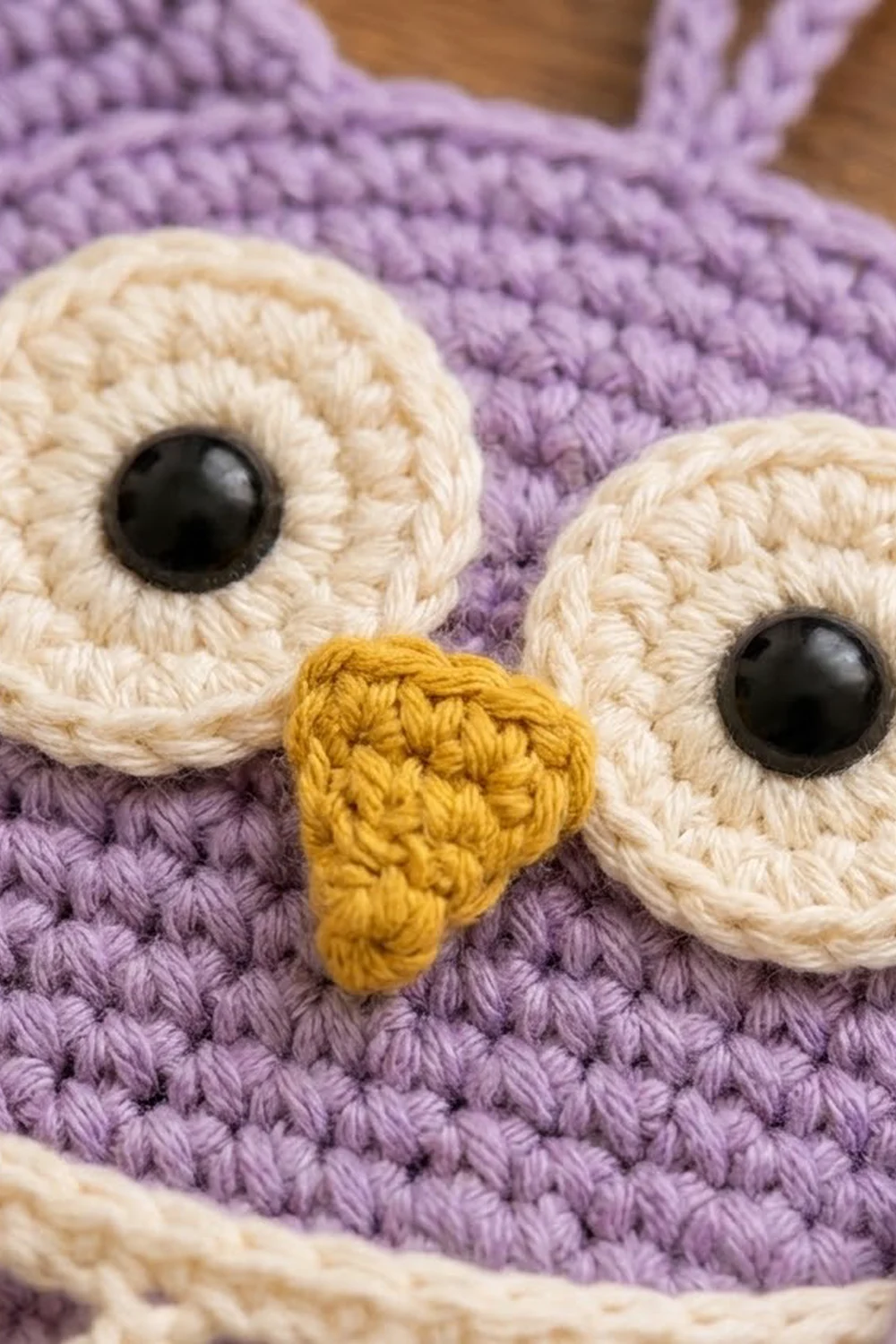
Eyes (Cream, make 2)
Work Rnds 1–4 exactly as for the body. (24 sts)
Fasten off and leave a long tail. Each eye should measure 1.75 in (4.4 cm). Push a safety eye post through the center, between Rnds 1 and 2. Don’t attach the washer yet.
Beak (Mustard)
Row 1: Ch 5, sc in 2nd ch from hook and next 3 ch, turn. (4 sts)
Row 2: Ch 1, sc2tog twice, turn. (2 sts)
Row 3: Ch 1, sc2tog. (1 st)
Fasten off and leave a long tail. The finished triangle is 1 in (2.5 cm) wide and 0.75 in (1.9 cm) tall.
Wings (Lavender, make 2)
Rnd 1: Ch 10. Sc in 2nd ch from hook, hdc in next 2 ch, dc in next 5 ch, 5 dc in last ch. Turn the chain and work along its other side: dc in next 5 ch, hdc in next 2 ch, 2 sc in the same ch as the first sc. Join. (22 sts: 8 on the first side, 5 at the tip, 7 on the second side, 2 at the top)
Rnd 2: Ch 1, sc in first 8 sts. Then work across the 5 tip sts: Point in next st, sl st in next st, Point in next st, sl st in next st, Point in next st. Sc in next 9 sts, join. (17 sc, 2 sl sts, 3 Points)
Fasten off and leave a long tail. For the feather lines, work two lines of surface sl st from the narrow top end down to the two sl sts between the Points. Each wing is 3.25 in (8.3 cm) long and 1.75 in (4.4 cm) wide.
Feet (Mustard, make 2)
Row 1: Ch 5, sc in 2nd ch from hook and next 3 ch, turn. (4 sts)
Row 2: Ch 1, sc 4, turn. (4 sts)
Row 3 (toes): Sl st in first st, ch 4, sc in 2nd ch from hook, hdc in next 2 ch, sl st in next st of Row 2 3 times. (3 toes, 4 sl sts)
Fasten off and leave a long tail. Each foot is 1 in (2.5 cm) wide and 1.25 in (3.2 cm) long.
Mesh Pocket (Cream)
Work the pocket from the top down. Each mesh row is half a loop narrower on each side than the row before, which shapes the U.
Row 1: Ch 26, sc in 2nd ch from hook and each ch across, turn. (25 sts)
Row 2: Ch 1, sc 25, turn. (25 sts)
Row 3: Ch 1, sc in first st, ch 5, skip 3 sts, sc in next st 6 times, turn. (6 loops; 1 + 6 x 4 = 25 sts used)
Row 4: Ch 5, sc in first loop, ch 5, sc in next loop 5 times, ch 5, sc in the end sc of Row 3 at the far edge, turn. (7 loops)
Row 5: Sl st in first 3 ch of first loop, ch 1, sc in same loop, ch 5, sc in next loop 6 times, turn. (6 loops)
Row 6: Sl st in first 3 ch, ch 1, sc in same loop, ch 5, sc in next loop 5 times, turn. (5 loops)
Row 7: Sl st in first 3 ch, ch 1, sc in same loop, ch 5, sc in next loop 4 times, turn. (4 loops)
Row 8: Sl st in first 3 ch, ch 1, sc in same loop, ch 5, sc in next loop 3 times. (3 loops)
Edging: Turn. Work across the bottom, then up the side. Fasten off, rejoin at the opposite top corner, and work down the other side in the reverse order.
– Bottom (across Row 8): 4 sc in first loop, sc in next sc, 4 sc in next loop, sc in next sc, 4 sc in last loop. (14 sc)
– Each side: 3 sc in each outer edge space of Rows 7, 6, 5, and 4 (12 sc), 1 sc in the end sc of Row 3, then 1 sc in each row-end of Rows 2 and 1. (15 sc)
The edging totals 15 + 14 + 15 = 44 sc. Leave the top band unedged. The finished pocket is 6.25 in (15.9 cm) wide at the top and 4.25 in (10.8 cm) tall.
Hanging Loop (Lavender)
Row 1: Ch 29, sc in 2nd ch from hook and each ch across. (28 sts)
Fasten off and leave a long tail. The strip is 7 in (17.8 cm) long.
Make All Pieces
- Lavender: 1 body with 2 ears, 2 wings, 1 loop
- Cream: 2 eyes, 1 pocket
- Mustard: 1 beak, 2 feet
Front layout map:
      [ear]   top center   [ear]
     [ eye ]  (13 sts)  [ eye ]
              [beak]
 [wing] [====== pocket band ======] [wing]
 [wing] [ \/\/\/ mesh pocket \/\/ ] [wing]
         [  \/\/\/\/\/\/\/\/\/  ]
            (foot)      (foot)
Assembly (Joining)
Sew with whipstitch. Go through the outer loops of each part and only the front layer of the body. Keep the stitches snug but not tight, because pulling too hard puckers the body.
- Eyes: Center each eye 1.5 in (3.8 cm) below the top edge of the circle and 0.9 in (2.3 cm) from the vertical center line, so the eyes almost touch. Push the posts through the body and lock the washers on the back. Whipstitch around Rnd 4 of each eye.
- Beak: Place it point-down, with its wide edge overlapping the inner edges of both eyes. Sew it all the way around.
- Pocket: Center the top band 2.5 in (6.4 cm) below the top edge. The body is about 6.7 in (17.0 cm) wide at that height, so the 6.25 in (15.9 cm) band sits just inside the edge. The bottom of the pocket ends 0.25 in (0.6 cm) above the body edge (2.5 + 4.25 = 6.75 of 7 in). Sew through every edging sc, and leave the top open.
- Wings: Place the narrow end of each wing at a top corner of the pocket, angled outward so the Points extend past the body edge. Sew only the upper 1.5 in (3.8 cm) of the inner edge.
- Feet: On the back, place each foot 0.75 in (1.9 cm) from the center line, with the toes extending 1 in (2.5 cm) below the edge. Sew Row 1 to the body.
- Loop: Fold the strip in half. Sew 1 in (2.5 cm) of each end to the back at top center, leaving 2.5 in (6.4 cm) of loop above the body.
Size checkpoint: The owl should measure 9 in (22.9 cm) across the wings and 9 in (22.9 cm) from ear tips to toes.
Border (Lavender Slip Stitch Edge)
Border gauge: 1 sl st per body stitch and 1 sl st per ear row-end.
Rnd 17: Join lavender at the bottom-center seam. Work through the body only, then join with a sl st to the first sl st.
– Body: 1 sl st in each Rnd 16 st that is not under an ear. (96 − 16 = 80 sl sts)
– Each ear: 7 sl sts up the side, (sl st, ch 1, sl st) in the tip, 7 sl sts down the other side. (16 sl sts + 1 ch-1 sp)
Total: 80 + 16 + 16 = 112 sl sts and 2 ch-1 sps.
Why the math works: Rnd 16 already has the right stitch count for a flat 7 in (17.8 cm) circle. Slip stitches add almost no height, so 1 per stitch needs no increases. An sc row is about as tall as an sc stitch is wide, so 1 sl st per ear row-end also lies flat. The ch-1 at each tip keeps the ear points sharp.
Final Blocking
- Mist the owl until it is damp but not soaked.
- Lay it face up on a blocking mat.
- Pin the body to a 7 in (17.8 cm) circle and pin the ears to sharp points.
- Gently open the pocket diamonds and pin the bottom curve.
- Pin the wing Points and toes outward.
- Let it dry completely, at least 12 hours.
Final Quality-Control Checklist
- The body measures 7 in (17.8 cm) across and lies flat.
- The ears match, with 13 sts between them.
- The eyes are level, and the washers are locked.
- The beak is centered and points straight down.
- The pocket edging has 44 sc, and the top is open.
- The wings mirror each other and are sewn only at the top.
- The border has 112 sl sts and 2 ch-1 sps.
- All tails are woven in on the back.
Troubleshooting
- The body cups: Your tension is too tight. Go up a hook size.
- The body ruffles: Your tension is too loose, or there are extra increases. Recount the rounds.
- The ears lean inward: Check that each ear starts exactly 6 sts from the center marker.
- The pocket is too narrow: Recount the 25-st band and the 3 skipped sts in each Row 3 loop.
- The mesh twists: Work each sc into the loop space, not into a chain.
- The border puckers: Your slip stitches are too tight. Loosen your tension.
Care
Hand wash in cool water, press the water out in a towel, and dry flat. Don’t wring it, because that stretches the mesh.
Final Notes
The measurements build on each other. A gauge of 16 sc = 4 in (10.2 cm) gives a 7 in (17.8 cm) body after Rnd 16. The 25-st pocket band is 6.25 in (15.9 cm) wide, so it fits 2.5 in (6.4 cm) below the top. The 4.25 in (10.8 cm) pocket then ends 0.25 in (0.6 cm) above the bottom edge. The wings and feet bring the owl to 9 in (22.9 cm) by 9 in (22.9 cm), and the loop adds 2.5 in (6.4 cm). Check each measurement as you go.
Happy crocheting!