

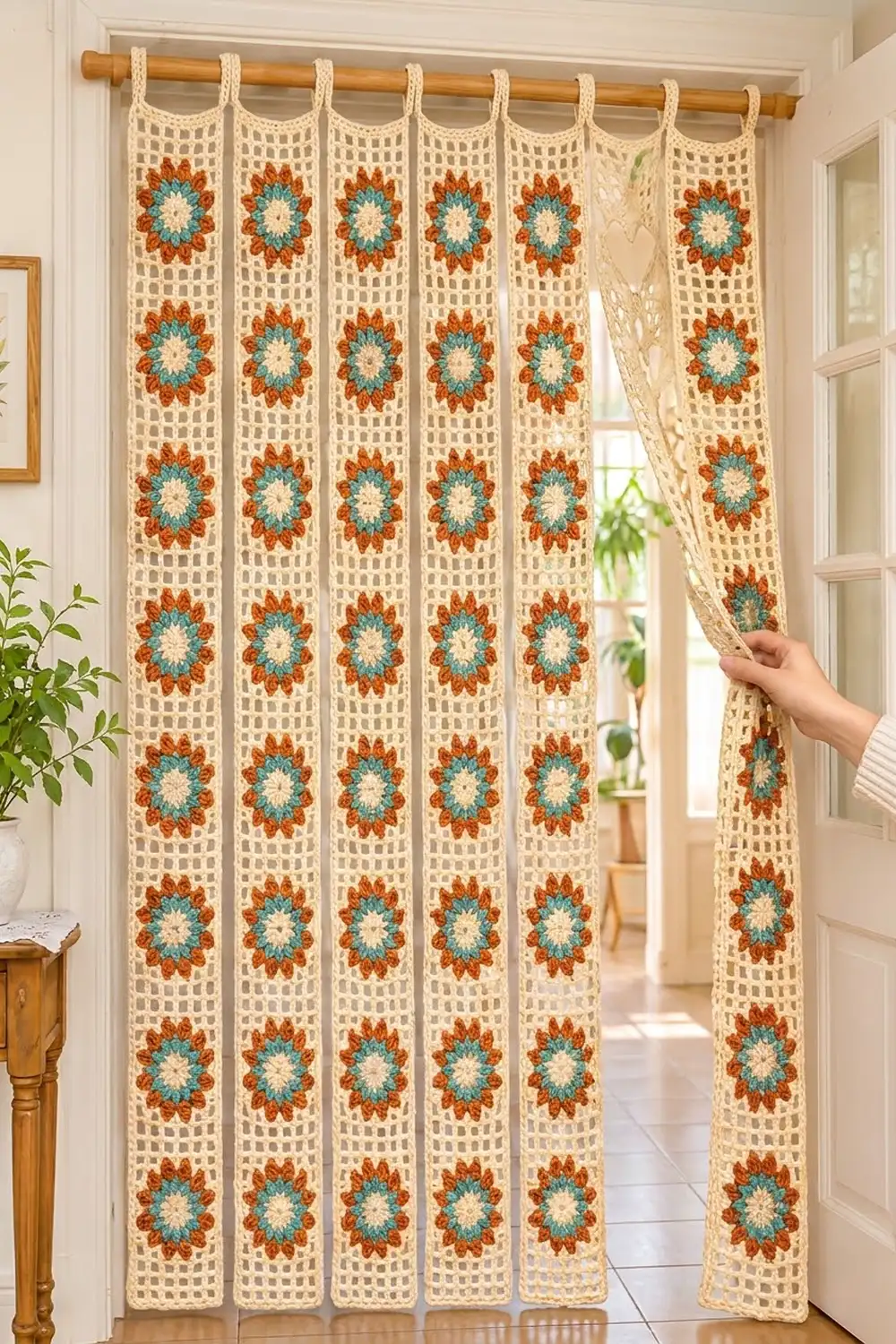
The Sunburst Bloom Door Curtain is a set of long, airy filet mesh strips, each decorated with a column of bright flower medallions. Hung side by side from a rod, the strips let light and air through while giving a doorway a warm, handmade boho look. Each strip moves on its own, so you can walk through or tie one aside.
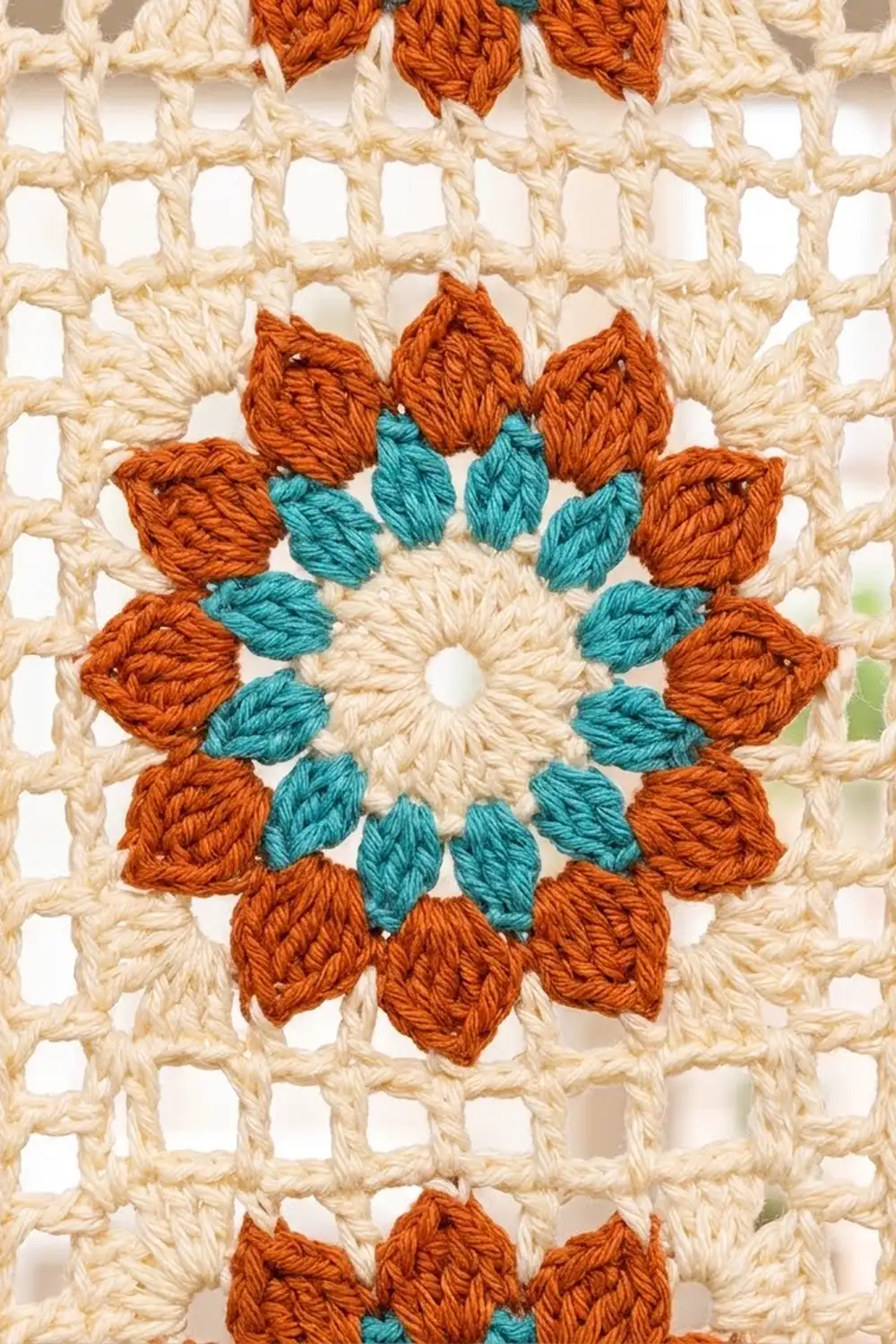
The palette is cream, teal, and rust-orange. The mesh, borders, tabs, and flower centers are cream. Each flower has a ring of small teal petals and an outer ring of twelve pointed rust petals tucked between them. The result reads like a row of little suns.
This pattern uses US crochet terms. Each finished strip measures 6.5 in (16.5 cm) wide and 75.5 in (191.8 cm) long, plus tabs that add about 3 in (7.6 cm) above the rod. Six strips hung edge to edge cover 39 in (99.1 cm).
Construction is simple and repetitive. You work each strip as a 10-square-wide filet mesh rectangle, add a single-crochet border, and work two tabs on the top edge. The flowers are made separately in the round and sewn on, eight per strip.
Finished Size and Construction
- Finished size (one strip): 6.5 in x 75.5 in (16.5 cm x 191.8 cm), plus 3 in (7.6 cm) tab loops
- Total hanging length: about 78.5 in (199.4 cm)
- Full curtain width: 39 in (99.1 cm) with strips touching
- Skill level: Intermediate
- Terminology: US
- Yarn weight: Worsted (#4), cotton or cotton blend
- Hook: 5 mm (H-8)
- Number of pieces: 54 (6 mesh strips + 48 flowers)
- Layout: 6 strips hung side by side, 8 flowers per strip in one vertical column
- Piece sizes: mesh strip 6 in x 75 in (15.2 cm x 190.5 cm) before border; flower 5 in (12.7 cm) across
- Border depth: 0.25 in (0.6 cm) per side
Materials
Choose a smooth worsted cotton or cotton blend. Cotton holds the square mesh shape, resists stretching under its own weight, and shows the petal points clearly. Avoid fuzzy or very stretchy acrylics, which make long strips grow.
Yarn amounts are based on a worsted cotton of about 190 m per 100 g:
- Cream (Color A): 1,100 g, about 2,090 m – mesh, borders, tabs, flower centers
- Teal (Color B): 150 g, about 285 m – inner petals
- Rust (Color C): 400 g, about 760 m – outer petals and sewing
Quantities include a margin of roughly 10% for gauge swatches, tails, and small differences in tension.
Tools:
- 5 mm (H-8) crochet hook
- Tapestry needle
- Locking stitch markers (at least 10)
- Measuring tape
- Rust-proof pins and a large blocking surface (towels on a floor or bed work well)
- Spray bottle
- Curtain rod up to 1.25 in (3.2 cm) in diameter
Abbreviations (US Terms)
- ch – chain
- sl st – slip stitch
- sc – single crochet
- hdc – half double crochet
- dc – double crochet
- tr – treble crochet
- sp(s) – space(s)
- sk – skip
- st(s) – stitch(es)
- RS / WS – right side / wrong side
Mesh square: one dc post plus the ch-2 space beside it. Each row has 10 squares built from 11 dc posts (the beginning ch-5 counts as the first post plus its ch-2).
Pointed petal: (sc, hdc, dc, tr, ch 2, tr, dc, hdc, sc) worked into one ch-4 space. The ch-2 forms the tip.
Gauge and Checkpoints
Mesh gauge: 5 squares and 5 rows = 3 in (7.6 cm). One square is 0.6 in (1.5 cm) wide and one row is 0.6 in (1.5 cm) tall.
Border and tab gauge: 14 sc = 4 in (10.2 cm), about 3.5 sc per inch; about 4 sc rows per inch.
Flower gauge: finished flower measures 5 in (12.7 cm) from petal tip to petal tip.
Test one piece of each type first. Make one flower and the first 10 rows of one strip, then measure:
- Flower Round 1: 1.5 in (3.8 cm)
- Flower Round 2: 2.5 in (6.4 cm)
- Flower Round 3: 3.5 in (8.9 cm)
- Flower Round 5: 5 in (12.7 cm)
- Strip after 10 rows: 6 in wide x 6 in long (15.2 cm x 15.2 cm)
If your pieces are too big, go down 0.5 mm. If they are too small, go up 0.5 mm. The flower must stay at least 1 in (2.5 cm) narrower than the 6 in (15.2 cm) mesh, so match the flower checkpoint even if it means using a different hook for flowers than for mesh.
Mesh Strip (Make 6)
With Color A, ch 35.
Row 1 (RS): Dc in 8th ch from hook, *ch 2, sk 2 ch, dc in next ch; repeat from * 8 more times. Turn. (11 dc posts, 10 ch-2 sps = 10 squares)
The 7 skipped chains at the start make up the 2 skipped base chains, the first dc post, and the first ch-2 space.
Row 2: Ch 5 (counts as dc + ch 2), dc in next dc, *ch 2, dc in next dc; repeat from * across. Work the last dc into the 5th of the 7 skipped chains, counting from the first dc of Row 1. Turn. (11 dc posts, 10 ch-2 sps)
Rows 3–125: Ch 5 (counts as dc + ch 2), dc in next dc, *ch 2, dc in next dc; repeat from * across, working the last dc in the 3rd ch of the turning ch-5. Turn. (11 dc posts and 10 ch-2 sps in every row)
Place a marker every 25 rows (Rows 25, 50, 75, 100) to make counting easier.
Checkpoint: after Row 125, the strip measures 6 in x 75 in (15.2 cm x 190.5 cm). Do not fasten off. Work the Border and Tabs below now, then come back to Joining to sew on the flowers.
Flower Appliqué (Make 48)
Round 1 (Color A): Make a magic ring. Ch 3 (counts as dc), 11 dc in ring. Join with sl st to top of ch-3. (12 dc)
Round 2 (Color A): Ch 3, dc in same st, 2 dc in each st around. Join. Fasten off. (24 dc)
Round 3 (Color B): Join teal in any st. Ch 1, *sc in next st, (hdc, dc, hdc) in next st; repeat from * 11 more times. Join to first sc. Fasten off. (12 sc + 36 petal sts = 48 sts, 12 small teal petals)
Round 4 (Color C): Join rust with sc in the center dc of any teal petal, ch 4, *sc in center dc of next teal petal, ch 4; repeat from * 10 more times. Join to first sc. (12 sc + 12 ch-4 sps)
Each ch-4 loop arches over one teal sc, so the rust petals land between the teal petals.
Round 5 (Color C): Sl st into first ch-4 sp, then work a pointed petal in each ch-4 sp around. Join to first sc. Fasten off, leaving a 36 in (91.4 cm) tail for sewing. (12 pointed petals, each 8 sts + 1 ch-2 tip)
Block the flowers flat to 5 in (12.7 cm) before sewing. That is much easier than blocking them once they’re on the strip.
Make All Pieces
- Color A: 6 mesh strips; Rounds 1–2 of all 48 flowers
- Color B: Round 3 of all 48 flowers
- Color C: Rounds 4–5 of all 48 flowers
Layout grid (S = strip, F = flower; read top to bottom as hung):
 S1   S2   S3   S4   S5   S6
 F    F    F    F    F    F     row 115
 F    F    F    F    F    F     row 100
 F    F    F    F    F    F     row 85
 F    F    F    F    F    F     row 70
 F    F    F    F    F    F     row 55
 F    F    F    F    F    F     row 40
 F    F    F    F    F    F     row 25
 F    F    F    F    F    F     row 10
Joining
The strips are not joined to each other. The only joining step is sewing the flowers onto the strips. Each strip then hangs from its own tabs.
Placement logic: flower centers sit 15 rows apart, which is 9 in (22.9 cm). Count rows from the bottom (Row 1). Centers fall on Rows 10, 25, 40, 55, 70, 85, 100, and 115. That leaves 10 rows below the first center and 10 rows above the last, so the column is centered from top to bottom.
Horizontally, center each flower over the 6th (middle) dc post of its row. This leaves 0.5 in (1.3 cm) of mesh showing on each side of the flower inside the border, and about 4 in (10.2 cm) of open mesh between flowers.
Method:
- Lay the strip flat, RS up, and mark the 8 center posts.
- Pin each flower in place, matching its magic ring to a marked post.
- With the rust tail, whipstitch the base of each rust petal (the sc–hdc portion) to the mesh behind it. Leave the petal tips free.
- Run the needle under the back of the flower between petals. Never carry yarn across open mesh, where it would show.
- Tack the cream center to the mesh post with 2–3 small stitches in cream.
Tension: sew loosely enough that the mesh under the flower stays square. If the squares pull together, the strip will narrow and pucker at each flower.
Checkpoint: after sewing, the bordered strip should still lie flat at 6.5 in (16.5 cm) wide, measured across a flower row.
Border
Border gauge: 3.5 sc per inch, so 6 in (15.2 cm) needs about 21 sc and 75 in (190.5 cm) needs about 262 sc.
Round 1 (Color A, RS): Ch 1, do not turn. Work along the top edge (Row 125):
- Top: 3 sc in first dc post (corner), 2 sc in each of the 10 ch-2 sps, 3 sc in last dc post (corner).
- Long side: 2 sc in each of the 125 row ends down to the bottom corner.
- Bottom: working into the foundation chain, 3 sc in corner, 2 sc in each of the 10 ch-2 sps, 3 sc in last corner.
- Long side: 2 sc in each of the 125 row ends back to the start.
Join with sl st to first sc. Fasten off.
Counts per side, including both corner stitches (the corner stitch is the middle sc of each 3-sc group):
- Each short side: 1 + 20 + 1 between corners, + 2 corners = 24 sc
- Each long side: 1 + 250 + 1 between corners, + 2 corners = 254 sc
- Round total: 4 corners + (22 x 2) + (252 x 2) = 552 sc
Why the math works: the short side carries 22 sc over 6 in (15.2 cm), about 3.7 per inch. The long side carries 252 sc over 75 in (190.5 cm), about 3.4 per inch. Both are within 5% of the 3.5-per-inch border gauge, so the edges lie flat. The slight undercount on the long sides keeps them from rippling under the strip’s weight.
Checkpoint: the strip measures 6.5 in x 75.5 in (16.5 cm x 191.8 cm).
Tabs (2 per strip)
With RS facing, join Color A in the corner sc at the right end of the top edge. The top edge has 24 sc, including corners.
Tab Row 1: Ch 1, sc in the corner sc and next 5 sc. Turn. (6 sc)
Tab Rows 2–24: Ch 1, sc in each sc across. Turn. (6 sc)
Fasten off, leaving a 12 in (30.5 cm) tail. The tab is 1.7 in (4.3 cm) wide and 6 in (15.2 cm) long.
Skip the next 12 sc. Join Color A in the 19th sc of the top edge and repeat Tab Rows 1–24 over sts 19–24. The last of these stitches is the left corner.
Fold each tab to the WS and whipstitch its last row along the base of the tab. This forms a 3 in (7.6 cm) loop.
Final Blocking
- Weave in all ends along mesh posts or behind flowers.
- Lay one strip flat on towels, RS up.
- Pin the long edges straight at 6.5 in (16.5 cm) wide, every 4 in (10.2 cm).
- Pin the ends square at 75.5 in (191.8 cm).
- Nudge any crooked mesh squares back to 90 degrees with your fingers.
- Spray until damp, not soaked. Press each flower flat and open the petal tips.
- Let it dry fully before unpinning. Repeat for all six strips.
Final Quality-Control Checklist
- Every row has 11 dc posts and 10 ch-2 sps.
- Each strip has 125 rows and measures 6 in x 75 in (15.2 cm x 190.5 cm) before the border.
- Border Round 1 has 552 sc: 24 per short side and 254 per long side, including corners.
- Bordered strip measures 6.5 in x 75.5 in (16.5 cm x 191.8 cm).
- All 48 flowers measure 5 in (12.7 cm) and have 12 teal and 12 rust petals.
- Flower centers sit on Rows 10, 25, 40, 55, 70, 85, 100, and 115, over the middle post.
- All 12 tabs are 6 sc wide and form 3 in (7.6 cm) loops.
- All six strips hang at the same length.
Troubleshooting
Strip is getting narrower. You may be skipping the last dc into the turning chain. Count 11 posts in each row.
Strip leans or twists. Your ch-2 spaces are tighter than your dc. Loosen the chains slightly, or go up 0.5 mm for the chains only.
Flower cups. The Round 4 chains are too short. Work ch 5 instead of ch 4 and keep Round 5 the same.
Flower ruffles. The Round 4 chains are too long or loose. Tighten them, or work ch 3.
Long border ripples. Work 2 sc in every row end except every 10th, which gets 1 sc. Recount the side.
Strips hang at different lengths. Cotton relaxes when hung. Hang all strips for 48 hours, then re-block any that grew.
Care
Hand wash in cool water with mild detergent, roll in a towel, and dry flat. Re-block if the strips lengthen over time.
Final Notes
The measurement chain is simple. 5 squares make 3 in (7.6 cm), so 10 squares make a 6 in (15.2 cm) strip and 125 rows make 75 in (190.5 cm). The 0.25 in (0.6 cm) border brings each strip to 6.5 in x 75.5 in (16.5 cm x 191.8 cm), and the tabs bring the hanging length to about 78.5 in (199.4 cm). Flower centers sit 9 in (22.9 cm) apart, each flower is 5 in (12.7 cm) across, and six strips span 39 in (99.1 cm). Check each link in that chain and the curtain will hang straight and even.
Happy crocheting!