
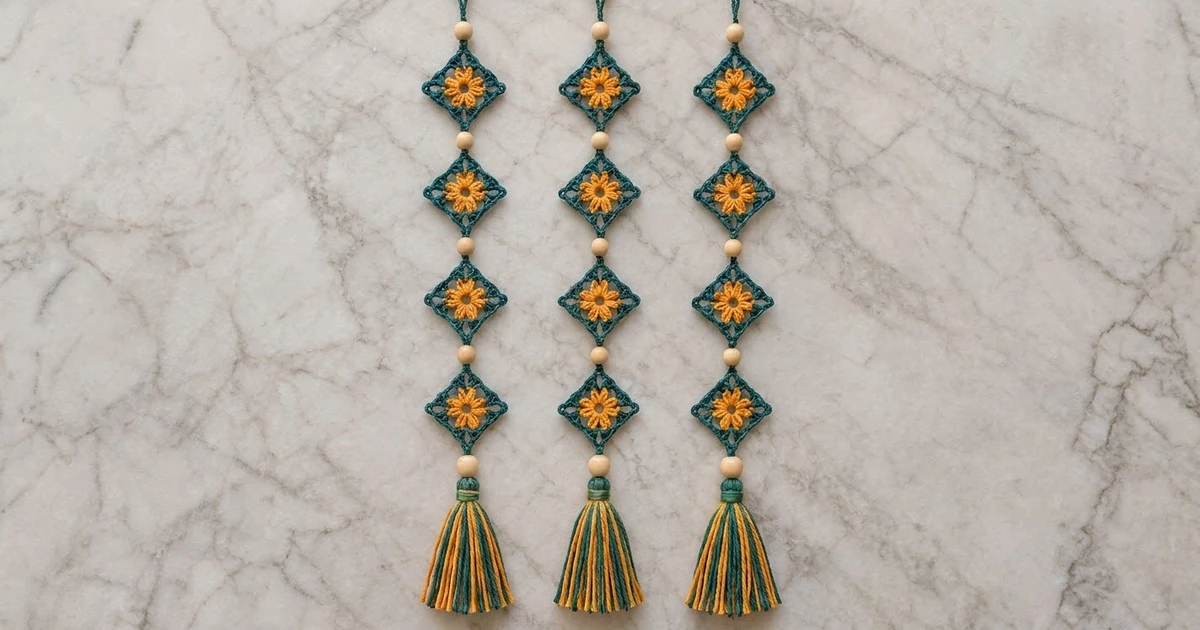
This beaded strand is built from small diamond motifs. Each one has a bright marigold flower in the center and a teal frame. Wooden beads link the diamonds into a column, and a two-color tassel weights the bottom so the strand hangs straight.
The colors are warm golden orange and deep teal, with natural wood accents. The look is boho and a little vintage. It works as a wall hanging, a window or doorway accent, or one strand of a beaded curtain.
This pattern uses US crochet terms. One finished strand is about 36 in (91.4 cm) long, including the hanging loop and tassel. Each motif is about 3.5 in (8.9 cm) per side and about 5 in (12.7 cm) from point to point.
Construction is simple. You work a two-round flower in orange, then a teal round that squares it off, then a teal single-crochet border with corner points and hanging loops. Finally, you connect four motifs with beads and yarn cords and add a tassel.
Finished Size and Construction
- Finished strand length: 36 in (91.4 cm)
- Skill level: Easy to intermediate
- Terminology: US crochet terms
- Yarn weight: Worsted (#4)
- Hook: 5 mm (H-8)
- Number of pieces: 4 motifs, 5 beads, 1 tassel
- Layout: One vertical column, with motifs set on point (diamond orientation)
- Motif size: 3.5 in (8.9 cm) per side; about 5 in (12.7 cm) point to point
- Size before border (after Round 3): 3 in (7.6 cm) per side
- Border depth: 0.25 in (0.6 cm)
- Top and bottom loops: 0.75 in (1.9 cm) long each
Materials
Yarn advice: Use a smooth worsted-weight cotton or cotton blend. Cotton keeps the petals crisp and the diamonds flat, and it holds up to light and handling. Avoid fuzzy yarns, which blur the cluster petals.
- Color A, Marigold Orange: 20 g / 35 m (flower centers and tassel)
- Color B, Deep Teal: 30 g / 55 m (frames, borders, cords and tassel)
Tools:
- 5 mm (H-8) crochet hook
- 5 wooden beads, 0.8 in (2.0 cm) wide, with holes at least 0.2 in (0.5 cm) across
- Large-eye blunt tapestry needle (it must pass through the bead holes)
- Scissors
- Stitch marker
- Piece of cardboard 4.5 in (11.4 cm) wide, for the tassel
- Rust-proof pins and a blocking mat
The quantities above include about a 25% margin for your gauge swatch and tension differences.
Abbreviations (US Terms)
- ch: chain
- sl st: slip stitch
- sc: single crochet
- dc: double crochet
- tr: treble crochet
- sp: space
- st(s): stitch(es)
- rep: repeat
- beg: beginning
Special stitches:
- Petal cluster (pc): *Yarn over twice, insert hook in the stitch, pull up a loop, (yarn over, pull through 2 loops) twice; rep from * 3 more times in the same stitch (5 loops on hook). Yarn over and pull through all 5 loops.
- Beginning petal cluster (beg pc): Ch 4 (this stands in for the first tr). Then work the petal cluster steps only 3 times in the same stitch (4 loops on hook), yarn over and pull through all 4 loops.
Gauge and Checkpoints
Make one complete motif before starting the others. The motif is your gauge swatch.
- After Round 1: the ring is 0.75 in (1.9 cm) across.
- After Round 2: the flower is 2 in (5.1 cm) from petal tip to opposite petal tip.
- After Round 3: the square is 3 in (7.6 cm) per side.
- After Round 4: the square is 3.5 in (8.9 cm) per side and about 5 in (12.7 cm) point to point, not counting the loops.
- Border gauge: 13 sc = 3.5 in (8.9 cm), or about 3.7 sc per inch (2.54 cm).
If your motif is too big: go down to a 4.5 mm hook. If it is too small: go up to a 5.5 mm hook. Small differences are fine, but all four motifs must match each other so the strand hangs evenly.
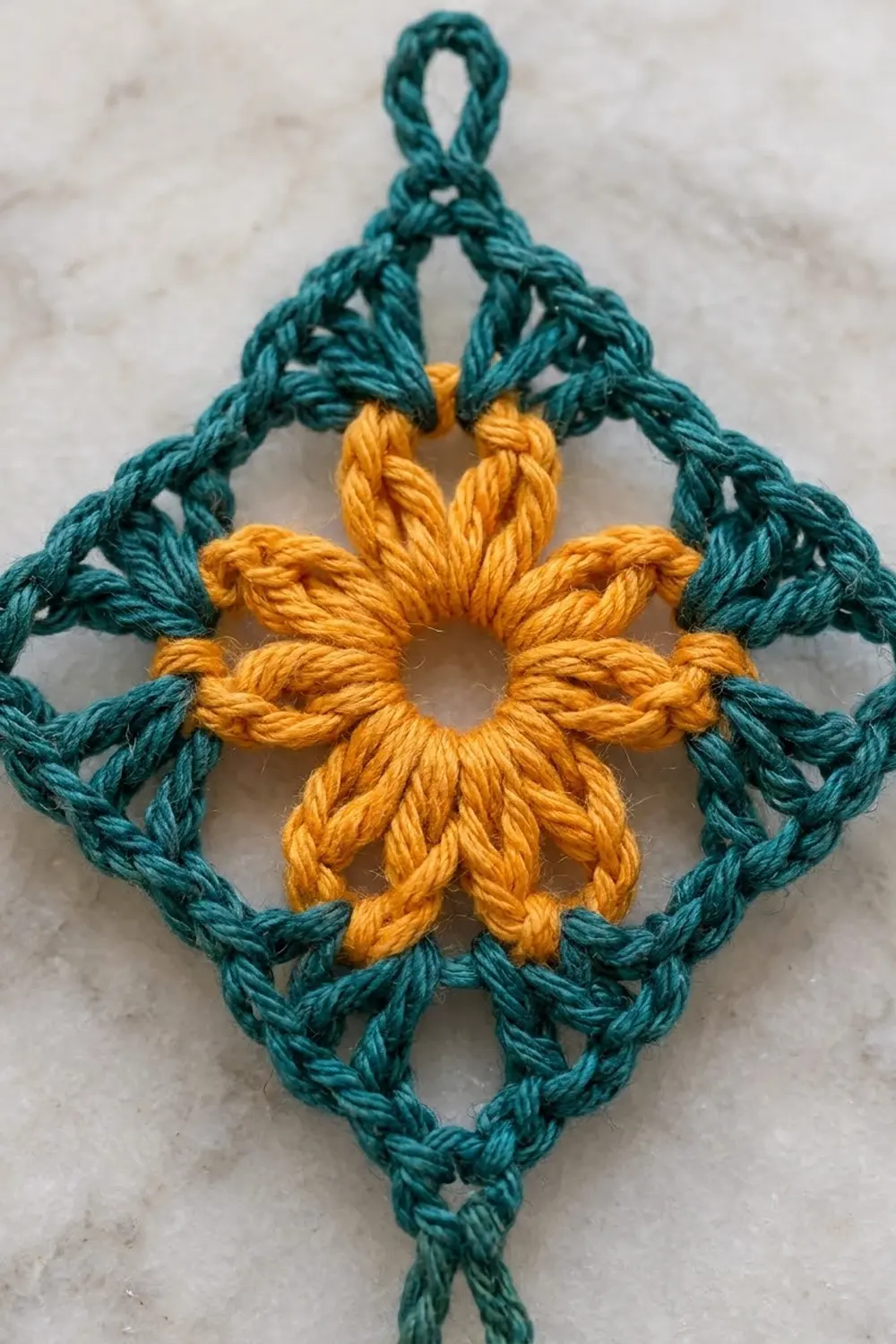
Motif (Make 4)
Round 1 (Color A)
Make a magic ring. Ch 1, then work 8 sc into the ring. Pull the ring partly closed, leaving a 0.5 in (1.3 cm) open center. Join with a sl st to the first sc.
Count: 8 sc.
Round 2 (Color A): Petals
Beg pc in the same st as the join, ch 2. *Pc in the next sc, ch 2; rep from * 6 more times. Join with a sl st to the top of the beg pc. Fasten off Color A.
Count: 8 petal clusters and 8 ch-2 spaces.
Each petal should stand up tall and puffy. If the petals cup, your ch-2 spaces are too tight. Try making the chains a little looser.
Round 3 (Color B): Squaring Round
This round turns the round flower into a square. The ch-2 spaces alternate between corners and side spaces.
Join Color B with a sl st in any ch-2 space. Ch 3 (counts as dc), work 2 dc in the same space, ch 1. *(3 dc, ch 2, 3 dc) in the next ch-2 space (corner made), ch 1. 3 dc in the next ch-2 space, ch 1; rep from * 2 more times. Work (3 dc, ch 2, 3 dc) in the last space, ch 1. Join with a sl st to the top of the beg ch-3.
Count: 36 dc (4 corners × 6 dc + 4 side groups × 3 dc = 24 + 12), plus 8 ch-1 spaces and 4 ch-2 corner spaces.
Per side, between the corner spaces: 3 dc + 1 ch + 3 dc + 1 ch + 3 dc = 11 stitches.
Checkpoint: 3 in (7.6 cm) per side.
Border (Round 4, Color B)
The teal single-crochet border gives the motif its clean outline, the small points at the left and right corners, and the long loops at the top and bottom corners.
Border gauge: 3.7 sc per inch (2.54 cm), so 13 sc per side = 3.5 in (8.9 cm).
Corner setup: As you work, you reach the corners in this order: Corner 1 (top loop), Corner 2 (side point), Corner 3 (bottom loop), Corner 4 (side point).
Round 4
Do not fasten off after Round 3. Ch 1. Sc in the same st as the join and in each of the next 2 dc, sc in the ch-1 sp, sc in each of the next 3 dc.
Corner 1: (sc, ch 8, sc) in the corner sp to make the top loop.
Sc in each of the next 3 dc, sc in the ch-1 sp, sc in each of the next 3 dc, sc in the ch-1 sp, sc in each of the next 3 dc.
Corner 2: (sc, ch 2, sc) in the corner sp.
Rep from * to * once.
Corner 3: (sc, ch 8, sc) in the corner sp to make the bottom loop.
Rep from * to * once.
Corner 4: (sc, ch 2, sc) in the corner sp.
Sc in each of the next 3 dc, sc in the ch-1 sp. Join with a sl st to the first sc. Fasten off and weave in the ends.
Per-side count: 11 sc worked into the Round 3 stitches + 2 corner sc = 13 sc per side. The 2 corner sc on each side are the halves of the (sc, ch, sc) corner groups, so each corner sc belongs to only one side.
Total count: 4 sides × 13 sc = 52 sc, plus two ch-2 points and two ch-8 loops.
Why the math works: Round 3 has 11 stitches per side. Round 4 places exactly 1 sc in each of them, so it adds no extra stitches along the sides. The only new stitches are the 2 corner sc per side. This keeps the edge flat. The border adds 0.25 in (0.6 cm) on each side, so 3 in + 0.25 in + 0.25 in = 3.5 in (8.9 cm) per side.
Checkpoint: 3.5 in (8.9 cm) per side, each loop about 0.75 in (1.9 cm) long, and the total motif length with loops about 6.5 in (16.5 cm).
Make All Pieces
Totals for one strand:
- Motifs: 4. Each one uses about 5 m of Color A and 9 m of Color B.
- Beads: 5
- Tassel: 1, made from 12 strands of Color A and 12 strands of Color B
- Cords: 5 lengths of Color B, all 12 in (30.5 cm) except the top hanger cord, which is 16 in (40.6 cm)
Layout grid (top to bottom):
[ Hanger loop  2 in / 5.1 cm ]
[ Bead 1 ]
[ Motif 1 ◇ ]
[ Bead 2 ]
[ Motif 2 ◇ ]
[ Bead 3 ]
[ Motif 3 ◇ ]
[ Bead 4 ]
[ Motif 4 ◇ ]
[ Bead 5 ]
[ Tassel  4 in / 10.2 cm ]
Every motif hangs the same way: the ch-8 loops sit at the top and bottom, and the ch-2 points face left and right.
Tassel
Wrap Color A and Color B together around the 4.5 in (11.4 cm) cardboard 12 times, which gives 24 strands total. Slide a 6 in (15.2 cm) teal tie under the wraps at the top edge and knot it tightly. Cut the loops at the bottom edge.
Wrap a separate teal length 6 times around the tassel, 0.5 in (1.3 cm) below the top, to form the neck. Knot it and bury the ends inside the tassel. Trim the bottom evenly so the tassel is 4 in (10.2 cm) long.
Joining
Method: bead-and-cord joins. Each join gives the strand a little flex and keeps the beads centered.
Motif-to-motif joins (3 joins):
- Thread a 12 in (30.5 cm) teal cord through the bottom ch-8 loop of the upper motif. Even out the two ends.
- Pass both ends through one bead with the tapestry needle.
- Thread the ends through the top ch-8 loop of the lower motif.
- Bring both ends back up through the bead.
- Tie a square knot above the bead, hidden inside the upper loop. Bury the tails inside the bead.
Loop-to-loop logic: Each join always connects the bottom loop of one motif to the top loop of the next motif, with exactly one bead between them. Do not connect the corner stitches or the side points.
Tension advice: Snug each cord until the loops just touch the ends of the bead, with no slack showing. If you pull too hard, the loops pucker the motif points. If the cord is too loose, the motifs twist.
Spacing: loop 0.75 in + bead 0.8 in + loop 0.75 in = 2.3 in (5.8 cm) between neighboring motif points.
Top hanger: Fold the 16 in (40.6 cm) cord in half. Thread its ends through Bead 1 and then through the top loop of Motif 1. Bring them back up through the bead and knot them, leaving a 2 in (5.1 cm) loop above the bead.
Tassel join: Thread a 12 in (30.5 cm) cord through the bottom loop of Motif 4. Pass both ends through Bead 5, then through the tassel’s top tie. Bring them back up through the bead, knot, and bury the tails.
Size checkpoint: hanger 2 in + Bead 1 0.8 in + top loop 0.75 in + 4 motifs × 5 in + 3 joins × 2.3 in + bottom loop 0.75 in + Bead 5 0.8 in + tassel 4 in = 36 in (91.4 cm).
Final Blocking
- Pin each motif flat on the mat before you string the beads, if possible.
- Shape each square to 3.5 in (8.9 cm) per side, with straight edges.
- Fan the eight petals evenly, keeping the center ring open at 0.5 in (1.3 cm).
- Pin the ch-2 side points outward and straighten the ch-8 loops.
- Mist the motifs with water until damp but not soaked.
- Let them dry completely, about 6–8 hours.
- After joining, hang the strand and steam the tassel lightly from a distance so it hangs straight.
Final Quality-Control Checklist
- [ ] Each motif has 8 petals, 36 dc in Round 3, and 52 sc in Round 4.
- [ ] Every side measures 3.5 in (8.9 cm).
- [ ] All loops are the same length, 0.75 in (1.9 cm).
- [ ] All motifs hang in the same diamond orientation.
- [ ] The beads sit centered, with no cord slack.
- [ ] The tassel is 4 in (10.2 cm) long and trimmed evenly.
- [ ] The total strand is 36 in (91.4 cm) long.
- [ ] All ends are knotted and buried.
Troubleshooting
- Flower cups or ruffles: Your Round 2 chains are too tight or too loose. Redo them so each ch-2 is about as wide as a petal base.
- Square looks round: Check that the corner groups (3 dc, ch 2, 3 dc) went into alternating spaces.
- Edges wave: You worked extra sc on a side. Recount to 13 per side.
- Edges pull in: Your border tension is too tight. Go up a hook size for Round 4 only.
- Motifs twist when hanging: Shorten the cords slightly and re-knot so the loops sit tight against the beads.
- Cord won’t pass through a bead: Use a thinner needle or a wire threader, or choose beads with larger holes.
Care
Hand wash in cool water with mild soap, roll the strand in a towel, and dry it flat. Re-pin the motifs if needed. Smooth the tassel with your fingers while it is still damp.
Final Notes
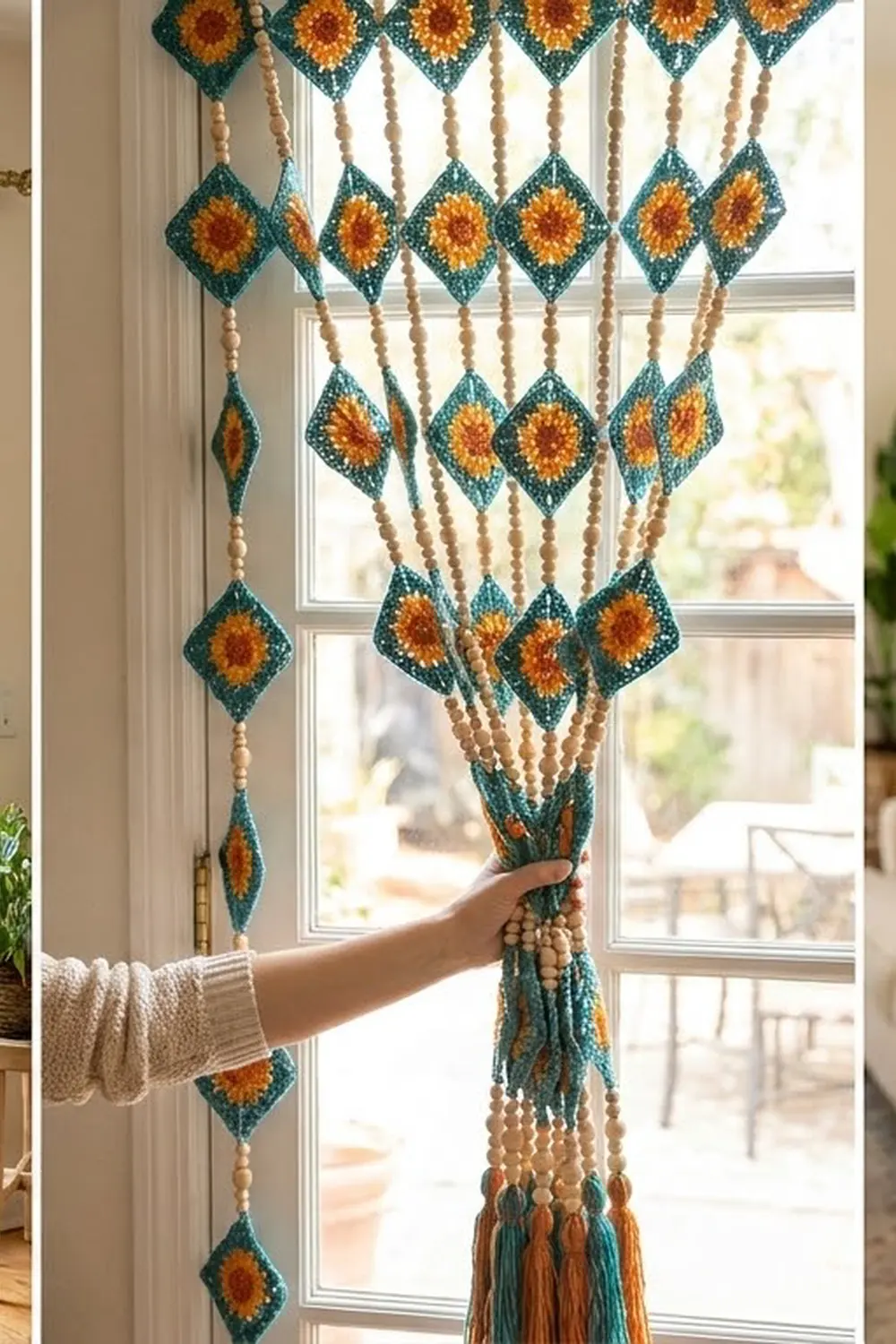
The measurement chain is simple: a 2 in (5.1 cm) flower, a 3 in (7.6 cm) square, and a 3.5 in (8.9 cm) bordered motif about 5 in (12.7 cm) point to point. Four motifs with 2.3 in (5.8 cm) bead joins, plus the hanger and tassel, give a 36 in (91.4 cm) strand. Check your first motif against every checkpoint, and the rest will match. If you want a fuller curtain look, make extra strands the same way and hang them side by side.
Happy crocheting!