

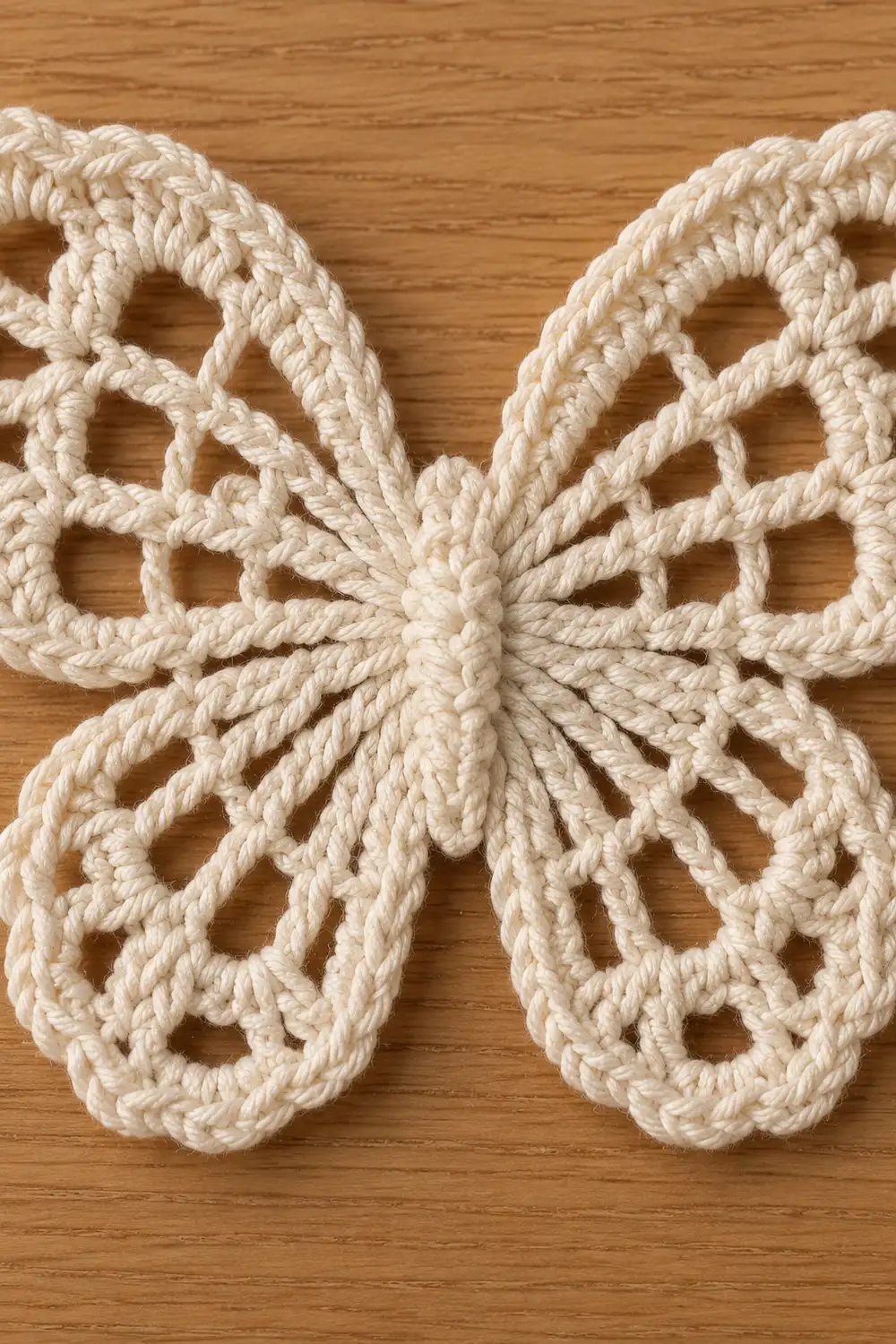
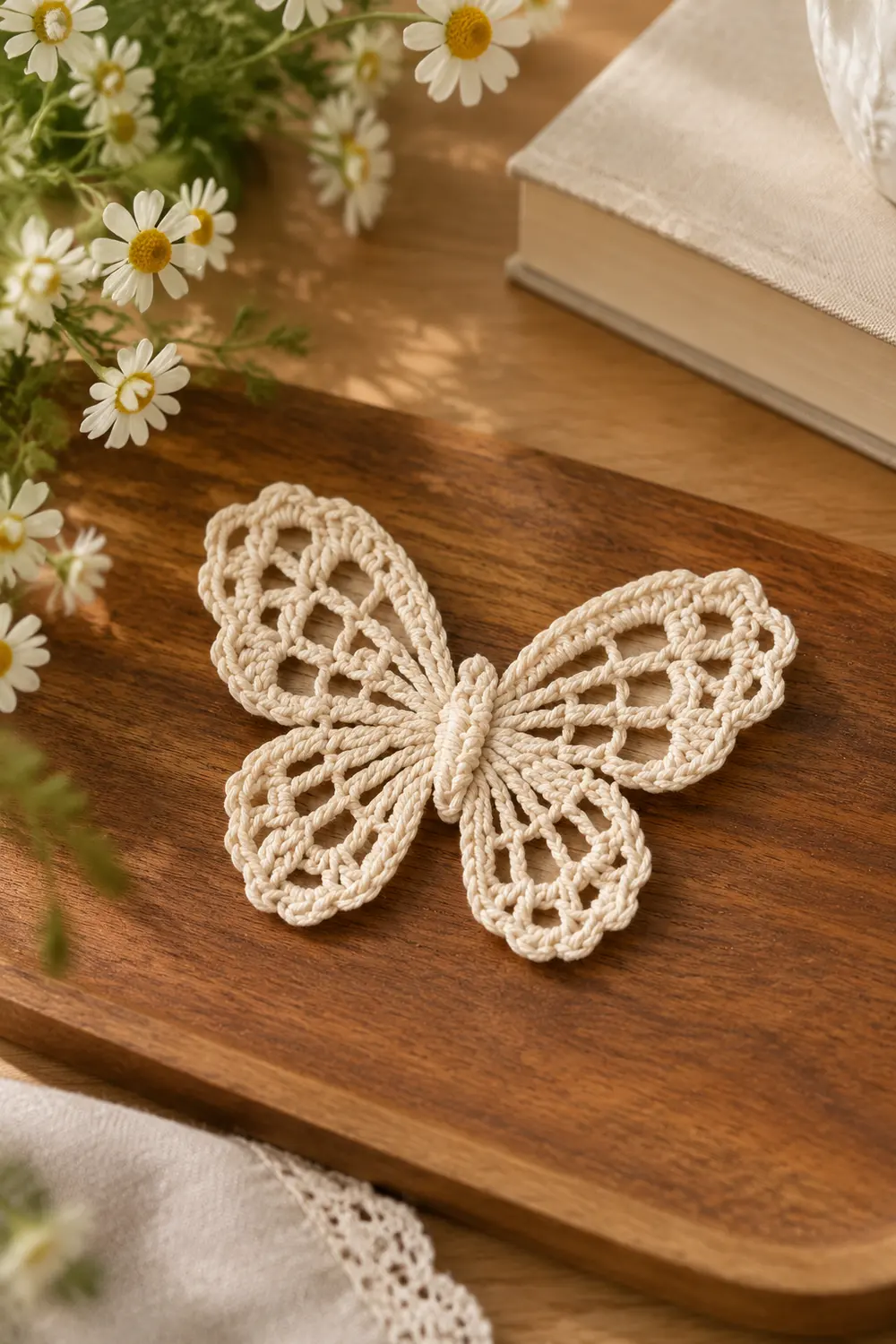
This lacy butterfly is a single flat motif with four symmetrical wings, two upper and two lower, and a compact, solid body at the center. Each wing is built from radiating spokes with open chain spaces between them, which creates an airy lattice. A scalloped shell edge finishes every wing.
The sample is worked in cream cotton, which shows the stitch definition and gives the piece a soft, vintage look. Any solid light color works well. Avoid busy variegated yarns, which hide the lattice.
The pattern uses US crochet terms. The finished butterfly measures about 4.5 in (11.4 cm) across the wingspan and 3.75 in (9.5 cm) tall. Use it as an appliqué, a brooch, or a standalone decoration.
Construction is simple. You crochet the body first as a small solid rectangle. Then you work each wing in three short rows directly off the body’s long edges. One continuous border round adds the scallops and ties everything together. The result is one single piece with no sewing between parts.
Finished Size and Construction
- Finished size: 4.5 in (11.4 cm) wingspan x 3.75 in (9.5 cm) tall
- Skill level: Easy / advanced beginner
- Terminology: US crochet terms
- Yarn weight: DK / light (#3), cotton
- Hook: 3.5 mm (E-4)
- Number of pieces: 1 (body and four wings worked as one motif)
- Layout: Vertical body at center, two upper wings and two lower wings mirrored left and right
- Body size: 1.75 in (4.4 cm) long x 0.6 in (1.5 cm) wide
- Size before border: 4 in (10.2 cm) wingspan x 3.25 in (8.3 cm) tall
- Border depth: 0.25 in (0.6 cm) on every wing edge
Materials
Yarn advice: Choose a smooth, mercerized or combed cotton in DK weight. Cotton holds the open spaces crisply after blocking and does not stretch out of shape. Acrylic will work, but the lattice looks softer and the scallops may curl.
- Cream (main and only color): 10 g, about 22 m (24 yd)
Tools:
- 3.5 mm (E-4) crochet hook
- Tapestry needle
- Scissors
- 1 stitch marker
- Blocking mat or folded towel
- Rust-proof pins
- Spray bottle with water
- Optional: pin back or brooch clasp
The quantity includes a margin of about 40% for your gauge swatch, joins, and weaving in ends. The motif itself uses roughly 6 to 7 g.
Abbreviations (US Terms)
- ch – chain
- sl st – slip stitch
- sc – single crochet
- hdc – half double crochet
- dc – double crochet
- tr – treble crochet
- sc2tog – single crochet 2 together (decrease)
- st(s) – stitch(es)
- sp(s) – space(s)
- rep – repeat
- RS – right side
Special stitch – Scallop: Work (sc, hdc, 3 dc, hdc, sc) all in the same ch-sp. This makes 7 sts.
Special stitch – Wing notch sc2tog: Insert hook in the side of the last post of one wing, yo, pull up a loop. Insert hook in the side of the first post of the next wing, yo, pull up a loop. Yo and pull through all 3 loops. Counts as 1 st.
Gauge and Checkpoints
Gauge: 18 sc and 20 rows = 4 in (10.2 cm) in sc worked in rows.
Gauge is not critical for a motif, but it controls the final size. Your test piece is the body plus one upper wing. Make these first and measure before continuing.
Checkpoints:
- After the body: 1.75 in (4.4 cm) long x 0.6 in (1.5 cm) wide.
- After one upper wing: the wing reaches about 1.7 in (4.3 cm) out from the body edge, laid flat.
- After one lower wing: the wing reaches about 1.25 in (3.2 cm) out from the body edge.
- Before the border: 4 in (10.2 cm) wingspan x 3.25 in (8.3 cm) tall.
- After border and blocking: 4.5 in (11.4 cm) x 3.75 in (9.5 cm).
If your body is too big: go down to a 3.25 mm (D-3) hook.
If your body is too small: go up to a 3.75 mm (F-5) hook.
Always re-check the body after a hook change. The wings scale with it.
Body
The body is a solid rectangle. Its two long edges each have 8 sts, which become the anchor points for the wings. Number those sts 1 to 8 from top to bottom. Sts 1–4 hold the upper wing and sts 5–8 hold the lower wing on each side.
Foundation: Ch 9.
Row 1: Sc in 2nd ch from hook and in each ch across. Turn. (8 sc)
Row 2: Ch 1 (does not count as a st), sc in each st across. Turn. (8 sc)
Row 3: Ch 1, sc in each st across. (8 sc)
Fasten off and weave in ends. The body totals 24 sc.
Lay the body vertically. The tops of Row 3 form the right long edge. The free loops of the foundation chain form the left long edge. Place a marker in st 1 of Row 3 so you can find the top easily.
Work firmly here. A tight body stays solid and slightly raised, which gives the finished butterfly its dimension.
Upper Wings
Each upper wing has 7 spokes. Three body sts get 2 spokes each and one st gets 1 spoke, so 3 x 2 + 1 = 7. The spokes fan outward toward the top of the butterfly.
Upper Right Wing
Row 1 (RS): Join yarn with sl st in st 1 of the right long edge (top). Ch 4 (counts as tr), ch 2, tr in same st. Ch 2, tr in next st, ch 2, tr in same st. Rep from * once more (sts 2 and 3). Ch 2, tr in next st (st 4). Turn. (7 tr, 6 ch-2 sps)
Row 2: Ch 6 (counts as dc + ch 3). [Dc in next tr, ch 3] 5 times. Dc in top of turning ch. Turn. (7 dc, 6 ch-3 sps)
Row 3: Ch 7 (counts as dc + ch 4). [Dc in next dc, ch 4] 5 times. Dc in 3rd ch of turning ch. (7 dc, 6 ch-4 sps)
Fasten off and weave in ends.
Upper Left Wing (Mirrored)
Row 1 (RS): Join yarn with sl st in the free loop of st 4 of the left long edge. Ch 4 (counts as tr). [Ch 2, tr in next st, ch 2, tr in same st] 3 times (sts 3, 2, and 1). Turn. (7 tr, 6 ch-2 sps)
Rows 2–3: Work exactly as Rows 2–3 of the upper right wing. (7 dc, 6 ch-4 sps after Row 3)
Fasten off and weave in ends.
Checkpoint: Each upper wing reaches about 1.7 in (4.3 cm) from the body edge. The ch-4 sps should form a gentle fan, not a straight line.
Lower Wings
Each lower wing has 5 spokes in dc, so the lower wings are shorter and rounder. One body st gets 2 spokes and three sts get 1 spoke each, so 2 + 3 = 5. The doubled spoke sits at the bottom of the body.
Lower Right Wing
Row 1 (RS): Join yarn with sl st in st 8 of the right long edge (bottom). Ch 3 (counts as dc), ch 2, dc in same st. [Ch 2, dc in next st] 3 times (sts 7, 6, and 5). Turn. (5 dc, 4 ch-2 sps)
Row 2: Ch 6 (counts as dc + ch 3). [Dc in next dc, ch 3] 3 times. Dc in top of turning ch. Turn. (5 dc, 4 ch-3 sps)
Row 3: Ch 7 (counts as dc + ch 4). [Dc in next dc, ch 4] 3 times. Dc in 3rd ch of turning ch. (5 dc, 4 ch-4 sps)
Fasten off and weave in ends.
Lower Left Wing (Mirrored)
Row 1 (RS): Join yarn with sl st in the free loop of st 5 of the left long edge. Ch 3 (counts as dc). [Ch 2, dc in next st] 3 times (sts 6, 7, and 8). Ch 2, dc in same st (st 8). Turn. (5 dc, 4 ch-2 sps)
Rows 2–3: Work exactly as Rows 2–3 of the lower right wing. (5 dc, 4 ch-4 sps after Row 3)
Fasten off and weave in ends.
Checkpoint: Each lower wing reaches about 1.25 in (3.2 cm) from the body edge. The full motif now measures 4 in (10.2 cm) wide x 3.25 in (8.3 cm) tall.
Border
Border gauge: Each scallop is 7 sts worked into one ch-4 sp. It spans about 0.9 in (2.3 cm) and stands 0.25 in (0.6 cm) deep. Wing side edges are worked in sc at 2 sc per dc post and 3 sc per tr post.
The border is one continuous round. It travels down the right side of the butterfly, crosses the bottom of the body, and climbs back up the left side.
Round 1 (RS): Join yarn with sl st in the row-end of body Row 2 at the top end of the body. Ch 1 (does not count as a st).
Right half:
- Upper wing, top (costa) edge: 3 sc in side of Row 1 tr post, 2 sc in side of Row 2 post, 2 sc in side of Row 3 post. (7 sc)
- Upper wing scallops: Scallop in each of the 6 ch-4 sps. (42 sts)
- Upper wing, inner edge: 2 sc in side of Row 3 post, 2 sc in side of Row 2 post, 2 sc in side of Row 1 tr post. (6 sc)
- Wing notch: Wing notch sc2tog, using the Row 1 tr post of the upper wing and the Row 1 dc post of the lower wing. (1 st)
- Lower wing, inner edge: 1 sc in side of Row 1 dc post, 2 sc in side of Row 2 post, 2 sc in side of Row 3 post. (5 sc)
- Lower wing scallops: Scallop in each of the 4 ch-4 sps. (28 sts)
- Lower wing, outer edge: 2 sc in side of Row 3 post, 2 sc in side of Row 2 post, 2 sc in side of Row 1 post. (6 sc)
- Sl st in the row-end of body Row 2 at the bottom end of the body.
Right half total: 7 + 42 + 6 + 1 + 5 + 28 + 6 = 95 sts.
Left half: Work the same sections in reverse order, climbing upward:
- Lower wing outer edge. (6 sc)
- Lower wing scallops. (28 sts)
- Lower wing inner edge. (5 sc)
- Wing notch sc2tog. (1 st)
- Upper wing inner edge. (6 sc)
- Upper wing scallops. (42 sts)
- Upper wing costa edge. (7 sc)
- Sl st in the first sl st to close.
Left half total: 95 sts.
Round total: 95 + 95 = 190 sts, plus 2 sl sts at the body ends. Fasten off and weave in ends.
Why the math works:
- There is exactly one scallop per ch-4 sp. That gives 6 scallops on each upper wing and 4 on each lower wing, matching the 6 and 4 sps counted in Row 3.
- Each dc post gets 2 sc and each tr post gets 3 sc. A dc is about two sc rows tall and a tr about three, so the edges lie flat without ruffling or pulling.
- On the inner edges, one leg of the sc2tog replaces one sc on each wing. That is why the upper inner edge has 6 sc instead of 7, and the lower inner edge has 5 sc instead of 6.
- The sc2tog cinches the notch between the wings for a crisp butterfly silhouette.
Final Blocking
- Soak the butterfly in cool water for 5 minutes.
- Press out water gently in a towel. Do not wring.
- Lay the motif RS up on a blocking mat.
- Pin the body straight first, at 1.75 in (4.4 cm) long.
- Pin the tip of each upper wing so the wingspan measures 4.5 in (11.4 cm).
- Pin the bottom of each lower wing so the height measures 3.75 in (9.5 cm).
- Pin the center dc of every scallop to open the shells evenly.
- Use a pin or your finger to open each lattice space into a clean shape.
- Mist lightly and let it dry completely, about 6 to 12 hours.
- Unpin only when fully dry.
For extra stiffness on a brooch, mist with a light fabric starch before drying.
Final Quality-Control Checklist
- Body is 8 sc long and 3 rows wide, firm and flat.
- Each upper wing has 7 spokes and 6 open spaces in every row.
- Each lower wing has 5 spokes and 4 open spaces in every row.
- Both halves mirror each other in shape and spoke direction.
- The border has 10 scallops per side: 6 upper and 4 lower.
- Wing notches are cinched neatly with the sc2tog.
- Finished size is 4.5 in (11.4 cm) x 3.75 in (9.5 cm).
- All ends are woven in securely and trimmed close.
Troubleshooting
Wings cup or curl upward: Your chains are too tight. Go up a hook size for the chain spaces only, or block more firmly.
Wings ruffle along the edge: Your chains are too loose, or you added extra sc on the side edges. Re-check the 7 / 6 / 5 / 6 edge counts.
Body looks thin or floppy: Work the body with a smaller hook than the wings, such as 3.25 mm (D-3).
Halves don’t match: Make sure both left wings were started from the correct body st (st 4 for the upper, st 5 for the lower).
Scallops look flat: Pull each scallop’s center dc taller, and pin each scallop point during blocking.
Lattice spaces are uneven: Count the chains in every space. One missing chain shows clearly in open work.
Care
Hand wash in cool water with mild soap and lay flat to dry. If the motif is sewn onto a garment, wash the garment gently and reshape the butterfly while damp.
Final Notes
The measurement chain is short and easy to track. The body sets the scale at 1.75 in (4.4 cm). The upper wings extend 1.7 in (4.3 cm) and the lower wings 1.25 in (3.2 cm), giving 4 in (10.2 cm) x 3.25 in (8.3 cm) before the border. The scalloped border adds 0.25 in (0.6 cm) on every wing edge, finishing at 4.5 in (11.4 cm) x 3.75 in (9.5 cm).
If your body checkpoint is correct, the rest will follow. Optional: make several butterflies in different colors to scatter across a bag or jacket.
Happy crocheting!