

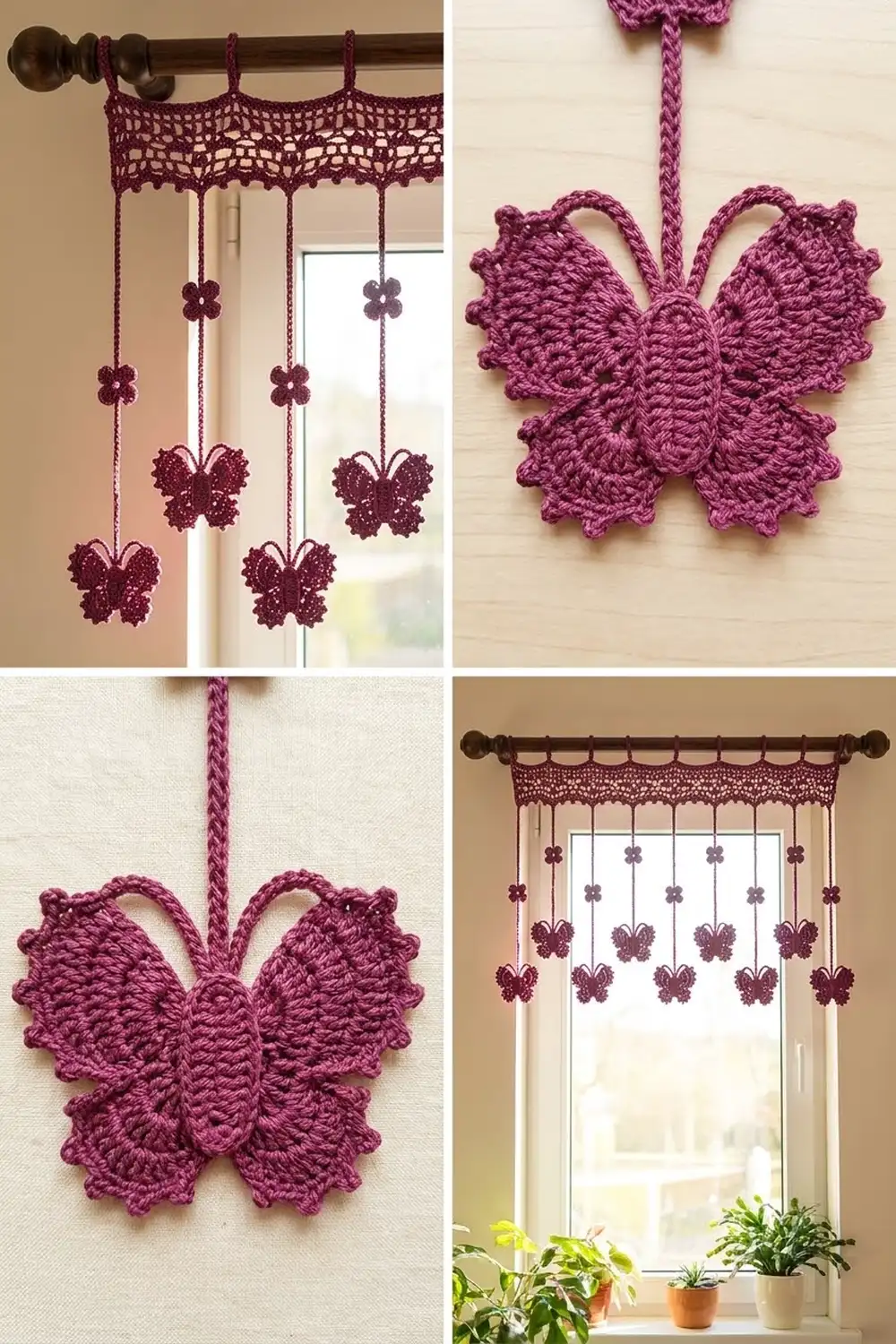
The Plum Flutter Valance is a lacy window topper in one rich berry-plum shade. A scalloped lace header hangs from curtain rings. Ten beaded cords drop from it, and each one carries an openwork butterfly and ends in a full tassel. When the sun is behind it, light shows through every wing.
Everything is worked in one color, so you can focus on your stitches instead of color changes. The butterflies sit at three heights for a light, layered look, and all the tassels end on one even line.
This pattern uses US crochet terms. The finished valance is about 36 in (91.4 cm) wide and 21.5 in (54.6 cm) long from the top edge to the tassel tips. Each butterfly is 4 in (10.2 cm) across the wings.
First you make ten butterflies and ten tassels. Next, you crochet a beaded cord up and down from each butterfly to build a strand. Last, you work the lace header in rows and catch each strand into the final row, so you don’t sew anything at the header.
Finished Size and Construction
- Finished size: about 36 in (91.4 cm) wide x 21.5 in (54.6 cm) long
- Skill level: Intermediate
- Terminology: US crochet terms
- Yarn weight: Sport (#2 Fine) mercerized cotton
- Hook: 3.25 mm (US D-3)
- Number of pieces: 10 butterflies, 10 beads, 10 tassels, 1 header (the cords are worked onto the butterflies)
- Layout: 10 strands in one row, spaced 4 in (10.2 cm) apart
- Butterfly size: 4 in (10.2 cm) wide x 3 in (7.6 cm) tall; 4.5 in (11.4 cm) including the stem
- Strand drop: 20 in (50.8 cm) from the header anchor to the tassel tip
- Header before scallops (Rows 1-4): 36 in x 1.5 in (91.4 x 3.8 cm)
- Scallop depth (Rows 5-6): 1.5 in (3.8 cm), for a total header depth of 3 in (7.6 cm)
Materials
Choose a smooth, mercerized sport-weight cotton. Cotton keeps the lace crisp, takes starch well, and makes heavy tassels. Avoid fuzzy or stretchy yarn, because the strands will grow as they hang.
Yarn:
– Berry Plum: 150 g / 465 m (about 509 yd), which is three 50 g / 155 m balls
Approximate use: header 40 g, butterflies 50 g (5 g each), cords 15 g, beads and tassels 17 g. These quantities include a margin of about 25 g for your test piece and for differences in tension.
Tools:
– 3.25 mm (US D-3) crochet hook
– Tapestry needle, scissors, stitch markers
– Yarn scraps for stuffing the beads
– A stiff card 3 in (7.6 cm) wide for winding tassels
– Blocking mat, rustproof pins, spray starch
– 10 curtain clip rings and a curtain rod
Abbreviations (US Terms)
- ch – chain
- sl st – slip stitch
- sc – single crochet
- hdc – half double crochet
- dc – double crochet
- sc2tog – single crochet 2 together
- sp – space
- MR – magic ring
- st(s) – stitch(es)
Special stitches:
- Picot: ch 3, sl st in 3rd ch from hook.
- Picot flower (pf): ch 3, sl st in 3rd ch from hook; [ch 3, sl st in same ch as last sl st] 3 times. You now have four picots around one point, which forms the small flower on the cords. Keep chaining from that point.
Gauge and Checkpoints
Gauge: 24 sc and 26 rows = 4 in (10.2 cm).
Make one complete butterfly first. It tells you more than a swatch does, because loose stitches show quickly in the open wings.
Checkpoints:
– After Rnd 2: each upper wing fan reaches about 1.5 in (3.8 cm) from the center
– Finished butterfly: 4 in (10.2 cm) wide x 3 in (7.6 cm) tall
– Body: 1.25 in (3.2 cm) long
– One cord segment (ch 8 + pf): 1.5 in (3.8 cm)
– Bead: 0.75 in (1.9 cm) across
– Header Row 1: 36 in (91.4 cm), within 35.5 to 36.5 in (90.2 to 92.7 cm)
If your pieces are too big: use a 3 mm hook. If they are too small: use a 3.5 mm (US E-4) hook. If only the cord segments are off, change ch 8 to ch 7 (segments too long) or ch 9 (segments too short). Make the same change on every strand.
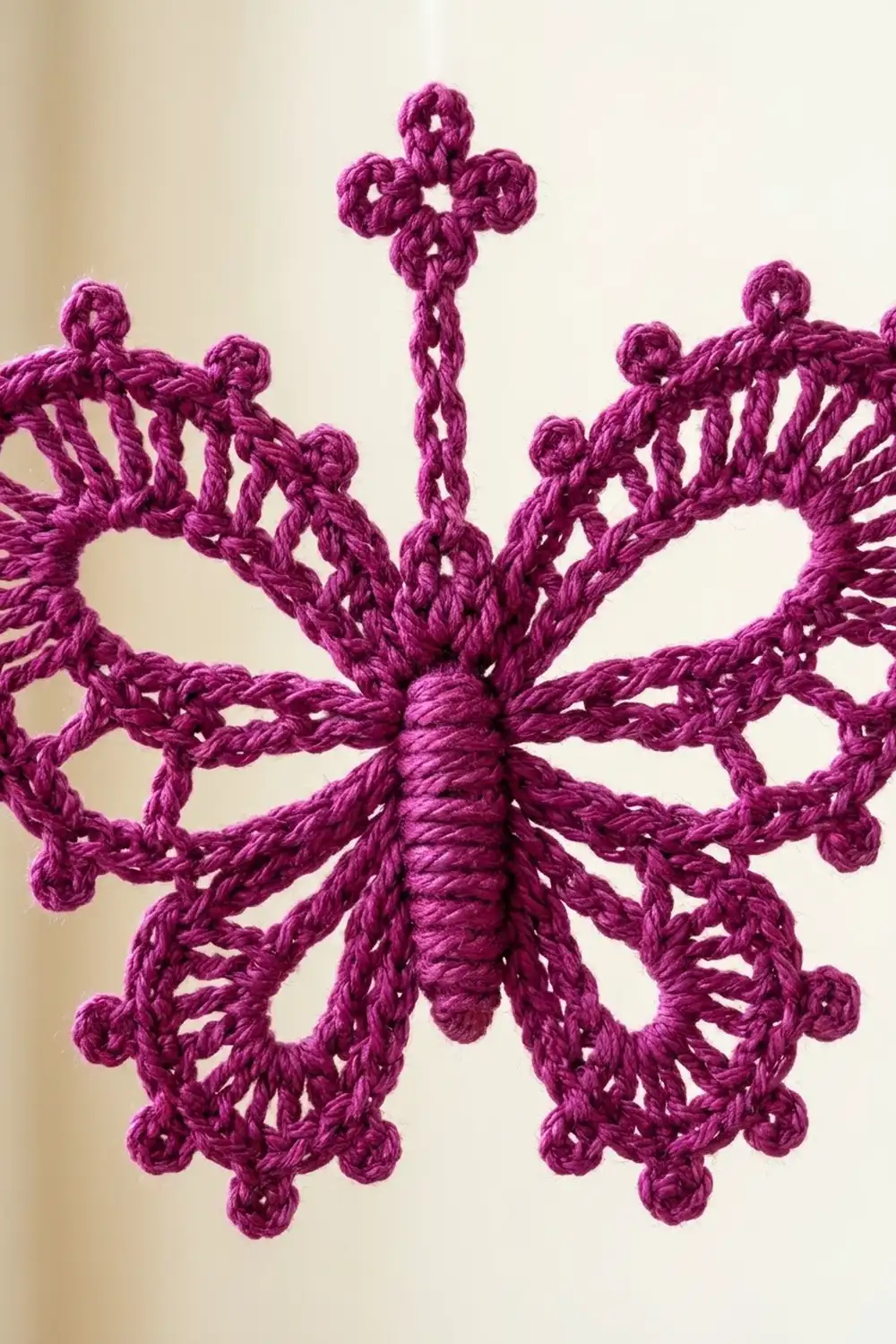
Butterfly (Make 10)
Center and Wings
Rnd 1: MR, ch 1, sc in ring, ch 13, sc in ring, ch 9, sc in ring, ch 9, sc in ring, ch 13, sl st in first sc. Pull the ring tight. (4 sc, 2 ch-13 loops, 2 ch-9 loops)
The four sc are your anchors, at the top, right, bottom, and left. The ch-13 loops become the upper wings, and the ch-9 loops become the lower wings.
Rnd 2 (wing fill):
– In each ch-13 loop: (sc, hdc, dc, [ch 2, dc] 8 times, hdc, sc). (9 dc and 8 ch-2 sps per upper wing)
– In each ch-9 loop: (sc, hdc, dc, [ch 2, dc] 5 times, hdc, sc). (6 dc and 5 ch-2 sps per lower wing)
– Sl st in each anchor sc between the loops.
Total: 30 dc and 26 ch-2 sps. The dc fan out like rays.
Rnd 3 (arch frame):
– Upper wing: ch 4, sc in first ch-2 sp, [ch 4, sc in next ch-2 sp] 7 times, ch 4, sl st in next anchor. (9 ch-4 loops)
– Lower wing: ch 4, sc in first ch-2 sp, [ch 4, sc in next ch-2 sp] 4 times, ch 4, sl st in next anchor. (6 ch-4 loops)
Total: 30 ch-4 loops. Wings that sit next to each other share one anchor sc.
Rnd 4 (picot edge): In each ch-4 loop: (2 sc, picot, 2 sc); sl st in each anchor. Fasten off.
Total: 120 sc and 30 picots (9 per upper wing, 6 per lower wing). This round creates the dotted outline.
Body
Ch 8. Sc in 2nd ch from hook and in next 5 ch, 3 sc in last ch. Working along the opposite side of the chain, sc in next 5 ch, 2 sc in last ch; sl st in first sc. (16 sc) Fasten off, leaving a 24 in (61.0 cm) tail.
Lay the body vertically over the center ring so it runs from the top anchor to the bottom anchor, and sew it down. Wrap the tail firmly around the body and wings 10 times, spacing the wraps evenly. The wraps pinch the wings in at the center and create the ridged body. Secure the tail and weave it in.
Checkpoint: 4 in (10.2 cm) wide x 3 in (7.6 cm) tall.
Bead and Tassel (Make 10 of Each)
Bead:
– Rnd 1: 6 sc in MR. (6)
– Rnd 2: 2 sc in each st. (12)
– Rnd 3: Sc in each st. (12)
– Rnd 4: Sc2tog 6 times. (6)
Stuff lightly with yarn scraps, close the opening, and weave in the end. The bead measures 0.75 in (1.9 cm).
Tassel: Wrap yarn 12 times around the 3 in (7.6 cm) card. Cut along one edge to get 24 strands, each 6 in (15.2 cm) long. Fold the bundle in half. With a separate strand, wrap tightly 6 times around the bundle, 0.5 in (1.3 cm) below the fold. Knot it and hide the ends inside. Trim the skirt to 2.75 in (7.0 cm) below the wraps.
Each tassel unit (bead plus skirt) is 3.5 in (8.9 cm) long.
Make All Pieces
All pieces are in Berry Plum: 10 butterflies, 10 beads, 10 tassels, and 1 header, which you work last.
Each strand has 8 cord segments. To set the butterfly’s height, you move segments from below it to above it:
- H (high): 2 segments above, 6 below
- M (middle): 4 above, 4 below
- L (low): 6 above, 2 below
Layout grid (left to right, seen from the room):
Strand:     1   2   3   4   5   6   7   8   9   10
Position:   M   H   L   H   M   M   H   L   H   M
Above:      4   2   6   2   4   4   2   6   2   4
Below:      4   6   2   6   4   4   6   2   6   4
Totals: 4 H, 4 M, and 2 L strands. That makes 36 segments above, 44 below, and 80 in all (10 strands x 8). The layout mirrors itself around the center.
Joining: Building the Strands
The cords are worked straight off each butterfly. They connect it to its tassel and to the header without any sewing.
Upper cord: Join yarn with a sl st at the top tip of the body. Ch 10, pf; this is the antenna stem with its flower top. Work [ch 8, pf] the “Above” number of times. Fasten off, leaving a 6 in (15.2 cm) tail. The last pf is the top of the strand.
Lower cord: Join yarn with a sl st at the bottom tip of the body. Work [ch 8, pf] the “Below” number of times. Fasten off, leaving a 10 in (25.4 cm) tail.
Attach the tassel: Thread the lower tail down through the bead, through the tassel fold, and back up through the bead. Knot it snugly under the last pf.
Tension: Keep your chains even and slightly relaxed. Tight chains twist the cords, and loose chains stretch under the weight of the tassels.
Size checkpoint: 8 segments x 1.5 in (3.8 cm) = 12 in (30.5 cm). Add the butterfly unit, 4.5 in (11.4 cm), and the tassel unit, 3.5 in (8.9 cm), for a strand of 20 in (50.8 cm). All strands should be within 0.5 in (1.3 cm) of each other.
The stem tops sit 3 in (7.6 cm) below the header for H strands, 6 in (15.2 cm) for M, and 9 in (22.9 cm) for L.
Border: Lace Header
The header is the border that holds the valance together. You work it in rows, and Row 6 joins all ten strands.
Border gauge: 24 sts = 4 in (10.2 cm), or 6 sts per inch. Each 12-st repeat is 2 in (5.1 cm).
Foundation: Ch 218.
Row 1: Sc in 2nd ch from hook and in each ch across, turn. (217 sc)
Row 2: Ch 1, sc in each st across, turn. (217 sc)
Row 3 (mesh): Ch 1, sc in first st, [ch 5, sk 5, sc in next st] 36 times, turn. (37 sc, 36 ch-5 sps)
Row 4: Ch 3 (counts as dc), [5 dc in next ch-5 sp, dc in next sc] 36 times, turn. (37 dc, one in each sc, + 180 dc in the spaces = 217 dc)
Checkpoint: Rows 1-4 measure 36 in x 1.5 in (91.4 x 3.8 cm).
Row 5 (arches): Ch 1, sc in first st, [ch 9, sk 11, sc in next st] 18 times, turn. (19 sc, 18 ch-9 loops)
Number these 19 sc as anchors 1 to 19. The strands join at the odd-numbered anchors: 1, 3, 5, and so on through 19.
Row 6 (scallops and join): Ch 1, sc in first sc, [(5 dc, picot, 5 dc) in next ch-9 loop, sc in next sc] 18 times. Fasten off. (19 sc and 18 scallops, each with 10 dc + 1 picot = 180 dc and 18 picots)
Joining in Row 6: At each odd anchor, insert the hook into the sc and then through the center of the next strand’s top pf. Take the strands in grid order and complete the sc. Strand 1 joins at anchor 1 and Strand 10 at anchor 19. Weave each strand’s tail up into the header.
Why the math works: 217 = 1 + (36 x 6) for the mesh, and 217 = 1 + (18 x 12) for the arches, so every repeat ends on the last stitch. Row 4 brings the count back to 217 (37 + 180), so the header stays 36 in (91.4 cm) wide all the way down. The anchors are 12 sts (2 in, 5.1 cm) apart. Using every other anchor spaces the strands 24 sts, or 4 in (10.2 cm), apart. Edge to edge, 9 gaps x 24 + 1 = 217.
Final Blocking
- Weave in all ends.
- Dampen the butterflies and the header.
- Pin each butterfly to 4 in x 3 in (10.2 x 7.6 cm), pinning every picot outward.
- Pin the header to 36 in x 3 in (91.4 x 7.6 cm), with each scallop picot pinned to a point.
- Spray with starch and let everything dry completely.
- Hang the valance for a day so the tassels can straighten the cords. Trim any uneven skirts to 2.75 in (7.0 cm).
- Clip a curtain ring into Row 1 directly above each strand.
Final Quality-Control Checklist
- Header is 36 in (91.4 cm) wide and 3 in (7.6 cm) deep
- Row 6 has 18 scallops and 19 anchors
- Ten strands, spaced 4 in (10.2 cm) apart
- Each strand has 8 segments plus the stem pf
- Butterfly positions follow M H L H M M H L H M
- Each butterfly has 30 picots and a wrapped body
- All tassels end 20 in (50.8 cm) below the anchors
Troubleshooting
Wings ruffle: Work ch 5 instead of ch 4 in Rnd 3, or block more firmly with starch.
Header is wider than 36.5 in (92.7 cm): Your foundation chain is too loose. Redo it with a smaller hook.
Strands are different lengths: Count the segments first. If the count is right, redo the longest cord with ch 7 segments.
Cords twist: Starch them and hang them with a small weight overnight.
Butterfly tilts: Rejoin the cords exactly at the top and bottom tips of the body.
Care
Hand wash in cool water with mild soap, roll in a towel to remove water, and lay flat to dry. Starch and pin the butterflies again after washing.
Final Notes
Each measurement builds on the one before it. A butterfly is 4 in x 3 in (10.2 x 7.6 cm), or 4.5 in (11.4 cm) with the stem. Eight segments of 1.5 in (3.8 cm) give 12 in (30.5 cm). Add the butterfly and the 3.5 in (8.9 cm) tassel for a 20 in (50.8 cm) strand. The 217-st header is 36 in (91.4 cm) wide, and its 1.5 in (3.8 cm) top band brings the valance to 21.5 in (54.6 cm) long.
Happy crocheting!