

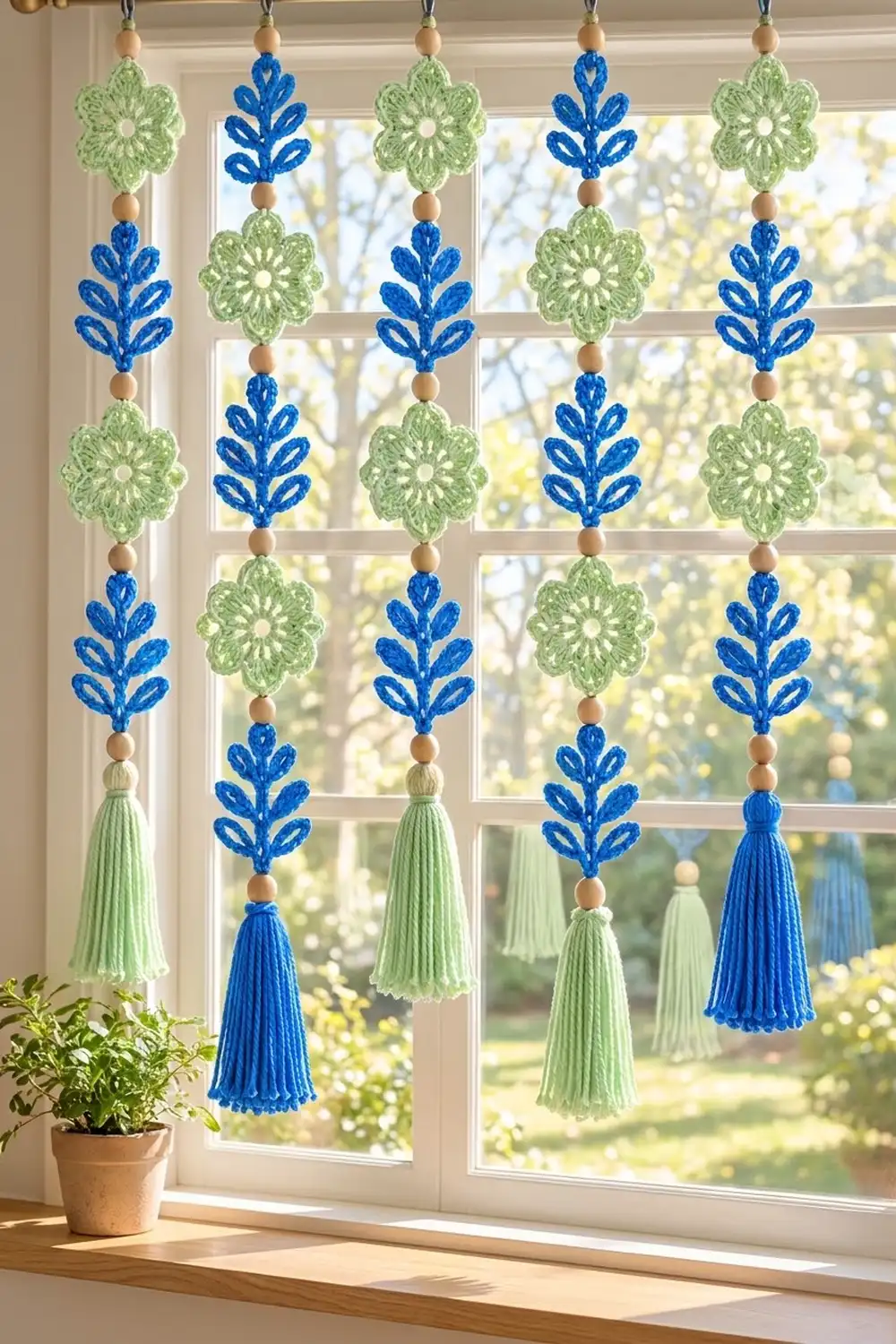
Bring a garden indoors with this beaded strand curtain. Mint green six-petal flowers alternate with cobalt blue leaf sprigs on five hanging strands. Natural wooden beads link the pieces, and each strand ends in a full, swingy tassel.
The palette is fresh and simple: soft mint, bold cobalt and pale wood. The style feels light and botanical. Sunlight shines through the open centers of the flowers and the hollow leaf loops, so the curtain looks good from both sides of the room.
This pattern uses US crochet terms. One finished strand is 24.5 in (62.2 cm) long. Hung at 5.5 in (14.0 cm) spacing, the five strands span about 25.5 in (64.8 cm).
You crochet each flower in four rounds and each leaf sprig in one continuous pass. Then you make the tassels, thread every strand together with beads, and block.
Finished Size and Construction
- Finished size: 25.5 in (64.8 cm) wide × 24.5 in (62.2 cm) long
- Skill level: Easy–Intermediate
- Terminology: US
- Yarn weight: Worsted (#4) cotton
- Hook: 4.0 mm (G-6)
- Number of pieces: 10 flowers, 10 leaf sprigs, 5 tassels
- Layout: 5 strands, each with 4 motifs (2 flowers, 2 leaves) plus a tassel
- Piece size: flower 3.5 in (8.9 cm) across; leaf sprig 4.5 in (11.4 cm) long × 2.75 in (7.0 cm) wide
- Flower size before border: 3 in (7.6 cm)
- Border depth: 1/4 in (0.6 cm) all around each flower
Materials
Choose a smooth, mercerized or combed worsted cotton. Cotton gives the stitches crisp definition and keeps its shape in the window. Acrylic will work, but it can droop and fuzz over time.
- Mint green: about 110 g / 200 m (10 flowers, 3 tassels)
- Cobalt blue: about 100 g / 180 m (10 leaf sprigs, 2 tassels, all connectors)
- Natural wooden beads: 28 round beads, 5/8 in (1.6 cm), with holes at least 1/8 in (0.3 cm) wide (25 needed plus 3 spares)
- 4.0 mm (G-6) crochet hook
- Large-eye tapestry needle
- A stiff card 4.5 in (11.4 cm) tall for tassels
- Scissors, tape measure, rust-proof pins and a blocking mat
- 5 curtain hooks or rings
All quantities include a margin of about 15–20% for gauge swatching and knots.
Abbreviations (US Terms)
- ch – chain
- sl st – slip stitch
- sc – single crochet
- hdc – half double crochet
- dc – double crochet
- sp – space
- st(s) – stitch(es)
- [ ] – repeat the instructions inside the brackets as directed
Special technique – covered loop: make a chain loop, then work single crochets into the loop (around the chains, not into individual chains). The chains end up fully hidden inside a smooth ring of sc, and the center stays open.
Gauge and Checkpoints
Make one flower and one leaf sprig first and measure them before you commit to the full set.
Flower checkpoints:
– After Round 1: 1.25 in (3.2 cm) across
– After Round 2: 2 in (5.1 cm) across
– After Round 3: 3 in (7.6 cm) tip to tip
– After Round 4 (border): 3.5 in (8.9 cm) tip to tip
Leaf checkpoints:
– 20-ch stem: 3 in (7.6 cm)
– Each side leaf: 1.25 in (3.2 cm) long
– Finished sprig: 4.5 in (11.4 cm) × 2.75 in (7.0 cm)
If your pieces are too big: go down to a 3.75 mm hook.
If they are too small: go up to a 4.5 mm hook.
Being off by 1/4 in (0.6 cm) per motif adds up to 1 in (2.5 cm) over a strand, so correct your gauge now rather than later.
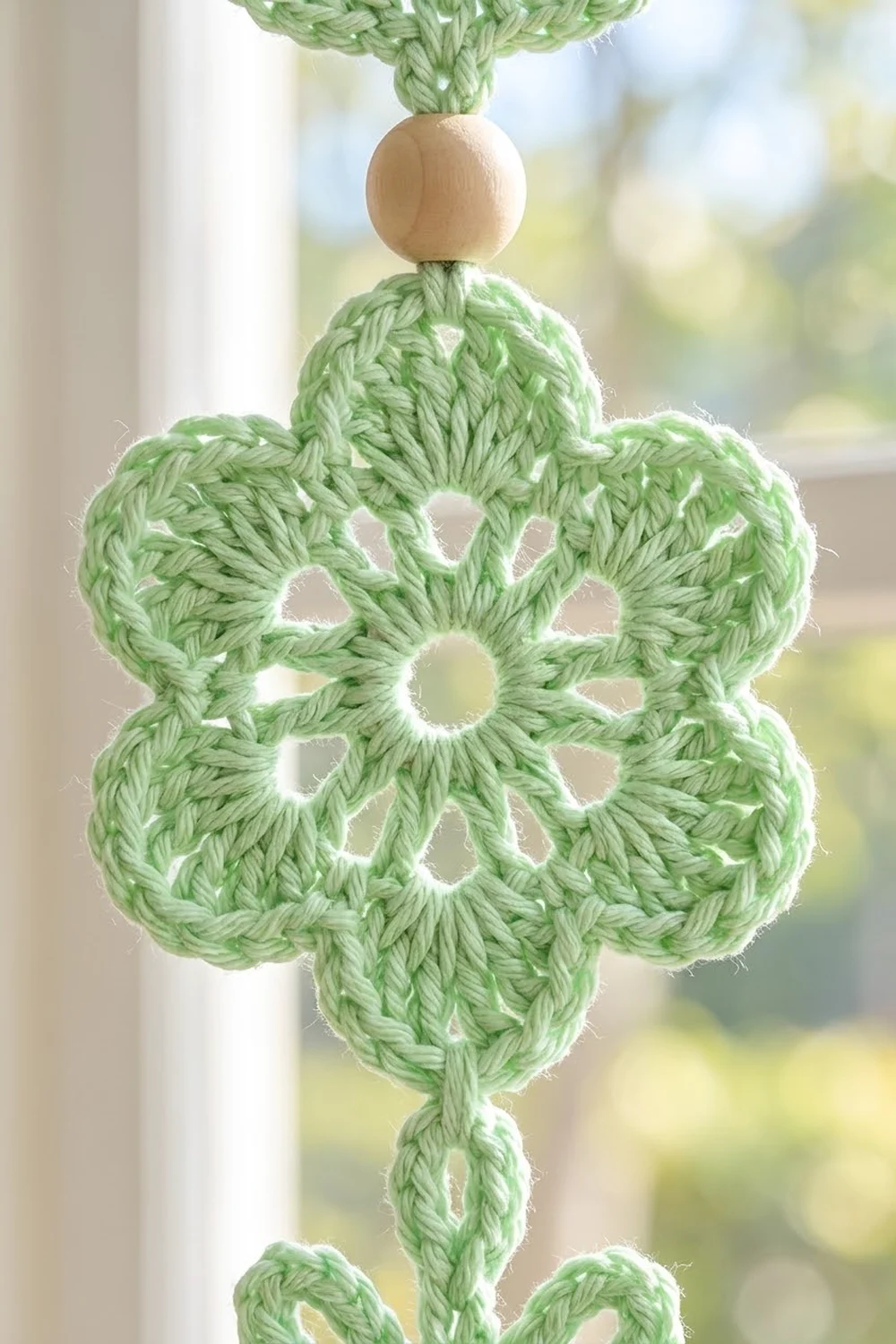
Flower Motif (Make 10 in Mint Green)
Round 1: Ch 6, sl st to the first ch to form a ring. Ch 3 (counts as dc), work 17 dc into the ring. Sl st to the top of the beginning ch-3. (18 dc)
Keep the ring open. Don’t pull the tail tight, because the open center is part of the design.
Round 2: Ch 1, sc in the same st. Ch 5, skip the next 2 sts. [Sc in next st, ch 5, skip next 2 sts] 5 times. Sl st to the first sc. (6 sc, 6 ch-5 arches)
These six arches make the ring of open windows around the center.
Round 3 (petals): Sl st into the first ch-5 arch. [Work (sc, hdc, 5 dc, hdc, sc) all into the same arch] in each of the 6 arches. Sl st to the first sc. (54 sts: 9 per petal, 6 petals)
Each sc on Round 2 sits between two petals and pulls them into the rounded scallops. Don’t fasten off yet; Round 4 is the border, given below in the Border section.
Leaf Sprig (Make 10 in Cobalt Blue)
You work the whole sprig in one pass. First the base loop and stem, then you work back down the stem, adding covered leaf loops as you go.
Base loop: Ch 6, sl st to the first ch to form a ring.
Stem: Ch 20. The last ch you made is stem ch 20 (the top). Stem ch 1 sits next to the base loop.
Top leaf: Ch 9, sl st into stem ch 20 to close a ch-9 loop. Work 14 sc into the loop. Sl st again into stem ch 20. (14 sc)
Work down the stem: Sl st in each of the next 3 stem chs (ch 19, 18, 17).
Leaf pair 1 (at stem ch 17):
– Left leaf: ch 8, sl st into stem ch 17 to close the loop. Work 12 sc into the loop, then sl st into stem ch 17. (12 sc)
– Right leaf: fold the first leaf to the left, then repeat on the right side: ch 8, sl st into stem ch 17, 12 sc into the loop, sl st into stem ch 17. (12 sc)
Leaf pairs 2–4: [Sl st in each of the next 4 stem chs, then work a leaf pair in the last stem ch you slip-stitched into] 3 times. The pairs sit at stem chs 13, 9 and 5.
Finish the base: Sl st in each of the next 4 stem chs (ch 4 down to ch 1). Sl st into the base loop. Work 8 sc into the base loop, then sl st to the first sc. Fasten off and weave in the ends.
Leaf stitch count: 14 (top) + 8 × 12 (sides) = 110 sc in the leaves, plus 8 sc in the base loop = 118 sc total. The stem has 20 ch and 19 sl sts on the way back down; stem ch 20 is used by the top leaf.
The 12 sc fill each ch-8 loop snugly without ruffling. The longer ch-9 top loop takes 14 sc, which makes the top leaf slightly larger, just like the leaf at the tip of a real sprig.
Make All Pieces
| Piece | Mint green | Cobalt blue | Total |
|---|---|---|---|
| Flowers | 10 | – | 10 |
| Leaf sprigs | – | 10 | 10 |
| Tassels | 3 | 2 | 5 |
Tassels: Wrap the yarn 60 times around the 4.5 in (11.4 cm) card. Slide a 10 in (25.4 cm) strand under the top and tie it tightly; leave these ends long for joining. Cut through the bottom of the wraps. Wrap the neck 1/2 in (1.3 cm) below the top 6 times with a separate strand, knot it and bury the ends inside the tassel. Trim the ends evenly to 4 in (10.2 cm).
Layout grid (top to bottom; F = mint flower, L = blue leaf, b = bead):
Strand:   1      2      3      4      5
          b      b      b      b      b
          F      L      F      L      F
          b      b      b      b      b
          L      F      L      F      L
          b      b      b      b      b
          F      L      F      L      F
          b      b      b      b      b
          L      F      L      F      L
          b      b      b      b      b
        mint   blue   mint   blue   mint   ← tassels
Because strands 1–5 alternate, the flowers and leaves form a checkerboard across the window.
Joining
Method: Every link is a doubled cobalt connector threaded through one bead. Each strand has 5 beads and 5 links, so you need 25 beads and 25 links in total.
Attachment points (stitch to stitch):
– Flower: Number the petals 1–6. Petal 1 points up and petal 4 points down. The tip of each petal is the gap between sc 7 and sc 8 of that petal’s 14 border sc, at the center of the middle dc.
– Leaf: The top point is the gap between sc 7 and sc 8 of the top leaf’s 14 sc. The bottom point is the base loop.
To make a link: Cut 12 in (30.5 cm) of cobalt yarn. Thread it through the bottom point of the upper piece and even up the ends. Pass both ends through a bead with the tapestry needle, then through the top point of the lower piece. Adjust the link until it is 0.75 in (1.9 cm) from piece to piece, including the bead. Tie a square knot behind the lower piece, add a drop of fabric glue if you like, and bury the ends.
Top hanging loop: Thread a connector through the top point of the first piece, then through a bead. Knot the ends to form a 1 in (2.5 cm) loop. Together, the bead and loop add 1.5 in (3.8 cm).
Tassel link: Pass the long top ties of the tassel through a bead and then through the bottom point of the last piece. Knot so the link is 0.75 in (1.9 cm).
Tension: Snug the knots, but don’t pull them so tight that the petal or leaf tip stretches into a point. Lay each finished strand flat before you knot the last link so it doesn’t twist.
Size checkpoint per strand:
1.5 (loop + bead) + 16 (two 3.5 in flowers + two 4.5 in leaves) + 2.25 (three links) + 0.75 (tassel link) + 4 (tassel) = 24.5 in (62.2 cm).
Border (Flower Edging Round)
The curtain has no outer frame. The “border” is the finishing round on each flower, which rounds out the petals and adds 1/4 in (0.6 cm) all around.
Border gauge: 4 sc = about 3/4 in (1.9 cm) along the petal curve.
Round 4 (border): Ch 1. On each petal, work: sc in the sc, sc in the hdc, 2 sc in each of the 5 dc, sc in the hdc, sc in the sc. Repeat on all 6 petals, then sl st to the first sc and fasten off.
Count per petal (side): 1 + 1 + 10 + 1 + 1 = 14 sc.
Round total: 54 stitches worked one into each existing stitch + 30 extra (one extra in each of the 30 dc) = 84 sc (14 × 6).
Why the math works: The outer edge of the 5 dc is much longer than their base. Doubling only those 5 stitches adds exactly the length the curve needs. The stitches at the petal ends (sc and hdc) stay single so the dips between petals stay sharp. The center dc of each petal gets sc 7 and sc 8, which gives you a clean, symmetrical tip to join through.
Final Blocking
- Weave in all ends before blocking. Leave the strands unassembled.
- Soak the flowers and leaves in cool water for 10 minutes, then roll them in a towel to press out the water.
- Pin each flower to 3.5 in (8.9 cm) tip to tip, with one pin at the center of each petal.
- Pin each leaf to 4.5 in (11.4 cm) × 2.75 in (7.0 cm). Fan the side leaves at about 45 degrees to the stem, and keep the stem straight.
- Let everything dry completely, which takes 12–24 hours.
- Steam the tassels lightly over a kettle or with a steamer and comb the strands straight, then trim them back to 4 in (10.2 cm).
- Assemble the strands (see Joining) and hang them. Let gravity settle the links for a day, then adjust any knots that have crept.
Final Quality-Control Checklist
- Each flower has 18 / 6 arches / 54 / 84 stitches and measures 3.5 in (8.9 cm).
- Each leaf has 1 top leaf (14 sc) and 4 pairs of side leaves (12 sc each).
- All leaf stems lie straight, with no twist.
- Each link is 0.75 in (1.9 cm) and has one bead.
- Each strand is 24.5 in (62.2 cm) long.
- The color order follows the layout grid, and the tassels alternate mint and blue.
- All knots are buried and no ends show from either side.
Troubleshooting
- The flower cups or curls: Your Round 3 dc may be too tight, or Round 2 arches too short. Loosen your tension or chain 6 instead of 5.
- Petals ruffle after the border: Your border sc is too loose. Go down half a hook size for Round 4 only.
- Leaf loops pucker: Your chains are tight. Chain more loosely or work 11 sc instead of 12, and use the same count on every leaf.
- Leaves twist around the stem: Make sure every leaf pair is worked in the same direction (left first, then right). Pin it flat when you block.
- Strands hang crooked: The links are uneven. Re-measure each one to 0.75 in (1.9 cm).
- The tassel looks thin: Add 10–15 wraps before cutting.
Care
Hand wash the strands in cool water with mild soap, press out the water in a towel and dry flat, pinning the pieces to size again if needed. Keep the curtain out of harsh all-day sun so the cobalt doesn’t fade.
Final Notes
Each stage of the curtain builds on the one before:
- Round 1 measures 1.25 in (3.2 cm).
- The petals reach 3 in (7.6 cm), and the border brings each flower to 3.5 in (8.9 cm).
- Each leaf sprig is 4.5 in (11.4 cm) long.
- Four motifs, five 0.75 in (1.9 cm) bead links, the hanging loop and a 4 in (10.2 cm) tassel make a 24.5 in (62.2 cm) strand.
- Five strands at 5.5 in (14.0 cm) spacing give a 25.5 in (64.8 cm) curtain.
If you check your gauge at each stage, every strand will hang evenly.
Happy crocheting!