

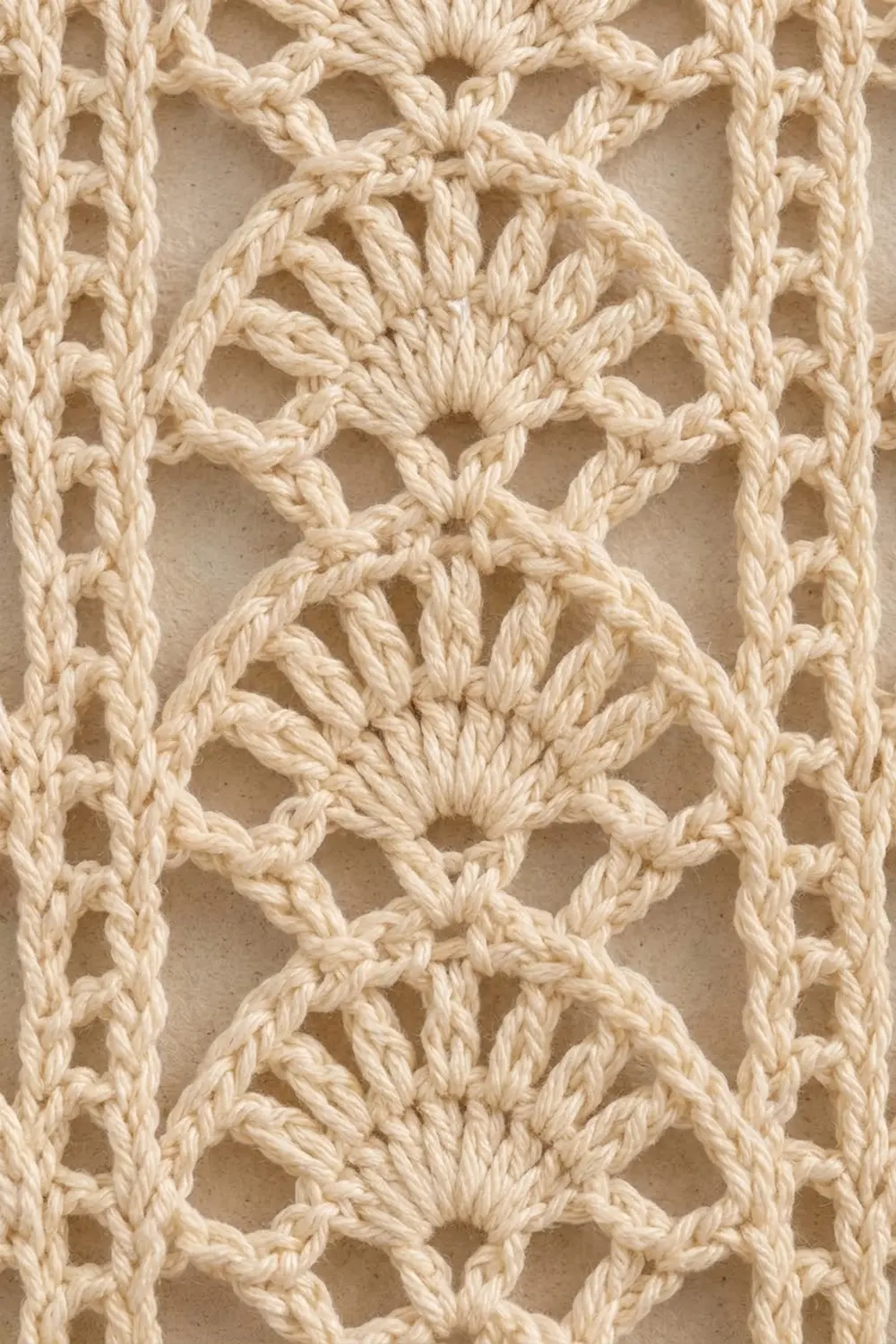
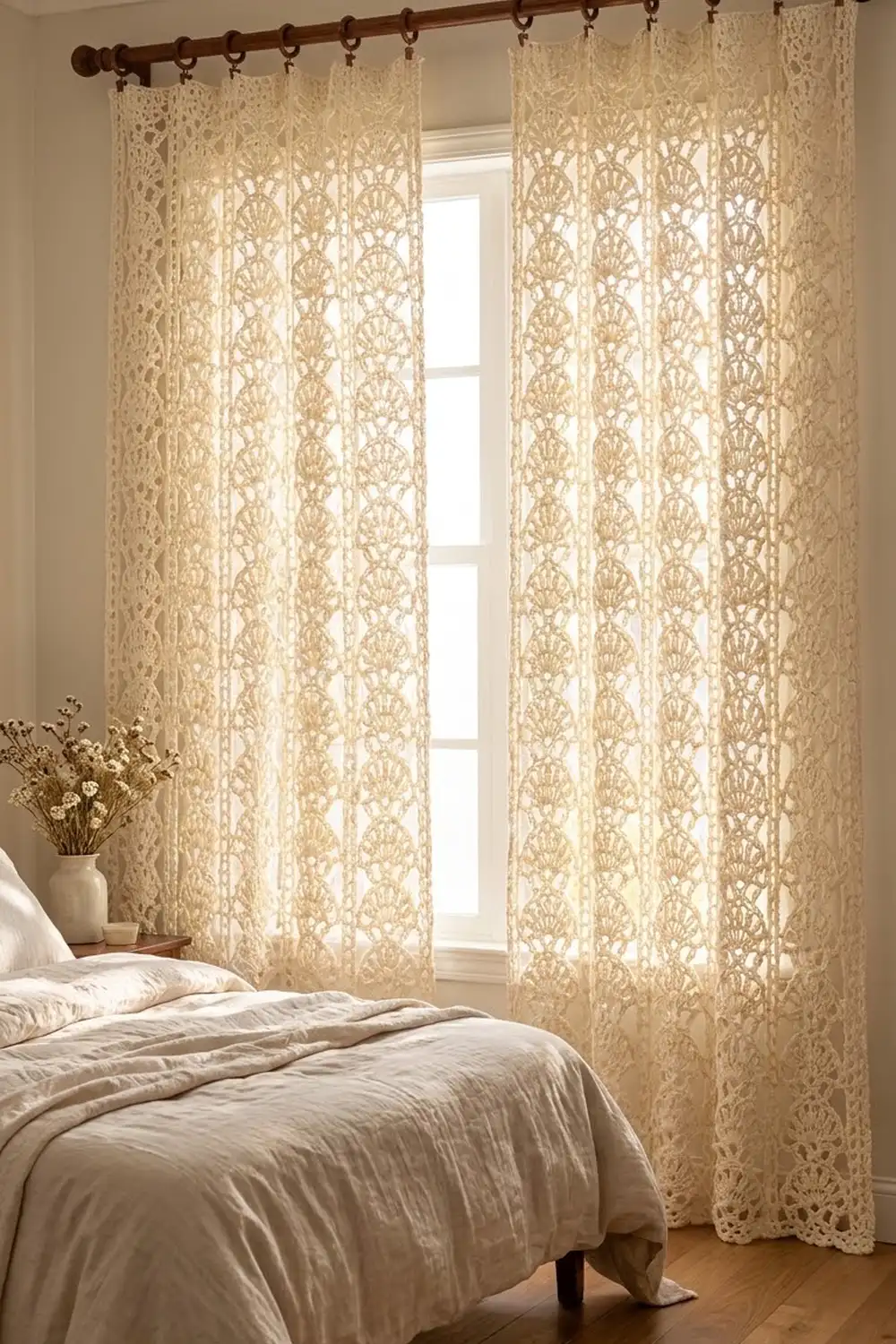
The Ivory Fan Lace Curtain Panel is a tall, airy window panel made of vertical columns of stacked fans. Each fan opens upward from a small pointed hole and sits under a soft chain arch. A narrow double-line ladder separates each fan column from the next. When light comes through, the panel looks like rows of little shells climbing the window.
The design uses only one color, a warm cream or ivory cotton. A single shade keeps the lace calm and lets the texture stand out. The panel suits cottage, farmhouse, and minimal bedrooms, and it filters light without blocking it.
This pattern is written in US crochet terms. One finished panel measures about 37.1 in (94.2 cm) wide and 79.1 in (200.9 cm) long, including a 0.5 in (1.3 cm) border. The pair in the photo is two identical panels hanging side by side, so you make the same panel twice.
Each panel is worked flat in one piece, from bottom to top, in rows. A 4-row repeat builds the V base, the fan, the chain arch, and a solid reset row. A two-round single crochet border finishes the edges, and the panels hang from clip rings. No sewing or joining is needed.
Finished Size and Construction
- Finished size (one panel): 37.1 in x 79.1 in (94.2 cm x 200.9 cm)
- Skill level: Intermediate
- Terminology: US crochet terms
- Yarn weight: Worsted (weight 4), cotton or cotton blend
- Hook: 6 mm (US J-10)
- Number of pieces: 2 identical panels, each worked as one single piece
- Layout: The panels hang side by side and are not joined to each other
- Piece size before border: 36.1 in x 78.1 in (91.7 cm x 198.4 cm)
- Border depth: 0.5 in (1.3 cm) on every side
Materials
Choose a smooth cotton in worsted weight, either mercerized or soft-spun. Cotton holds the fan shapes crisply and hangs straight. Avoid fuzzy yarns, because they blur the holes. Look for a yarn with about 170 m per 100 g. A cotton-linen or cotton-bamboo blend also works and drapes a little more. Natural, undyed cream hides small changes in tension better than bright white.
- Cream / ivory: 1,250 g (about 2,125 m) per panel; 2,500 g (about 4,250 m) for the pair
Tools:
- 6 mm (US J-10) crochet hook
- Tapestry needle
- Stitch markers (at least 10)
- Tape measure
- Blocking mats or a towel-covered carpet, plus rust-proof pins
- Spray bottle
- 18 curtain clip rings (9 per panel) and a curtain rod
The yarn amounts include a margin of about 10% for your swatch, small gauge differences, and weaving in ends. Buy all the yarn from the same dye lot.
Abbreviations (US Terms)
- ch – chain
- sc – single crochet
- dc – double crochet
- sk – skip
- st(s) – stitch(es)
- sp – space
- RS / WS – right side / wrong side
Special stitch – V-stitch (V): (dc, ch 3, dc) in the same st. The ch-3 sp becomes the small hole at the base of each fan.
Ladder (3 sts): dc in next st, ch 1, sk next st, dc in next st. This makes the narrow double-line column between fans. Ladder dc always go into dc, never into a ch-1 sp.
Counting rule: every dc, sc, and chain counts as 1 st. The turning ch-4 counts as a dc plus a ch-1, which is 2 sts.
Gauge and Checkpoints
Gauge in pattern: 14 sts (one fan section plus one ladder) = 5 in (12.7 cm); 8 rows = 5 in (12.7 cm). Each row is 0.625 in (1.6 cm) tall.
Why gauge matters here: being off by just 1 st per 5 in changes the panel width by almost 2.8 in (7.1 cm). Over 125 rows, small height differences also add up.
Test one piece first. Ch 33. Work Row 1 (31 sts), then work Rows 2–5 twice, for 9 rows in total. The swatch has 2 fan columns and 3 ladders. Wet block it lightly. It should measure about 11.1 in (28.2 cm) wide and 5.6 in (14.2 cm) tall.
- Swatch too big: use a hook 0.5 mm smaller.
- Swatch too small: use a hook 0.5 mm larger.
- Width correct but height off: pull up the first loop of each dc a little more or a little less instead of changing hooks.
Panel checkpoints (measure flat, lightly smoothed):
- After Row 1: 36.1 in (91.7 cm) wide
- After Row 33: 20.6 in (52.3 cm) long
- After Row 65: 40.6 in (103.1 cm) long
- After Row 97: 60.6 in (153.9 cm) long
- After Row 125: 78.1 in (198.4 cm) long, 36.1 in (91.7 cm) wide
If the width drifts by more than 0.5 in (1.3 cm), recount. Every row must have 101 sts.
Panel Pattern
The panel has 7 fan columns separated by 8 ladders, including one ladder on each edge. Width math: 8 ladders x 3 sts = 24 sts, plus 7 fan sections x 11 sts = 77 sts, for 101 sts.
Reading the pattern: every row follows the same rhythm across the width: ladder, fan section, ladder, fan section, and so on, ending with a ladder. Once you see that rhythm, you will rarely need the written instructions. On Row 2, place a marker in the first st of each fan section and move the markers up every few rows.
Foundation: Ch 103.
Row 1 (RS): Dc in 4th ch from hook (the skipped 3 ch count as the first dc) and in each ch across. Turn. (101 sts)
Rows 2–5 are the pattern repeat. Every row starts with the first ladder: ch 4 (counts as dc and ch-1), sk next st, dc in next st. Every row ends with the last ladder, with the final dc worked in the 3rd ch of the turning ch.
Row 2 (V row): Ch 4, sk next st, dc in next st. Ch 3, sk next 5 sts, V in next st, ch 3, sk next 5 sts (fan section, 11 sts); ladder over next 3 sts; rep from * 6 more times. Turn. (101 sts: 7 fan sections x 11 + 8 ladders x 3)*
Row 3 (fan row): Ch 4, sk next st, dc in next st. Ch 1, sk next 4 sts (ch-3 and dc), 9 dc in ch-3 sp of V, sk next 4 sts (dc and ch-3), ch 1 (fan section, 11 sts); ladder over next 3 sts; rep from * 6 more times. Turn. (101 sts)*
The 9 dc spread out from the V hole, which gives each fan its pointed base and rounded top.
Row 4 (arch row): Ch 4, sk next st, dc in next st. Ch 5, sk next 5 sts (ch-1 and 4 dc), sc in next dc (center dc of fan), ch 5, sk next 5 sts (4 dc and ch-1) (fan section, 11 sts); ladder over next 3 sts; rep from * 6 more times. Turn. (101 sts)*
The two ch-5 loops make the soft chain arch over each fan.
Row 5 (reset row): Ch 4, sk next st, dc in next st. 5 dc in next ch-5 sp, dc in sc, 5 dc in next ch-5 sp (fan section, 11 dc); ladder over next 3 sts; rep from * 6 more times. Turn. (101 sts)*
Row 5 is solid across each fan section, so it is the easiest row for checking your count. Each fan section should have exactly 11 dc.
Rows 6–125: Repeat Rows 2–5 thirty more times, for 31 repeats in total. End after a Row 5. Either fasten off and weave in ends, or keep the loop live and start the border.
Row count check: 1 foundation row + 31 repeats x 4 rows = 125 rows. 125 rows x 0.625 in = 78.1 in (198.4 cm).
Adjusting the length: each 4-row repeat adds 2.5 in (6.4 cm). Only add or remove whole repeats, always end after a Row 5, and change each side’s border count by 7 sc per repeat. All the finished sizes in this pattern assume 31 repeats.
Make Both Panels
Make 2 panels in cream, each exactly as written above. Each panel uses about 1,250 g (2,125 m).
Window layout (as hung):
[ Panel A ] [ Panel B ]
  37.1 in     37.1 in
Use the same hook for both panels, and try to make them close together in time so your tension matches. Compare them at the Row 33 checkpoint; they should be within 0.25 in (0.6 cm) of each other. When you change skeins, alternate between the old and new skein for a few rows. Any slight shade difference will then blend in instead of making a visible line.
Joining
The panels are not joined to each other. Each one hangs on its own clip rings, so you can open and close them like regular curtains.
Hanging logic: after the border, the top edge has 105 sts including both corners. Clip into sts 1, 14, 27, 40, 53, 66, 79, 92, and 105. That makes 8 equal intervals of 13 sts (8 x 13 = 104 = 105 – 1), so the 9 clips are about 4.6 in (11.7 cm) apart.
Tension advice: clip into the border sc, not into the lace, so the fans do not stretch. For a gathered look, keep the same 9 clips and slide them closer together on the rod. Let the panel hang for 24 hours before you judge the length, because cotton lace drops a little.
Size checkpoint: a hanging panel can grow up to 1 in (2.5 cm) in length. Set the rod height so the bottom border sits just above the floor or sill.
Border
Border gauge: 14 sc = 5 in (12.7 cm), which matches the panel’s 2.8 sts per inch. Along the sides, work 7 sc over every 4 rows (2.5 in / 6.4 cm), which is also 2.8 sc per inch.
Round 1 (RS): With RS facing, join yarn in the first st of Row 125.
- Top: 3 sc in first st, sc in next 99 sts, 3 sc in last st.
- First side: working in row ends, 2 sc in each of the next 3 rows, then 1 sc in the 4th row. Repeat this 2-2-2-1 sequence for all 31 repeats (217 sc), then work 2 sc in the end of Row 1. (219 sc between corner groups)
- Bottom: working in the free loops of the foundation chain, 3 sc in first ch, sc in next 99 ch, 3 sc in last ch.
- Second side: 2 sc in Row 1, then the 2-1-2-2 sequence going up so it mirrors the first side (219 sc).
- Sl st to first sc. Place a marker in each of the 4 corner sts, which are the middle sc of each 3-sc group.
Counts per side, including both corner sts: top 103, bottom 103, each side 223 (corner + 1 + 219 + 1 + corner). Round 1 total: 648 sts (103 + 103 + 223 + 223 – 4 shared corners).
Round 2 (conversion round): Ch 1, sc in each sc around, working 3 sc in each marked corner st. Sl st to first sc. (648 sts worked 1-per-stitch + 8 extra at corners = 656 sts)
Counts per side, including corners: top 105, bottom 105, each side 225. Check: 105 + 105 + 225 + 225 – 4 = 656.
Fasten off and weave in ends.
Why the math works: the top and bottom edges use one sc per panel st, so the 101 sts keep their spacing of 2.8 per inch. On the sides, 7 sc per 2.5 in is also 2.8 per inch, so the border lies flat without ruffling or pulling in. The two sc rounds add 0.5 in (1.3 cm) per edge: 36.1 in + 1 in = 37.1 in (94.2 cm) wide, and 78.1 in + 1 in = 79.1 in (200.9 cm) long.
Final Blocking
- Soak the panel in cool water with a little mild soap for 15 minutes.
- Press the water out gently without wringing, then roll the panel in towels.
- Lay it flat on mats or a towel-covered carpet. Because the panel is so long, you can block it in two sections.
- Pin the corners first, to 37.1 in x 79.1 in (94.2 cm x 200.9 cm).
- Pin along each ladder column to keep it straight and vertical.
- Smooth each fan’s 9 dc into an even half circle. If a center hole closes up, pin it open.
- Let the panel dry completely, for at least 24 hours.
- Optional: hold a steam iron above the dry panel, without touching it, to relax any stubborn fans. Repeat all steps for the second panel.
Final Quality-Control Checklist
- Every row has 101 sts, and every Row 5 has 11 dc per fan section.
- There are seven fan columns, and each fan rises from a small V hole.
- The ladders run straight from bottom to top on both edges and between all the fans.
- Border Round 2 counts: 105 top, 105 bottom, 225 per side.
- The panel measures 37.1 in x 79.1 in (94.2 cm x 200.9 cm) after blocking.
- Both panels match within 0.5 in (1.3 cm).
- No joins or knots show on the right side.
- Clips are evenly spaced along the top border.
Troubleshooting
- Fans lean to one side: the V is off-center. It belongs in the 6th st of each 11-st section.
- Panel gets narrower as you go: you are missing the turning ch at the end of the row. Work the last dc into the 3rd ch of the turning ch-4.
- Ladders zigzag: you are working ladder dc into the ch-1 sp. Work them into the dc instead.
- Holes at the fan bases are closed: the V is too tight. Make the ch-3 a little looser.
- Arches look tight: chain more loosely, or use a hook 0.5 mm larger for the ch-5s only.
- Border ruffles on the sides: there are too many sc. Follow the 2-2-2-1 sequence exactly.
- Border pulls in: use a hook 0.5 mm larger for the border only.
- Panel twists on the rod: check that both side borders have the same number of sc.
- Panels are different lengths: add or remove a full 4-row repeat before the border, or block the shorter panel a little longer.
Care
Hand wash, or machine wash on a gentle cool cycle inside a mesh laundry bag. Dry flat and reshape the fans while damp; never hang a wet panel.
Final Notes
The measurements build on each other. A gauge of 14 sts and 8 rows to 5 in (12.7 cm) gives 101 sts at 36.1 in (91.7 cm) wide and 125 rows at 78.1 in (198.4 cm) long. Two border rounds add 0.5 in (1.3 cm) to each edge, for a finished panel of 37.1 in x 79.1 in (94.2 cm x 200.9 cm). Make two panels, clip each one to nine rings, and let the light shine through the fans.
Happy crocheting!