

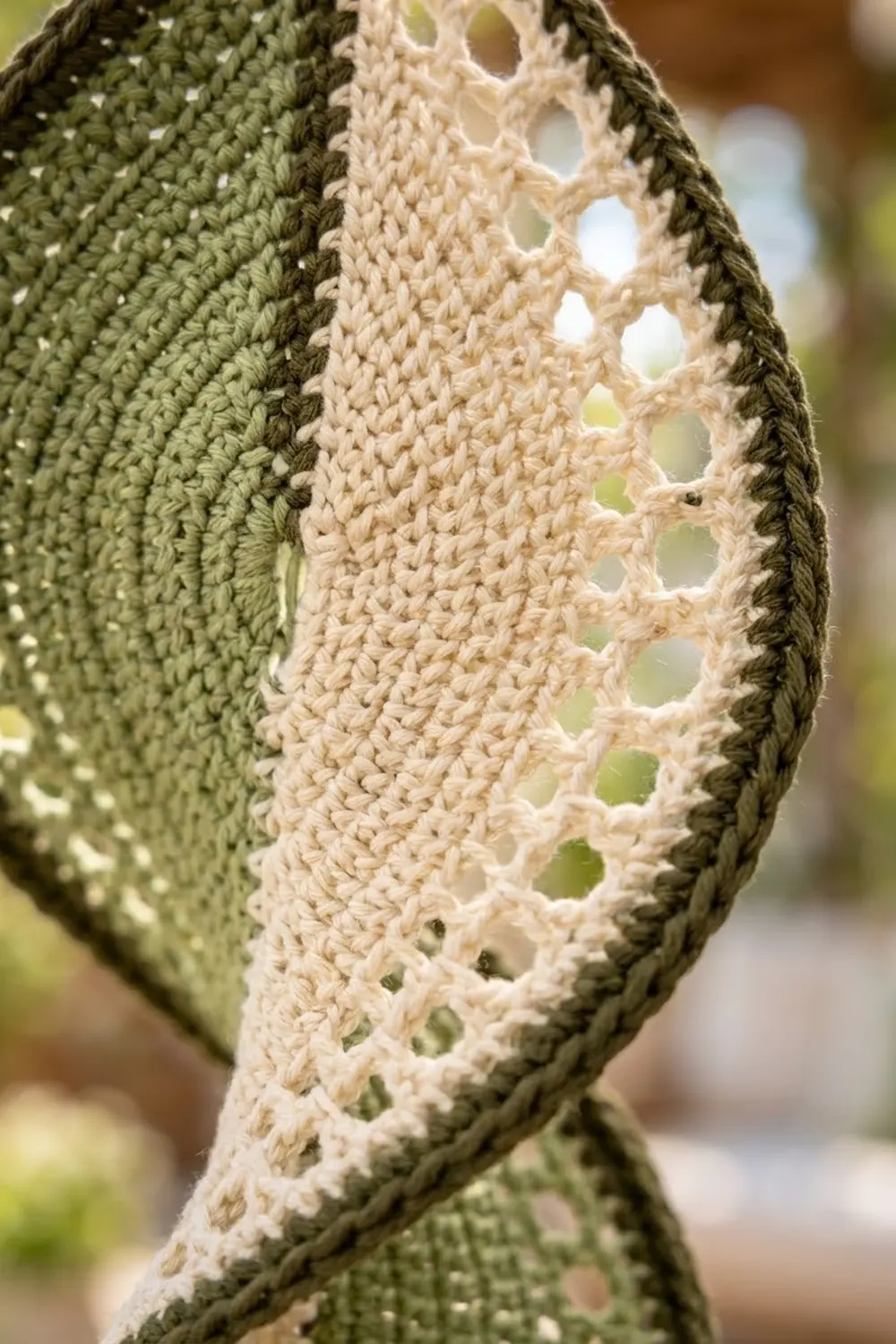
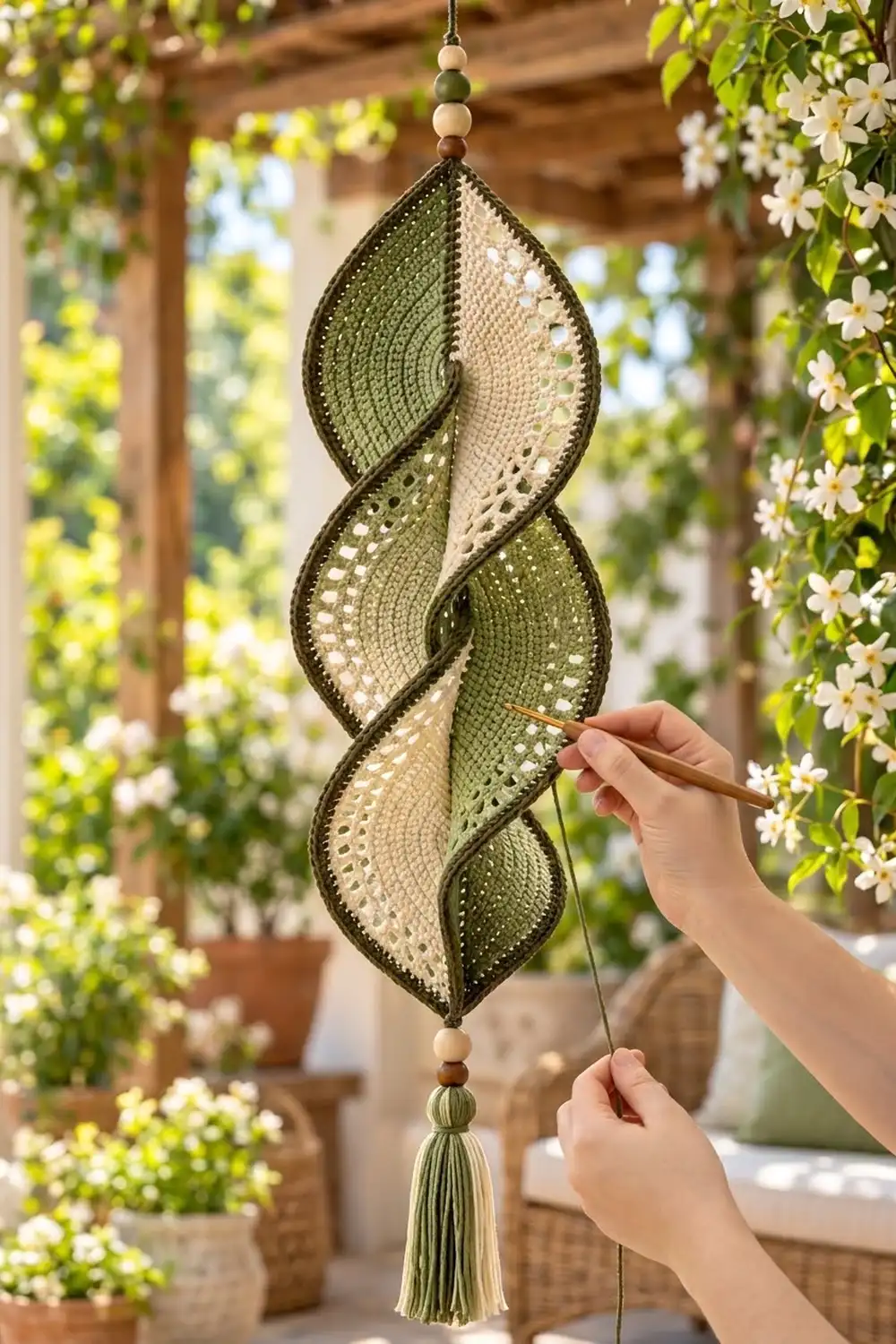
The Sage Twist Spiral Wall Hanging is one long, pointed oval of crochet. It is stiffened and twisted so its green and cream halves wind around each other as it hangs. As light hits it, you see dense sage stitches on one turn and airy cream eyelets on the next, all outlined in a corded dark olive edge.
The palette is calm and garden-inspired: sage green, warm cream and deep olive, with natural wooden beads and a three-color tassel. It suits a sunroom window, a porch post or a plant corner.
This pattern uses US crochet terms. The flat piece measures 18 in (45.7 cm) long and 5 in (12.7 cm) wide. Twisted, the body hangs about 16 in (40.6 cm) long. With beads and tassel, the total drop is about 23.5 in (59.7 cm).
The construction is simple. You chain a long foundation, work the green half in tapering rows along one side of it, then work the cream half the same way into the chain’s free loops. A two-round olive border goes all the way around. Finally you stiffen the piece, twist it and add the beads and tassel.
Finished Size and Construction
- Finished size (flat): 18 in x 5 in (45.7 cm x 12.7 cm)
- Finished size (twisted body): about 16 in (40.6 cm) long
- Total hanging length: about 23.5 in (59.7 cm)
- Skill level: Intermediate
- Terminology: US
- Yarn weight: DK cotton (#3 light)
- Hook: 3.5 mm (E/4)
- Number of pieces: 1
- Layout: One lens-shaped panel, split lengthwise into two colors
- Piece size before border: 17.4 in x 4.4 in (44.2 cm x 11.2 cm)
- Border depth: 0.3 in (0.8 cm) on every side
Materials
Use a smooth, mercerized or combed DK cotton. Cotton holds the stiffened twist and shows the eyelets crisply. Avoid fuzzy or very stretchy yarns, because they won’t keep the spiral shape.
- Sage green: 25 g / 60 m (body half plus tassel)
- Cream: 25 g / 60 m (body half plus tassel)
- Dark olive: 15 g / 36 m (border, tassel and tassel wrap)
All quantities include a margin of about 20 percent for swatching and tails.
Tools and notions:
- 3.5 mm (E/4) crochet hook
- Tapestry needle
- Stitch markers (2)
- 1 yd (91.4 cm) of 2 mm cotton cord, or a twisted cord made from olive yarn
- 6 wooden beads with holes of at least 3 mm: top set of natural, green, natural, brown (12 mm); bottom set of natural, brown (10 mm)
- Fabric stiffener or heavy starch
- Blocking mat, rustproof pins and a 4.5 in (11.4 cm) piece of cardboard
- A spare hook or dowel to hang the piece from while it dries
Abbreviations (US Terms)
- ch: chain
- sl st: slip stitch
- sc: single crochet
- dc: double crochet
- sk: skip
- sp: space
- st(s): stitch(es)
- rev sc: reverse single crochet (crab stitch)
- FLO: free loops of the foundation chain
Special stitch: Reverse single crochet (rev sc). Work from left to right (or right to left if you crochet left-handed). Insert the hook into the next stitch to the right, yarn over, pull up a loop, yarn over and draw through both loops. This makes the raised, corded olive edge.
Counting note: Slip stitches used to move along at the start of a shortened row are never counted.
Gauge and Checkpoints
Gauge: 20 sc and 20 rows = 4 in (10.2 cm) in sc. One sc is 0.2 in (0.5 cm) wide and one sc row is 0.2 in (0.5 cm) tall. One dc row is about 0.4 in (1.0 cm) tall.
Work a 4 in (10.2 cm) swatch first. Because the shape depends on the stitch chain along its length, gauge matters more here than usual.
Checkpoints:
- After green Row 1, the 87 sc should measure 17.4 in (44.2 cm).
- After green Row 7, the green half should be 1.4 in (3.6 cm) tall at its center.
- After green Row 8, the eyelet row, it should be 1.8 in (4.6 cm) tall.
- After green Row 10, it should be 2.2 in (5.6 cm) tall.
- With both halves done, the piece should measure 17.4 in x 4.4 in (44.2 cm x 11.2 cm).
- After the border, it should measure 18 in x 5 in (45.7 cm x 12.7 cm).
If your piece is too big, go down 0.5 mm in hook size. If it is too small, go up 0.5 mm. Don’t change the stitch counts, because the border math depends on them.
Green Half
Work in rows along one side of the foundation chain. Each row is shorter at both ends, which curves the edge into a pointed oval.
Foundation: With sage green, ch 88.
Row 1: Sc in 2nd ch from hook and in each ch across. Turn. (87 sc)
Place a marker in the first and last sc. These mark the two tips.
Row 2: Sl st in first 2 sts, ch 1, sc in next 83 sts, leave last 2 sts unworked. Turn. (83 sc)
Row 3: Sl st in first 2 sts, ch 1, sc in next 79 sts, leave last 2 sts unworked. Turn. (79 sc)
Row 4: Sl st in first 2 sts, ch 1, sc in next 75 sts, leave last 2 sts unworked. Turn. (75 sc)
Row 5: Sl st in first 3 sts, ch 1, sc in next 69 sts, leave last 3 sts unworked. Turn. (69 sc)
Row 6: Sl st in first 3 sts, ch 1, sc in next 63 sts, leave last 3 sts unworked. Turn. (63 sc)
Row 7: Sl st in first 3 sts, ch 1, sc in next 57 sts, leave last 3 sts unworked. Turn. (57 sc)
Checkpoint: 1.4 in (3.6 cm) tall at the center.
Row 8 (eyelet row): Sl st in first 4 sts, ch 3 (counts as dc) in the same st as the last sl st… see note. Ch 1, sk next st, dc in next st. Repeat from * 24 times in total, leaving the last 4 sts unworked. Turn. (25 dc + 24 ch-1 sps = 49 sts)
Note: The ch 3 sits on the 5th stitch, so 4 stitches are skipped at each end. The pattern is 1 starting dc + (ch 1, dc) x 24 = 49 sts across, with 24 eyelets.
Row 9: Sl st in first 5 sts (counting each dc and ch-1 sp as a st), ch 1, sc in next 39 sts, leave last 5 sts unworked. Turn. (39 sc)
Row 10: Sl st in first 6 sts, ch 1, sc in next 27 sts, leave last 6 sts unworked. (27 sc) Fasten off.
Checkpoint: 2.2 in (5.6 cm) tall at the center.
Shortening check: at each end you have skipped 2 + 2 + 2 + 3 + 3 + 3 + 4 + 5 + 6 = 30 stitch positions. That leaves 87 – 60 = 27 stitches for Row 10, which matches.
Cream Half
Turn the piece so the free loops of the foundation chain face up and the green half points away from you.
Row 1: Join cream in the free loop at the right-hand tip. Ch 1, sc in each FLO across. Turn. (87 sc)
The cream sc sit directly under the green sc. This forms a neat center line that becomes the axis of the spiral.
Rows 2–10: Work exactly like green Rows 2–10, with the same counts: 83, 79, 75, 69, 63, 57, 49 (eyelet row), 39, 27. Fasten off.
Checkpoint: the whole piece should now measure 17.4 in x 4.4 in (44.2 cm x 11.2 cm), with tips at both ends of the foundation chain.
Weave in all green and cream tails along their own color.
Border
The border is two rounds in dark olive. It closes over the stepped row ends and makes the corded outline.
Border gauge: same as the body, 5 sc per inch (2.5 cm). Each long edge is a curve about 18 in (45.7 cm) long once the border sits on it.
How the sides are counted: each long edge (one per color half) is a “side.” The 3 sc at each tip are counted separately as tip groups. The side counts below do not include tip stitches.
Round 1: Join olive in the first st of green Row 10. Then work the green side as follows:
- Sc in each of the 27 sts of Row 10.
- Work down the flank toward the tip. Put 1 sc in each exposed stitch on the step tops, including the stitches under the slip stitches (30 sts). Add 1 extra sc at the side of the Row 8 dc post. That is 31 sc. Don’t work separately into the short sc row ends, because the sc on each step covers them.
- Work 3 sc in the tip, at the end of the foundation chain.
Work the cream side the same way: 31 sc up the flank, 27 sc across Row 10 and 31 sc down the other flank. Then work 3 sc in the second tip. Finish the remaining green flank with 31 sc and sl st to the first sc.
Count: each side has 31 + 27 + 31 = 89 sc, and each tip group has 3 sc.
Round total: (2 sides x 89) + (2 tips x 3) = 178 + 6 = 184 sc.
Round 2: Ch 1, rev sc in each st around, keeping the center sc of each tip group sharp. Sl st to the first rev sc. (184 rev sc) Fasten off and weave in the ends.
Why the math works: each curved side is about 18.1 in (46.0 cm) along its arc. At 5 sc per inch (2.5 cm), that needs about 90 sc. The 89 sc per side, plus a share of each tip group, matches that length, so the edge lies flat without ruffling or cupping. Round 2 adds no stitches. The rev sc only rolls the edge into a cord, so it adds about 0.1 in (0.3 cm) of depth without changing the length. Round 1 (0.2 in / 0.5 cm) plus Round 2 (0.1 in / 0.3 cm) makes 0.3 in (0.8 cm) of border on every side. That brings 17.4 in x 4.4 in (44.2 cm x 11.2 cm) up to 18 in x 5 in (45.7 cm x 12.7 cm).
Tassel and Hanging Hardware
Tassel: Wrap yarn 30 times around the 4.5 in (11.4 cm) cardboard: 12 wraps of sage, 10 of cream and 8 of olive. Slide a 12 in (30.5 cm) piece of sage under the wraps at one edge and tie tightly. Cut the opposite edge. Wrap sage 8 times around the bundle 0.5 in (1.3 cm) below the tie to form the head, and knot. Trim the strands to 4 in (10.2 cm).
Top cord: Cut 18 in (45.7 cm) of cord. Thread it through the center stitch of the top tip group and knot it snugly against the edge. Slide on the brown, natural, green and natural beads. Tie a 2 in (5.1 cm) hanging loop at the end.
Bottom drop: Cut 8 in (20.3 cm) of cord. Thread it through the center stitch of the bottom tip group and knot. Add the natural and brown beads, then tie on the tassel’s top ties.
Add the cords after blocking, so the stiffener doesn’t stain the beads.
Final Blocking
- Soak the piece in lukewarm water for 10 minutes, then roll it in a towel to remove extra water.
- Pin it flat to 18 in x 5 in (45.7 cm x 12.7 cm). Pin both tips to sharp points and open every eyelet.
- Let it dry completely so the shape is set flat.
- Saturate the piece with fabric stiffener and squeeze out the excess. Leave no film in the eyelets.
- Hang the top tip from a hook or dowel. Holding the bottom tip, rotate it 1.5 full turns (540°) in one direction. The green and cream halves should alternate three times down each edge.
- Pin or clip the bottom tip to a weight or a lower anchor so the twisted body is about 16 in (40.6 cm) long. Adjust the twists so they are evenly spaced.
- Let it dry for 24 hours. Check that it holds the spiral when you release it, then add the cords, beads and tassel.
Final Quality-Control Checklist
- Green Row 1 and cream Row 1 each have 87 sc.
- Both halves end with 27 sc in Row 10.
- Each half has 24 eyelets.
- The center line is straight and runs exactly from tip to tip.
- Border Round 1 has 184 sc: 89 per side and 3 per tip.
- Border Round 2 has 184 rev sc and a smooth, even cord.
- The flat size was 18 in x 5 in (45.7 cm x 12.7 cm) before twisting.
- The twist is even, about 1.5 turns over 16 in (40.6 cm).
- The beads are knotted securely and the tassel is trimmed level.
Troubleshooting
The edge ruffles after Round 1. You worked too many stitches into the flanks. Keep exactly 31 per flank and never work into the short row ends.
The edge cups or pulls in. You have too few stitches or your tension is tight. Check your counts and loosen up, or go up a hook size for Round 1 only.
The tips are rounded. Make sure the tip group is exactly 3 sc in one spot, and pin the tips firmly while blocking.
The spiral untwists. It needs more stiffener. Re-wet the piece, apply a heavier coat and let it dry fully before handling.
One half is wider than the other. The two halves have different row heights. Match tension between colors or change hook size for the looser color.
The eyelets close up. Pin them open while blocking, or use a slightly larger hook for Row 8.
Care
Dust it gently with a soft brush or a cool hairdryer. Washing removes the stiffener, so if you ever wash it, block it flat, stiffen it and twist it again.
Final Notes
The measurement chain is simple to follow:
- 87 sc gives 17.4 in (44.2 cm) of length.
- Ten tapering rows per half give 2.2 in (5.6 cm) on each side of the chain, for 4.4 in (11.2 cm) of width.
- A 0.3 in (0.8 cm) border of 184 stitches finishes the piece at 18 in x 5 in (45.7 cm x 12.7 cm).
- One and a half turns shape it into a 16 in (40.6 cm) spiral.
Check each stage against its checkpoint and the twist will fall into place.
Happy crocheting!