

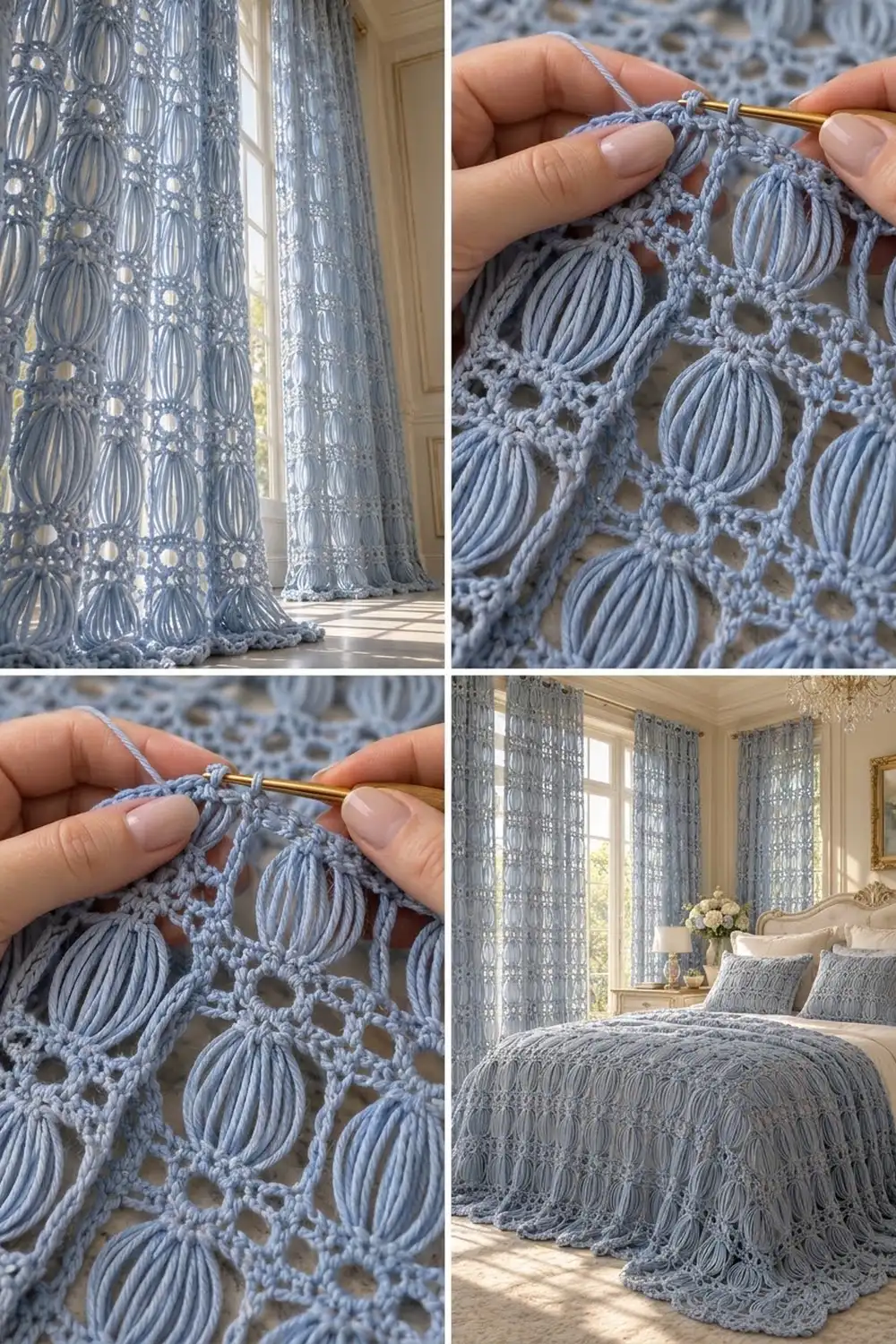
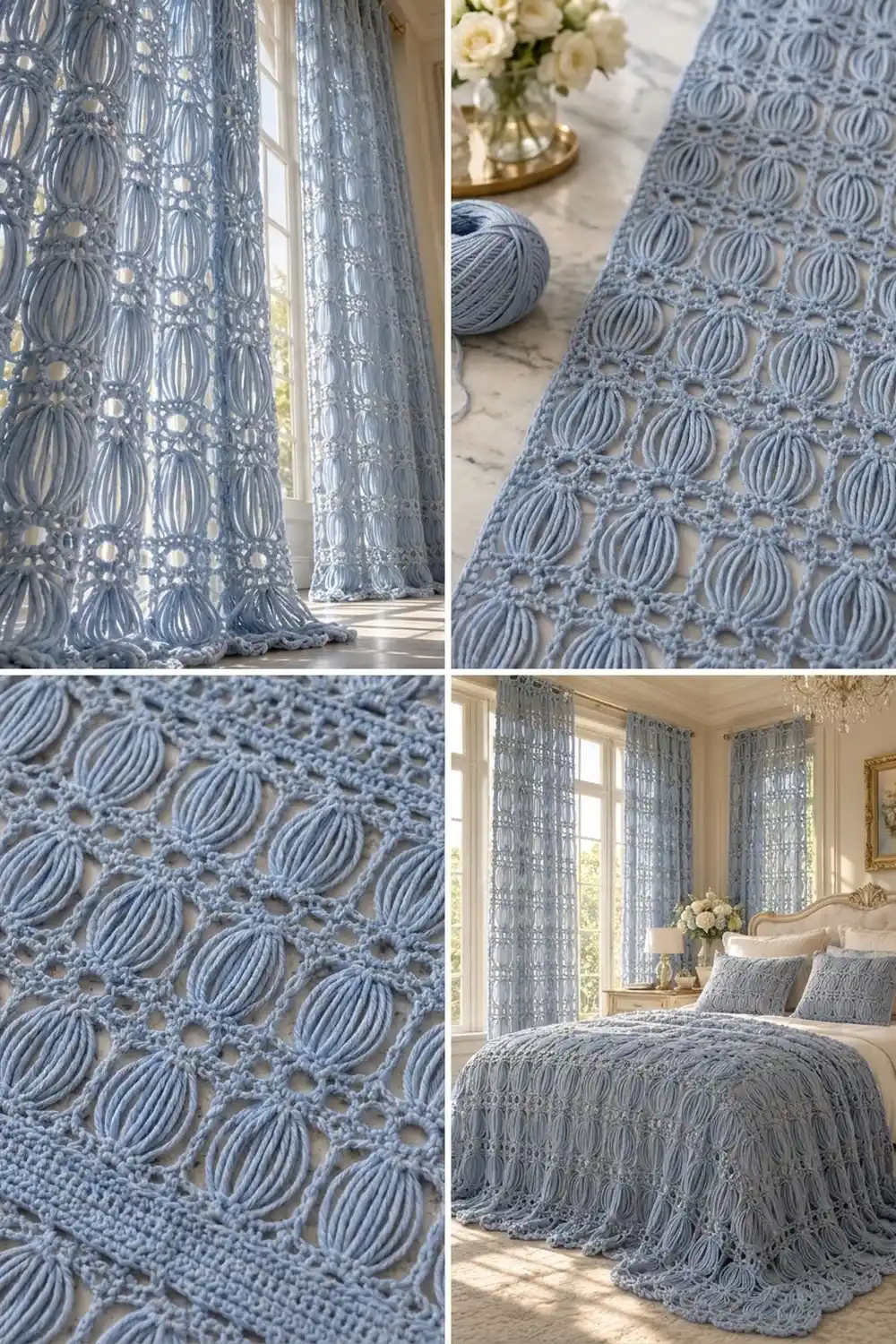
This floor-length curtain panel is built on one simple idea: tall, airy “lanterns” made of long drawn-up loops. They stack in neat columns with a small eyelet ring between each one. When the panel hangs in a sunny window, light comes through the open strands and the whole piece glows.
The sample uses a single soft powder-blue cotton, which keeps the look calm and slightly vintage. It suits a bedroom, a guest room, or any window where you want privacy without blocking the light.
This pattern uses US crochet terms. The finished panel measures 50.3 in (127.8 cm) wide by 83 in (210.8 cm) long, including the border.
The panel is one piece, worked flat in rows from the bottom up. A four-row repeat builds each band: an eyelet row, a closing row, a tall lantern row, and a single crochet row. A three-round border finishes all four edges and gives you small loops for clip rings at the top.
Finished Size and Construction
- Finished size: 50.3 in x 83 in (127.8 cm x 210.8 cm)
- Skill level: Intermediate
- Terminology: US crochet terms
- Yarn weight: Aran / heavy worsted (weight 4), cotton or cotton blend
- Hook: 6 mm (US J-10)
- Number of pieces: 1 (single panel)
- Layout: 12 lantern columns across, 20 lantern bands up
- Piece size before border: 48.3 in x 81 in (122.7 cm x 205.7 cm)
- Border depth: 1 in (2.5 cm) on every side
Materials
Choose a smooth, firm cotton or cotton blend in aran weight. Mercerized or combed cotton shows the long lantern strands clearly and resists stretching while the panel hangs. Avoid fuzzy or very splitty yarns, because the drawn-up loops need to slide cleanly off the hook.
A cotton-linen blend also works well and drapes a little more. Avoid pure acrylic for a window panel, since it can stretch and shine in direct sun.
- Powder blue: 1,600 g, about 2,720 m (2,975 yd). For example, 16 balls of 100 g / 170 m (186 yd).
This quantity includes a margin of about 15 percent for swatching, differences in loop height, and the border. Buy all of your yarn from one dye lot.
Tools:
- 6 mm (US J-10) crochet hook
- Loop gauge strip: stiff cardboard or a plastic ruler cut 3 in (7.6 cm) wide and about 8 in (20.3 cm) long
- Stitch markers
- Tapestry needle
- Measuring tape
- Rust-proof pins and blocking space (a clean floor with towels works)
- Clip-style curtain rings for hanging
Abbreviations (US Terms)
- ch – chain
- sc – single crochet
- sl st – slip stitch
- sp – space
- st(s) – stitch(es)
- yo – yarn over
- RS / WS – right side / wrong side
Special stitches
Long single crochet (Lsc): Insert hook in st, yo, draw up a loop to the top edge of your 3 in (7.6 cm) loop gauge strip, yo, draw through both loops on hook.
Lantern: (Yo, insert hook in st, yo, draw up a loop to the height of the gauge strip) 5 times in the same st, giving 11 loops on the hook. Yo and draw through all 11 loops, then ch 1 firmly to close. The closing ch-1 is the top of the lantern. The 10 long strands bow outward to form the oval bulb, gathered at both ends.
Using the gauge strip: Hold the strip upright against the front of the work, with its lower edge on the row below. Draw each loop up over the top edge so every strand is the same length.
Gauge and Checkpoints
Base gauge: 12 sc x 12 rows = 4 in (10.2 cm) in single crochet.
Repeat gauge:
- Width: One 12-st repeat = 4 in (10.2 cm).
- Height: One four-row repeat (Rows 2–5) = 4 in (10.2 cm). That is three sc-height rows of about 0.33 in (0.8 cm) each, plus a 3 in (7.6 cm) lantern row.
Test one piece first. Ch 26 and work Row 1, then Rows 2–5 twice, then Rows 2–3 once. This gives 25 sts with 2 lanterns per band. Your swatch should measure 8.3 in (21.1 cm) wide and 9 in (22.9 cm) tall. Block it and let it hang for a day before you measure, because cotton lace drops a little.
If your swatch is too big, go down to a 5.5 mm hook. If it is too small, go up to a 6.5 mm hook. If only the height is off, change the width of the gauge strip instead of the hook, since the lantern rows control most of the length.
Checkpoints on the panel:
- After Row 1: 48.3 in (122.7 cm) wide
- After 5 repeats: 20.3 in (51.6 cm) tall
- After 10 repeats: 40.3 in (102.4 cm) tall
- After 15 repeats: 60.3 in (153.2 cm) tall
- After 20 repeats: 80.3 in (204.0 cm) tall
- After final Rows 2–3: 81 in (205.7 cm) tall
Measure flat, without stretching. Keep the width at 48.3 in (122.7 cm) the whole way up.
Panel Pattern
The panel uses a multiple of 12 sts + 1. Lanterns sit over position 7 of each 12-st repeat. The single-strand columns sit over positions 1, 13, 25, and so on, including both edges.
Foundation: Ch 146.
Row 1 (RS): Sc in 2nd ch from hook and in each ch across, turn. (145 sc)
Four-Row Repeat
Row 2 (eyelet row): Ch 1, sc in first 4 sc, ch 5, skip 5 sc, sc in next 7 sc; repeat from * 10 more times, ch 5, skip 5 sc, sc in last 4 sc, turn. (85 sc and 12 ch-5 sps; 85 + 60 ch = 145 sts)*
Check: 4 + (11 x 12) + 5 + 4 = 145 sts used.
Row 3 (closing row): Ch 1, sc in each sc and work 5 sc in each ch-5 sp across, turn. (85 sc + 60 sc = 145 sc)
Each ch-5 arch over the skipped stitches leaves a small round hole. This is the eyelet ring that sits between the lanterns.
Row 4 (lantern row): Ch 1, Lsc in first sc, ch 4, skip 5 sc, Lantern in next sc, ch 4, skip 5 sc, Lsc in next sc; repeat from * across, turn. (13 Lsc, 12 Lanterns, 24 ch-4 sps)*
Each Lantern goes into the center sc of the 5 sc worked into the eyelet arch, so every lantern rises straight out of its eyelet. Keep the ch-4 sps relaxed and level with the top of the gauge strip.
Lantern tip: Before the final yo, slide the strip out and pinch the base of the loops with your thumb. This keeps the strands from shortening while you pull through all 11 loops.
Row 5 (sc row): Ch 1, sc in first Lsc, 5 sc in next ch-4 sp, sc in closing ch-1 of Lantern, 5 sc in next ch-4 sp, sc in next Lsc; repeat from * across, turn. (13 + 12 + 120 = 145 sc)*
This is a conversion row: 25 sc worked one per Lsc or Lantern top, plus 120 sc worked into the 24 ch-4 sps.
Repeat Rows 2–5 until you have 20 lantern bands in total. The panel should measure 80.3 in (204.0 cm).
Top eyelet band: Work Rows 2 and 3 once more so the top lanterns are capped with eyelets, matching the bottom. (145 sc) Do not fasten off; go straight on to the border.
The pattern is symmetrical, so the lanterns fall in the same columns whichever way you turn. Lantern rows always fall on WS rows, so every lantern looks the same.
Border
Border gauge:
- Top and bottom edges: 1 sc per stitch.
- Side edges: 1 sc per sc-row end, and 9 sc along each 3 in (7.6 cm) lantern-row end. This matches the gauge of 3 sc per inch.
Side count: Each side has:
- Row 1: 1 sc
- 20 repeats of (1 + 1 + 9 + 1 = 12 sc): 240 sc
- Top Rows 2–3: 2 sc
That is 1 + 240 + 2 = 243 sc. At 3 sc per inch, 243 sc = 81 in (205.7 cm), which matches the panel length.
In this border, the per-side counts do not include the ch-2 corner spaces.
Round 1: Ch 1 and turn the panel to work down the side. Sc evenly along the side as described above: 243 sc. Ch 2 for the corner. Work 145 sc along the bottom into the free loops of the foundation chain. Ch 2. Work 243 sc up the second side. Ch 2. Work 145 sc across the top. Ch 2, join with sl st to first sc. (145 + 243 + 145 + 243 = 776 sc, plus 4 ch-2 corner sps)
Round 2: Ch 1, sc in each sc around, working (sc, ch 2, sc) in each corner ch-2 sp, join. (776 + 8 = 784 sc; 147 sc per short side and 245 sc per long side, plus 4 ch-2 corner sps)
Round 3 (loop edge): Sl st into the next corner ch-2 sp. Ch 1, (sc, ch 3, sc) in the corner sp. Work each side as follows: *ch 3, skip 1 sc, sc in next sc; repeat from * to the last sc before the corner, ch 3, skip last sc, then work (sc, ch 3, sc) in the corner sp. Repeat on all sides and join to the first sc. Fasten off.
Round 3 counts:
- Short sides: 73 sc and 74 ch-3 loops
- Long sides: 122 sc and 123 ch-3 loops
- Corners: 2 sc and 1 ch-3 loop each
- Total ch-3 loops: 148 + 246 + 4 = 398
Why the math works:
- Symmetry: Both side counts are odd (147 = 2 x 73 + 1 and 245 = 2 x 122 + 1). Skipping every other stitch therefore leaves a loop at both ends of each side, so the edging is symmetrical and the corners lie flat.
- Size: Each round adds about 0.33 in (0.8 cm), giving a 1 in (2.5 cm) border. The width becomes 48.3 + 2 = 50.3 in (127.8 cm) and the length becomes 81 + 2 = 83 in (210.8 cm).
Final Blocking
- Weave in all ends securely along the sc bands, never through the lantern strands.
- Soak the panel in cool water with a little gentle wash for 15 minutes. Press out the water without wringing, then roll it in towels.
- Lay it flat on towels or blocking mats and pin it to 50.3 in x 83 in (127.8 cm x 210.8 cm).
- Pin each sc band straight across, and pin every border loop on the bottom edge.
- Gently pinch each lantern to even out its strands so the bulb sits centered in its column.
- Let it dry completely. Then hang it for 24 hours before you adjust anything, because cotton may drop by up to 0.5 in (1.3 cm).
- Attach a clip ring through a top-border ch-3 loop about every 6 in (15.2 cm).
Final Quality-Control Checklist
- 145 sts on every sc row
- 12 lanterns per band, all lined up vertically
- One eyelet directly above and below every lantern
- All lantern strands the same height, about 3 in (7.6 cm)
- Edge Lsc columns straight on both sides
- Border corners flat, with 398 ch-3 loops in total
- Final size 50.3 in x 83 in (127.8 cm x 210.8 cm)
Troubleshooting
Lanterns are different heights: Always draw the loops over the gauge strip, never by eye.
Strands pull out while you finish the lantern: Hold the loops on the hook with your index finger, and yo in one firm motion.
Panel narrows above the lantern rows: Your ch-4 sps are too tight. Chain loosely, or go up a hook size for the chains only.
Panel flares at the edges: Check that Row 5 has exactly 5 sc in each ch-4 sp.
Border ruffles along the sides: Work 8 sc instead of 9 on the lantern-row ends, but only if your lantern rows are shorter than 3 in (7.6 cm).
Lanterns twist sideways: Re-block and straighten each bulb while it is damp.
Care
Hand wash cool, dry flat, and rehang while barely damp so the weight pulls the lace straight. Avoid tumble drying, which can tangle the long lantern strands.
Final Notes
The measurement chain is simple:
- Each 12-st repeat is 4 in (10.2 cm) wide, so 145 sts make 48.3 in (122.7 cm).
- Each four-row repeat is 4 in (10.2 cm) tall, so Row 1, 20 repeats, and the top eyelet band make 81 in (205.7 cm).
- The 1 in (2.5 cm) border brings the panel to 50.3 in x 83 in (127.8 cm x 210.8 cm).
Check your swatch, use your gauge strip for every loop, and measure at each checkpoint. Your lanterns will line up from hem to rod. Happy crocheting!