

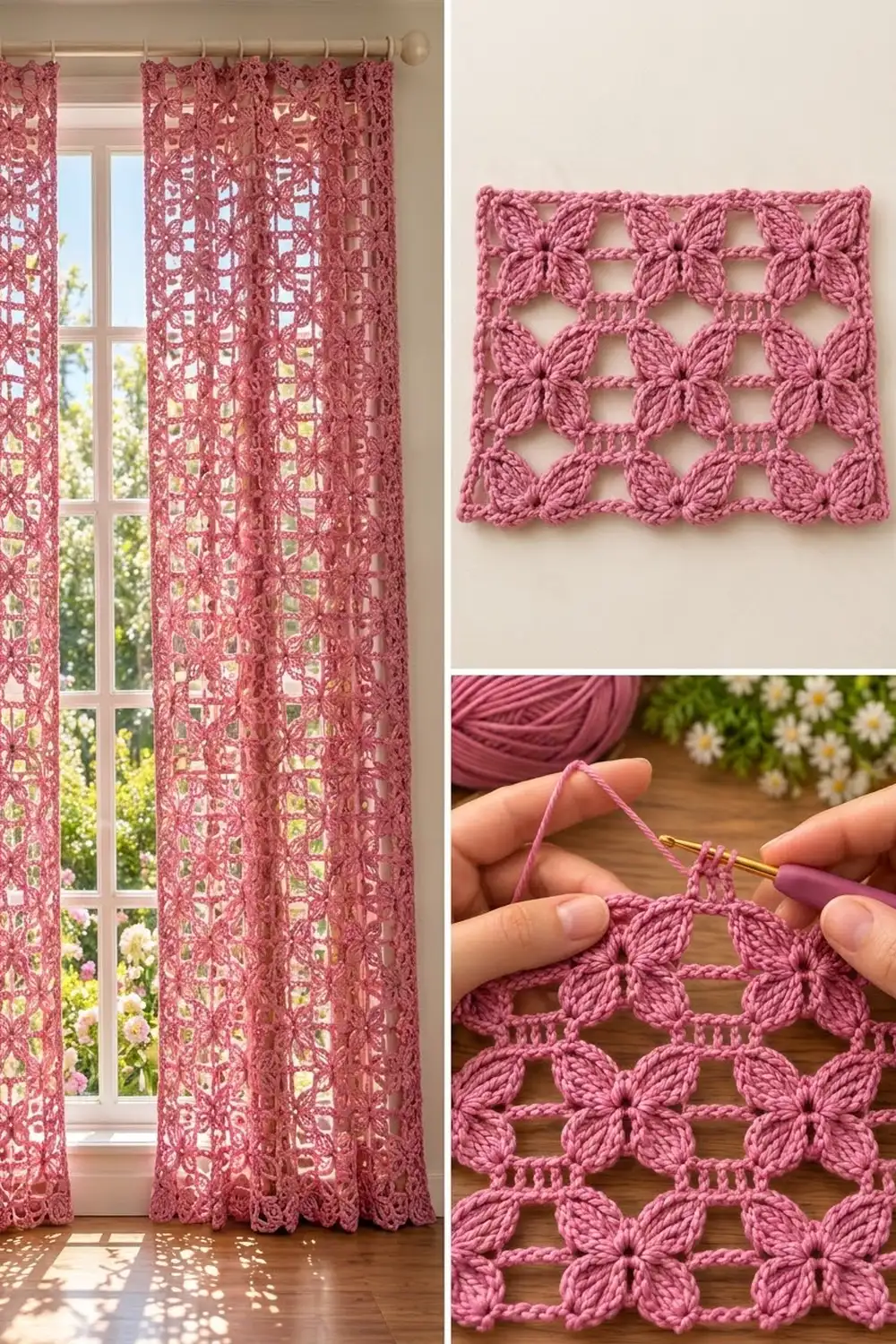
These lace curtains are what you get when a soft floral swatch grows to full length. Each panel is a grid of four-petal flowers with almond-shaped petals that point out on the diagonals in an X. Open windows framed by chain bars sit between the flowers, and a small ladder of five double crochets joins each flower to the one above it.
The sample is a single dusty rose shade, a warm muted pink that suits cottage, farmhouse, and vintage rooms. One color keeps the lace easy to read, and a matte cotton DK gives the petals crisp edges and a nice drape.
The pattern uses US crochet terms. Each finished panel measures 31.25 in (79.4 cm) wide and 83.25 in (211.5 cm) long, not counting the hanging loops. The pattern makes two identical panels.
Each panel is one piece worked flat in rows from the hem up. There are no motifs to join. A 3-row repeat builds each band of flowers: the lower petals, then the upper petals, then a ladder row that closes the flower. A two-round border adds hanging loops along the top and a scalloped hem along the bottom.
Finished Size and Construction
- Finished panel size: 31.25 in x 83.25 in (79.4 cm x 211.5 cm)
- Skill level: Intermediate
- Terminology: US crochet terms
- Yarn weight: DK (#3), cotton or cotton blend
- Hook: 4.0 mm (US G-6)
- Number of pieces: 2 panels, each worked in one piece
- Layout: 10 flowers across x 27 flowers down per panel
- Flower cell size: 3 in x 3 in (7.6 cm x 7.6 cm)
- Panel size before border: 30.25 in x 82 in (76.8 cm x 208.3 cm)
- Border depth: 0.5 in (1.3 cm) at the sides and top, 0.75 in (1.9 cm) at the scalloped hem
- Hanging loops: 13 per panel, each hanging about 1.5 in (3.8 cm) above the top edge
Materials
Choose a smooth, matte cotton or cotton-linen DK with about 240 m per 100 g. Very fuzzy or splitty yarn hides the clusters and the chain windows. Buy every skein from one dye lot, because a mismatched skein shows up clearly against a window.
- Dusty rose (only color): 1,000 g (2,400 m) per panel; 2,000 g (4,800 m) for the pair
These amounts include a margin of roughly 10%. One panel uses about 900 g, and the extra covers swatching.
Tools:
– 4.0 mm (US G-6) crochet hook
– Tapestry needle
– Stitch markers (at least 4)
– Measuring tape
– Rust-proof pins and a large blocking surface
– Spray bottle
– Curtain rod, 0.75 in to 1.25 in (1.9 cm to 3.2 cm) across
Abbreviations (US Terms)
- ch – chain
- sl st – slip stitch
- sc – single crochet
- dc – double crochet
- dtr – double treble crochet (yo 3 times, insert hook, pull up a loop, [yo, pull through 2 loops] 4 times)
- sk – skip
- sp – space
- yo – yarn over
- st(s) – stitch(es)
Special stitches:
- Petal (3-dtr cluster): *Yo 3 times, insert hook in the given st, pull up a loop, [yo, pull through 2 loops] 3 times; repeat from * 2 more times in the same st (4 loops on hook), yo, pull through all 4 loops.
- Joint petal (jp): *Yo 3 times, insert hook in the first given st, pull up a loop, [yo, pull through 2 loops] 3 times; repeat from * 2 more times in the same st, then repeat from * 3 times in the second given st (7 loops on hook), yo, pull through all 7 loops. This makes two petals that rise from separate bases and meet at one top. That top is the flower center.
Gauge and Checkpoints
Gauge: 12 sts = 3 in (7.6 cm) in the ladder row. One flower repeat (Rows 3–5) = 3 in (7.6 cm) tall. Dc rows measure about 0.5 in (1.3 cm), and each petal row about 1.25 in (3.2 cm).
Test swatch: Before starting a full panel, make one 3-flower swatch. Ch 39 and work Row 1 (37 dc). Work Rows 2–5, then Rows 3–5 once more, repeating the starred section 3 times in each row instead of 10. Block the swatch and let it dry.
- Width: 9.25 in (23.5 cm)
- Height: 7 in (17.8 cm)
If the swatch is too big, go down one hook size. If it is too small, go up one. If only the height is wrong, look at how far you pull up the dtr loops. Short loops give squat petals, and loose loops give floppy ones.
Panel checkpoints (lightly stretched flat):
- After Row 1: 30.25 in (76.8 cm) wide
- After the first Row 5: 4 in (10.2 cm) tall
- After 10 flower repeats: 31 in (78.7 cm) tall
- After 20 flower repeats: 61 in (154.9 cm) tall
- Finished body: 82 in (208.3 cm) tall
Panel Pattern
Each row has 121 stitch positions: one edge stitch, then 10 repeats of 12. Within each repeat, positions 4–8 hold the flower column and position 12 holds the post between flowers. Every row is symmetrical, so you don’t need to track right or wrong side.
Foundation: Ch 123.
Row 1 (base row): Dc in 4th ch from hook and in each ch across, turn. (121 sts; the skipped 3 ch count as a dc.)
Row 2 (ladder row): Ch 3 (counts as dc), ch 3, sk 3 sts, dc in next 5 sts, ch 3, sk 3 sts, dc in next st; repeat from * 9 more times, ending in the top of the turning ch, turn. (61 dc and 20 ch-3 sps = 121 stitch positions.)*
This row makes the first set of 5-dc ladder groups. The chain bars on either side frame the window openings.
Row 3 (lower petal row): Ch 5 (counts as dtr), ch 3, jp with first legs in the 1st dc of the next 5-dc group and second legs in the 5th dc of the same group, ch 3, dtr in next single dc; repeat from * 9 more times, ending in the top of the turning ch, turn. (11 dtr, 10 jp, 20 ch-3 sps.)*
The two halves of each joint petal lean in and meet at the center. They form the bottom half of the X.
Row 4 (upper petal row): Ch 5 (counts as dtr), ch 3, (petal, ch 3, petal) in top of next jp, ch 3, dtr in next dtr; repeat from * 9 more times, ending in the top of the turning ch, turn. (11 dtr, 20 petals, 30 ch-3 sps.)*
Both petals start at the flower center and fan upward. They form the top half of the X.
Row 5 (ladder row): Ch 3 (counts as dc), ch 3, dc in top of next petal, 3 dc in next ch-3 sp (between the two petals), dc in top of next petal, ch 3, dc in next dtr; repeat from * 9 more times, ending in the top of the turning ch, turn. (61 dc and 20 ch-3 sps = 121 stitch positions.)*
Row 5 has the same layout as Row 2. It pulls the petal tips out to positions 4 and 8, which finishes the X. It also makes the ladder group that sits between this flower and the next one up.
Rows 6–83: Repeat Rows 3–5 another 26 times. Do not fasten off.
You now have 27 flower repeats and 83 rows. The panel measures 30.25 in x 82 in (76.8 cm x 208.3 cm): 0.5 in + 0.5 in for Rows 1–2, plus 27 x 3 in for the flowers.
Make Both Panels
Make 2 panels in dusty rose, about 900 g each. Stop both panels at exactly 83 rows. Blocking evens out small differences in length.
Layout as hung (each “F” is one flower):
Panel 1 (10 x 27)          Panel 2 (10 x 27)
F F F F F F F F F F        F F F F F F F F F F
F F F F F F F F F F        F F F F F F F F F F
...27 flower rows...       ...27 flower rows...
F F F F F F F F F F        F F F F F F F F F F
~~ scalloped hem ~~        ~~ scalloped hem ~~
Joining
The two panels are not joined to each other. They hang side by side on one rod. When you hang them, make sure the flower rows line up across the gap. If one panel is longer, re-block it rather than changing the row count.
Border
Border gauge: 4 sc = 1 in (2.5 cm) along every edge, which matches the body gauge.
Along the side edges, work 2 sc in the end of each dc row and 5 sc in the end of each dtr row. One flower repeat (1 dc row + 2 dtr rows) then gets 2 + 5 + 5 = 12 sc over 3 in (7.6 cm), the same 4 sc per inch as the width.
Round 1: Continuing from the last row, ch 1, sc in each st across the top (in each dc and 3 sc in each ch-3 sp): 121 sc. Ch 2 for the corner. Down the side, work 2 sc in each dc row end and 5 sc in each dtr row end: 328 sc. Ch 2 for the corner. Along the bottom, sc in each foundation ch: 121 sc. Ch 2 for the corner. Up the second side: 328 sc. Ch 2, then sl st to the first sc. (Top 121, sides 328 each, bottom 121; total 898 sc plus 4 corner ch-2 sps.)
The corners are ch-2 spaces, not stitches, so no side count includes a corner. The side count works out as follows. The panel has 29 dc rows (Rows 1, 2, and the 27 Row 5s) x 2 sc = 58 sc. It has 54 dtr rows x 5 sc = 270 sc. That gives 58 + 270 = 328 sc, and 328 ÷ 4 = 82 in (208.3 cm), which equals the body height.
Round 2: Ch 1, then work the top: sc in each of the 121 sc, and work a hanging loop right after sc numbers 1, 11, 21, 31, 41, 51, 61, 71, 81, 91, 101, 111, and 121. To make a loop, ch 12 and sl st into the sc just made. (121 sc plus 13 loops; the stitch count does not change.)
Work 3 sc in the corner ch-2 sp. Down the side, sc in each sc: 328 sc. Work 3 sc in the corner sp.
Bottom (scalloped hem): sc in first sc, sk 1 sc, 5 dc in next sc, sk 1 sc, sc in next sc; repeat from * 29 more times. (30 shells and 31 sc, using all 121 sts: 1 + 30 x 4 = 121.)*
Work 3 sc in the corner sp. Up the second side: 328 sc. Work 3 sc in the last corner sp, sl st to the first sc, and fasten off.
Why the math works: The loops land every 10 sts from sc 1 to sc 121, so the first and last loops sit exactly over the panel corners. The hem uses 121 = 4 x 30 + 1 sts, so it starts and ends on a sc and the scallops are symmetrical. The 12 corner sc are worked into the corner spaces and are not part of any side count.
After the border: 31.25 in x 83.25 in (79.4 cm x 211.5 cm).
Final Blocking
- Weave in all ends along the stitch lines, never across an open window.
- Soak the panel in cool water for 15 minutes, then press the water out gently. Do not wring it.
- Roll the panel in towels to remove extra moisture.
- Lay it flat and pin the corners to 31.25 in x 83.25 in (79.4 cm x 211.5 cm).
- Pin each side every 6 in (15.2 cm), keeping the ladder columns straight.
- Pin the center of each hem scallop.
- Shape each petal into an almond with your fingers, and square up each window.
- Let it dry completely. Block the second panel to the same pin marks.
Final Quality-Control Checklist
- Each row has 121 stitch positions, and each ladder row has 61 dc
- Every flower has 4 petals in an even X with a closed center
- The 5-dc ladder groups line up in straight vertical columns
- Each panel has 27 flowers in each column, and both panels have the same row count
- Side borders have 328 sc each, with no ripples
- 13 hanging loops are evenly spaced on each panel
- 30 scallops along each hem
- Each panel blocks to 31.25 in x 83.25 in (79.4 cm x 211.5 cm)
Troubleshooting
- Petals look thin: Pull each dtr loop up to full height before closing the cluster.
- The flower center has a hole: Close the joint petal firmly. Make sure both petals in Row 4 go into the top of the jp and not the ch-3 next to it.
- Panel is narrowing: Count the 121 stitch positions on Row 5. A missing ch-3 or a skipped post is the usual cause.
- Sides wave after the border: You have more than 328 sc. Keep to 2 sc per dc row and 5 sc per dtr row.
- Sides pull in: You have fewer than 328 sc, or your sc are too tight. Count again, or go up a hook size for Round 1 only.
- Panels hang at different lengths: Re-wet the shorter panel and block it to length.
Care
Hand wash cool or use a gentle machine cycle in a mesh laundry bag, then lay flat to dry and re-pin lightly if needed. Do not tumble dry.
Final Notes
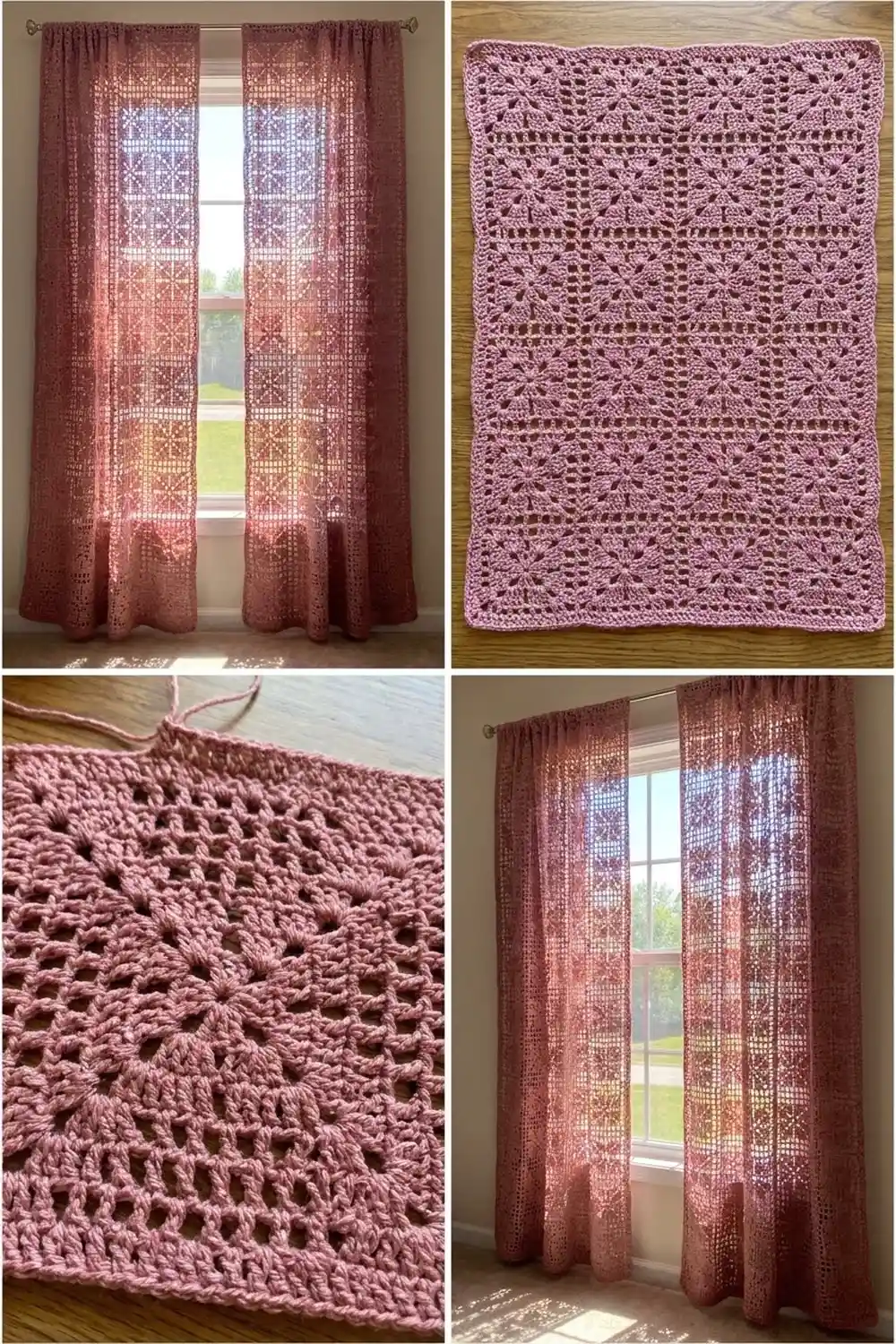
Every measurement follows from the stitch gauge. The swatch gives 12 sts = 3 in (7.6 cm) and one flower repeat = 3 in (7.6 cm). From there, 121 sts give a 30.25 in (76.8 cm) width, and 83 rows give an 82 in (208.3 cm) body. Round 1 of the border adds 121 sc to the top and bottom and 328 sc to each side at the same 4 sc per inch. Round 2 adds the loops and the scallops, for a finished panel of 31.25 in x 83.25 in (79.4 cm x 211.5 cm). If you check those numbers at each stage, the second panel will match the first.
Happy crocheting!