

This floor-length curtain panel is worked in classic filet crochet. Open mesh squares fill the background, and solid blocks draw a single waving vine with alternating almond leaves up the center. In daylight the mesh glows and the leaves show as soft silhouettes.
The panel uses one color, a muted sage green in mercerized cotton. The look is calm, botanical, and a little vintage, and it suits cottage, farmhouse, or modern rooms.
This pattern uses US crochet terms. The finished panel measures 40.4 in × 83.2 in (102.6 cm × 211.3 cm) including the border.
You crochet the panel in one piece from the bottom up in rows of blocks and spaces. Then you add a three-round border and wet block it. For a pair of curtains like the ones shown, make a second identical panel.
Finished Size and Construction
- Finished size: 40.4 in × 83.2 in (102.6 cm × 211.3 cm)
- Skill level: Intermediate (simple stitches, but you need to track the motif carefully)
- Terminology: US
- Yarn weight: #1 Super Fine (fingering) mercerized cotton
- Hook: 2.5 mm (US B-1 or C-2)
- Number of pieces: 1 per panel
- Layout: One rectangle, 99 blocks wide × 206 rows tall
- Size before border: 39.6 in × 82.4 in (100.6 cm × 209.3 cm)
- Border depth: 0.4 in (1.0 cm) on each edge
- Motif: Vine column 25 blocks (10 in / 25.4 cm) wide, centered between two plain mesh margins of 37 blocks (14.8 in / 37.6 cm) each
Materials
Yarn: Use a smooth, mercerized cotton or cotton blend in fingering weight, about 170 m per 50 g. Mercerized cotton gives crisp mesh, holds its shape when hanging, and won’t stretch as much as soft acrylic. Choose a light-to-mid sage so the leaves stay visible against the light.
- Sage green: 450 g (about 1,530 m), which is 9 balls of 50 g
These amounts include a margin of roughly 15% for your gauge swatch, tension differences, and the border. Buy all your yarn from one dye lot. Color shifts show up clearly on a large panel with light behind it.
Tools:
– 2.5 mm crochet hook
– Tapestry needle
– Stitch markers (at least 4)
– Row counter or a printed tracking sheet
– Measuring tape
– Rustproof pins and a large blocking surface (foam mats or a bed covered with towels)
– Spray bottle
Abbreviations (US Terms)
- ch – chain
- dc – double crochet
- sc – single crochet
- rev sc – reverse single crochet (crab stitch)
- sp(s) – space(s)
- st(s) – stitch(es)
- RS / WS – right side / wrong side
Filet units:
– Block (bl): dc in each of the next 3 sts. Over a space, work 2 dc in the ch-2 sp, then dc in the next dc.
– Space (sp): ch 2, skip 2 sts (or the ch-2 sp), dc in the next dc.
– Every row starts with ch 3, which counts as the first dc. A row that starts with a space begins with ch 5, which counts as the first dc plus ch 2.
– Every row ends with a dc in the top of the turning chain.
– Stitch count: Each row of N units has 3N + 1 sts. For this panel’s 99 units, that is always 298 sts (chains included).
Reverse single crochet: Working from left to right (right-handed), insert the hook into the next st to the right, yarn over, pull up a loop, then yarn over and draw through both loops.
Gauge and Checkpoints
Gauge: 10 blocks and 10 rows = 4 in (10.2 cm) in filet mesh, after blocking. Each block is 0.4 in (1.0 cm) square.
Test first: Ch 39. Dc in the 4th ch from the hook and in each ch across (37 sts, or 12 blocks). Work 11 more rows, alternating all-space rows and all-block rows. Wash, pin, and let the swatch dry. Your 10 center blocks should measure 4 in (10.2 cm) each way.
- Swatch too big: go down 0.25–0.5 mm in hook size.
- Swatch too small: go up 0.25–0.5 mm.
- Square but rows too short: pull up a slightly taller loop on each dc rather than changing hooks.
Checkpoints on the panel (measure lying flat, unstretched):
– After Row 3: width 39.6 in (100.6 cm); band height 1.2 in (3.0 cm)
– After Row 7: height 2.8 in (7.1 cm)
– After Row 39 (first vine repeat): height 15.6 in (39.6 cm)
– After Row 199: height 79.6 in (202.2 cm)
– After Row 206: 39.6 in × 82.4 in (100.6 cm × 209.3 cm)
Hanging stretches the panel a little. If it measures up to 2% short while lying flat, that’s fine.
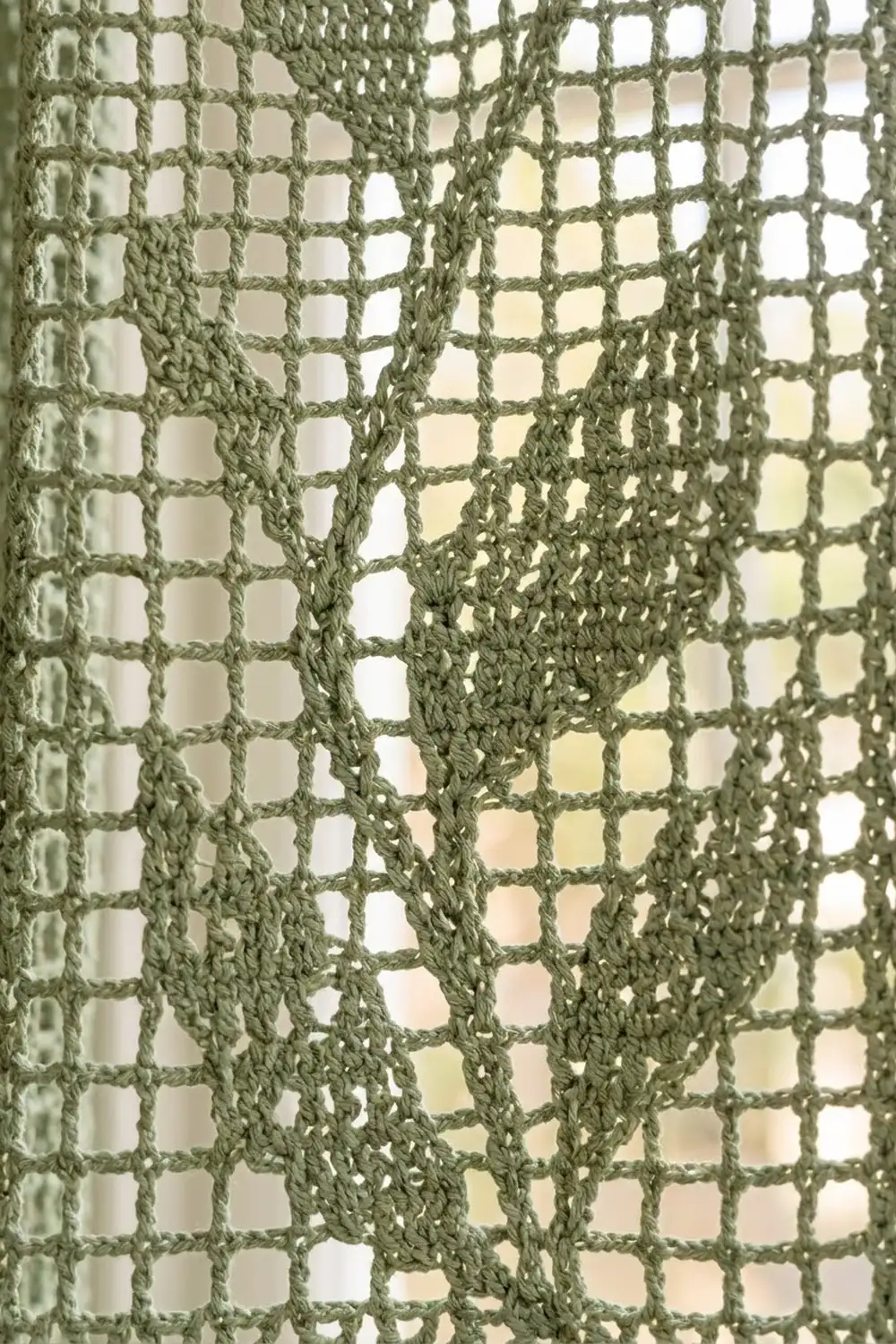
The Panel
Foundation and Bottom Band
Foundation: Ch 300.
Row 1 (RS): Dc in the 4th ch from the hook (the skipped 3 ch count as the first dc) and in each ch across. Turn. (298 sts = 99 bl)
Rows 2–3: Ch 3, dc in each st across, ending with dc in the top of the turning ch. Turn. (298 sts = 99 bl)
This solid band, 1.2 in (3.0 cm) tall, gives the bottom edge enough weight to hang straight.
Lower Mesh
Rows 4–7: Ch 5, skip 2 sts, dc in the next st, ch 2, skip 2, dc in the next st, repeat across, ending with dc in the top of the turning ch. Turn. (298 sts = 99 sp)
Vine Section (Rows 8–199)
Each row in this section is worked like this:
37 sp, then one motif line (25 units), then 37 sp.
When a space sits next to a margin space, just keep working spaces. The row count is always 298 sts (99 units).
Reading direction: Each motif line below is written as it looks from the RS, read from right to left. On RS (odd-numbered) panel rows, work it in the order written. On WS (even-numbered) panel rows, work it in reverse order. The margins are symmetrical, so they don’t change.
To find your motif line, use: motif line = (panel row − 8), divided by 32, take the remainder, then add 1. So Row 8 is M1, Row 39 is M32, and Row 40 is M1 again. Work the 32-line repeat 6 times, in Rows 8–39, 40–71, 72–103, 104–135, 136–167, and 168–199.
Lines M1–M16: right leaf, stem leans one block right
– M1: 12 sp, 1 bl, 12 sp
– M2: 12 sp, 1 bl, 12 sp
– M3: 12 sp, 2 bl, 11 sp
– M4: 12 sp, 3 bl, 10 sp
– M5: 12 sp, 5 bl, 8 sp
– M6: 12 sp, 1 bl, 1 sp, 5 bl, 6 sp
– M7: 11 sp, 1 bl, 3 sp, 6 bl, 4 sp
– M8: 11 sp, 1 bl, 4 sp, 6 bl, 3 sp
– M9: 11 sp, 1 bl, 5 sp, 6 bl, 2 sp
– M10: 11 sp, 1 bl, 6 sp, 5 bl, 2 sp
– M11: 11 sp, 1 bl, 7 sp, 5 bl, 1 sp
– M12: 11 sp, 1 bl, 8 sp, 4 bl, 1 sp
– M13: 12 sp, 1 bl, 8 sp, 3 bl, 1 sp
– M14: 12 sp, 1 bl, 9 sp, 2 bl, 1 sp
– M15: 12 sp, 1 bl, 10 sp, 1 bl, 1 sp
– M16: 12 sp, 1 bl, 12 sp
Lines M17–M32: left leaf, the mirror image of M1–M16
– M17: 12 sp, 1 bl, 12 sp
– M18: 12 sp, 1 bl, 12 sp
– M19: 11 sp, 2 bl, 12 sp
– M20: 10 sp, 3 bl, 12 sp
– M21: 8 sp, 5 bl, 12 sp
– M22: 6 sp, 5 bl, 1 sp, 1 bl, 12 sp
– M23: 4 sp, 6 bl, 3 sp, 1 bl, 11 sp
– M24: 3 sp, 6 bl, 4 sp, 1 bl, 11 sp
– M25: 2 sp, 6 bl, 5 sp, 1 bl, 11 sp
– M26: 2 sp, 5 bl, 6 sp, 1 bl, 11 sp
– M27: 1 sp, 5 bl, 7 sp, 1 bl, 11 sp
– M28: 1 sp, 4 bl, 8 sp, 1 bl, 11 sp
– M29: 1 sp, 3 bl, 8 sp, 1 bl, 12 sp
– M30: 1 sp, 2 bl, 9 sp, 1 bl, 12 sp
– M31: 1 sp, 1 bl, 10 sp, 1 bl, 12 sp
– M32: 12 sp, 1 bl, 12 sp
Every line adds up to 25 units. The stem sits on block 13 (the center) and shifts one block to the side in M7–M12 and M23–M28, which gives the S-shaped wave.
Each leaf starts from the stem as a 2-block bud and widens to 5–6 solid blocks. It then slants outward and tapers to a single-block tip, so you get an almond about 2.4 in (6.1 cm) wide and 5.2 in (13.2 cm) long. Leaves alternate right and left every 16 rows, which is 6.4 in (16.3 cm). The panel has 6 right leaves and 6 left leaves.
Tip: Place a stitch marker at each end of the 25-unit motif column on Row 8, and move the markers up every few rows. Then you only need to count inside the markers.
Upper Mesh and Top Band
Rows 200–203: Work as Rows 4–7. (298 sts = 99 sp)
Rows 204–206: Work as Rows 2–3. (298 sts = 99 bl)
Don’t fasten off. Go straight on to the border.
Border
Border gauge: 7.5 sc = 1 in (2.5 cm), which matches the panel’s 3 sts per 0.4 in (1.0 cm) block.
- Top and bottom edges: work 1 sc into each of the 298 sts.
- Side edges: each dc row is 0.4 in (1.0 cm) tall, so work 3 sc into each row end.
- Corners: each corner gets a ch-2 sp. The side counts below do not include the corner chains.
Round 1 (RS): Ch 1, then sc in each st across the top edge. (298 sc) Ch 2 to make the corner.
Rotate the panel and work 3 sc into each row end down the side. (206 rows × 3 = 618 sc) Ch 2.
Work 1 sc in each foundation ch along the bottom edge. (298 sc) Ch 2.
Work 3 sc into each row end up the second side. (618 sc) Ch 2, then sl st to the first sc.
Total: 298 + 618 + 298 + 618 = 1,832 sc, plus 4 ch-2 corner sps.
Round 2: Ch 1. Sc in each sc, and work (sc, ch 2, sc) in each corner sp. Sl st to the first sc.
Each side now has its previous count plus 2. (Top and bottom 300 sc each; sides 620 sc each; total 1,840 sc, plus 4 ch-2 sps)
Round 3: Ch 1. Rev sc in each sc, and work 2 rev sc in each corner sp. Sl st to the first st and fasten off.
(Top and bottom 302 sts each; sides 622 sts each; total 1,848 sts)
Why the math works: Round 1’s per-inch rate equals the panel’s per-inch rate on all four edges: 298 sts across 39.6 in, and 618 sc along 82.4 in, are both 7.5 per inch. Because of this, the edge doesn’t ruffle or pull in.
The 4 corner spaces add 2 sts per side in Round 2 and 2 more per side in Round 3. That growth is only enough to turn the corners flat. The three rounds add 0.4 in (1.0 cm) to every edge, which gives a finished size of 40.4 in × 83.2 in (102.6 cm × 211.3 cm).
Final Blocking
- Weave in all ends inside solid blocks or along the border, never across open mesh.
- Soak the panel in cool water with a little wool wash for 15 minutes.
- Press out the water (don’t wring it), then roll the panel in towels.
- Lay it flat on your blocking surface. If space is tight, block it in halves and let the first half dry fully before you shift it.
- Pin the corners to 40.4 in × 83.2 in (102.6 cm × 211.3 cm).
- Pin along each edge every 2–3 in (5.1–7.6 cm), and straighten the mesh columns with a ruler.
- Nudge each leaf into shape so its edges run smoothly.
- Let it dry completely, about 24–48 hours.
Final Quality-Control Checklist
- Every row has 298 sts (99 units).
- The stem forms a continuous S-wave with no breaks between motif lines.
- Every leaf connects to the stem and tapers to a single-block tip.
- Leaves alternate right and left, 6 on each side.
- The margins are exactly 37 blocks on each side of the motif.
- The border has 302 sts on the top and bottom and 622 on each side.
- The blocked panel measures 40.4 in × 83.2 in (102.6 cm × 211.3 cm), with corners at true right angles.
- All ends are hidden in solid areas.
Troubleshooting
- Mesh squares are tall rectangles: your dc stitches are too tall for your chains. Make the ch-2 slightly looser or shorten your dc.
- The panel slants (bias): check that every row ends with a dc in the top of the turning ch, not in the ch-3 space.
- A leaf looks shifted by one block: you probably read a WS row in the RS direction. Rip back to the error and check the motif line in reverse order.
- The border ripples: you have too many sc on the sides. Work 3 sc per row end exactly.
- The border cups or pulls in: you have too few sc. Recount Round 1.
- The panel is shorter than the checkpoint: add whole all-space rows in the upper mesh, then recalculate the side border at 3 sc per row.
Care
Hand wash cool, or machine wash on a delicate cycle in a mesh laundry bag, then lay flat to dry. Hang the panel while it is very slightly damp to refresh the drape. Don’t tumble dry.
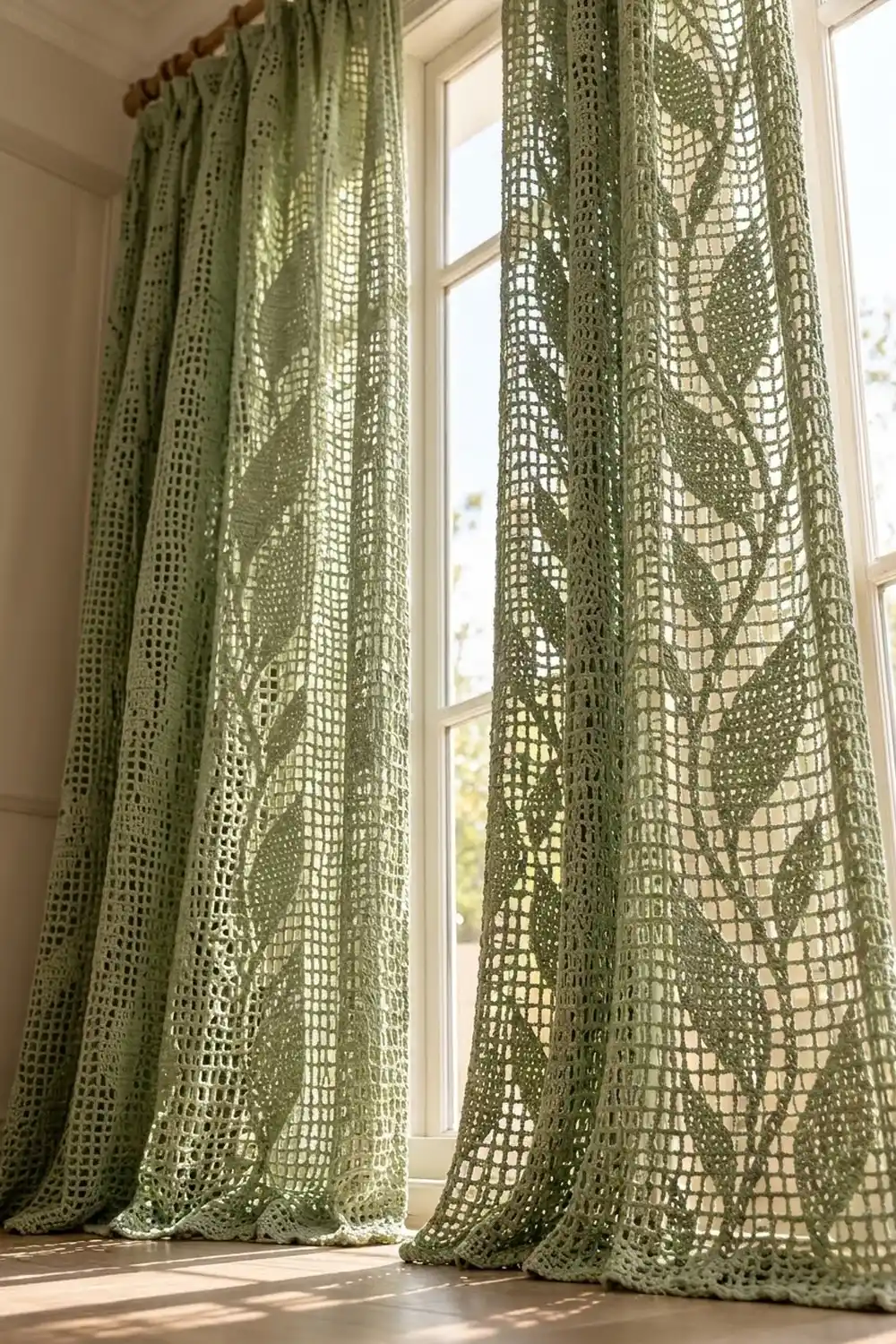
Final Notes
The whole panel depends on one number: a 0.4 in (1.0 cm) filet block. That block gives you 99 blocks across, or 39.6 in (100.6 cm). Rows 1–7 build the 2.8 in (7.1 cm) base, six 32-row vine repeats bring the height to 79.6 in (202.2 cm), and 7 finishing rows give 82.4 in (209.3 cm). The three-round border then adds 0.4 in (1.0 cm) on every edge, for a finished 40.4 in × 83.2 in (102.6 cm × 211.3 cm).
Check your swatch, track your motif lines, and your vine will grow straight up the window.
Happy crocheting!