

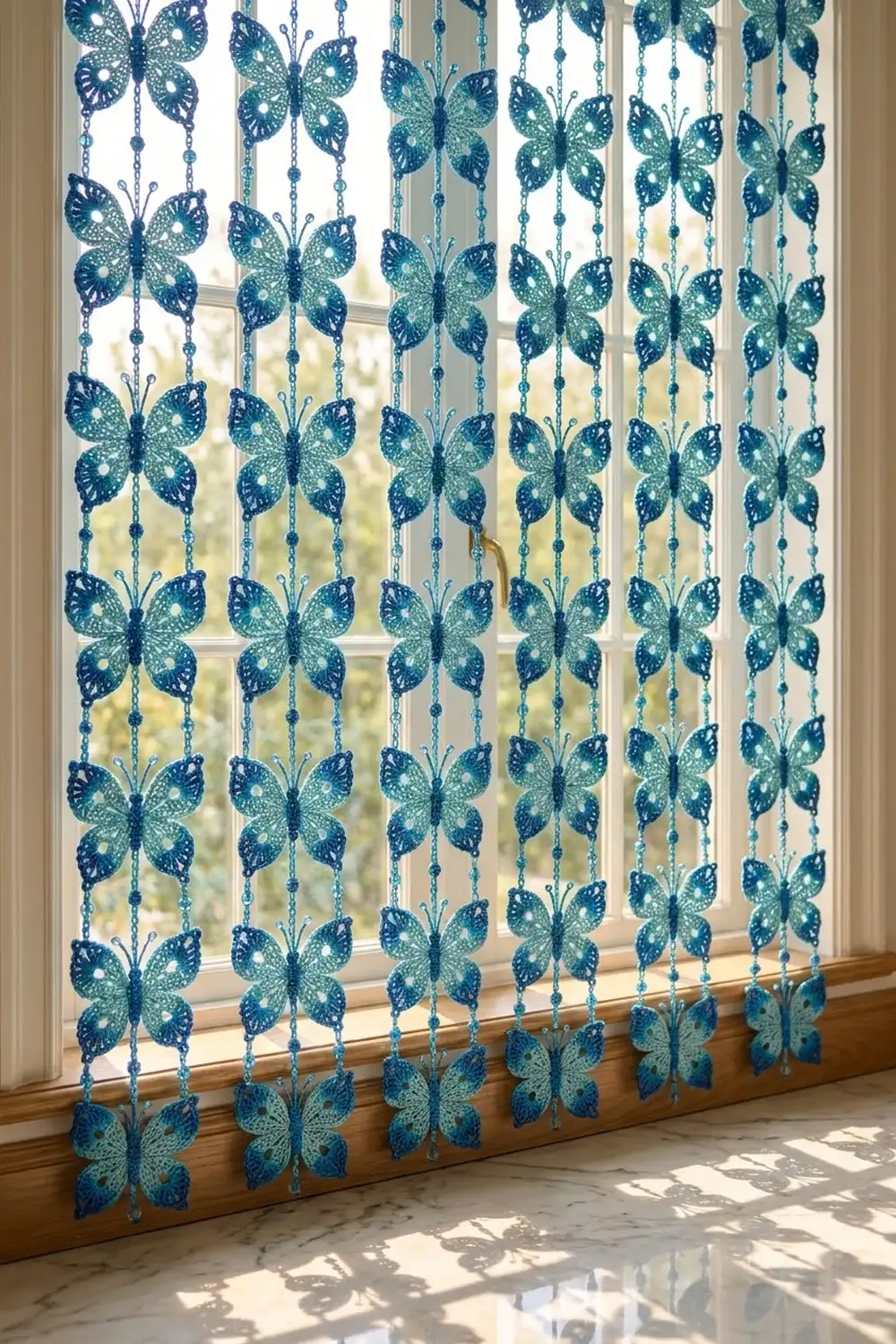
The Azure Flutter curtain is a light, airy panel of crocheted butterflies on vertical beaded cords. Each butterfly has four teardrop wings with an open center hole, a segmented body and two beaded antennae. Neighboring strands are offset by half a step, so the butterflies sit in a staggered pattern with light coming through between them.
The palette uses three blues. Turquoise rings each wing hole, light aqua fills the wing and deep cobalt edges it. The same cobalt is used for the bodies, cords, bobbles and header, and clear blue glass beads catch the light.
This pattern uses US crochet terms. The finished panel measures 42 in wide x 65¾ in long (106.7 x 167.0 cm), including the 1 in (2.5 cm) header. Each butterfly measures 6 x 4 in (15.2 x 10.2 cm), not counting the antennae.
Here’s the order of work:
1. Make 56 butterflies, working each wing in the round from a ring.
2. Build 7 strands from the bottom up, with 8 butterflies linked into a chain cord on each strand.
3. Work a single crochet header that catches the top of every strand at even spacing.
Finished Size and Construction
- Finished size: 42 x 65¾ in (106.7 x 167.0 cm)
- Skill level: Intermediate
- Terminology: US
- Yarn weight: Sport (#2), mercerized cotton
- Hook: 3.0 mm, plus a 0.75 mm steel hook for the beads
- Number of pieces: 56 butterflies
- Layout: 7 strands x 8 butterflies each; even-numbered strands are offset half a step lower
- Piece size: 6 x 4 in (15.2 x 10.2 cm); antennae add 1½ in (3.8 cm)
- Size before border: 7 loose strands, each 64¾ in (164.5 cm) long
- Border depth: 1 in (2.5 cm) header
Materials
Use a smooth mercerized cotton at about 155 m (170 yd) per 50 g. It keeps the wing points crisp and stretches very little when hanging. Avoid fuzzy yarns, which blur the wing holes.
- Color A, light aqua: 100 g / 310 m
- Color B, turquoise: 50 g / 155 m
- Color C, cobalt: 200 g / 620 m
Tools:
– 3.0 mm hook
– 0.75 mm steel hook
– 200 transparent blue 6 mm glass beads (hole at least 1 mm)
– Tapestry needle
– Stitch markers
– Rustproof pins and a blocking mat
– 8 curtain clip rings
– Measuring tape
All yarn and bead quantities include a margin of about 15-20%.
Abbreviations (US Terms)
- ch: chain
- sl st: slip stitch
- sc: single crochet
- hdc: half double crochet
- dc: double crochet
- tr: treble crochet
- BLO: back loop only
- rev sc: reverse single crochet (crab stitch)
- sp: space
- st(s): stitch(es)
- rnd: round
Special stitches:
- cb (cord bobble): Ch 3. [Yo, insert hook in 3rd ch from hook, yo, pull up a loop, yo, draw through 2 loops] 4 times. Yo, draw through all 5 loops. The ch 3 belongs to the cb and is never counted in a chain group.
- pb (place bead): Remove the loop from your hook. Slide a bead onto the 0.75 mm hook, catch the loop and pull it through the bead. Put the loop back on the 3.0 mm hook and ch 1 to lock the bead. This ch is not counted in a chain group.
- Surface sl st: With the yarn held at the back, insert the hook through the fabric and pull up a loop through the loop on your hook.
Gauge and Checkpoints
Make one complete butterfly first and measure it at every stage.
- Cord: 6 ch = 1 in (2.5 cm). One cb is about 0.4 in (1.0 cm). One placed bead is about 0.25 in (0.6 cm).
- Header: 24 sc and 24 rows = 4 in (10.2 cm).
- Upper wing: About 1 in (2.5 cm) across after Rnd 1. After Rnd 4, 2¾ x 2¼ in (7.0 x 5.7 cm).
- Lower wing: 2 x 1¾ in (5.1 x 4.4 cm) after Rnd 3.
- Body: 2½ x ¾ in (6.4 x 1.9 cm).
- Assembled butterfly: 6 x 4 in (15.2 x 10.2 cm).
If a piece is more than ¼ in (0.6 cm) too big, switch to a 2.75 mm hook. If it’s too small, use a 3.25 mm hook. Check the cord gauge separately, because chains often run tighter than stitches.
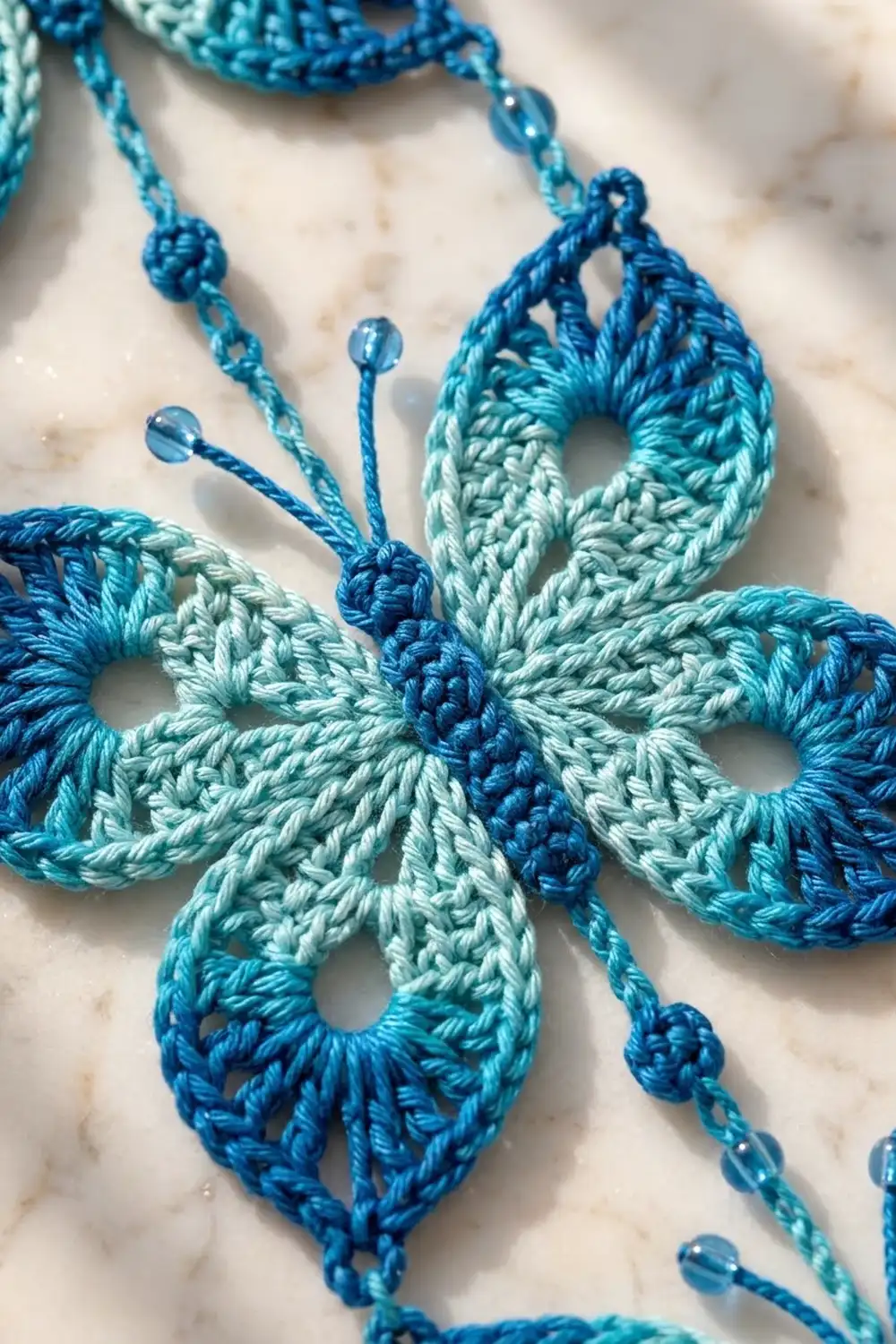
Upper Wing (make 2 per butterfly)
Rnd 1 (B): Ch 5, sl st to form a ring. Ch 3 (counts as dc), 14 dc in ring, join to the top of the ch-3. (15 dc) Fasten off.
Rnd 2 (A): Join A with a sl st in any dc, ch 1.
– Sc in the same st and the next st.
– 2 hdc in each of the next 2 sts.
– 2 dc in each of the next 3 sts.
– (2 tr, ch 2, 2 tr) in the next st for the tip.
– 2 dc in each of the next 3 sts.
– 2 hdc in each of the next 2 sts.
– Sc in the last 2 sts.
– Join to the first sc. (28 sts + ch-2 tip)
The short stitches at each end form the wing base. The tall stitches push the tip outward, which makes the teardrop shape and moves the hole toward the body.
Rnd 3 (A): Ch 1.
– Sc in the first 2 sts.
– (Hdc in the next st, 2 hdc in the next st) twice.
– (Dc in the next st, 2 dc in the next st) 3 times.
– Dc in the next tr, 2 dc in the next tr.
– (2 dc, ch 2, 2 dc) in the ch-2 sp.
– 2 dc in the next tr, dc in the next tr.
– (2 dc in the next st, dc in the next st) 3 times.
– (2 hdc in the next st, hdc in the next st) twice.
– Sc in the last 2 sts.
– Join and fasten off. (44 sts + ch-2 tip)
Rnd 4 (C): Join C in the BLO of the first sc and ch 1. Work every stitch in BLO except the stitches in the tip space.
– Sc in the first 2 sts.
– Hdc in the next 6 sts.
– (Dc in the next 2 sts, 2 dc in the next st) 3 times.
– Dc in the next 5 sts.
– (2 tr, ch 3, 2 tr) in the ch-2 sp.
– Dc in the next 5 sts.
– (2 dc in the next st, dc in the next 2 sts) 3 times.
– Hdc in the next 6 sts.
– Sc in the last 2 sts.
– Join and fasten off, leaving a 12 in (30.5 cm) tail. (54 sts + ch-3 tip)
Working in the back loops leaves the aqua front loops as a raised ridge under the cobalt band. The 4 sc at the ends of the round are the wing base.
Lower Wing (make 2 per butterfly)
Rnd 1 (B): Ch 4, sl st to form a ring. Ch 3 (counts as dc), 10 dc in ring, join. (11 dc) Fasten off. The piece should be about ¾ in (1.9 cm) across.
Rnd 2 (A): Join A in any dc, ch 1.
– Sc in the same st and the next st.
– 2 hdc in each of the next 2 sts.
– 2 dc in the next st.
– (2 tr, ch 2, 2 tr) in the next st.
– 2 dc in the next st.
– 2 hdc in each of the next 2 sts.
– Sc in the last 2 sts.
– Join and fasten off. (20 sts + ch-2 tip)
The wing should be about 1½ x 1¼ in (3.8 x 3.2 cm).
Rnd 3 (C): Join C in the BLO of the first sc and ch 1. Work in BLO except in the tip space.
– Sc in the first 2 sts.
– (Hdc in the next st, 2 hdc in the next st) twice.
– Dc in the next st, 2 dc in the next st.
– Dc in the next 2 sts.
– (2 tr, ch 3, 2 tr) in the ch-2 sp.
– Dc in the next 2 sts.
– 2 dc in the next st, dc in the next st.
– (2 hdc in the next st, hdc in the next st) twice.
– Sc in the last 2 sts.
– Join and fasten off, leaving a 12 in (30.5 cm) tail. (30 sts + ch-3 tip)
Body, Antennae and Assembly
Body Rnd 1 (C): Ch 13. Sc in the 2nd ch from the hook and the next 10 ch, then 3 sc in the last ch. Working along the opposite side of the foundation chain, sc in the next 10 ch, then 2 sc in the last ch. Join. (26 sc)
Body Rnd 2: Ch 1.
– 2 sc in the first st.
– Sc in the next 10 sts.
– 2 sc in each of the next 3 sts.
– Sc in the next 10 sts.
– 2 sc in each of the last 2 sts.
– Join. (32 sc)
Fasten off, leaving a 20 in (50.8 cm) tail. Wrap the tail tightly 3 times around the body at 4 points, ½ in (1.3 cm) apart. This forms a round head and 4 segments. Hide the tail inside.
Antennae: Join C in the 2nd st to the left of the center top st of the head. Ch 8, pb, then sl st back along all 8 ch. Sl st into the body and fasten off. Repeat in the 2nd st to the right of center. Each antenna is about 1½ in (3.8 cm) long.
Assembly: Sew the 4 base sc of an upper wing to each side of the body, centered ¾ in (1.9 cm) below the top of the head, with the tips angled slightly up. Sew the lower wings centered 1¾ in (4.4 cm) below the top of the head, with the tips angled down and the bases tucked just under the upper wings.
Checkpoint: Each butterfly measures 6 x 4 in (15.2 x 10.2 cm).
Make All Pieces
Make 56 butterflies in total: 112 upper wings, 112 lower wings, 56 bodies and 112 antennae.
- Color B: Rnd 1 of all 224 wings.
- Color A: Rnds 2-3 of the upper wings and Rnd 2 of the lower wings.
- Color C: The last round of every wing, plus the bodies, antennae, cords and header.
Layout (B = butterfly, | = cord):
HEADER 252 sc =================================
Strand: 1    2    3    4    5    6    7
        B    |    B    |    B    |    B
        |    B    |    B    |    B    |
        B    |    B    |    B    |    B
        |    B    |    B    |    B    |
       ... 8 butterflies per strand ...
Joining: Building the Strands
Work every strand in C from the bottom up. The cord carries the weight, so each butterfly is stitched directly into it.
Butterfly link: From the back, sl st in the bottom center st of the body. Work 11 surface sl sts up the center back along the foundation-chain line. Sl st in the center top st of the head, so the cord comes out between the antennae.
Connector (5 in / 12.7 cm): Ch 6, cb, ch 6, pb, ch 6, cb, ch 6. This is 24 ch, 2 cb and 1 bead.
Odd strands (1, 3, 5, 7):
1. Long tail: cb, ch 6, pb, ch 6, cb, ch 6, pb, ch 6, cb, ch 6. This is 30 ch, about 6¾ in (17.1 cm).
2. Work [butterfly link, connector] 7 times, then 1 more butterfly link.
3. Lead A: Ch 6, cb, ch 6, pb, ch 2. This is 14 ch, about 3 in (7.6 cm).
4. Ring: Ch 4, sl st in the 4th ch from the hook. Fasten off.
Even strands (2, 4, 6):
1. Short tail: cb, pb, ch 6, cb, ch 6. This is 12 ch, about 3 in (7.6 cm).
2. Link 8 butterflies with 7 connectors, the same way as on the odd strands.
3. Lead B: Ch 6, cb, ch 6, pb, ch 6, cb, ch 6, pb, ch 6, cb. This is 30 ch, about 6¾ in (17.1 cm).
4. Make the ring and fasten off.
Both strand types come out the same length: 3 + (8 x 2½) + (7 x 5) + 6¾ = 64¾ in (164.5 cm). Lead B is 3¾ in (9.5 cm) longer than Lead A. That drops the even strands by exactly half of the 7½ in (19.1 cm) step from one butterfly to the next.
Tension: Chain evenly and loosely. Tight chains shorten the strand and twist the butterflies.
Checkpoint: Hang each strand from its ring. It should measure 64¾ in (164.5 cm), within ½ in (1.3 cm). If it doesn’t, adjust the last chain group of the lead.
Border: Header Band
Border gauge: 6 sc = 1 in (2.5 cm). Each strand gets its own bay of 36 sts, which is 6 in (15.2 cm). For 7 strands, that’s 7 x 36 = 252 sts = 42 in (106.7 cm), with no extra stitches between bays.
Row 1 (C): Ch 253. Sc in the 2nd ch from the hook and in each ch across. (252 sc)
As you work Row 1, catch each strand’s ring in sts 18 and 19 of its bay by inserting the hook through the chain and the ring together. The rings go into these stitches:
– 18-19
– 54-55
– 90-91
– 126-127
– 162-163
– 198-199
– 234-235
The rings are worked into existing stitches, so the count stays at 252. This places the outer strands 3 in (7.6 cm) from each edge, with 6 in (15.2 cm) between strands.
Rows 2-5: Ch 1, turn, sc in each st across. (252 sc)
Row 6: Ch 1, do not turn, rev sc in each st across. (252 rev sc) Fasten off.
At 6 rows per inch, these 6 rows make 1 in (2.5 cm). The total length is 64¾ + 1 = 65¾ in (167.0 cm).
Final Blocking
- Weave in all ends through stitches of the same color.
- Soak the panel in cool water and press it in a towel. Don’t wring it.
- Pin each butterfly to 6 x 4 in (15.2 x 10.2 cm). Open each wing hole and shape each tip to a point.
- Pin the header straight to 42 x 1 in (106.7 x 2.5 cm).
- Let it dry completely.
- Hang the panel from 8 clip rings spaced 6 in (15.2 cm) apart, starting at each end of the header. Let the cords settle for a day.
Final Quality-Control Checklist
- Every wing hole is round and open.
- Every wing tip comes to a clean point.
- The aqua ridge shows evenly under the cobalt band.
- Each body has 4 even wraps.
- All bead tips are secure.
- Each strand measures 64¾ in (164.5 cm).
- Butterflies on neighboring strands alternate in height.
- The header has 252 sc and lies flat at 42 in (106.7 cm).
Troubleshooting
- The wing cups: Work Rnd 4 with a hook 0.25 mm larger.
- The wing ruffles: Go down a hook size and check Rnd 3 against the gauge.
- The tip is blunt: Work the tr groups into the ch-sp, not into the next stitch.
- The butterflies twist: Keep the surface sl sts exactly on the center line of the body.
- The strands are uneven: Adjust the last chain group of the lead.
- The beads won’t pass over the yarn: Use beads with larger holes or a finer steel hook.
Care
Hand wash in cool water with mild soap, then dry flat and reblock. Don’t tumble dry, because the cords tangle and the beads can chip.
Final Notes
Each measurement depends on the one before it:
– Wings of 2¾ in (7.0 cm) and 2 in (5.1 cm) make a 6 x 4 in (15.2 x 10.2 cm) butterfly.
– A 2½ in (6.4 cm) body plus a 5 in (12.7 cm) connector makes a 7½ in (19.1 cm) step.
– Eight steps, plus the leads and tails, make a 64¾ in (164.5 cm) strand.
– Seven bays of 36 sc make a 42 in (106.7 cm) header.
Check each one before moving on, and the panel will hang straight and even.
Happy crocheting!