

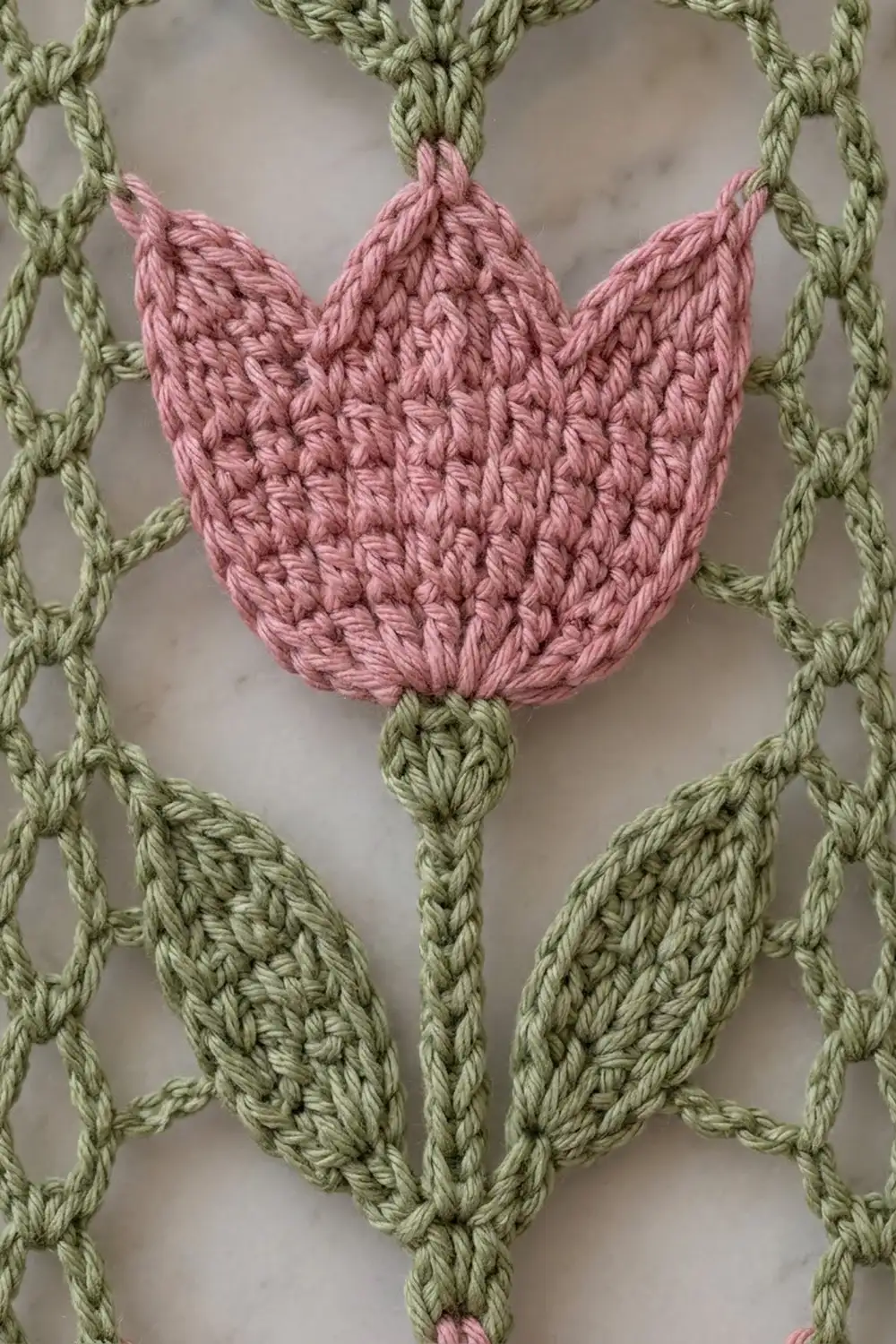
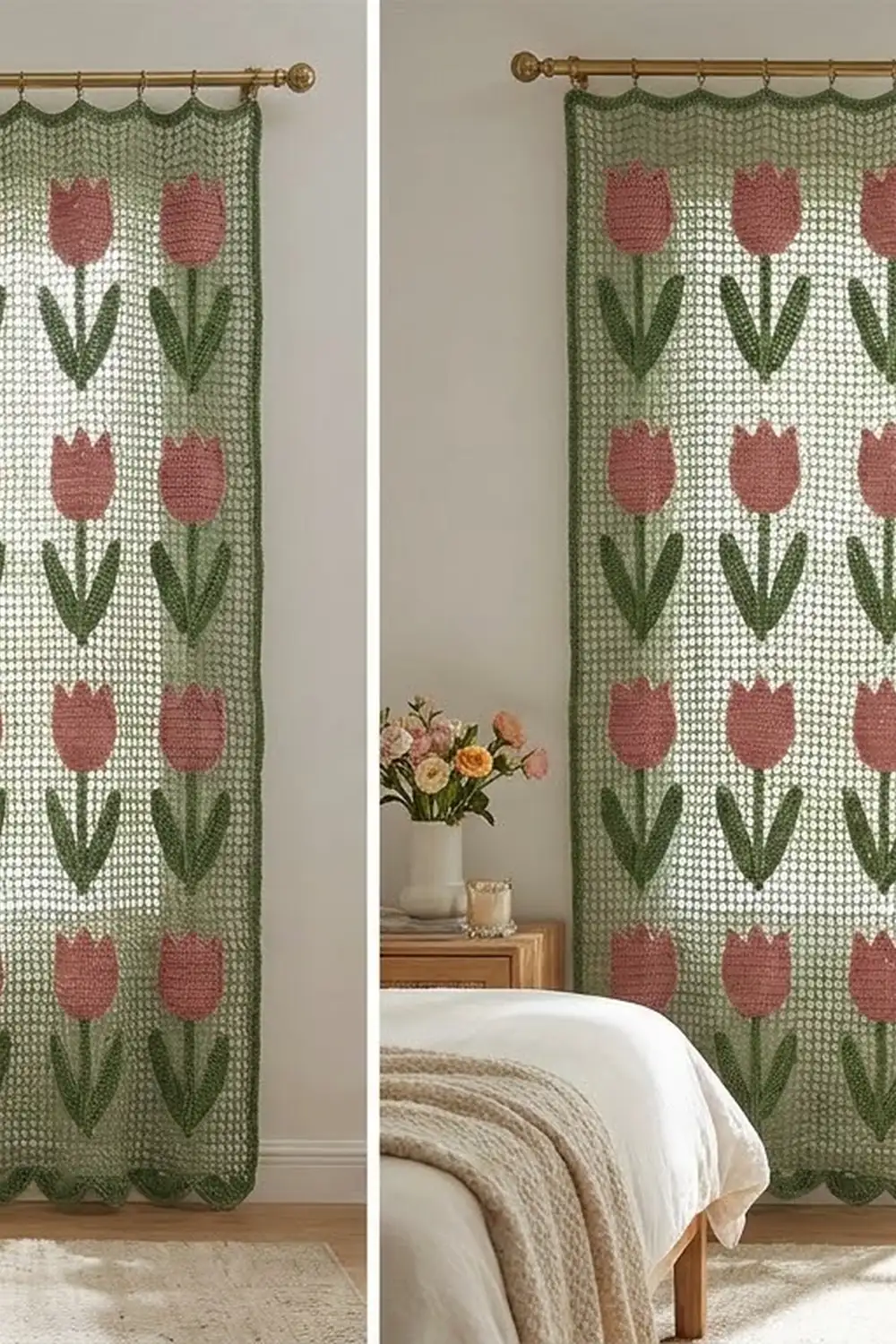
This curtain panel is covered in rows of dusty pink tulips. Each one stands on a sage-green stem with two angled leaves, and they’re set in a light, open mesh that lets daylight through. Hung as a pair, the panels give a bedroom or sunroom a soft cottage-garden look without feeling heavy.
The design uses two colors: sage green for the mesh, stems, leaves and edging, and dusty rose for the tulip cups. The style is classic filet crochet. Every motif is made from solid squares (blocks) and open squares (spaces), so the tulips look the same from both sides of the window. All instructions use US crochet terms.
Each finished panel measures 31 in wide x 87.75 in long (78.7 cm x 222.9 cm), including the border. The pattern is written for one panel. Make two for a pair.
You work each panel flat from the bottom hem to the top, so the tulips stand upright. The pink is added with small intarsia bobbins. Once the body is done, you work two rounds of single crochet edging all around, then a row of fan scallops along the bottom edge.
Finished Size and Construction
- Finished size (per panel): 31 x 87.75 in (78.7 x 222.9 cm)
- Skill level: Intermediate
- Terminology: US
- Yarn weight: DK (#3)
- Hook: 4.0 mm (G-6)
- Number of pieces: 1 per panel; make 2 panels for a pair (not joined)
- Layout: 4 tulip columns across x 12 tulips tall
- Tulip repeat: 15 squares wide x 14 rows tall = 7.5 x 7 in (19.1 x 17.8 cm)
- Size before border: 30 x 86 in (76.2 x 218.4 cm)
- Border depth: 0.5 in (1.3 cm) on the sides and top; 1.25 in (3.2 cm) at the bottom, including the fans
Materials
Choose a smooth, mercerized cotton or a cotton blend in DK weight. Crisp stitch definition makes the open squares read clearly, and cotton hangs straight without stretching too much. Avoid fuzzy yarns, because they fill in the mesh.
Amounts for a pair of panels (based on 50 g = 120 m skeins):
- Sage green (MC): 500 g / 1,200 m
- Dusty rose (CC): 150 g / 360 m
These quantities include a margin of roughly 15% for gauge differences and bobbin waste.
Tools:
– 4.0 mm (G-6) crochet hook
– 4 small yarn bobbins (for pink)
– Tapestry needle
– Stitch markers
– Measuring tape
– Blocking mats or a large clean floor area, plus rust-proof pins
– Spray bottle
– Curtain clip rings (about 8 per panel)
Abbreviations (US Terms)
- ch: chain
- sc: single crochet
- dc: double crochet
- sk: skip
- sp: space
- st(s): stitch(es)
- MC / CC: main color (green) / contrast color (pink)
Filet squares:
– Space (sp): ch 2, sk 2, dc in next dc.
– Block (bl): dc in each of the next 2 sts (or 2 dc in a ch-2 sp), then dc in the next dc.
– First square of a row: for a space, ch 5 (counts as dc + ch 2). For a block, ch 3 (counts as dc), then complete the block.
– Color change: work the last dc before the new color until 2 loops remain, then finish it with the new color.
Every row has 181 sts, which make 60 squares plus 1 closing dc.
Gauge and Checkpoints
Gauge: 4 filet squares = 2 in (5.1 cm) wide, and 4 rows = 2 in (5.1 cm) tall. Each square measures 0.5 x 0.5 in (1.3 x 1.3 cm).
Swatch: Ch 27. Row 1: dc in the 4th ch from hook and in each ch across (25 sts = 8 blocks). Work 7 rows of spaces. The swatch should measure 4 x 4 in (10.2 x 10.2 cm) after a light steam.
Checkpoints:
– After Row 1: 30 in (76.2 cm) wide
– After Row 16 (first full tulip repeat): 8 in (20.3 cm) tall
– After Row 58 (4 repeats): 29 in (73.7 cm) tall
– After Row 172: 86 in (218.4 cm) tall
If your swatch is too big, go down half a hook size. If it’s too small, go up half a size. If the width is right but the rows are short, pull up the first loop of each dc a little taller. Make these checks early, because a 1/8 in (0.3 cm) error per square adds up to 7.5 in (19.1 cm) across the panel.
Panel Body
Wind 4 pink bobbins, one for each tulip column. Inside a tulip, carry the green strand along the top of the previous row and work the pink dc over it. On Rows 12 and 13 of the repeat, work the open squares between the petals in green, and lay the pink strand along the chain so the next pink dc encloses it.
Row 1 (MC): Ch 183. Dc in the 4th ch from hook and in each ch across. Turn. (181 sts = 60 blocks)
Row 2: Ch 5, sk 2, dc in next dc. Work 59 more spaces across, with the last dc in the top of the turning ch. Turn. (61 dc + 60 ch-2 sps = 181 sts)
Rows 3–170: Tulip repeat. Work the 15-square repeat below 4 times across every row. Each row is symmetrical, so you read it the same way in both directions. Work 12 full repeats (168 rows).
Repeat Row 1: 7 sp, 1 bl (stem), 7 sp.
Repeat Row 2: 7 sp, 1 bl, 7 sp.
Repeat Row 3: 6 sp, 3 bl (leaf bases and stem), 6 sp.
Repeat Row 4: 4 sp, 2 bl, 1 sp, 1 bl, 1 sp, 2 bl, 4 sp.
Repeat Row 5: 3 sp, 2 bl, 2 sp, 1 bl, 2 sp, 2 bl, 3 sp.
Repeat Row 6: 3 sp, 1 bl (leaf tip), 3 sp, 1 bl, 3 sp, 1 bl (leaf tip), 3 sp.
Repeat Row 7: 7 sp, 1 bl, 7 sp.
Repeat Row 8: 6 sp, 3 CC bl (tulip base), 6 sp.
Repeat Row 9: 5 sp, 5 CC bl, 5 sp.
Repeat Row 10: 4 sp, 7 CC bl, 4 sp.
Repeat Row 11: 4 sp, 7 CC bl, 4 sp.
Repeat Row 12: 4 sp, 2 CC bl, 1 sp, 1 CC bl, 1 sp, 2 CC bl, 4 sp.
Repeat Row 13: 4 sp, 1 CC bl, 2 sp, 1 CC bl, 2 sp, 1 CC bl, 4 sp. (three petal tips)
Repeat Row 14: 15 sp (open gap above the tulip).
Each row is still 181 sts. For example, Repeat Row 10 has 4 x (4 + 7 + 4) = 60 squares.
Per tulip: 30 pink blocks (3 + 5 + 7 + 7 + 5 + 3) and 19 green blocks in the stem and leaves.
Row 171: Work 60 spaces as in Row 2.
Row 172: Ch 3. Work 2 dc in each ch-2 sp and 1 dc in each dc across. (181 sts) Do not fasten off.
The body now measures 30 x 86 in (76.2 x 218.4 cm). Make a second panel the same way.
Border
Border gauge: 6 sc = 1 in (2.5 cm). Each sc round adds 0.25 in (0.6 cm).
Rnd 1 (MC, working around the edge): Work 3 sc in the corner st. Work 1 sc in each of the next 179 sts across the top. Work 3 sc in the corner st. Down the side, work 3 sc in each of the 172 row-ends (516 sc). Work 3 sc in the corner st of the foundation row. Work 1 sc in each of the next 179 sts. Work 3 sc in the last corner. Work 516 sc up the second side. Sl st to the first sc.
Counts per side, including the 2 corner center sts: top and bottom = 183; each side = 520. Total: 2 x 183 + 2 x 520 − 4 shared corners = 1,402 sts.
Rnd 2: Ch 1. Sc in each st around, with 3 sc in each corner center st. Each side gains 2: top and bottom = 185, sides = 522. Total: 1,410 sts. Do not fasten off. Sl st along the side to the bottom-right corner center st.
Row 3 (bottom fans only): Sc in the corner center st. Sk 3, 9 dc in next st, sk 3, sc in next st. Repeat from * 23 times, ending in the opposite corner center st. Fasten off.
Why the math works: The top and bottom are 181 dc wide at 6 sts per inch, which is 30 in. On the sides, 3 sc per 0.5 in row-end is also 6 per inch, so 172 rows give 516 sc for 86 in. Because the edges match the border gauge, they stay flat instead of flaring or puckering. The bottom edge has 185 sts, and 1 + (23 x 8) = 185, so the 23 fans fit exactly. Each fan is 1 1/3 in (3.4 cm) wide and about 0.75 in (1.9 cm) deep.
Final size: 31 x 87.75 in (78.7 x 222.9 cm).
Final Blocking
- Weave in all ends inside solid blocks of the same color.
- Soak the panel in cool water, then press it gently in a towel. Do not wring.
- Lay it flat and pin the long edges first, to 87 in (221.0 cm) from the top border to the base of the fans.
- Pin the width to 31 in (78.7 cm) at the top, middle and bottom.
- Pin each fan open into a smooth curve.
- Square up any slanted mesh by nudging the rows straight by hand.
- Let it dry completely, at least 24 hours.
- Clip about 8 rings evenly along the top, roughly every 4 in (10.2 cm).
Final Quality-Control Checklist
- Every row has 181 sts (60 squares).
- 4 tulip columns x 12 tulips, all upright and lined up vertically.
- Each tulip ends in three distinct petal tips.
- Leaves angle up and out, symmetrically.
- No pink shows through the green mesh.
- Sides measure 87 in (221.0 cm) before the fans; width is 31 in (78.7 cm).
- 23 even fans along the bottom.
- Both panels match within 0.5 in (1.3 cm).
Troubleshooting
- Mesh slants: Your turning chains are too tight. Ch 5 loosely at the start of each space row.
- Panel narrows toward the top: Count the sts every 10 rows. A lost closing dc is the usual cause.
- Tulips look lumpy: Pull the carried green snug, not tight, and spread the pink dc evenly.
- Side edging waves: Work 5 sc per 2 row-ends instead of 6, keeping the same corner counts.
- Fans cup: Your hook is too small for Row 3. Go up to 4.5 mm for the fans only.
Care
Hand wash cool and dry flat, or machine wash on a gentle cycle inside a large mesh bag. Re-pin to the blocked size if the panels relax over time.
Final Notes
Everything depends on the square size. A 0.5 in (1.3 cm) square gives a 7.5 x 7 in (19.1 x 17.8 cm) tulip repeat. Four repeats across and 12 up, plus 4 plain rows, give a 30 x 86 in (76.2 x 218.4 cm) body. Two sc rounds and the fan row bring each panel to 31 x 87.75 in (78.7 x 222.9 cm). If your squares match gauge, every other measurement in the pattern will match too.
Happy crocheting!