

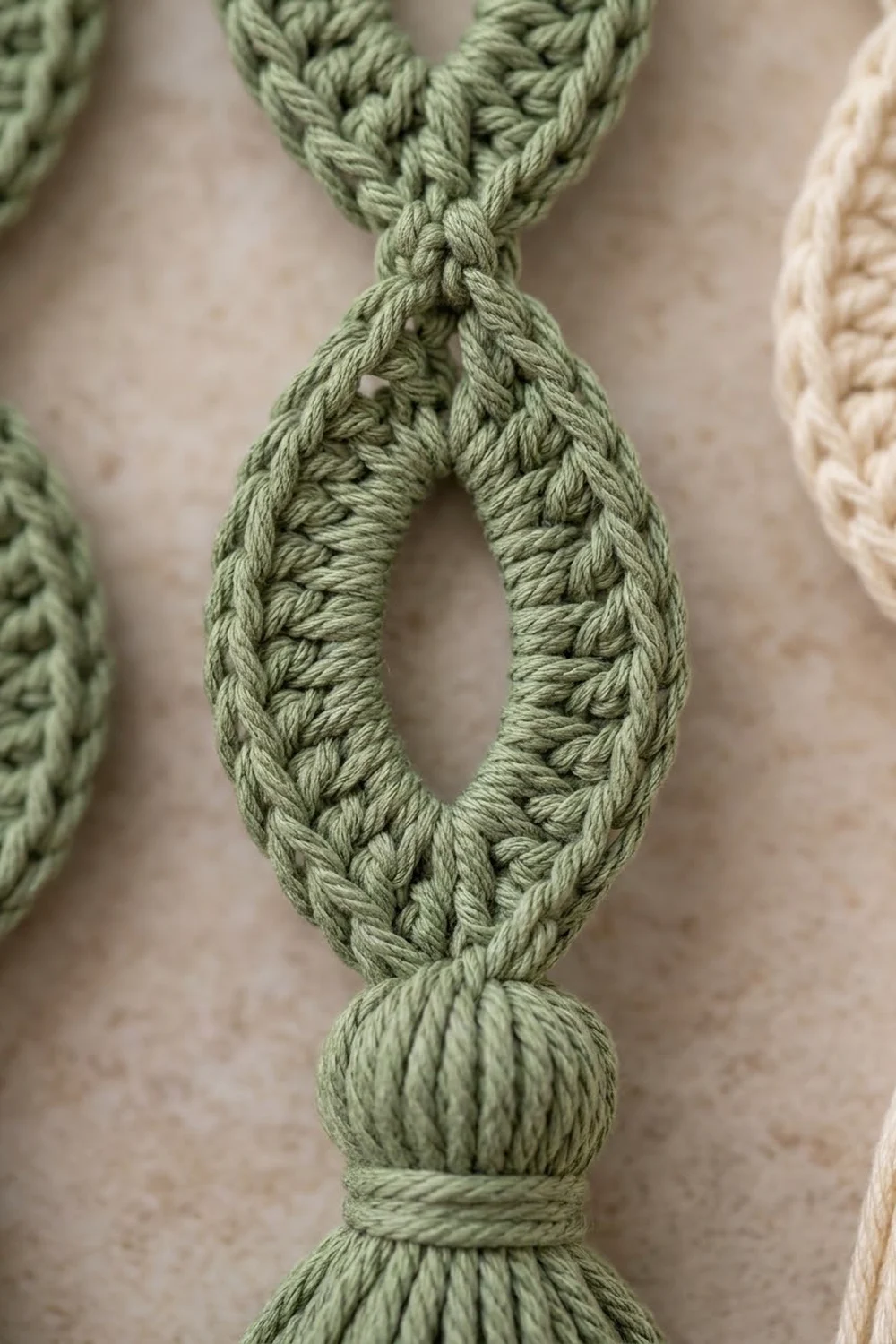
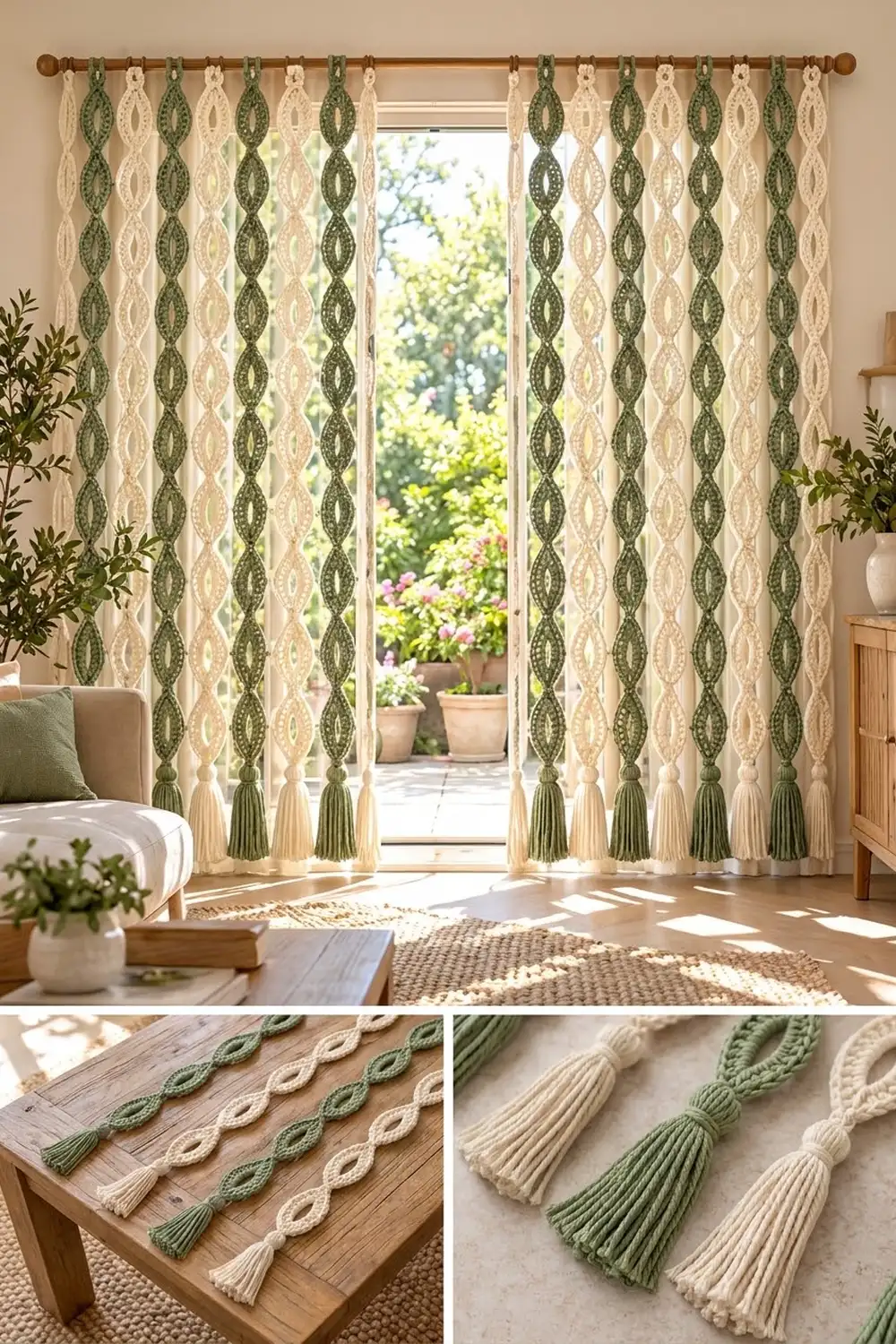
This strand curtain is a row of long, separate crochet cords hanging from one rod. Each cord is a chain of pointed, eye-shaped openings linked by short cinched waists, and each one ends in a full tassel. Hung side by side, the strands let light through their open centers but still look like a soft wall of texture.
The curtain uses two colors, sage green and warm cream, alternating strand by strand. The look is boho and botanical without being busy. Because every strand is the same, the curtain is relaxing to make and easy to resize.
This pattern uses US crochet terms. Each finished strand is 2.25 in (5.7 cm) wide at its widest point. The crocheted body is 73.5 in (186.7 cm) long. With the 6 in (15.2 cm) tassel, each strand hangs 79.5 in (201.9 cm) below its hanging loop. The full curtain has 16 strands hung as two panels of 8, and each panel takes up 24 in (61.0 cm) of rod.
Each strand is worked in two passes. On the way down, you make every eye ring and crochet its left side. On the way back up, you crochet each right side and tighten the waists. A border round then outlines the strand, and the tassel goes on last.
Finished Size and Construction
- Finished strand size: 2.25 in (5.7 cm) wide × 79.5 in (201.9 cm) long, including tassel
- Skill level: Easy–Intermediate
- Terminology: US crochet terms
- Yarn weight: Worsted weight (#4) cotton or cotton blend
- Hook: 5.0 mm (H-8)
- Number of pieces: 16 strands (8 sage, 8 cream), plus 16 tassels
- Layout: 2 panels of 8 strands, alternating sage and cream, hung from one rod
- Piece size: Each eye is 4.5 in (11.4 cm) long × 2.25 in (5.7 cm) wide; one eye plus one waist is 6 in (15.2 cm)
- Size before border: Each eye is 4.25 in (10.8 cm) × 1.75 in (4.4 cm)
- Border depth: 0.25 in (0.6 cm) per side
Materials
Choose a smooth, firm cotton or cotton blend. Strand curtains hang under their own weight, and very stretchy fibers grow longer over time. Mercerized or combed cotton gives the clean outline you see along the eye edges.
- Sage green: 350 g, about 600 yd (548.6 m)
- Cream: 350 g, about 600 yd (548.6 m)
One strand, including its tassel, uses about 64 yd (58.5 m), or roughly 38 g. These amounts include a margin of about 15% for your gauge swatch, test strand, and tassel trimming.
Tools:
- 5.0 mm (H-8) crochet hook
- Tapestry needle
- Scissors
- Stiff card, 6.5 in (16.5 cm) tall, for tassels
- Measuring tape
- Stitch markers
- Curtain rod, up to 1.25 in (3.2 cm) in diameter
Abbreviations (US Terms)
- ch – chain
- sl st – slip stitch
- sc – single crochet
- hdc – half double crochet
- dc – double crochet
- tr – treble crochet
- st(s) – stitch(es)
Special stitch – Eye Side (16 sts): Work 1 st in each of the next 16 ring chains, in this order: sc, sc, hdc, hdc, dc, dc, tr, tr, tr, tr, dc, dc, hdc, hdc, sc, sc. The short stitches at each end make the pointed tips. The 4 tr in the middle make the widest part of the eye.
Gauge and Checkpoints
Gauge: 14 sc = 4 in (10.2 cm) in a row with a 5.0 mm hook.
Before making all 16 strands, crochet a test strand with 2 eyes. Measure at each stage:
- After Pass 1 on the first eye: The ring of 32 ch measures about 4.5 in (11.4 cm) when pinched flat.
- After Pass 2: Each eye is 4.25 in (10.8 cm) long × 1.75 in (4.4 cm) wide. Each waist is 1.5 in (3.8 cm).
- After the border: Each eye is 4.5 in (11.4 cm) × 2.25 in (5.7 cm). One eye plus one waist is 6 in (15.2 cm).
If your eyes are too big: Go down to a 4.5 mm hook, or chain more tightly.
If your eyes are too small: Go up to a 5.5 mm hook.
Length matters most, because small errors add up over 12 repeats. A repeat that is 0.25 in (0.6 cm) too long makes the strand 3 in (7.6 cm) too long.
Pass 1: Rings and Left Sides (Working Down)
Hanging loop: Ch 18, sl st in first ch to form a loop. The loop fits rods up to 1.25 in (3.2 cm) across.
Top stem: Ch 6.
Eye 1:
- Ch 32. Sl st in the last stem ch (the 33rd ch from hook) to close the ring. Ring: 32 ch.
- Work Eye Side into ring chs 1–16, starting with the ch next to the join. 16 sts.
- Ch 1 for the bottom point. Mark this ch-1.
Waist stem: Ch 6.
Eyes 2–12: Repeat Eye 1, each followed by a waist stem, until you have 12 rings. After Eye 12’s ch-1 point, skip the waist stem and go straight to the bottom stem.
Bottom stem: Ch 7. Sl st in 2nd ch from hook and in each of next 5 ch. 6 sl st + 1 tip ch. Sl st in the ch-1 point of Eye 12.
Count check: You should have 12 rings of 32 ch, each with 16 sts on its left side and a ch-1 point. You should also have a top stem and 11 waist stems, each 6 ch. Do not fasten off.
Pass 2: Right Sides and Waists (Working Up)
Now work back up the strand, closing each eye.
Eye 12: Work Eye Side into ring chs 17–32. 16 sts. Sl st into the join at the top of the ring. Eye 12 total: 32 sts + ch-1 point.
Waist: Sl st in each of the 6 stem ch above, working into the back bump. 6 sl st. Sl st in the ch-1 point of the eye above.
Eyes 11–1: Repeat the Eye 12 and Waist steps up the strand. After Eye 1, sl st in the join, then sl st in each of the 6 top-stem ch.
Hanging loop: Work 24 sc into the loop. Sl st at the base of the loop. 24 sc. Do not fasten off; go straight into the border.
Count check: Every eye has 32 sts (16 per side). Every stem has 6 ch with 6 sl st along it. This slip-stitch pass pulls the waists tight, which gives the cinched, wrapped look between the eyes.
Make All Pieces
Make 16 identical strands:
- Sage green: 8 strands, 8 tassels
- Cream: 8 strands, 8 tassels
Layout on the rod (S = sage, C = cream):
Panel 1:  S  C  S  C  S  C  S  C
Panel 2:  C  S  C  S  C  S  C  S
Starting Panel 2 with cream keeps the colors alternating if the panels are pushed together.
Joining (Hanging the Strands)
The strands are never stitched to each other. The rod is the only thing that joins them, so each strand moves freely.
- Method: Slide each hanging loop onto the rod in layout order.
- Spacing: Allow 3 in (7.6 cm) of rod per strand, center to center. That leaves 0.75 in (1.9 cm) of space beside each 2.25 in (5.7 cm) strand. The eyes may overlap a little when they swing, but they won’t tangle.
- Tension: Match strand lengths before you finish. Hang all 16 on the rod and let them settle for a day. If one strand is more than 0.5 in (1.3 cm) longer than its neighbors, re-block it (see below).
- Size checkpoint: Each panel spans 24 in (61.0 cm) of rod (8 × 3 in / 7.6 cm). Every strand should measure 79.5 in (201.9 cm) from the top of the stem to the tassel ends.
Border
The border is worked around each strand separately and gives the clean outline along the eye edges.
Border gauge: Same as the main gauge, 14 sc = 4 in (10.2 cm). The sc edge adds 0.25 in (0.6 cm) of depth on each side.
Border Round: Continue from the base of the hanging loop, starting down the left edge.
Left side, working down:
- Sl st in each of 6 top-stem sts. 6
- [Sc in each of 16 Eye Side sts, sl st in ch-1 point, sl st in each of 6 stem sts] 11 times. 11 × 23 = 253
- Sc in each of 16 Eye Side sts of Eye 12, sl st in ch-1 point, sl st in each of 6 bottom-stem sts. 23
- Left side total: 6 + 253 + 23 = 282 sts (192 sc + 90 sl st)
Bottom tip: Sc in the tip ch. 1 sc. The tassel ties on here.
Right side, working up:
- Sl st in each of 6 bottom-stem sts. 6
- [Sc in each of 16 Eye Side sts, sl st in top join, sl st in each of 6 stem sts] 11 times (Eyes 12–2). 11 × 23 = 253
- Sc in each of 16 Eye Side sts of Eye 1, sl st in top join, sl st in each of 6 top-stem sts. 23
- Right side total: 6 + 253 + 23 = 282 sts (192 sc + 90 sl st)
Sl st in the first border st. Fasten off and weave in ends.
Round total: 282 + 1 + 282 = 565 sts.
Why the math works: Each eye has exactly 16 stitches per side, and the border puts 1 sc in each one, so each side gets 12 × 16 = 192 sc. The graded stitches have already shaped the curve, so one sc per stitch lies flat without ruffling. The stems get only sl sts, so the waists stay narrow and the strand doesn’t get longer. Each side also has 12 single point stitches: the bottom points on the left and the top joins on the right. That keeps both sides at exactly 282 stitches, so the strand hangs straight without twisting.
Tassels
- Wrap yarn 30 times around the 6.5 in (16.5 cm) card.
- Thread a 12 in (30.5 cm) tie under the wraps at the top of the card. Pass it through the tip sc of the strand and knot it firmly.
- Slide the wraps off the card. To form the head, wrap a separate strand tightly around the bundle 6 times, 0.75 in (1.9 cm) below the top. Knot it and bury the ends inside the tassel.
- Cut the bottom loops and trim the tassel to 6 in (15.2 cm).
Final Blocking
- Soak each finished strand in cool water, then press out the extra water in a towel. Do not wring it.
- Lay the strand flat on a long blocking surface, or on a towel on the floor.
- Pin each eye open to 4.5 in (11.4 cm) × 2.25 in (5.7 cm), with sharp points at the top and bottom.
- Pinch each waist so it is narrow and straight.
- Check that the body is 73.5 in (186.7 cm) long.
- Comb the tassel straight with your fingers.
- Let the strand dry completely. Then lightly steam the tassel and trim any uneven ends.
Final Quality-Control Checklist
- Every strand has 12 eyes, 11 waists, a top stem, and a bottom stem.
- Every eye has 16 sts per side, and the border has 282 sts per side.
- Eyes measure 4.5 in (11.4 cm) × 2.25 in (5.7 cm).
- All body lengths match within 0.5 in (1.3 cm).
- Tassels are 6 in (15.2 cm) long, with neat, tight necks.
- Each hanging loop has 24 sc and slides easily on the rod.
- All ends are woven in securely.
- Colors alternate as shown in the layout grid.
Troubleshooting
An eye twists sideways: The two sides of that eye probably have different counts. Recount both; each needs 16 sts.
An eye looks round, not pointed: The tips may have stitches that are too tall. Make sure each Eye Side starts and ends with 2 sc.
Waists are loose or long: Work the Pass 2 sl sts more firmly, or use a smaller hook for the stems only.
The border ruffles: You probably added extra sc at the points. Work just 1 sl st at each point and at each join.
Strands are different lengths: Re-block the long ones, pinning them to 73.5 in (186.7 cm). If a strand is more than 3 in (7.6 cm) off, take out one eye and one stem.
A tassel looks thin: Increase to 36 wraps. This uses about 2 yd (1.8 m) more yarn per tassel.
Care
Hand wash in cool water with mild soap, press out the water in a towel, and lay flat to dry. Don’t tumble dry: the heat and the weight of the wet strands will stretch them.
Final Notes
Every measurement in this curtain follows from the gauge. At 14 sc to 4 in (10.2 cm), a 32-ch ring becomes an eye 4.25 in (10.8 cm) × 1.75 in (4.4 cm). The border grows each eye to 4.5 in (11.4 cm) × 2.25 in (5.7 cm). Twelve eyes plus 13 stems of 1.5 in (3.8 cm) each make a 73.5 in (186.7 cm) body, and the tassel brings the strand to 79.5 in (201.9 cm). At 3 in (7.6 cm) per strand, 8 strands make a 24 in (61.0 cm) panel. Check each of these measurements on your test strand, and the rest of the curtain will come out right.
Happy crocheting!