

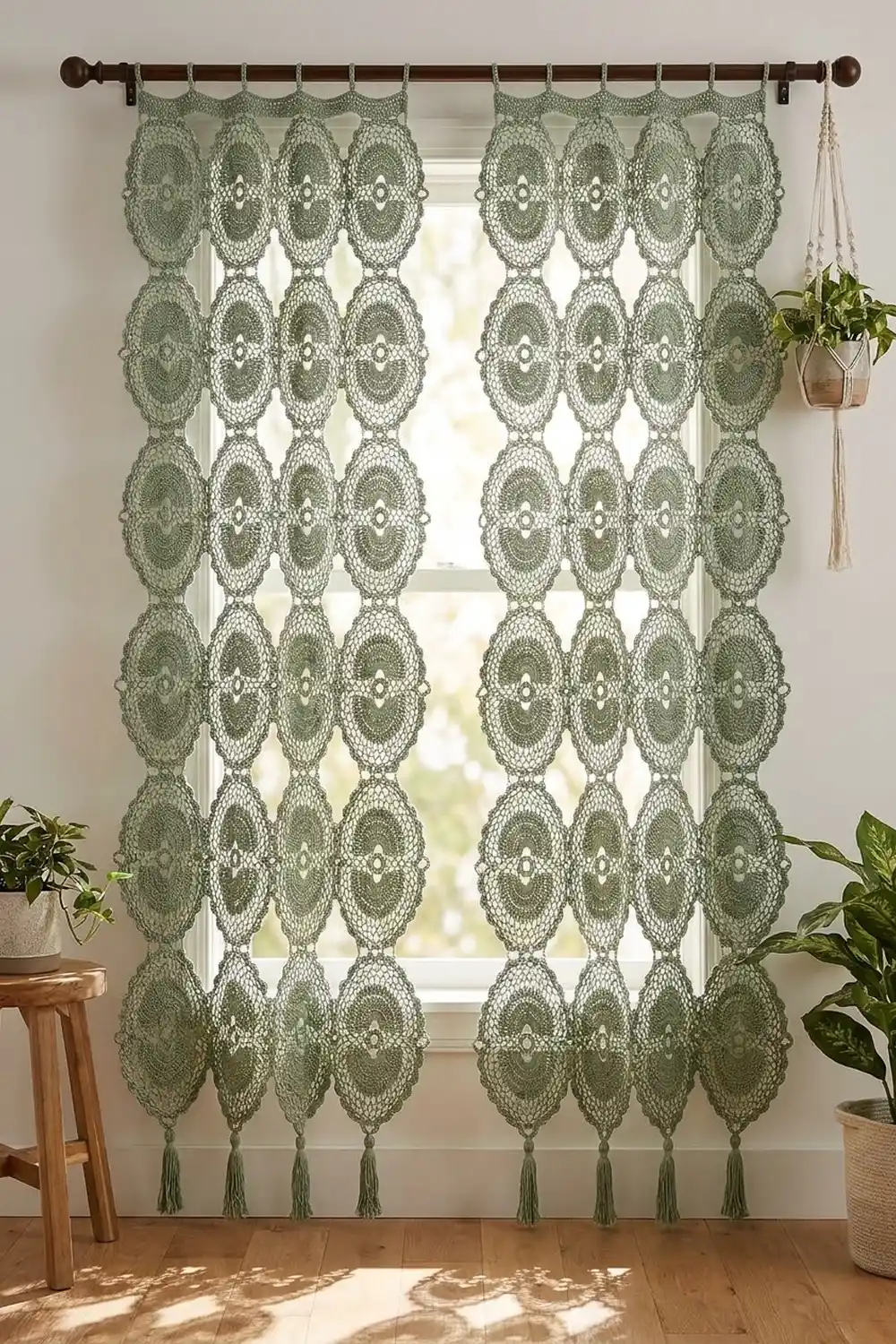
These lace curtain panels are made of soft sage green motifs, each with two fans set back to back. When the panels hang, the motifs line up into long scalloped columns, and a tassel at the bottom of each column finishes the look.
The style is light and a little vintage. It works well in a winter window next to greenery and string lights, and it still looks right all year. Every panel uses one color only, so the texture of the fans and arcs carries the design.
This pattern uses US crochet terms. Each finished panel measures 27 in (68.6 cm) wide. The motif body is 82.5 in (209.6 cm) long. With the heading, tabs, and tassels, the total length is 89.5 in (227.3 cm).
You make each motif in four rounds from two small linked rings. You join the motifs as you go, top to bottom and side to side, into a grid 6 motifs wide and 15 motifs tall. Then you add a short heading with rod tabs along the top and tie a tassel to the bottom of each strip.
Finished Size and Construction
- Finished panel size: 27 in (68.6 cm) wide x 82.5 in (209.6 cm) long for the motif body; 89.5 in (227.3 cm) overall
- Skill level: Intermediate
- Terminology: US crochet terms
- Yarn weight: DK (#3), cotton or cotton blend
- Hook: 4.0 mm (G-6)
- Number of pieces: 90 motifs per panel, 180 for the pair
- Layout: 6 strips across x 15 motifs down per panel
- Motif size: 4.5 in (11.4 cm) wide x 5.5 in (14.0 cm) tall, measured from the tip of one loop to the tip of the opposite loop
- Size before border: 27 in x 82.5 in (68.6 cm x 209.6 cm)
- Border depth: a 1.25 in (3.2 cm) heading along the top edge plus 1.75 in (4.4 cm) tabs. The sides and bottom keep their natural scallops, and the bottom gets 4 in (10.2 cm) tassels.
Materials
Yarn: Use a smooth DK cotton or cotton blend so the fans and arcs show up clearly. Mercerized cotton gives the crispest scallops. Avoid fuzzy yarns, which blur the lace.
- Sage green: 1,200 g (2,760 m) for the pair, which is 600 g (1,380 m) per panel. That is 24 balls of 50 g / 115 m.
These amounts include a margin of about 15% for gauge differences, tassels, and a test motif.
Tools:
– 4.0 mm (G-6) crochet hook
– Tapestry needle
– Scissors
– A stiff card 4.5 in (11.4 cm) tall for making tassels
– Rustproof pins and a blocking surface large enough for one strip, or for the full panel
– Measuring tape
– Stitch markers
Abbreviations (US Terms)
- ch – chain
- sl st – slip stitch
- sc – single crochet
- dc – double crochet
- tr – treble crochet
- sk – skip
- sp – space
- st(s) – stitch(es)
- RS – right side
Special technique: join-as-you-go loop (JAYG). Wherever the pattern says to join, work the first half of the loop’s chains. Then remove your hook, insert it from front to back through the matching loop on the finished motif, pick up the dropped loop, and pull it through (this counts as 1 sl st). Finish by working the second half of the chains. The joined loop has exactly the same number of stitches as an unjoined one.
Gauge and Checkpoints
Make one full test motif before you start. Block it lightly and measure it. Every other measurement in this pattern depends on it.
- Motif gauge: 1 motif = 4.5 in (11.4 cm) wide x 5.5 in (14.0 cm) tall, tip to tip
- Heading gauge: 20 sts = 4.5 in (11.4 cm), which is about 18 sc = 4 in (10.2 cm)
Checkpoints for one motif:
– After Round 1: 1.75 in (4.4 cm) wide x 2.25 in (5.7 cm) tall
– After Round 2: 3 in (7.6 cm) wide x 3.5 in (8.9 cm) tall
– After Round 3: 3.75 in (9.5 cm) wide x 4.5 in (11.4 cm) tall
– After Round 4: 4.5 in (11.4 cm) wide x 5.5 in (14.0 cm) tall
If your motif is too big, go down to a 3.75 mm hook. If it is too small, go up to a 4.5 mm hook. Being off by 0.25 in (0.6 cm) on one motif grows to 1.5 in (3.8 cm) across the panel width and 3.75 in (9.5 cm) down its length, so it is worth fixing now.
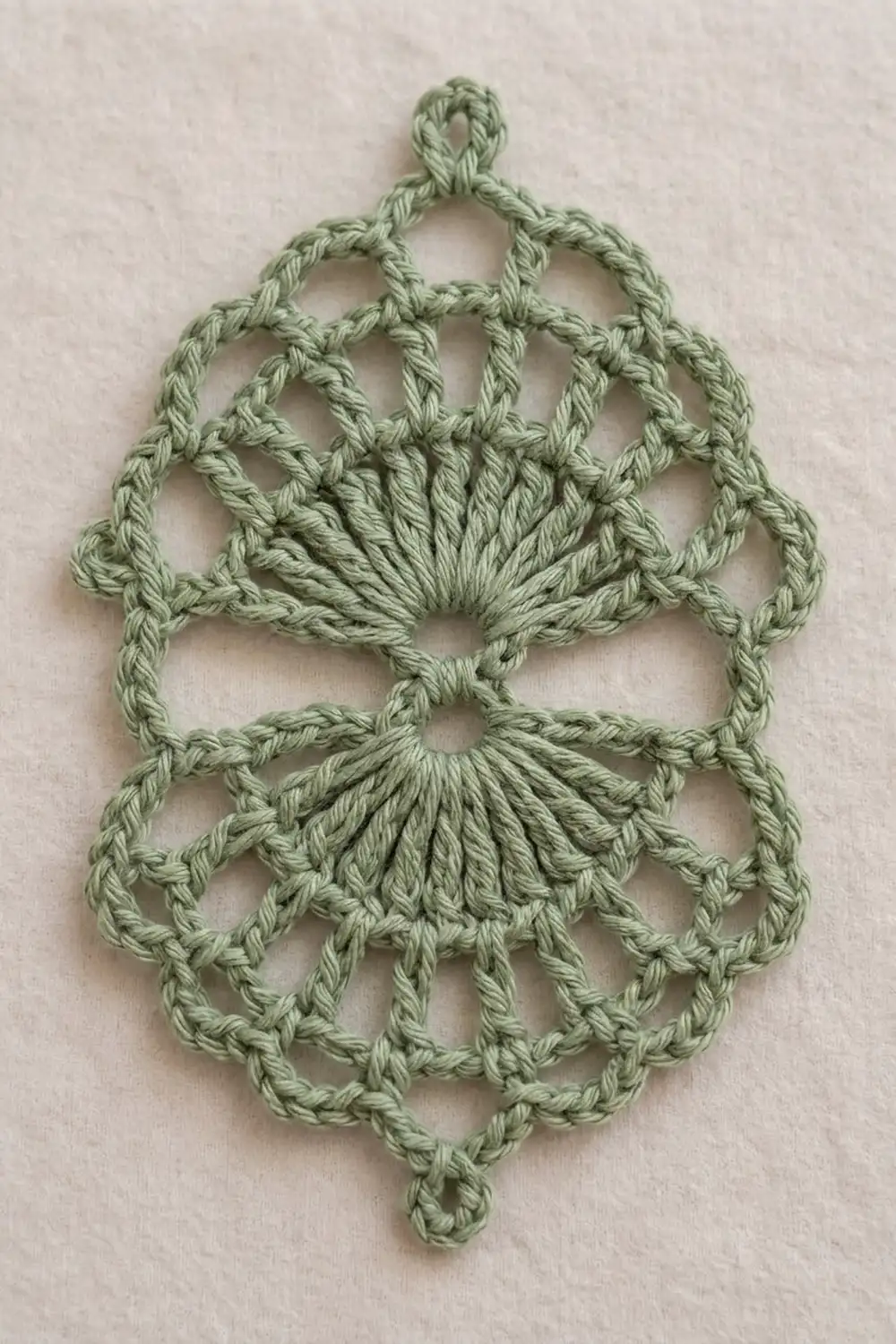
Fan Motif
Center Rings
Ch 6, sl st in first ch to form the Lower Ring.
Ch 6, sl st in the same ch as the first joining sl st to form the Upper Ring. The two rings now share one junction point.
Round 1 (Fans)
Ch 3 (counts as dc), 13 dc in Upper Ring, sl st in junction.
Ch 3 (counts as dc), 13 dc in Lower Ring, sl st in junction.
Count: 28 dc (14 dc per fan). Each fan wraps around the outer three-quarters of its ring, and the two rings stay visible in the center.
Round 2 (Spokes)
Sl st into the top of the beginning ch-3 of the Upper fan.
Ch 3 (counts as dc), dc in the same st, then 2 dc in each of the next 13 dc. That gives 28 dc on the Upper fan.
Ch 2 for the first waist space.
Work 2 dc in each of the 14 dc of the Lower fan, for 28 dc.
Ch 2 for the second waist space, then sl st to the top of the beginning ch-3.
Count: 56 dc and 2 ch-2 spaces. This round doubles every stitch, so the fans become solid half-circles.
Round 3 (Lace Arcs)
Ch 1, sc in the first dc.
Ch 5, sk 2 dc, sc in next dc. Repeat from * 8 more times, for 9 arcs. The last sc goes in the 28th dc of the Upper fan.
Ch 2, then work (sc, ch 3, sc) in the waist ch-2 space to make a picot, then ch 2.
Sc in the first dc of the Lower fan. Repeat the 9 arcs from * to * across the Lower fan.
Ch 2, (sc, ch 3, sc) in the second waist space, ch 2, sl st to the first sc.
Count: 18 ch-5 arcs (9 per fan), 24 sc, 2 ch-3 picots, and 4 ch-2 spaces. Each fan uses 1 + (9 x 3) = 28 dc, so the arcs come out even.
Round 4 (Scalloped Edge and Loops)
Number the arcs on each fan from 1 to 9. Arc 5 is the center arc, at the top or bottom point of the motif.
Ch 1. On the Upper fan, work 6 sc in each of arcs 1–4. In arc 5, work 3 sc, ch 7 (the end loop), 3 sc. Work 6 sc in each of arcs 6–9.
At the waist, work 2 sc in the ch-2 space. In the ch-3 picot, work (sc, ch 5, sc); the ch 5 is the side loop. Then work 2 sc in the next ch-2 space.
Work the Lower fan the same way as the Upper fan, then work the second waist the same way. Sl st to the first sc and fasten off.
Count, shown as a trim round: 108 sc over the arcs (18 arcs x 6 sc) plus 12 sc at the waists (6 per waist), for 120 sc. There are also 2 ch-7 end loops and 2 ch-5 side loops.
Make All Pieces
Make 90 motifs per panel, 180 for the pair, all in sage green. Finish the first motif of each panel completely. For every motif after that, join it during Round 4 (see Joining).
Layout grid for one panel (columns A–F, rows 1–15):
       A    B    C    D    E    F
 1    [M]--[M]--[M]--[M]--[M]--[M]   <- heading and tabs above
       |    |    |    |    |    |
 2    [M]--[M]--[M]--[M]--[M]--[M]
       |    |    |    |    |    |
 ...  (rows 3-14 repeat the same) ...
       |    |    |    |    |    |
15    [M]--[M]--[M]--[M]--[M]--[M]
       T    T    T    T    T    T   <- 6 tassels
In the grid, “|” marks an end-loop join and “–” marks a side-loop join. Each panel has 6 x 15 = 90 motifs.
Joining
Method: Join as you go in Round 4, working row by row from left to right.
- Row 1, column A: Work Round 4 with no joins.
- Any motif in column B–F: In its left waist, work (sc, ch 2, sl st into the right side loop of the neighbor, ch 2, sc) in the picot. That is 2 ch + 1 sl st + 2 ch = 5 sts, the same as the unjoined ch-5 loop.
- Any motif in row 2–15: In arc 5 of its Upper fan, work 3 sc, ch 3, sl st into the bottom ch-7 end loop of the motif above, ch 3, 3 sc. That is 3 + 1 + 3 = 7 sts, the same as the unjoined ch-7 loop.
How the stitches line up: Each joint connects one loop to exactly one loop, tip to tip. No extra stitches are added, and no stitch counts change.
Tension: Keep the join chains as loose as your normal chains. If they are tight, the strips pucker. If they are loose, the columns drift apart and the panel sags.
Size checkpoint: 2 motifs joined top to bottom measure 11 in (27.9 cm). After 5 rows, the panel should be 27.5 in (69.9 cm) long. A full row of 6 motifs should measure 27 in (68.6 cm) wide.
Border (Top Heading and Tabs)
The sides and bottom are left as natural scallops. Only the top edge gets a heading, which straightens it and holds the rod tabs.
Border gauge: 20 sts = 4.5 in (11.4 cm). That is one motif width.
Starting count: 6 top motifs x 20 sts per motif = 120 sts. Nothing is added at the seams.
Row 1 (Straightening Row, RS)
With RS facing, start at the top right motif. Join the yarn with a standing tr in the 3rd sc of arc 2 on that motif’s Upper fan, counting arcs from the right side.
Work across each top motif in this order:
– Ch 3, dc in the 3rd sc of arc 4.
– Ch 2, 6 sc in the ch-7 end loop.
– Ch 2, dc in the 4th sc of arc 6.
– Ch 3, tr in the 4th sc of arc 8.
Go straight on to the next motif with a tr in its arc 2, with no chain in between. Repeat the same sequence across all 6 motifs.
Per motif: 1 tr + 3 ch + 1 dc + 2 ch + 6 sc + 2 ch + 1 dc + 3 ch + 1 tr = 20 sts.
Row total: 6 x 20 = 120 sts. Turn.
Rows 2–3
Ch 1, sc in each st and each ch across. Turn after each row.
Count: 120 sc per row.
Row 4 (Tab Row)
Ch 1, sc in the first 5 sc. Ch 16, sc in next 10 sc. Repeat from * 10 more times. Ch 16, sc in the last 5 sc. Turn.
Count: 120 sc and 12 ch-16 tabs. The sc count is 5 + (11 x 10) + 5 = 120. Each motif gets 2 tabs, set 5 sts in from each motif edge.
Row 5 (Tab Covering)
Ch 1, sc in each sc, and work 20 sc around each ch-16 tab. Fasten off.
Count: 120 + (12 x 20) = 360 sc.
Why the math works: Each motif gives exactly 20 sts, and 20 sts at border gauge measure 4.5 in (11.4 cm), which is the motif width. So 120 sts measure 6 x 4.5 = 27 in (68.6 cm), and the heading neither pulls the panel in nor ruffles it. The heading adds 1.25 in (3.2 cm), and the tabs hang 1.75 in (4.4 cm). They fit a rod up to 1.5 in (3.8 cm) across.
Tassels (6 per panel)
- Wrap the yarn 30 times around the 4.5 in (11.4 cm) card.
- Slide a 10 in (25.4 cm) strand under the top of the wraps and tie it tightly.
- Cut the wraps open at the bottom.
- Wrap a second strand around the tassel 0.5 in (1.3 cm) below the top tie, then knot and bury the ends.
- Trim the tassel to 4 in (10.2 cm).
- Use the top tie to attach the tassel through the bottom ch-7 end loop of each row-15 motif.
Final Blocking
- Weave in all ends along the sc edges. Do not weave them through the arcs, where they would show.
- Soak the panel in cool water for 15 minutes, then press the water out gently. Do not wring it.
- Lay the panel flat on towels or blocking mats, working one section at a time if needed.
- Pin the width to 27 in (68.6 cm), with one pin in each side loop along both edges.
- Pin the length to 82.5 in (209.6 cm), checking every 5 rows against 27.5 in (69.9 cm).
- Pin out the scallops on the side edges and open each fan so the spokes lie straight.
- Straighten the heading and let the tabs lie flat.
- Let the panel dry completely, then comb the tassels and trim them evenly.
Final Quality-Control Checklist
- Every motif has 56 dc in its fans and 120 sc in Round 4.
- Each panel has 90 motifs, with every end-loop and side-loop join in place.
- Every column hangs straight, with no twisted joins.
- The panel measures 27 in x 82.5 in (68.6 cm x 209.6 cm).
- The heading has 120 sts, with 12 tabs spaced evenly.
- All 6 tassels are 4 in (10.2 cm) long and tied securely.
- All ends are woven in and trimmed.
- The second panel matches the first within 1 in (2.5 cm) in length.
Troubleshooting
- Fans ripple: Your Round 2 tension is loose. Go down a hook size for Round 2 only.
- Fans cup: Check that you have 14 dc in each ring in Round 1.
- Arcs come out uneven: Count your skips: always skip 2 dc, so each fan uses 28 dc.
- A column twists: The join went into the wrong loop. Undo it and rejoin into the end loop directly above.
- The heading flares: You have more than 20 sts per motif. Recount Row 1.
- The panel is too long after blocking: Cotton stretches when wet. Re-wet the panel and pin it shorter, or remove one row of motifs.
Care
Hand wash in cool water with a mild detergent, press the water out, and dry flat in shape. Do not tumble dry, because the heat and tumbling distort the lace and tangle the tassels.
Final Notes
Each measurement leads to the next. One motif is 4.5 in x 5.5 in (11.4 cm x 14.0 cm). Six motifs across make 27 in (68.6 cm), and 15 motifs down make 82.5 in (209.6 cm). The heading gives 20 sts per motif, 120 sts in total, so it matches the panel width exactly. Adding the heading, tabs, and tassels brings each panel to 89.5 in (227.3 cm). Measure your test motif first, check it again at each stage, and the pair of panels will hang straight.
Happy crocheting!