

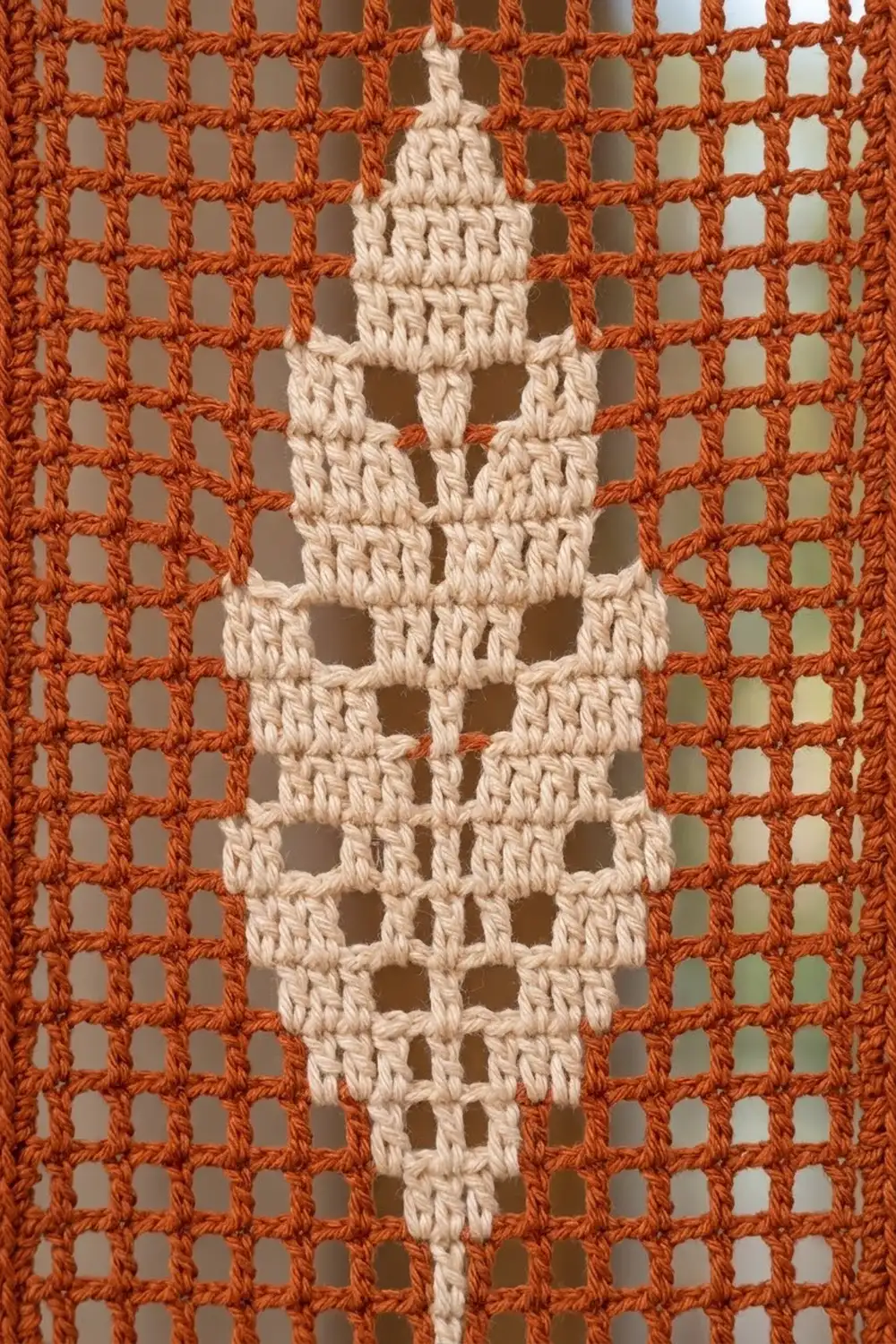
This curtain is made from ten long, narrow filet crochet strips that hang side by side from wooden rings. Each strip is an open mesh with a wheat-stalk motif repeating up the center. Each stalk has a straight stem, pairs of leaves angled upward, and a small pointed tip.
The colors alternate. Rust strips have cream wheat stalks, and cream strips have rust wheat stalks. Daylight comes through the mesh, and the solid blocks of the stalks stay crisp. The look is warm, earthy, and boho.
All instructions use US crochet terms. Each finished strip measures 7.5 in (19.1 cm) wide by 84 in (213.4 cm) long after the border. The strips are not sewn together. They hang in two panels of five, so you can make as many or as few as your window needs.
Each strip is worked flat in rows of filet mesh, 13 squares wide. You work the wheat motif in the contrast color with small bobbins and carry the main color inside the solid blocks. A two-round single crochet border finishes every edge.
Finished Size and Construction
- Finished strip size: 7.5 in x 84 in (19.1 cm x 213.4 cm)
- Skill level: Intermediate (filet plus color changes)
- Terminology: US crochet terms
- Yarn weight: DK / light (#3) cotton
- Hook: 4 mm (G-6)
- Number of pieces: 10 separate strips (6 rust, 4 cream)
- Layout: two panels of 5 strips, hung with no seams
- Strip size before border: 6.5 in x 83 in (16.5 cm x 210.8 cm), 13 squares x 166 rows
- Border depth: 0.5 in (1.3 cm) on every edge, 2 rounds
Materials
Choose a smooth mercerized cotton or cotton blend in DK weight. Cotton makes clean, square mesh and keeps the outline of the stalks sharp. Avoid fuzzy yarns, because they blur the holes.
- Rust: about 700 g / 1,750 m (1,914 yd). This covers the mesh of 6 rust strips plus the stalks of 4 cream strips.
- Cream: about 600 g / 1,500 m (1,640 yd). This covers the mesh of 4 cream strips plus the stalks of 6 rust strips.
For each strip, plan on about 75 g of main color and 40 g of contrast color. All quantities include a margin of about 10–15%.
Tools:
- 4 mm (G-6) crochet hook
- 3 small yarn bobbins
- Tapestry needle
- Stitch markers
- Rust-proof pins and blocking towels
- 20 curtain clip rings (2 per strip) and a curtain rod
Abbreviations (US Terms)
- ch – chain
- sc – single crochet
- dc – double crochet
- sk – skip
- sp – space
- st(s) – stitch(es)
- MC – main color (the strip’s mesh color)
- CC – contrast color (the stalk color)
- RS / WS – right side / wrong side
Special stitches:
- Mesh (open square): ch 2, sk 2 sts (or the ch-2 sp), dc in next dc.
- Block (filled square): 2 dc in the ch-2 sp (or 1 dc in each of the next 2 dc), dc in next dc.
- CC block: work a block entirely in CC while holding MC along the top of the row, so the 3 dc enclose it.
Every square uses 3 sts, and the first dc (or the turning ch) counts as the first post. A row of 13 squares always has 13 x 3 + 1 = 40 sts, whether the squares are mesh or blocks.
Gauge and Checkpoints
Gauge: 4 squares and 4 rows = 2 in (5.1 cm) in filet mesh. Each square is 0.5 in (1.3 cm) wide and tall.
Test your first strip before you buy all the yarn. Work Rows 1–20, then lay the piece flat without stretching it and check these measurements:
- After Row 4: 6.5 in (16.5 cm) wide, 2 in (5.1 cm) tall
- After Row 20: 6.5 in (16.5 cm) wide, 10 in (25.4 cm) tall
- After Row 36 (first full repeat): 18 in (45.7 cm) tall. The wheat motif itself is 14 in (35.6 cm) tall.
- After Row 166: 83 in (210.8 cm) tall before the border
If the strip is wider than 6.5 in (16.5 cm), go down a hook size. If it’s narrower, go up a size. Row height matters even more on a strip this long. If each row is off by 1/16 in, the strip ends up more than 10 in (25.4 cm) off at the top. Fix the hook size now rather than later.
Strip Pattern
Every strip is worked the same way. For a rust strip, MC = rust and CC = cream. For a cream strip, MC = cream and CC = rust.
Foundation and Plain Rows
With MC, ch 44.
Row 1: Dc in 8th ch from hook, *ch 2, sk 2 ch, dc in next ch; repeat from * across. Turn. (13 mesh squares, 40 sts)
Row 2: Ch 5 (counts as dc + ch 2), sk ch-2 sp, dc in next dc, *ch 2, sk ch-2 sp, dc in next dc; repeat from * across, working the last dc in the 3rd ch of the turning ch. Turn. (13 mesh, 40 sts)
Rows 3–4: Repeat Row 2. (13 mesh, 40 sts each row)
If a row begins with a block, start with ch 3 (counts as first dc) instead of ch 5.
Color-Change Method
Change color on the last yarn over of the stitch before the new color starts. Carry MC across the whole row: lay it along the top of the previous row and enclose it inside every CC block. Never carry MC across an open mesh square.
Use one CC bobbin for the stem. When a leaf splits away from the stem, join a separate bobbin for it, and cut that bobbin when the leaf ends. A bobbin never crosses a mesh square. When a leaf moves one square outward, bring its bobbin up through the first dc of the new block.
Wheat Motif (28 Rows)
Number the squares 1 to 13 across. The motif is symmetrical, so you can count from either edge on both RS and WS rows. Any square not listed is a mesh square in MC. Every row still has 40 sts.
M1–M2: CC block in square 7. (1 block, 12 mesh)
Leaf pair (5 rows), worked 4 times for M3–M22:
- Row a: CC blocks in squares 5–9. (5 blocks, 8 mesh)
- Row b: CC blocks in squares 4–5, 7, 9–10. (5 blocks, 8 mesh)
- Row c: CC blocks in squares 3–4, 7, 10–11. (5 blocks, 8 mesh)
- Row d: CC blocks in squares 2–3, 7, 11–12. (5 blocks, 8 mesh)
- Row e: CC block in square 7. (1 block, 12 mesh)
Rows a–e form the angled leaves. Each leaf starts beside the stem and moves one square outward on each row, so it points upward like a wheat leaf.
M23: CC blocks in squares 5–9. (5 blocks)
M24: CC blocks in squares 4–5, 7, 9–10. (5 blocks)
M25: CC block in square 7. (1 block)
M26–M27: CC blocks in squares 6–8. (3 blocks each row)
M28: CC block in square 7. (1 block)
The motif has 2 + (4 x 21) + 11 + 7 = 104 CC blocks.
M29–M32: Plain MC mesh. (13 mesh, 40 sts each row)
This completes one 32-row repeat, 16 in (40.6 cm) tall.
Strip Body
Rows 5–36: Work M1–M32 (repeat 1).
Rows 37–68: Repeat 2.
Rows 69–100: Repeat 3. Checkpoint: 50 in (127.0 cm) tall.
Rows 101–132: Repeat 4.
Rows 133–164: Repeat 5.
Rows 165–166: Plain MC mesh.
You now have 166 rows of 13 squares and 40 sts each, measuring 6.5 in x 83 in (16.5 cm x 210.8 cm). Five wheat stalks run up the strip. There are 4 plain rows below the first stalk and 6 above the last, so the top has a little extra room for the clip rings. Don’t fasten off; go straight on to the border.
Make All Pieces
Make 10 strips:
- Rust strips (rust mesh, cream stalks): 6
- Cream strips (cream mesh, rust stalks): 4
Layout, as seen from inside the room:
Left panel                Right panel
[R] [C] [R] [C] [R]   |   [R] [C] [R] [C] [R]
            (window opening)
R = rust strip, C = cream strip
Joining
The strips aren’t seamed to each other. They’re joined only at the rod, which keeps the curtain airy and lets each strip move on its own.
Attach 2 clip rings to each strip, 1 in (2.5 cm) in from each top corner. Clip through the border and the top mesh row together. Clip every strip the same way so the tops stay level.
Space the strips evenly with small gaps between them. Edge to edge, the 5 strips of one panel are 37.5 in (95.3 cm) wide. Keep the weight even on both clips. A strip hung from only one corner will twist and stretch on the diagonal.
Size checkpoint: each hung strip should measure 84 in (213.4 cm) from the top of the border to the bottom. Cotton relaxes, so let the strips hang for 24 hours before you set the final rod height.
Border
Border gauge: 5 sc = 1 in (2.5 cm) along the row edges. Along the top and bottom, 1 sc per stitch keeps the filet’s own width because the sc sit on compressed chains.
Round 1 (MC): Ch 1. Working across the last row, sc in each dc and 2 sc in each ch-2 sp: 14 + 26 = 40 sc. Ch 2 for the corner. Down the long side, work 3 sc around the first row-end and 2 sc around the next. Repeat this 2-row pattern 83 times, for 415 sc. Ch 2. Across the foundation chain, sc in the base of each dc and 2 sc in each ch-2 sp, for 40 sc. Ch 2. Work the second long side like the first, for 415 sc. Ch 2 and join with a sl st to the first sc.
Round 1 has 40 + 415 + 40 + 415 = 910 sc, plus 4 corner ch-2 sps.
Round 2 (MC): Ch 1. Sc in each sc around, and work (sc, ch 2, sc) in each corner ch-2 sp. Join.
Each short side now has 40 + 2 = 42 sc, and each long side has 415 + 2 = 417 sc. Round 2 has 42 + 417 + 42 + 417 = 918 sc, plus 4 corner ch-2 sps. Fasten off and weave in.
Why the math works: each dc row is 0.5 in (1.3 cm) tall, so 5 sc over every 2 rows equals 5 sc per inch, which matches the border gauge. That gives 166 ÷ 2 x 5 = 415 sc over 83 in (210.8 cm). The top and bottom keep the strip’s 40 sts, so the width stays 6.5 in (16.5 cm). The two rounds add 0.5 in (1.3 cm) to every edge: 6.5 + 1 = 7.5 in (19.1 cm) wide and 83 + 1 = 84 in (213.4 cm) long.
Final Blocking
- Weave in all CC tails inside CC blocks of the same color so nothing shows through the holes.
- Soak each strip in cool water for 15 minutes, then gently press out the water. Don’t wring it.
- Roll the strip in a towel to take out the extra water.
- Lay it flat on blocking towels, one section at a time. Pin the long edges straight at 7.5 in (19.1 cm) apart.
- Use your fingers to square each mesh hole, especially next to the stalks.
- Check that each stalk is centered on square 7 and that the leaves on each side mirror each other.
- Let it dry completely flat. Don’t hang it wet, because wet cotton stretches.
- Measure it: 7.5 in x 84 in (19.1 cm x 213.4 cm).
Final Quality-Control Checklist
- Every row has 40 sts and 13 squares.
- Each strip has 5 stalks, each 28 rows / 14 in (35.6 cm) tall.
- All stalks are centered on square 7.
- MC is never carried across an open mesh square.
- The border has 42 sc on each short side and 417 sc on each long side.
- Each strip measures 7.5 in x 84 in (19.1 cm x 213.4 cm).
- You have 6 rust strips and 4 cream strips.
- The clip rings are level and 1 in (2.5 cm) in from the corners.
Troubleshooting
The strip is longer than expected. Your rows are too tall. Go down a hook size or pull up less on each dc loop.
The mesh holes look rectangular. Your ch-2 tension doesn’t match your dc. Adjust your chains until each hole is square.
MC shows through the CC blocks. Keep the carried strand flat along the top of the row and work over it snugly. A faint rust shadow on cream strips is normal, and blocking softens it.
The leaves look jagged. You’re probably changing color too late. Switch on the last yarn over of the previous stitch.
The long edges ruffle. Your sc are wider than 5 per inch. Work 2 sc in every row-end instead: 332 sc per long side in Round 1 and 334 in Round 2.
The strips stretch after hanging. This is normal for cotton. Re-block, and raise the clip rings or rod slightly if a strip has grown more than 1 in (2.5 cm).
Care
Hand wash in cool water with mild soap and dry flat. Don’t tumble dry, because it shrinks cotton and distorts the mesh.

Final Notes
The measurements build step by step. Because 4 squares = 2 in (5.1 cm), 13 squares = 6.5 in (16.5 cm) and 166 rows = 83 in (210.8 cm). Two border rounds bring each strip to 7.5 in x 84 in (19.1 cm x 213.4 cm), and ten strips make two airy wheat panels. Check your gauge early and count to 40 on every row.
Happy crocheting!