

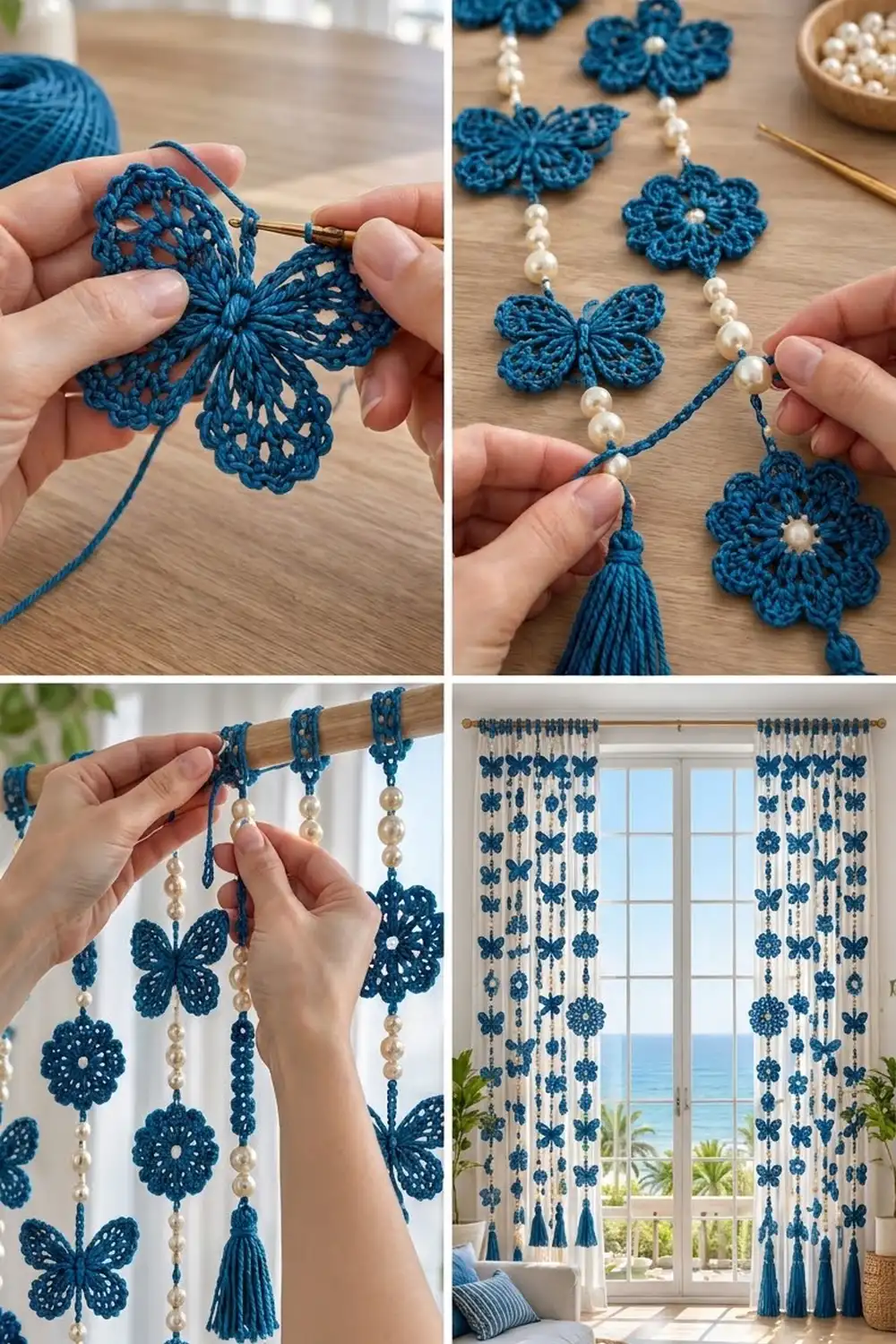
This hanging-strand curtain catches the light like a breezy beach-house window. Lacy butterflies and six-petal flowers alternate down long chain cords, and pearl beads and a soft tassel finish each strand. The panels filter light without blocking the view.
The whole curtain uses one color, a deep cobalt blue cotton, with cream pearls as the only accent. The look is coastal, fresh, and a little vintage. All instructions use US crochet terms.
Each panel measures about 23 in (58.4 cm) wide and 74 in (188.0 cm) long, not counting the hanging loops. This pattern makes a matching pair of two panels.
Construction is simple and modular. You crochet flat butterfly and flower motifs first and block them. Then you work each strand as one continuous chain cord with the pearls pre-strung on the yarn, joining motifs in line as you go. A tassel finishes the bottom of each strand, and a chain loop at the top slips over the rod.
Finished Size and Construction
- Finished size (one panel): 23 in (58.4 cm) wide x 74 in (188.0 cm) long
- Skill level: Intermediate (easy stitches, many repeats)
- Terminology: US
- Yarn weight: Sport (#2) mercerized cotton
- Hook: 3.0 mm
- Number of pieces: 2 panels; 6 strands per panel; 12 motifs per strand (144 motifs total)
- Layout: 6 strands spaced 4 in (10.2 cm) apart; butterflies and flowers alternate in a checkerboard
- Piece size: flower 2.5 in (6.4 cm) across; butterfly 3 in (7.6 cm) wide x 2.5 in (6.4 cm) tall
- Size before border: each strand 69.5 in (176.5 cm) of cord and motifs
- Border depth: tassels add 4.5 in (11.4 cm) at the bottom; the hanging loops sit above the rod
Materials
Choose a smooth, mercerized cotton in sport weight, about 155 m per 50 g. Cotton holds the lacy shapes crisply and does not stretch much under hanging weight.
- Deep cobalt blue: 800 g (about 2,480 m), sixteen 50 g balls
- 8 mm cream pearl beads: 500 (468 needed), hole at least 2 mm
- 6 mm cream pearl beads: 80 (72 needed) for flower centers
Tools:
- 3.0 mm crochet hook
- Big-eye beading needle (to pre-string pearls)
- Tapestry needle and sewing needle with matching blue thread
- Stitch markers
- Cardboard rectangle 5 in (12.7 cm) tall for tassels
- Measuring tape, blocking mat, rustproof pins, light spray starch
All quantities include a margin of about 15 percent for swatching and dye-lot safety.
Abbreviations (US Terms)
- ch – chain
- sl st – slip stitch
- sc – single crochet
- hdc – half double crochet
- dc – double crochet
- sp – space
- st(s) – stitch(es)
- picot – ch 3, worked between two sc in the same space
- PB (place bead) – slide one pre-strung pearl up snug against the hook, then ch 1 to lock it
- Drop-loop join – remove the hook from the loop, insert it from front to back through the stitch named, pick up the dropped loop, and pull it through
Gauge and Checkpoints
Gauge: 5 ch = 1 in (2.5 cm) of hanging cord, measured relaxed.
Before starting the full curtain, make one flower, one butterfly, and one cord segment. These three tests tell you whether every later measurement will land.
- Flower Rnd 1: 1.25 in (3.2 cm) across
- Finished flower: 2.5 in (6.4 cm) tip to tip
- Finished butterfly: 3 in (7.6 cm) wide x 2.5 in (6.4 cm) tall
- One cord segment (13 ch plus 3 pearls): 3.5 in (8.9 cm)
If your pieces are too big, go down to a 2.75 mm hook. If they are too small, go up to a 3.25 mm hook. Change the hook, not the stitch counts, because the strand length depends on them.
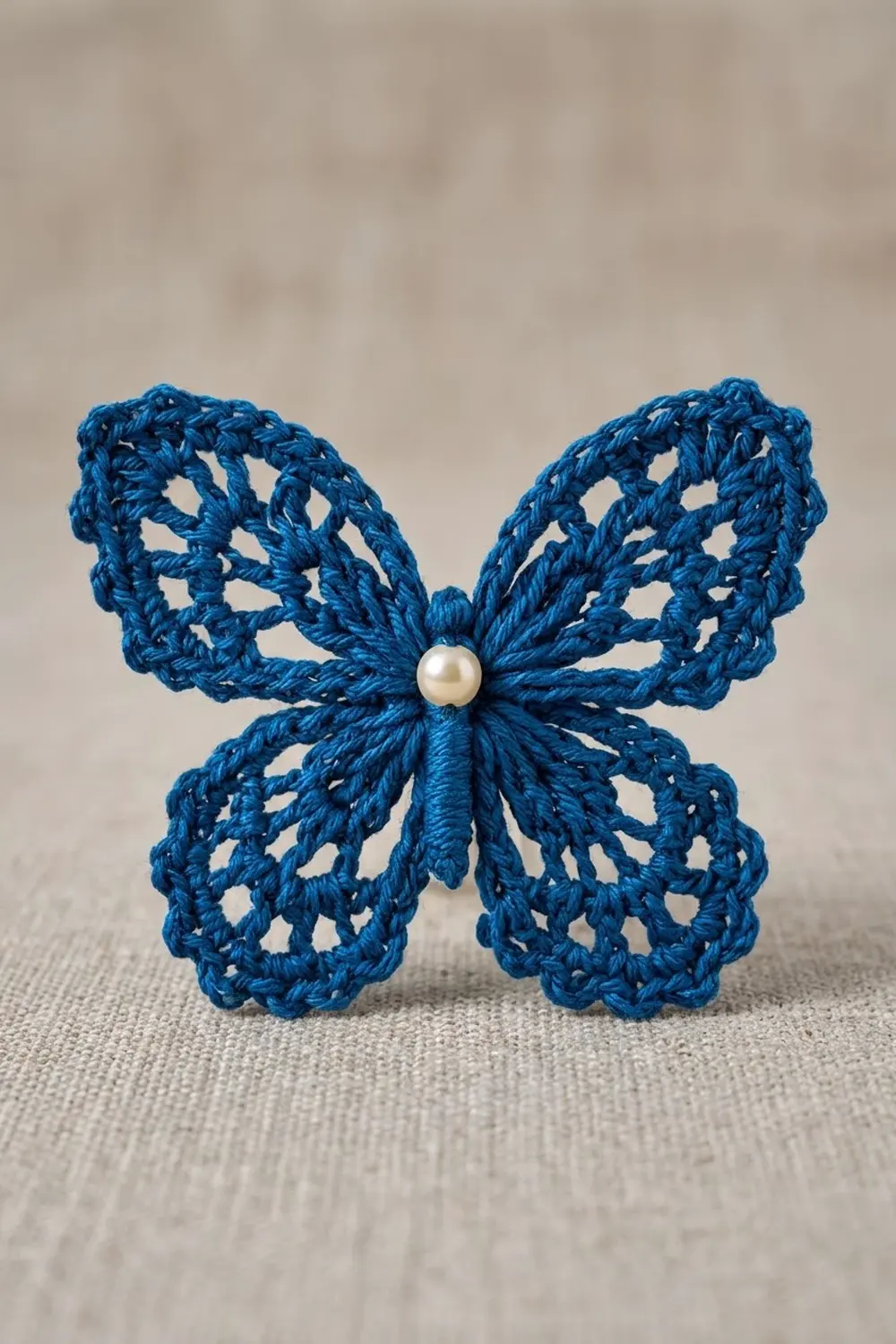
Flower Motif (make 72)
Rnd 1: Ch 6, sl st in first ch to form a ring. Ch 3 (counts as dc), 17 dc in ring, sl st to top of ch-3. (18 dc)
Rnd 2: Ch 1, sc in same st, ch 5, skip 2 sts, sc in next st, ch 5, skip 2 sts; repeat from * to * 4 more times, sl st to first sc. (6 sc, 6 ch-5 loops)
Rnd 3: Sl st into first ch-5 loop. In each ch-5 loop work (sc, hdc, 7 dc, hdc, sc), sl st to first sc. (6 petals, 11 sts each, 66 sts)
Fasten off, leaving an 8 in (20.3 cm) tail. Thread the tail on a sewing needle, sew a 6 mm pearl across the center ring from the front, knot on the back, and weave in.
Join points: on two opposite petals, place a marker in the center dc (the 4th of 7 dc). One will be the top, the other the bottom.
Checkpoint: 2.5 in (6.4 cm) tip to tip.
Butterfly Motif (make 72)
Rnd 1: Ch 4, sl st in first ch to form a ring. Ch 3 (counts as dc), 11 dc in ring, sl st to top of ch-3. (12 dc)
Number these sts 1 to 12, with st 1 being the ch-3.
Rnd 2 (wing loops): Ch 1, sc in st 1, ch 8, sc in st 4, ch 6, sc in st 7, ch 6, sc in st 10, ch 8, sl st to first sc. (4 sc, 2 ch-8 loops, 2 ch-6 loops)
The two ch-8 loops sit side by side on either side of the sc in st 1 and become the upper wings. The two ch-6 loops sit on either side of the sc in st 7 and become the lower wings.
Rnd 3 (wing shells): Sl st into the first ch-8 loop. Work the loops in order around the ring:
– In each ch-8 loop: (2 dc, ch 2) 4 times, 2 dc. (10 dc, 4 ch-2 sps)
– In each ch-6 loop: (2 dc, ch 2) twice, 2 dc. (6 dc, 2 ch-2 sps)
– Sl st in the Rnd 2 sc after each loop. The last sl st goes in the first sc.
Round total: 32 dc, 12 ch-2 sps, 4 sl st.
Rnd 4 (picot edge): Work around each wing. Sc in each dc and (sc, picot, sc) in each ch-2 sp. Sl st in each sl st between wings, and join with a sl st at the end.
– Upper wing: 10 sc + 8 sc = 18 sc, 4 picots
– Lower wing: 6 sc + 4 sc = 10 sc, 2 picots
Round total: 56 sc, 12 picots, 4 sl st.
Fasten off, leaving an 18 in (45.7 cm) tail.
Body: Thread the tail on a tapestry needle. Wrap it vertically 8 times through the center ring and around the outside, from the st-1 junction to the st-7 junction. Pull just firmly enough to pinch the wings into shape. Knot on the back and weave in.
Join points: the top is the junction at st 1 (between the upper wings) and the bottom is the junction at st 7 (between the lower wings). The distance between them along the body is 1.5 in (3.8 cm).
Checkpoint: 3 in (7.6 cm) wide x 2.5 in (6.4 cm) tall.
Make All Pieces
- Flowers: 72 (36 per panel)
- Butterflies: 72 (36 per panel)
- Strands: 12 (6 per panel)
- Tassels: 12
Block every motif before joining. Pin each flower to a 2.5 in (6.4 cm) circle and each butterfly to 3 in x 2.5 in (7.6 cm x 6.4 cm). Mist with light starch and let dry.
Layout for one panel, read top (position 1) to bottom (position 12). B = butterfly, F = flower.
Pos   S1  S2  S3  S4  S5  S6
 1    B   F   B   F   B   F
 2    F   B   F   B   F   B
 3    B   F   B   F   B   F
 4    F   B   F   B   F   B
 5    B   F   B   F   B   F
 6    F   B   F   B   F   B
 7    B   F   B   F   B   F
 8    F   B   F   B   F   B
 9    B   F   B   F   B   F
10    F   B   F   B   F   B
11    B   F   B   F   B   F
12    F   B   F   B   F   B
Odd strands start with a butterfly. Even strands start with a flower. Each strand holds 6 of each.
Joining (Building Each Strand)
Each strand is one continuous chain cord. Before you begin, use the beading needle to pre-string 39 of the 8 mm pearls onto the ball (13 segments x 3 pearls).
Cord segment (13 ch + 3 pearls): Ch 6, (PB) 3 times, ch 4. That gives 6 + 3 + 4 = 13 ch and 3 locked pearls, measuring 3.5 in (8.9 cm).
Strand:
- Hanging loop: Make a slip knot, ch 20, and sl st in the first ch. The loop is 4 in (10.2 cm) around and fits rods up to 1 in (2.5 cm) thick.
- Work one cord segment.
- Drop-loop join into the top join point of the first motif.
- Work the span chain behind the motif: ch 7 for a butterfly or ch 12 for a flower.
- Drop-loop join into the bottom join point of the same motif.
- Work one cord segment.
- Repeat steps 3-6 for the remaining 11 motifs, following the layout grid. After the 12th motif you will have worked the 13th segment.
- Fasten off, leaving a 10 in (25.4 cm) tail for the tassel.
Stitch-to-stitch logic: Always join into the exact marked center stitch, from the front. This keeps every motif centered on the cord and facing forward. The span chain carries the weight behind the motif, so the lace is never stretched.
Tension: Keep chains relaxed and even. Tight chains shorten the strand and make the pearls bunch. Loose chains let the motifs droop.
Chain count per strand: 20 + (13 x 13) + (6 x 12) + (6 x 7) = 20 + 169 + 72 + 42 = 303 ch, plus 24 joins and 39 pearls.
Size checkpoint: Lay the strand flat, measuring from the base of the loop to the last chain. It should be 69.5 in (176.5 cm).
Border: Top Loops and Tassel Finish
This curtain has no fabric border. Its edges are the row of hanging loops at the top and the row of tassels at the bottom. The border gauge is the cord gauge: 5 ch = 1 in (2.5 cm).
Top edge, per panel: 6 loops x 20 ch = 120 ch. Space the loops 4 in (10.2 cm) apart on the rod. The outer strand centers are 5 x 4 in = 20 in (50.8 cm) apart. Add half a butterfly’s width, 1.5 in (3.8 cm), on each side to get 23 in (58.4 cm).
Bottom edge, per panel: 6 tassels.
Tassel:
1. Wrap yarn 30 times around the 5 in (12.7 cm) card.
2. Slide the strand’s 10 in (25.4 cm) tail under the wraps at the top, tie it tightly, and slip the bundle off.
3. Cut the bottom loops.
4. Wrap a separate yarn piece 6 times around the bundle 0.5 in (1.3 cm) below the top, then knot it and bury the ends inside.
5. Trim the tassel to 4.5 in (11.4 cm) overall.
Why the math works:
– Cord segments: 13 x 3.5 in = 45.5 in (115.6 cm)
– Flowers: 6 x 2.5 in = 15 in (38.1 cm)
– Butterflies: 6 x 1.5 in = 9 in (22.9 cm)
– Strand before tassel: 45.5 + 15 + 9 = 69.5 in (176.5 cm)
– Add the tassel: 69.5 + 4.5 = 74 in (188.0 cm)
Because every strand uses the same counts, all the tassels end on one level line.
Final Blocking
- Hang all 6 strands of a panel on the rod, or on a broom handle across two chairs.
- Untwist each strand so every motif faces forward.
- Mist the motifs and cords lightly with water or diluted starch.
- Gently shape the wings and petals with your fingers.
- Let the strands dry hanging, which straightens the cords naturally.
- Steam each tassel from a distance and comb its strands straight. Re-trim to 4.5 in (11.4 cm) if needed.
- Measure each strand against the 74 in (188.0 cm) target.
Final Quality-Control Checklist
- Every flower is 2.5 in (6.4 cm), and every butterfly is 3 in x 2.5 in (7.6 cm x 6.4 cm)
- Flower Rnd 3 has 66 sts, and butterfly Rnd 4 has 56 sc and 12 picots
- Each segment has 13 ch and 3 locked pearls
- Each strand has 12 motifs that alternate correctly against the grid
- All joins are in the center stitches and face forward
- Each strand is 74 in (188.0 cm) with its tassel
- The strands are 4 in (10.2 cm) apart, giving a panel width of 23 in (58.4 cm)
- All ends are woven in securely
Troubleshooting
- Pearls slide along the cord: you skipped the locking ch 1 after a pearl. Undo it and lock each pearl.
- Strand too long: your chains are too loose. Go down a hook size for the cord only.
- Strand too short: your chains are too tight. Go up a hook size for the cord only.
- Motif tilts: you joined off center. Redo the join into the marked dc or body junction.
- Butterfly wings flop: wrap the body more firmly and re-block with starch.
- Flower cups: Rnd 3 is too tight. Rework it with relaxed dc.
- Ran out of pearls mid-strand: cut the yarn, string more pearls, and rejoin at the next motif join so the ends hide behind it.
Care
Hand wash in cool water with mild soap, roll in a towel, and dry hanging. Re-starch lightly if the motifs soften.
Final Notes
Everything rests on one measurement chain. Five chains equal 1 in (2.5 cm), so each segment is 3.5 in (8.9 cm). Each flower adds 2.5 in (6.4 cm) and each butterfly adds 1.5 in (3.8 cm) along the cord. Thirteen segments and twelve motifs make 69.5 in (176.5 cm), and a 4.5 in (11.4 cm) tassel brings each strand to 74 in (188.0 cm). Six strands spaced 4 in (10.2 cm) apart make a 23 in (58.4 cm) panel. Check your test pieces, and the rest of the curtain will follow.
Happy crocheting!