

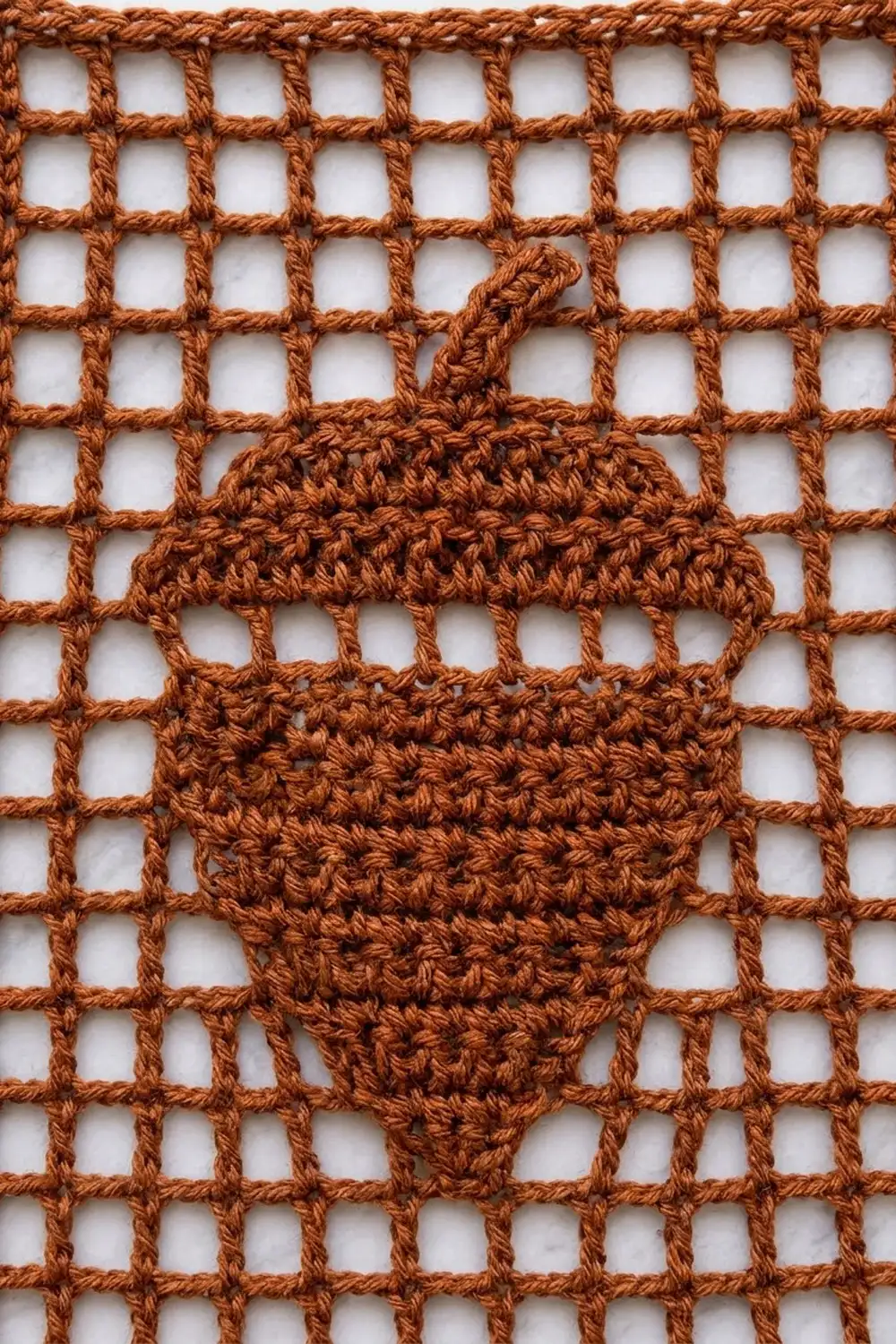
This curtain brings an autumn woodland feel into a doorway. It is made of seven tall filet crochet strips that alternate in rich rust brown and soft cream. Each strip carries a column of solid acorns and lobed oak leaves set into an open grid, so light passes through while the motifs stay crisp.
The style is classic filet crochet: a mesh of double crochet posts and chain spaces, with “blocks” filled in to draw the pictures. Every strip is a single color. A plain single crochet edging frames each strip, and two sturdy loops at the top slide onto a curtain rod.
All instructions use US crochet terms. Each finished strip measures 6.0 in (15.2 cm) wide and 70.0 in (177.8 cm) long, plus 1.5 in (3.8 cm) hanging loops. Seven strips hung edge to edge span 42.0 in (106.7 cm).
Construction is simple and repetitive. You work each strip flat in rows from the bottom up, add a one-round border, then crochet the two loops. The strips are never sewn together; they hang side by side on the rod.
Finished Size and Construction
- Finished strip size: 6.0 in x 70.0 in (15.2 cm x 177.8 cm), loops not included
- Skill level: Intermediate (easy stitches, careful chart reading)
- Terminology: US crochet terms
- Yarn weight: DK (#3 light)
- Hook: 3.5 mm (E-4)
- Number of pieces: 7 separate strips (4 rust, 3 cream)
- Layout: 7 strips side by side on one rod, colors alternating, not joined
- Strip size before border: 5.5 in x 69.5 in (14.0 cm x 176.5 cm)
- Border depth: 0.25 in (0.6 cm) on every edge
- Motifs per strip: 5 acorns and 4 oak leaves
Materials
Choose a smooth, firm DK yarn with good stitch definition. Cotton or a cotton blend gives the sharpest grid and hangs straight; acrylic works but may drape more. Avoid fuzzy or very splitty yarns, which blur the mesh. Amounts below assume about 230 m per 100 g.
- Color A, Rust Brown: 730 g (1680 m), for 4 strips
- Color B, Cream: 550 g (1265 m), for 3 strips
One strip uses about 165 g (380 m). These quantities include a margin of roughly 10% for gauge differences and swatching.
Tools:
- 3.5 mm (E-4) crochet hook
- Tapestry needle
- Stitch markers
- Measuring tape
- Rust-proof pins and a long blocking surface
- Spray bottle
- Curtain rod up to 1 in (2.5 cm) in diameter
Abbreviations (US Terms)
- ch – chain
- sc – single crochet
- dc – double crochet
- sl st – slip stitch
- sk – skip
- st(s) – stitch(es)
- sp – space (open mesh)
- bl – block (filled mesh)
- RS / WS – right side / wrong side
Special stitches:
- Space (sp): ch 2, sk next 2 sts, dc in next dc.
- Block (bl): work 2 dc into the next ch-2 sp (or 1 dc in each of the next 2 dc), then dc in next dc.
- Beginning space: ch 5 (counts as dc + ch 2), sk next 2 sts, dc in next dc.
- Beginning block: ch 3 (counts as dc), then 2 dc over the next 2 sts and dc in next dc.
Every filet row has 11 meshes and 34 sts: 12 dc posts plus 22 sts across the meshes (chains or dc). Always work the last dc of a row into the 3rd ch of the turning chain.
Gauge and Checkpoints
Gauge: 8 meshes and 8 filet rows = 4 in (10.2 cm) square. Each mesh is 0.5 in (1.3 cm) wide and tall. In single crochet, 34 sc = 5.5 in (14.0 cm).
Swatch: Ch 26. Sc in 2nd ch from hook and each ch across (25 sc). Work 8 rows of open mesh (8 meshes per row). The mesh area should measure 4 in (10.2 cm) each way.
Test one full strip before starting the others. Check it at these points:
- After Row 4: 5.5 in (14.0 cm) wide, 1.75 in (4.4 cm) tall
- After Row 16 (first acorn): 7.75 in (19.7 cm) tall
- After Row 34 (first full repeat): 16.75 in (42.5 cm) tall
- After Row 124: 61.75 in (156.8 cm) tall
- After Row 140: 5.5 in x 69.5 in (14.0 cm x 176.5 cm)
Too big? Go down 0.25 to 0.5 mm in hook size. Too small? Go up the same amount. If only the height is off, adjust how tall you pull up each dc rather than changing hooks. The final length can also shift about 1 in (2.5 cm) during blocking.
Strip Pattern
The motif charts are written as mesh sequences. Read each sequence in the order you work it, from the hook end. Rows 2, 4, 6, and every even row are RS rows.
Foundation
Row 1 (WS): Ch 35. Sc in 2nd ch from hook and in each ch across. Turn. (34 sc)
Row 2 (RS): Beginning space, *ch 2, sk 2 sc, dc in next sc; repeat from * 9 more times. Turn. (11 sp; 34 sts)
Rows 3–4: Work 11 sp. Turn. (34 sts)
Acorn Motif (12 rows)
The acorn is symmetrical, so each row reads the same in either direction. The nut is 7 meshes, 3.5 in (8.9 cm), wide; the cap is 9 meshes, 4.5 in (11.4 cm), wide and overhangs the nut.
- A1 (tip): 5 sp, 1 bl, 5 sp
- A2: 4 sp, 3 bl, 4 sp
- A3: 3 sp, 5 bl, 3 sp
- A4: 3 sp, 5 bl, 3 sp
- A5: 2 sp, 7 bl, 2 sp
- A6: 2 sp, 7 bl, 2 sp
- A7: 2 sp, 7 bl, 2 sp
- A8 (cap rim): 1 sp, 9 bl, 1 sp
- A9: 1 sp, 9 bl, 1 sp
- A10: 2 sp, 7 bl, 2 sp
- A11: 3 sp, 5 bl, 3 sp
- A12 (stem): 5 sp, 1 bl, 5 sp
Each row: 34 sts. The acorn is 12 rows, 6 in (15.2 cm), tall.
Oak Leaf Motif (12 rows)
The leaf runs on a diagonal, with its stem at lower left and tip at upper right when viewed from the RS. Alternating wide and narrow rows create the lobed edge. L1 always falls on a RS row.
- L1 (RS, stem): 9 sp, 1 bl, 1 sp
- L2 (WS): 2 sp, 1 bl, 8 sp
- L3 (RS): 4 sp, 1 bl, 1 sp, 2 bl, 3 sp
- L4 (WS): 2 sp, 5 bl, 4 sp
- L5 (RS): 4 sp, 4 bl, 3 sp
- L6 (WS): 2 sp, 6 bl, 3 sp
- L7 (RS): 2 sp, 5 bl, 4 sp
- L8 (WS): 3 sp, 5 bl, 3 sp
- L9 (RS): 1 sp, 5 bl, 5 sp
- L10 (WS): 5 sp, 4 bl, 2 sp
- L11 (RS): 2 sp, 3 bl, 6 sp
- L12 (WS, tip): 7 sp, 1 bl, 3 sp
Each sequence totals 11 meshes, so every row is still 34 sts.
Body Rows
Rows 5–16: Work Acorn rows A1–A12.
Rows 17–19: Work 11 sp. (3 open rows)
Rows 20–31: Work Oak Leaf rows L1–L12.
Rows 32–34: Work 11 sp.
Rows 5–34 form one 30-row repeat, 15 in (38.1 cm) tall.
Rows 35–124: Repeat Rows 5–34 three more times (4 repeats total).
Rows 125–136: Work Acorn rows A1–A12 once more.
Rows 137–139: Work 11 sp.
Row 140 (RS): Ch 1, sc in first dc, *2 sc in next ch-2 sp, sc in next dc; repeat from * across, ending with sc in 3rd ch of turning ch. (34 sc) Do not fasten off.
You now have 138 filet rows (Rows 2–139) between two sc rows: 5 acorns and 4 leaves, with 3 open rows at each end.
Make All Pieces
Make 7 identical strips:
- Color A (Rust): 4 strips
- Color B (Cream): 3 strips
Layout on the rod, viewed from the room side:
| A | B | A | B | A | B | A |
Both outer strips are rust. Make all strips with the same hook and in similar sessions so the row height stays even.
Joining (Hanging Only, No Seams)
These strips are not stitched to one another. Each one hangs from its own two loops, which lets the curtain part easily as people walk through.
Every strip has exactly 140 rows, so the acorns and leaves line up across the curtain. Hang the strips with their top edges level. If one strip hangs longer, re-block it rather than adding or removing rows.
Size checkpoint: With 7 strips touching, the curtain is 42.0 in (106.7 cm) wide. Slide the strips apart slightly on the rod for a wider doorway.
Border
Border gauge: 34 sc = 5.5 in (14.0 cm), so each sc is about 0.16 in (0.4 cm) wide. One filet row is 0.5 in (1.3 cm) tall, and 3 sc across a row end cover 0.48 in (1.2 cm), which lies flat without gathering.
Border Round (RS): Continuing from Row 140, ch 1 and do not turn. Work (sc, ch 1, sc) in the last sc of Row 140 [corner].
- Side 1: Working down the row ends, work 3 sc around each dc post of Rows 139 to 2 (138 rows x 3 = 414 sc). Skip the Row 1 row end.
- Bottom corner: Working into the foundation ch loops, (sc, ch 1, sc) in the first loop.
- Bottom: Sc in each of the next 32 loops, (sc, ch 1, sc) in the last loop.
- Side 2: Skip the Row 1 row end, work 3 sc around each dc post of Rows 2 to 139 (414 sc).
- Top corner: (sc, ch 1, sc) in the first sc of Row 140.
- Top: Sc in each of the next 32 sc. Sl st to the first sc.
Counts per side (corner sc included):
- Top: 1 + 32 + 1 = 34 sc
- Bottom: 1 + 32 + 1 = 34 sc
- Each long side: 1 + 414 + 1 = 416 sc
- Total: 900 sc plus 4 corner ch-1 sps
Why the math works: The top and bottom carry the same 34 sts as every row, so they stay 5.5 in (14.0 cm) wide. The sides use 3 sc per 0.5 in (1.3 cm) row, which matches the sc width. The border adds 0.25 in (0.6 cm) on every edge, giving 6.0 in x 70.0 in (15.2 cm x 177.8 cm).
Hanging Loops
Number the top-edge sc from 1 to 34, starting at the right-hand corner with the RS facing.
Right loop: Join yarn with a sl st in sc 6. Ch 18, sl st in sc 9. Turn, work 27 sc over the ch-18, sl st in sc 6. Fasten off.
Left loop: Work the same way, joining in sc 26 and anchoring in sc 29.
The loops sit symmetrically, 5 sts in from each edge. Each rises about 1.5 in (3.8 cm) and fits a rod up to 1 in (2.5 cm) thick. Weave in all ends along dc posts, never across open meshes.
Final Blocking
- Soak each strip in cool water for 15 minutes.
- Press out water gently in a towel; do not wring.
- Lay the strip flat on a long surface, RS up.
- Pin the width to 6.0 in (15.2 cm), checking every 6 in (15.2 cm) along the length.
- Pin the length to 70.0 in (177.8 cm), keeping both long edges perfectly straight.
- Nudge each mesh square and each block into crisp outline.
- Pin the loops upright so they dry open.
- Let dry completely, then compare all 7 strips side by side.
Final Quality-Control Checklist
- Every row has 34 sts and 11 meshes.
- Each strip has 5 acorns and 4 oak leaves in the same rows.
- Every leaf slants the same way, stem lower left.
- Acorn caps overhang the nut by 1 mesh on each side.
- Border: 34 sc top and bottom, 416 sc on each long side.
- Each strip blocks to 6.0 in x 70.0 in (15.2 cm x 177.8 cm).
- Loops sit at sc 6–9 and 26–29 and are evenly sized.
- No ends show through open meshes.
Troubleshooting
- Meshes look tall and narrow: Your dc is too tall. Pull up a shorter loop or try a smaller hook.
- Row has 10 or 12 meshes: You missed or added a dc post at an edge. Check that the last dc goes into the turning chain.
- Leaf slants the wrong way: The first leaf row fell on a WS row. Make sure L1 starts on an even-numbered row.
- Border ruffles: Work 2 sc on some row ends instead of 3.
- Border pulls in: Loosen your tension and check that you worked 3 sc per row end.
- Strips differ in length: Re-block the longer or shorter strip to 70.0 in (177.8 cm).
- Loops twist: Steam them lightly and pin them flat to dry.
Care
Hand wash cool and lay flat to dry, re-pinning to size if needed. Avoid hanging the strips wet, as the weight can stretch them.

Final Notes
The measurement chain is straightforward. Each mesh is 0.5 in (1.3 cm), so 11 meshes make 5.5 in (14.0 cm) of width. Then 138 filet rows give 69.0 in (175.3 cm), and two sc rows add 0.5 in (1.3 cm) for 69.5 in (176.5 cm). The border adds 0.25 in (0.6 cm) on every edge, bringing each strip to 6.0 in x 70.0 in (15.2 cm x 177.8 cm). Seven strips side by side cover 42.0 in (106.7 cm).
Check your gauge, count your meshes, and the acorns will line up across the whole doorway.
Happy crocheting!