

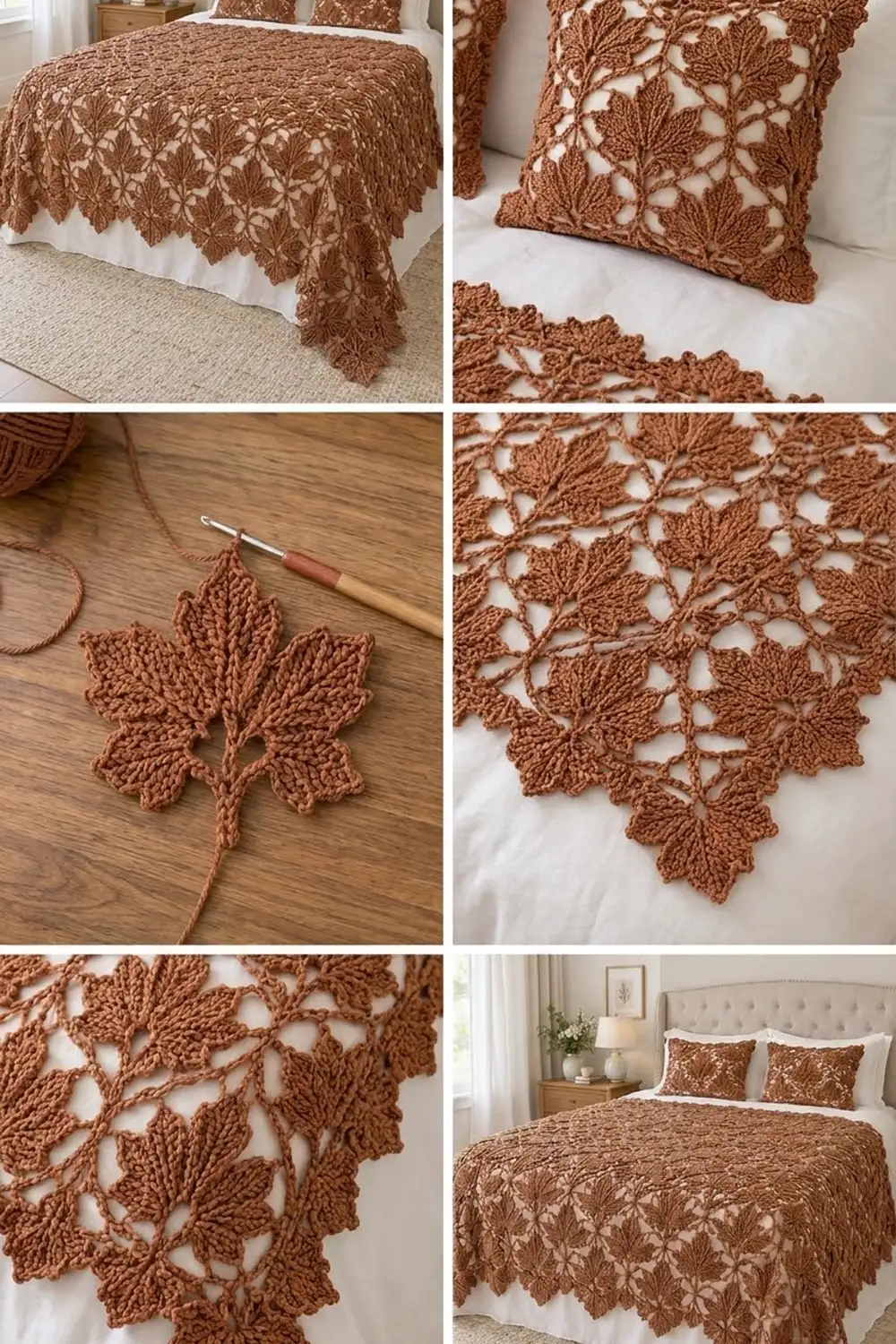
The Autumn Canopy Bedspread is an openwork coverlet made from 99 identical square motifs. Each square holds one five-lobed maple leaf with a raised center vein on every lobe, a short stem, and small picot points along the edges. A light chain lattice surrounds each leaf. When the squares are joined, the leaves seem to float in one continuous web.
The sample is worked in a single warm rust-cinnamon shade. Over white bedding, the open lattice lets the sheets show through and the solid leaves stand out. The look is classic, cozy, and quietly seasonal.
This pattern uses US crochet terms. The finished bedspread measures 76 x 92 in (193.0 x 233.7 cm) to the leaf points of the border. That fits a full or queen bed with a generous drop on the sides.
The construction is straightforward. You crochet the leaf in the round, frame it with chain loops and square it off with a round of single crochet. Then you join the squares with slip stitch seams and finish with a three-round leaf-point border.
Finished Size and Construction
- Finished size: 76 x 92 in (193.0 x 233.7 cm) including border
- Skill level: Intermediate
- Terminology: US
- Yarn weight: Worsted (#4)
- Hook: 5.0 mm (H-8)
- Number of pieces: 99 square motifs
- Layout: 9 motifs across x 11 motifs down
- Piece size: 8 x 8 in (20.3 x 20.3 cm)
- Size before border: 72 x 88 in (182.9 x 223.5 cm)
- Border depth: 2 in (5.1 cm) at the leaf points
Materials
Choose a smooth worsted-weight yarn with good stitch definition. Wool blends and cotton-acrylic blends both work well. A smooth yarn keeps the vein ridges and picots crisp. Avoid fuzzy or very splitty yarns, which blur the lattice.
Yarn:
– Rust / cinnamon: 2,100 g, about 4,200 m (based on yarn with roughly 200 m per 100 g)
Quantities include a margin of about 10% for the test motif and tension differences. Buy all skeins from the same dye lot.
Tools:
– 5.0 mm (H-8) crochet hook
– 5.5 mm (I-9) hook (optional, for loose joining)
– Tapestry needle
– Stitch markers
– Rust-proof pins and blocking mats
– Measuring tape
– Spray bottle
Abbreviations (US Terms)
- ch – chain
- sl st – slip stitch
- sc – single crochet
- hdc – half double crochet
- dc – double crochet
- tr – treble crochet
- sp – space
- st(s) – stitch(es)
- RS / WS – right side / wrong side
Special stitches:
– Picot: ch 3, sl st in 3rd ch from hook.
– Vein: ch 9, sl st in 2nd ch from hook and in the back bump of each of next 7 ch (8 sl st). This leaves 8 free chain loops on one side, 8 sl sts on the other, and a ch-1 at the tip.
– Lobe side: sc, hdc, dc, tr, picot, tr, dc, hdc, sc, worked 1 st per loop over 8 loops (8 sts plus 1 picot).
Gauge and Checkpoints
Gauge: 31 sc = 8 in (20.3 cm) across one finished motif side, measured flat before blocking.
Always make one complete test motif before starting the batch. Check it at each stage:
- After Round 2: the circle is about 1.75 in (4.4 cm) across.
- After Round 4: the leaf is about 5.75 in (14.6 cm) from top lobe tip to stem end.
- After Round 5: the loop frame is about 7 in (17.8 cm) across.
- After Round 7: the square is 8 x 8 in (20.3 x 20.3 cm).
A tolerance of 0.25 in (0.6 cm) per side is fine. If your square is too big, go down one hook size. If it is too small, go up one size. Do not change stitch counts, because the joining and border math depends on exactly 31 sc per side.
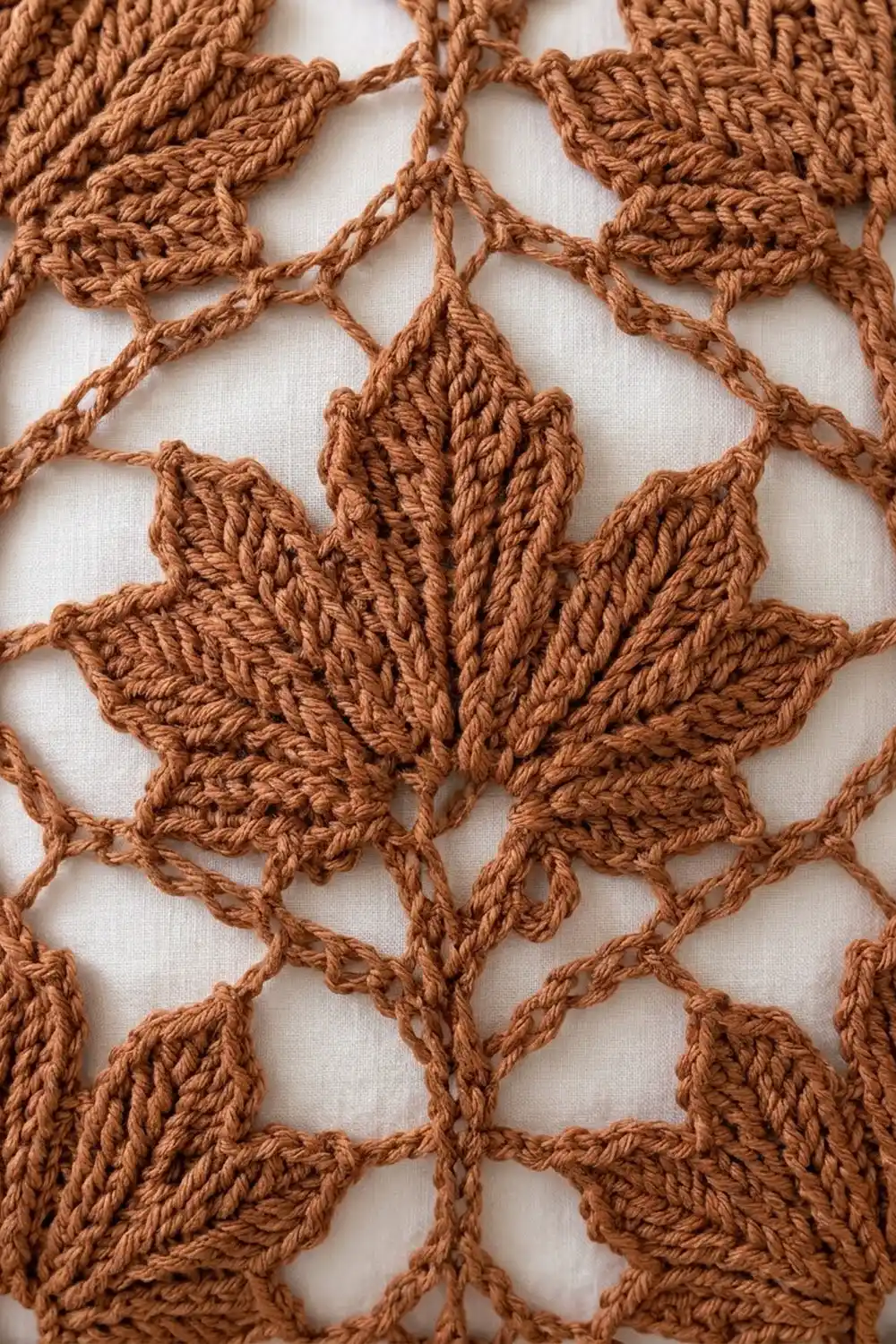
Motif: Maple Leaf Square
The Leaf
Round 1: Ch 4, sl st to first ch to form a ring. Ch 1, 10 sc in ring, sl st to first sc. (10 sc)
Round 2: Ch 3 (counts as dc), dc in same st, 2 dc in each st around, sl st to top of ch-3. (20 dc)
Round 3 (veins): Ch 1. Sc in next st, work Vein, sc in same st as last sc, sc in each of next 3 sts; repeat from * 4 more times, sl st to first sc. (25 sc and 5 veins)*
Each lobe group uses 4 sts of Round 2: 5 x 4 = 20. You now have 5 sc between each pair of veins. Label them A, B, C, D, E in working order: A sits right after a vein and E sits right before the next vein.
Round 4 (lobes): Ch 1 (does not count). *Work Lobe side up the vein’s free chain loops (8 sts). In the ch-1 at the tip work (hdc, picot, hdc). Work Lobe side down the 8 sl sts (8 sts). Skip sc A and B, sc in sc C, skip sc D and E. Repeat from * 4 more times.
On the 3rd repeat, replace “sc in sc C” with: sc in sc C, ch 7, sl st in 2nd ch from hook and in each of next 5 ch (stem), sc in same sc C. Sl st to first st to join and fasten off.
Count per lobe: 8 + 2 + 8 + 1 = 19 sts. Total: 5 x 19 = 95, plus 1 extra sc at the stem notch. (96 sts, 15 picots, 1 stem)
Skipping 4 sc at each notch spreads the lobes apart and forms the deep notches of a maple leaf. Lobe 1 is the top lobe, and the stem sits in the bottom notch between lobes 3 and 4.
The Frame
You now have 16 anchor points: 15 picots (5 tips and 10 side picots) plus the end of the stem.
Round 5: With RS facing, join yarn in the tip picot of lobe 1. Ch 1, sc in anchor, ch 6; repeat from * around all 16 anchors in order, sl st to first sc. Anchors are taken lobe by lobe, with the stem end between lobes 3 and 4. (16 sc, 16 ch-6 sps)*
Number the spaces 1 to 16, starting with the space right after the joining sc. Spaces 2, 6, 10 and 14 are the corner spaces. Mark them now.
Round 6: Sl st into sp 1, ch 1, sc in sp 1, ch 5. *In corner sp work (3 tr, ch 3, 3 tr). [Ch 5, sc in next sp] 3 times, ch 5. Repeat from * 3 more times, but end the last repeat with [ch 5, sc in next sp] 2 times, ch 5, sl st to first sc.
(24 tr, 12 sc, 16 ch-5 sps, 4 corner ch-3 sps)
Each side now reads: 3 tr, ch-5, sc, ch-5, sc, ch-5, sc, ch-5, 3 tr.
Round 7 (squaring round): Ch 1. Sc in each sc and tr, 5 sc in each ch-5 sp, and (sc, ch 2, sc) in each corner ch-3 sp. Sl st to first sc. Fasten off, leaving a 6 in (15.2 cm) tail.
This is a conversion round. Per side: 9 sts worked 1-per-existing-st (6 tr + 3 sc) + 20 sts added in the 4 ch-5 sps + 2 corner sc = 31.
(31 sc per side including both corner sc; 124 sc total, plus 4 corner ch-2 sps)
Check the total: 24 tr + 12 sc + 80 sc in spaces + 8 corner sc = 124.
Make All Pieces
Make 99 motifs, all in rust / cinnamon, and weave in ends as you go.
Layout grid: 9 across x 11 down. L = leaf motif. Every stem points toward the bottom edge.
Rows 1-11 (each row identical):
L L L L L L L L L
Block all motifs to 8 x 8 in (20.3 x 20.3 cm) before joining. Squared motifs join much more evenly.
Joining
Method: Slip stitch seam on the WS.
Hold two motifs RS together with the edges matched. Sl st through both layers in the corner ch-2 sps. Then sl st through both loops of each matching pair of sc: 31 sl st for 31 sc pairs. Finish with 1 sl st through the next pair of corner ch-2 sps.
Seams are worked strictly stitch to stitch. Every motif side has 31 sc, so the edges always match 1:1. No stitches are added to the outer edge, because the seam sits entirely on the WS.
- Join 9 motifs into a horizontal row (8 seams). Repeat to make 11 rows.
- Join the rows with 10 long seams. Match 279 sc pairs per seam and work through the corner ch-2 sps where four motifs meet.
Tension: Seams should stretch as much as the motifs. If seams pull or pucker, switch to the 5.5 mm (I-9) hook for joining only.
Size checkpoint: One joined row measures 72 in (182.9 cm) long. The joined panel measures 72 x 88 in (182.9 x 223.5 cm). If it is more than 1 in (2.5 cm) off, recheck your motif blocking before starting the border.
Border
Border gauge: Same as the motif, 31 sc = 8 in (20.3 cm).
The starting count per side comes straight from the motifs: short sides 9 x 31 = 279 sc and long sides 11 x 31 = 341 sc. Work only into motif sc and skip the joined ch-2 corner sps at the seams.
Round 1: With RS facing, join yarn in the first sc of a short side, just after a corner. Ch 1, sc in each sc to end of side. Ch 2 at the outer corner, skipping the motif’s corner ch-2 sp. Repeat for all sides and sl st to first sc.
(279 sc on each short side, 341 sc on each long side, 4 corner ch-2 sps; 1,240 sc total)
Round 2 (mesh): Ch 1. On each side, work this group once per motif (31 sts): sc in first st, [ch 3, skip 2 sts, sc in next st] 10 times. At each corner, ch 3 across the corner ch-2 sp. Sl st to first sc.
Per group: 11 sc and 10 ch-3 sps. (Short sides: 9 groups = 99 sc and 90 ch-3 sps. Long sides: 11 groups = 121 sc and 110 ch-3 sps. Plus 4 corner ch-3 sps.)
Round 3 (leaf points): Sl st into first ch-3 sp. Work into the ch-3 sps only and skip the sc between them, except for the center sc of each group. Number the spaces in each group 1 to 10:
- Sps 1, 2, 3: 3 sc in each (9 sts)
- Sp 4: (sc, hdc, dc) (3 sts)
- Sp 5: (hdc, dc, 2 tr) (4 sts)
- Center sc (6th sc of the group): (tr, picot, tr) (2 sts)
- Sp 6: (2 tr, dc, hdc) (4 sts)
- Sp 7: (dc, hdc, sc) (3 sts)
- Sps 8, 9, 10: 3 sc in each (9 sts)
In each corner ch-3 sp: (2 sc, ch 3, 2 sc). Sl st to first sc and fasten off.
Per group: 9 + 3 + 4 + 2 + 4 + 3 + 9 = 34 sts and 1 picot. (Short sides: 9 x 34 = 306 sts. Long sides: 11 x 34 = 374 sts. Corners: 4 x 4 = 16 sts. Total 1,376 sts and 40 picots.)
Why the math works: 279 = 9 x 31 and 341 = 11 x 31, and 31 is prime, so no small repeat fits both sides evenly. Instead, the border repeats once per motif edge. Each group uses exactly 31 sts (1 + 10 x 3 = 31) and every leaf point sits centered on its motif at st 16. The corners need no fudging.
Final Blocking
- Weave in all remaining ends, following the stitch path.
- Lay out mats on a large floor area, or block one half at a time.
- Spray the bedspread until evenly damp, or wet block if your yarn is wool.
- Pin the base of the border to 72 x 88 in (182.9 x 223.5 cm).
- Pin each border leaf point out so the bedspread measures 76 x 92 in (193.0 x 233.7 cm) to the tips.
- Open up the lattice and smooth the vein ridges of the leaves by hand.
- Leave to dry completely before unpinning.
Final Quality-Control Checklist
- Every motif has 31 sc per side and 4 corner ch-2 sps.
- Every leaf has 5 lobes, 15 picots and 1 stem.
- All stems point toward the same edge.
- Seams lie flat and stretch with the motifs.
- Border Round 1 counts 279 and 341 sc per side.
- Each motif edge carries one centered leaf point.
- The finished piece measures 76 x 92 in (193.0 x 233.7 cm).
- All ends are secured and invisible from the RS.
Troubleshooting
Lobes curl or cup: The veins are too tight. Work the vein sl sts looser, or chain with the 5.5 mm hook.
Leaf sits off-center in the frame: Check that you worked into every anchor in order. Blocking squares the lattice; pin the leaf tips toward the frame.
Square is not square after Round 7: Recount the corner spaces from Round 5. They must be sps 2, 6, 10 and 14.
Seams pucker: Use the larger hook for joining and don’t pull each sl st snug.
Border ruffles or cups: The Round 2 ch-3 loops are too loose or too tight. Go down or up one hook size for the border only.
Care
Hand wash in cool water with a mild wool wash, press the water out in a towel, and dry flat. Don’t hang the bedspread while it is wet, because the lattice will stretch.
Final Notes
The measurement chain is short and reliable. A 1.75 in (4.4 cm) center grows into a 5.75 in (14.6 cm) leaf, which is framed into an 8 in (20.3 cm) square with 31 sc per side. Nine squares across and eleven down give 72 x 88 in (182.9 x 223.5 cm). The 2 in (5.1 cm) leaf-point border then brings the bedspread to 76 x 92 in (193.0 x 233.7 cm). Keep every square at exactly 31 sc per side and everything else falls into place.
Happy crocheting!