

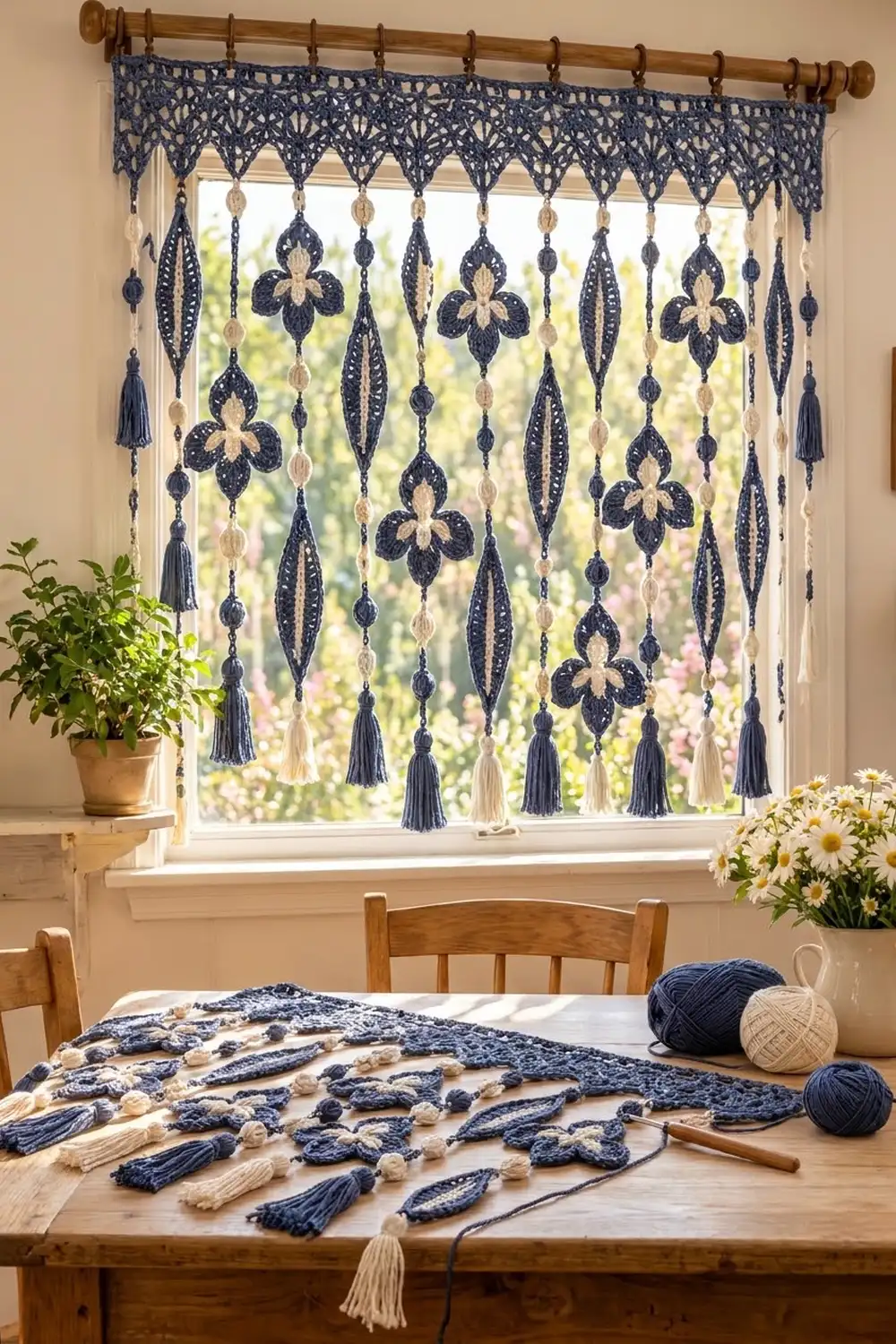
This curtain pairs navy denim blue with soft cream in a lace window hanging. A pointed lace header holds eleven strands. Four-petal flowers, slim almond leaves and little round beads hang from them, and each strand ends in a tassel. Morning light shines through the gaps, so the window stays bright while the curtain softens the view.
The style is farmhouse boho: crisp outlines, a cream center in every motif, and a calm rhythm of flower strand, leaf strand, flower strand. The two colors read clearly from across a room.
The pattern uses US crochet terms. The finished curtain measures 38.5 in (97.8 cm) wide and 33.5 in (85.1 cm) long from the top of the header to the tassel tips. The rod loops add extra length above that.
You make eleven lace triangles, then join them with the first row of the header band. Next you work the header upward and add rod loops. Finally you make the motifs, beads and tassels and link them into strands that hang from the triangle points.
Finished Size and Construction
- Finished size: 38.5 in (97.8 cm) wide × 33.5 in (85.1 cm) long
- Skill level: Intermediate
- Terminology: US
- Yarn weight: DK (#3 light) cotton
- Hook: 3.5 mm (E-4)
- Number of pieces: 11 triangles, 15 flowers, 18 leaves, 77 beads, 11 tassels
- Layout: 11 triangles in one row; 11 hanging strands, one per triangle point
- Triangle size: 3.5 in (8.9 cm) wide × 3 in (7.6 cm) tall
- Size before border: 38.5 in (97.8 cm) wide across the joined triangles
- Border (header band) depth: 2.25 in (5.7 cm)
- Strand length: 28.25 in (71.8 cm)
Materials
Pick a smooth mercerized or combed cotton. It holds stitch definition, shapes the beads well and hangs straight. Avoid acrylic, which tends to curl in long strands.
- Navy (MC): 200 g / 440 m
- Cream (CC): 100 g / 220 m
These quantities include a margin of roughly 20 percent, so you can make a gauge swatch and replace a piece or two.
Tools:
– 3.5 mm (E-4) crochet hook
– Tapestry needle
– Stitch markers
– Small amount of polyester fiberfill (or cotton scraps) for beads
– Cardboard, 3.25 in (8.3 cm) wide, for tassels
– Rust-proof pins and a blocking mat
– Measuring tape
Abbreviations (US Terms)
- ch – chain
- sl st – slip stitch
- sc – single crochet
- hdc – half double crochet
- dc – double crochet
- tr – treble crochet
- sc2tog – single crochet 2 together
- sp – space
- st(s) – stitch(es)
- rep – repeat
- RS – right side
Edge increase (special stitch): (dc, ch 1, dc) worked into a single edge stitch. In this pattern it widens the triangle by one dc and one ch-1 space at each end of a row.
Gauge and Checkpoints
Gauge: 24 sc and 26 rows = 4 in (10.2 cm). Chain gauge: 6 ch = 1 in (2.5 cm).
Make one triangle before anything else, because every later measurement depends on it.
- Triangle after Row 5: 3.5 in (8.9 cm) across the top.
- Triangle after Rnd 6: 3.5 in (8.9 cm) wide × 3 in (7.6 cm) tall.
- Flower: 3.5 in (8.9 cm) from tip to tip.
- Leaf: 1.75 in (4.4 cm) × 4 in (10.2 cm).
- Bead: 0.75 in (1.9 cm) across.
If your triangle is too big, change to a hook 0.25 mm smaller. If it is too small, go up 0.25 mm. Even 0.25 in (0.6 cm) of extra width per triangle adds 2.75 in (7.0 cm) across the curtain, so fix gauge now.
Lace Triangle (make 11, navy)
Worked in rows from the point upward, then edged in one round.
Row 1 (RS): Magic ring. Ch 4 (counts as dc and ch-1), dc in ring, ch 1, dc in ring. Turn. (3 dc + 2 ch-1 sps = 5 sts)
Row 2: Ch 4 (counts as dc and ch-1), dc in first dc, ch 1, dc in next dc, ch 1, (dc, ch 1, dc) in 3rd ch of turning ch. Turn. (9 sts)
Row 3: Ch 4, dc in first dc, ch 1, dc in next dc; rep from * to turning ch, ch 1, (dc, ch 1, dc) in 3rd ch of turning ch. Turn. (13 sts)
Row 4: Rep Row 3. (17 sts)
Row 5: Rep Row 3. (21 sts: 11 dc + 10 ch-1 sps)
Each row adds 4 sts: one edge increase at each end.
Rnd 6 (edging): Do not turn. Ch 1. Work down the first slanted edge: 2 sc around each of the 5 row-end posts (10 sc). In the magic ring at the point: (sc, ch 2, sc). Work up the second slanted edge: 2 sc around each row-end post (10 sc). Across the top: sc in each dc and each ch-1 sp of Row 5 (21 sc). Join with sl st to first sc. (43 sc + 1 ch-2 sp)
Fasten off. The top edge has 21 sc, and the first and last of these are its corner stitches. The ch-2 point loop is where a strand will hang.
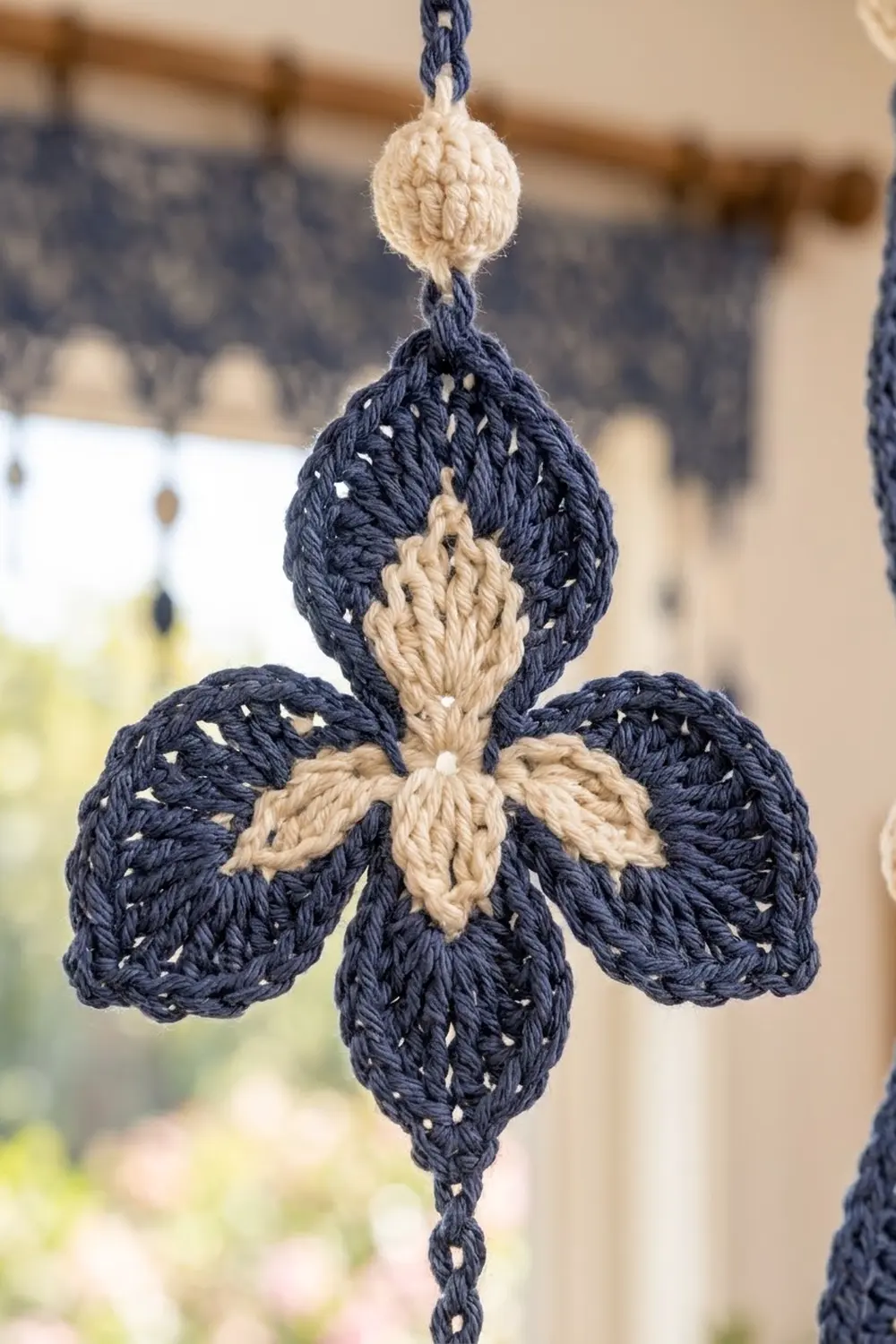
Flower Motif (make 15)
Rnd 1 (cream): Magic ring, ch 1, 8 sc in ring. Join. (8 sc)
Rnd 2 (cream): Ch 1, sc in next st, (hdc, dc, ch 2, dc, hdc) in next st; rep from * 3 more times. Join. (20 sts + 4 ch-2 sps)
This makes four small cream inner petals. Fasten off cream.
Rnd 3 (navy): Join navy in any sc. Sc in sc, 2 dc in hdc, 2 dc in dc, (2 tr, ch 2, 2 tr) in ch-2 sp, 2 dc in dc, 2 dc in hdc; rep from * 3 more times. Join. (52 sts + 4 ch-2 sps; 13 sts per petal)
Rnd 4 (navy): Ch 1, sc in sc, sc in next 6 sts, (2 sc, ch 2, 2 sc) in ch-2 sp, sc in next 6 sts; rep from * 3 more times. Join. (68 sc + 4 ch-2 sps; 17 sc per petal)
Fasten off. Hang the flower with one petal at the top, so the top and bottom ch-2 tips become its link loops.
Leaf Motif (make 18)
Rnd 1 (cream): Ch 16. Sc in 2nd ch from hook, hdc in next 13 ch, 3 sc in last ch. Rotate and work in the other side of the chain: hdc in next 13 ch, 2 sc in last ch (same ch as first sc). Join. (32 sts)
Fasten off cream. This makes a narrow raised cream spine.
Rnd 2 (navy): Join navy in the center sc at one end. Ch 1, (sc, ch 2, sc) in same st, sc in next 15 sts, (sc, ch 2, sc) in center sc at the other end, sc in next 15 sts. Join. Count: 32 (1 per existing st) + 2 extra = 34 sc + 2 ch-2 sps.
Rnd 3 (navy): Sl st into ch-2 sp. Ch 1, (sc, ch 2, sc) in ch-2 sp, sc in next 3 sts, hdc in next 11 sts, sc in next 3 sts; rep from * once more. Join. (38 sts + 2 ch-2 sps; 17 sts per side between tips)
Rnd 4 (navy): Sl st into ch-2 sp. Ch 1, (sc, ch 2, sc) in ch-2 sp, sc in each st to next tip; rep from * once more. Join. (42 sc + 2 ch-2 sps)
Fasten off. The two pointed ch-2 tips are the link loops.
Beads (make 38 cream, 39 navy)
Rnd 1: Magic ring, 6 sc in ring. (6 sc)
Rnd 2: 2 sc in each st. (12 sc)
Rnd 3: Sc in each st. (12 sc)
Rnd 4: Sc2tog 6 times. (6 sc)
Stuff firmly. Close the opening and leave a 6 in (15.2 cm) tail. Each bead measures 0.75 in (1.9 cm). The magic ring is the top pole and the closed end is the bottom pole.
Tassels (make 6 navy, 5 cream)
Wrap yarn 20 times around the 3.25 in (8.3 cm) card. Tie the loops at the top, slide them off, and wrap a neck 0.5 in (1.3 cm) below the top. Cut the bottom loops and trim to 3 in (7.6 cm).
Make All Pieces
- Navy: 11 triangles, 39 beads, 6 tassels, plus the outer rounds of all flowers and leaves
- Cream: Rnds 1–2 of 15 flowers, Rnd 1 of 18 leaves, 38 beads, 5 tassels
Strand A (flower, make 5): ch-21 link (3.5 in / 8.9 cm), then [cream bead + navy bead stack, ch-6 link, flower, ch-6 link] three times, then cream bead, cream tassel.
Strand B (leaf, make 6): ch-12 link (2 in / 5.1 cm), then [cream bead + navy bead stack, ch-6 link, leaf, ch-6 link] three times, then navy bead, navy tassel.
Each ch-6 link is 1 in (2.5 cm) and each bead stack is 1.5 in (3.8 cm).
Strand A: 3.5 + 3 × (1.5 + 1 + 3.5 + 1) + 0.75 + 3 = 28.25 in (71.8 cm).
Strand B: 2 + 3 × (1.5 + 1 + 4 + 1) + 0.75 + 3 = 28.25 in (71.8 cm).
The longer first link on Strand A drops its flowers lower than the leaves next to them, which gives the staggered look while the tassels still line up.
Layout (triangles left to right, strand below each):
T1  T2  T3  T4  T5  T6  T7  T8  T9  T10 T11
B   A   B   A   B   A   B   A   B   A   B
Joining
Triangles: Lay all 11 triangles RS up in a row with their top edges level. Use navy to tack each pair of touching top corners together with one whipstitch. Then work Header Row 1 straight across all of them.
The join works stitch to stitch: 1 sc in each of the 21 top sc of every triangle. Seams get no extra stitches. Keep the tension even so the corners do not pucker.
Size checkpoint: The joined row measures 38.5 in (97.8 cm), which is 11 × 3.5 in.
Strands: For every link, join yarn in the bottom loop or bottom pole of the piece above, chain the stated number, sl st into the top loop or top pole of the piece below, and fasten off. Sew the two beads in each stack pole to pole with their tails. Tie the tassel to the bottom pole of the last bead.
The first link of each strand starts in the ch-2 point loop of its triangle. Chain links loosely and evenly. Tight links shorten a strand by up to 0.5 in (1.3 cm).
Border (Header Band)
Border gauge: 24 sc = 4 in (10.2 cm). Mesh rows keep the same count: 1 dc or ch-1 per sc.
Row 1 (RS): Join navy at the top-right corner of T1. Ch 1, sc in each top sc of all 11 triangles. Turn. (11 × 21 = 231 sc)
Row 2 (mesh): Ch 4 (counts as dc and ch-1), sk next st, dc in next st, ch 1, sk next st, dc in next st; rep from * across. Turn. (116 dc + 115 ch-1 sps = 231 sts)
Row 3: Ch 1, sc in each dc and each ch-1 sp, ending with sc in 3rd ch of turning ch. Turn. (231 sc)
Rows 4–7: Rep Rows 2–3 twice. (231 sts per row)
Row 8 (rod loops): Ch 1, sc in first 10 sts, (sc, ch 24, sc) in next st, sc in next 20 sts; rep from * 9 more times, (sc, ch 24, sc) in next st, sc in last 10 sts. Count: 231 (1 per existing st) + 11 extra = 242 sc, plus 11 ch-24 loops.
Fasten off. Each loop sits over the center stitch (the 11th) of its triangle and fits rods up to 1 in (2.5 cm) thick.
Why the math works: Each triangle top has 21 sts, the corners included, and the seams add nothing, so 11 × 21 = 231. The mesh pattern needs an odd count (dc, then ch-1 and dc pairs), and 231 = 1 + 2 × 115. Every row keeps 231, so the band stays exactly 38.5 in (97.8 cm) wide. The finished band is 2.25 in (5.7 cm) deep.
Final Blocking
- Weave in all ends before blocking.
- Spray the header and triangles with water until damp.
- Pin the header flat to 38.5 in (97.8 cm) × 2.25 in (5.7 cm).
- Pin each triangle point so the triangle is 3 in (7.6 cm) tall.
- Pin the flower and leaf tips open. Steam them lightly if you need to.
- Let everything dry completely.
- Hang the curtain, then let the strands relax for 24 hours before trimming the tassels level.
Final Quality-Control Checklist
- 11 triangles, each 3.5 in (8.9 cm) wide
- Header Rows 1–7 each have 231 sts
- 11 rod loops, each centered over a triangle
- Strand order is B-A-B-A-B-A-B-A-B-A-B
- Every strand is 28.25 in (71.8 cm)
- All beads are firmly stuffed and closed
- All ends are woven in and the tassels are trimmed level
Troubleshooting
- Triangle curls: Your Rnd 6 edging is too tight. Redo it with a looser tension.
- Header ruffles: You added stitches at the seams. Recount Row 1 to 231.
- Header narrows: You skipped the turning-chain stitch. Check the end of every row.
- Flower petals cup: Block them flat, or use a hook 0.25 mm larger for Rnd 3.
- Strands twist: Spritz them with water and let them hang straight to dry.
- Strands uneven: Recount the links, since every ch counts as 0.17 in (0.4 cm).
Care
Hand wash in cool water with mild soap. Roll it in a towel and lay it flat to dry, then reblock the header.
Final Notes
The measurement chain is simple. A 21-stitch triangle is 3.5 in (8.9 cm) wide, eleven of them make 38.5 in (97.8 cm), and the 2.25 in (5.7 cm) header holds that width with a steady 231 stitches. The strands add 28.25 in (71.8 cm) below the 3 in (7.6 cm) points. Together they make a curtain 33.5 in (85.1 cm) long. Check your gauge on the first triangle and everything else will fall into place.
Happy crocheting!