
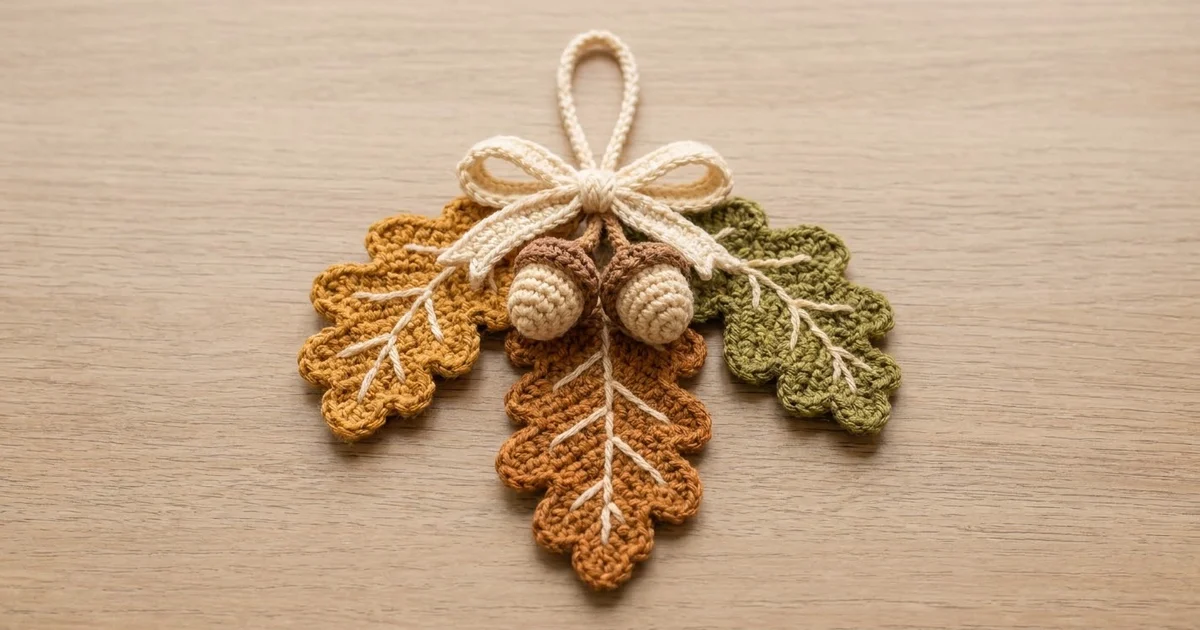
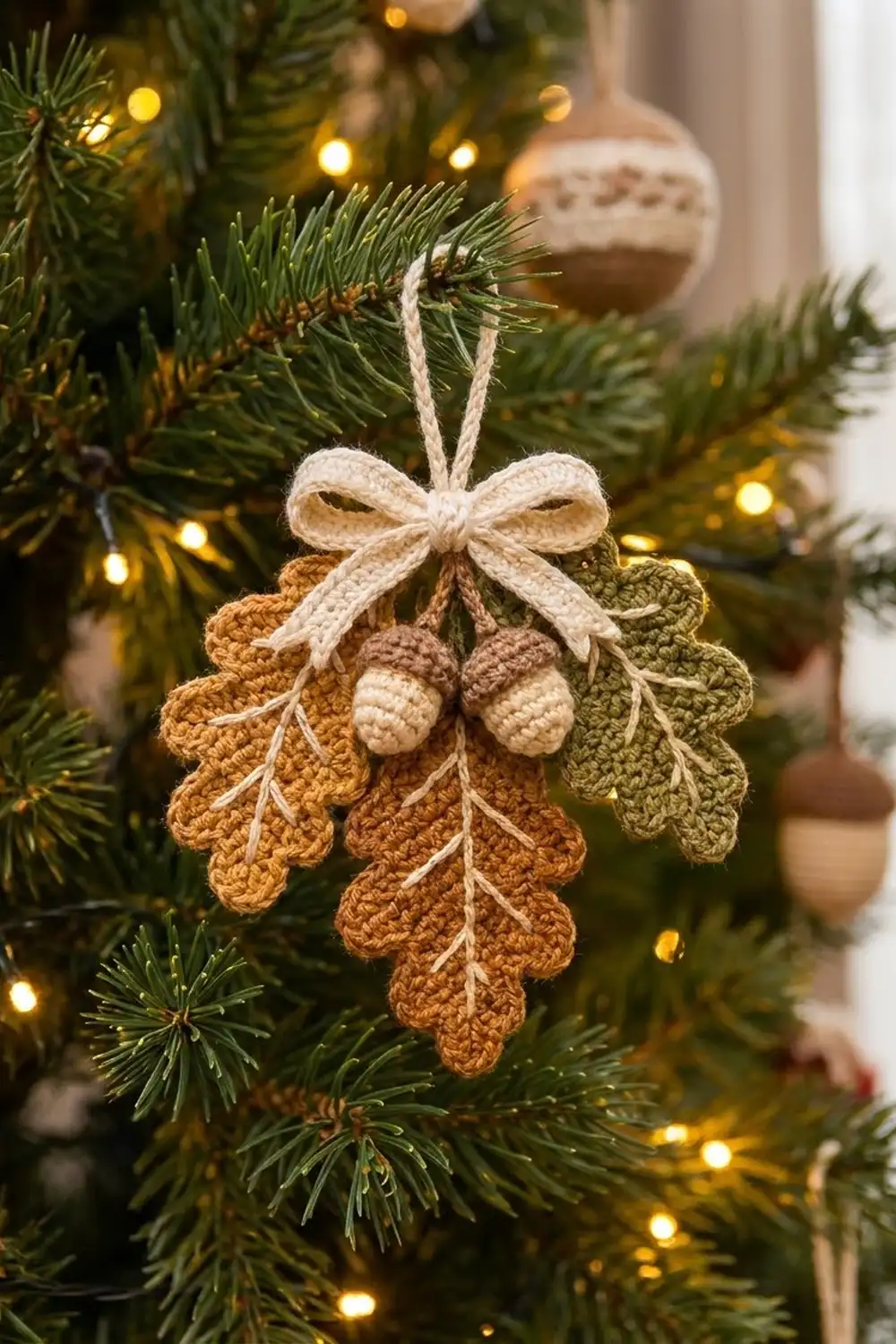
This ornament gathers three crochet oak leaves, two plump acorns, and a soft cream bow into one cozy cluster. It bridges autumn and the holidays, so it looks just as good on a harvest wreath as on a Christmas tree.
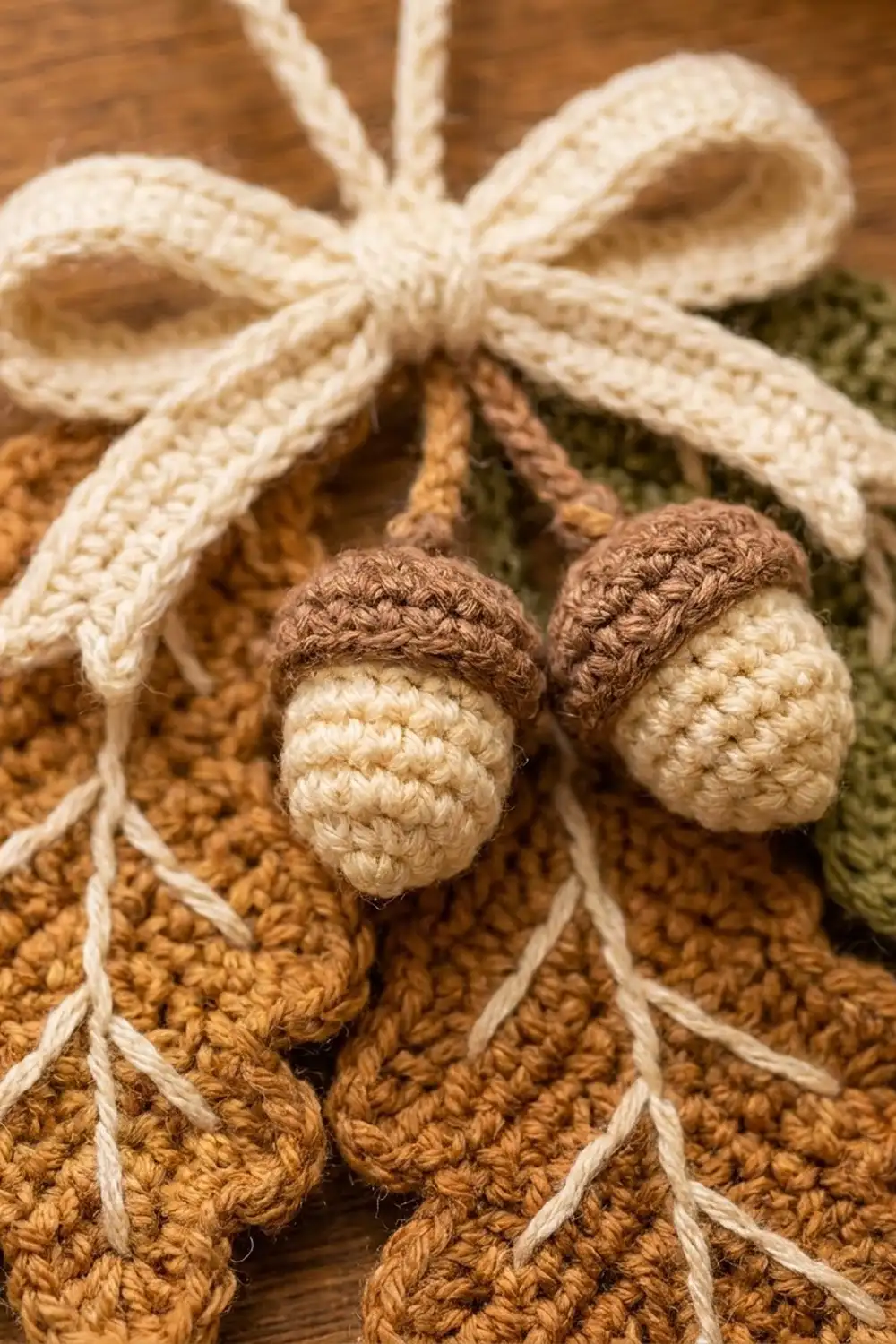
The palette comes from the forest floor: golden ochre, rust cinnamon, and olive green for the leaves, medium brown for the acorn caps, and warm cream for the nuts, veins, bow, and hanging loop. The leaves are dense and lightly textured, with rounded lobes and raised veins that catch the light.
The pattern uses US crochet terms. The finished cluster measures about 5.5 in (14.0 cm) wide by 6 in (15.2 cm) tall. With the hanging loop it is about 8 in (20.3 cm) tall.
Each leaf is worked in three rounds around a foundation chain: a shaping round, a smoothing round, and a lobed edge round with a built-in stem. The acorns are tiny amigurumi pieces with a color change for the cap. The bow is made from three small strips. Everything is then embroidered, blocked, and sewn together.
Finished Size and Construction
- Finished size: 5.5 in (14.0 cm) wide x 6 in (15.2 cm) tall; 8 in (20.3 cm) tall with loop
- Skill level: Advanced beginner
- Terminology: US crochet terms
- Yarn weight: DK (light, #3)
- Hooks: 3.5 mm (E-4) for leaves, bow, and loop; 2.75 mm (C-2) for acorns
- Number of pieces: 9 crocheted parts: 3 leaves, 2 acorns, 3 bow parts, 1 hanging loop
- Layout: fan of 3 leaves, acorns at center, bow and loop on top
- Leaf size: 3.75 in (9.5 cm) long x 2.25 in (5.7 cm) wide, plus a 1.25 in (3.2 cm) stem
- Leaf size before edge round: 3.5 in (8.9 cm) x 1.5 in (3.8 cm)
- Edge (border) depth: 0.375 in (1.0 cm) per side
Materials
Use a smooth, matte DK yarn in wool, acrylic, or a wool blend. Smooth yarn gives clean lobes and shows the veins well. Cotton works but makes a stiffer leaf.
- Golden ochre: 8 g / 18 m (left leaf)
- Rust cinnamon: 8 g / 18 m (center leaf)
- Olive green: 8 g / 18 m (right leaf)
- Cream: 15 g / 35 m (acorn nuts, veins, bow, loop)
- Medium brown: 6 g / 14 m (acorn caps and stems)
These quantities include a comfortable margin, so leftovers from other projects are usually enough.
Tools:
– 3.5 mm (E-4) and 2.75 mm (C-2) hooks
– Tapestry needle
– Small pinch of fiberfill
– Stitch markers
– Rust-proof pins, blocking mat, spray bottle
– Scissors
Abbreviations (US Terms)
- ch – chain
- sl st – slip stitch
- sc – single crochet
- hdc – half double crochet
- dc – double crochet
- inc – 2 sc in the same stitch
- dec – sc2tog (invisible decrease recommended)
- FLO – front loop only
- MR – magic ring
- sk – skip
- st(s) – stitch(es)
Special stitches:
– Large lobe: 5 dc in the same stitch.
– Small lobe: (hdc, dc, hdc) in the same stitch.
– Picot: ch 3, sl st in 3rd ch from hook.
Gauge and Checkpoints
Gauge with the 3.5 mm hook: 20 sc and 22 rows = 4 in (10.2 cm). Exact gauge matters less than matching the checkpoints, so make one leaf first and measure it before making the rest.
Leaf checkpoints (lightly flattened):
– After Rnd 1: 3.25 in (8.3 cm) x 1 in (2.5 cm)
– After Rnd 2: 3.5 in (8.9 cm) x 1.5 in (3.8 cm)
– After Rnd 3: 3.75 in (9.5 cm) x 2.25 in (5.7 cm), stem 1.25 in (3.2 cm)
Acorn checkpoint: 0.9 in (2.3 cm) tall x 0.75 in (1.9 cm) wide.
If your leaf is more than 0.25 in (0.6 cm) too long, go down half a hook size. If it is too short, go up half a size. If the lobes ruffle, your dc are too tall: try pulling up shorter loops or go down a hook size. If the acorn looks soft or shows stuffing, use a smaller hook.
Oak Leaf (Make 3)
Make one leaf each in golden ochre, rust cinnamon, and olive green. Use the 3.5 mm hook.
Ch 16. The chain has 15 working chains. The 2nd ch from hook is the base end and the last ch is the tip.
Rnd 1: 2 sc in 2nd ch from hook (base), hdc in next 2 ch, dc in next 8 ch, hdc in next 2 ch, sc in next ch, 3 sc in last ch (tip). Rotate to work along the opposite side of the chain: sc in next ch, hdc in next 2 ch, dc in next 8 ch, hdc in next 2 ch, sc in same ch as the first 2 sc. Join with sl st to first sc. (32 sts)
Count check: 2 + 13 + 3 + 13 + 1 = 32. The first st is the base center and the middle st of the 3-sc tip group is the tip center. That leaves 15 sts on each side between them. The tall dc in the middle make the leaf widest at its center.
Rnd 2: Ch 1 (does not count), 3 sc in first st (base center), sc in next 15 sts, 3 sc in next st (tip center), sc in next 15 sts. Join with sl st to first sc. (36 sts)
Count check: 3 + 15 + 3 + 15 = 36. The new base center is st 2 and the new tip center is st 20. Each side now has 17 sts between the two centers: sts 3–19 and sts 21–36 plus st 1.
Measure now (see the checkpoints). Do not fasten off.
Leaf Edge Round (Border)
Rnd 3 is the leaf’s border. It forms the lobes, the pointed tip, and the stem in one round.
Border gauge: each lobe uses 4 sts of Rnd 2 (sk 1, lobe, sk 1, sl st). Four lobes use 16 sts, and one opening sl st makes 17, which is exactly one side.
Rnd 3:
1. Base and stem: Sl st in next st (st 2, base center). Ch 9, sl st in 2nd ch from hook and in next 7 ch (8 sl sts), sl st in same base st.
2. Side A, base to tip (17 sts): Sl st in next st. Sk 1, small lobe in next st, sk 1, sl st in next st. Then work (sk 1, large lobe in next st, sk 1, sl st in next st) 3 times. This ends with a sl st in st 19.
3. Tip (st 20): (hdc, dc, picot, dc, hdc) in the same st.
4. Side B, tip to base (17 sts): Sl st in next st. Work (sk 1, large lobe in next st, sk 1, sl st in next st) 3 times. Then sk 1, small lobe in next st, sk 1, sl st in next st. The last sl st lands in st 1.
5. Join with sl st to the base center st. Fasten off and weave in ends.
Rnd 3 counts: each side has 5 sl sts + 3 (small lobe) + 15 (three large lobes) = 23 sts per side. The tip adds 4 sts plus a picot, and the stem has 8 sl sts.
Why the math works: Rnd 2 added exactly 2 sts per side over Rnd 1’s 15, giving 17. 17 = 1 + (4 x 4), so the lobes divide each side evenly with no leftover or crowded stitches. The small lobe always sits next to the stem, which gives the true oak taper.
Veins
Use cream and a tapestry needle on the right side.
1. Center vein: Surface slip stitch (yarn held behind, hook through the leaf) along the foundation chain, from the stem base to 0.25 in (0.6 cm) below the tip.
2. Side veins: Backstitch 4 veins on each side. Start each one at the center vein and angle it up toward a lobe. Make the two nearest the tip and the one nearest the stem about 0.5 in (1.3 cm) long, and the rest about 0.75 in (1.9 cm). Add a short spur of 1–2 straight stitches to the longer veins.
3. Keep the tension relaxed so the leaf does not pucker.
Acorn (Make 2)
Use the 2.75 mm hook. Work in continuous spiral rounds and mark the first st of each round.
Nut (cream):
– Rnd 1: 6 sc in MR. (6)
– Rnd 2: (sc, inc) 3 times. (9)
– Rnd 3: (2 sc, inc) 3 times. (12)
– Rnds 4–6: Sc in each st around. (12)
Change to medium brown on the last st of Rnd 6.
Cap (brown):
– Rnd 7 (FLO): (sc, inc) 6 times. (18) Working in the front loops makes the ridged cap rim stand out over the nut.
– Rnd 8: Sc in each st around. (18)
– Stuff the acorn firmly with a small pinch of fiberfill.
– Rnd 9: (sc, dec) 6 times. (12)
– Rnd 10: Dec 6 times. (6)
Stem: Without fastening off, ch 8, then sl st in 2nd ch from hook and next 6 ch (7 sl sts). This makes a stem about 1 in (2.5 cm) long. Fasten off, leaving a 6 in (15.2 cm) tail. Thread the tail back down the stem, weave it through the front loops of Rnd 10, and pull to close the top. Keep the rest of the tail for assembly.
Bow and Hanging Loop
Use cream and the 3.5 mm hook.
Bow loops strip: Ch 31.
– Row 1: Sc in 2nd ch from hook and each ch across. (30)
– Rows 2–3: Ch 1, turn, sc in each st across. (30)
– Edging: Sl st loosely around the whole strip: 30 sts along each long edge and 3 row ends at each short end. (66 sl sts) This makes the raised outline.
The strip measures about 6 in (15.2 cm) x 0.5 in (1.3 cm). Fold both short ends to the center back, overlap them 0.25 in (0.6 cm), and tack them down. You now have two loops, about 3 in (7.6 cm) wide in total.
Bow tails strip: Ch 21.
– Row 1: Sc in 2nd ch from hook and each ch across. (20)
– Row 2: Ch 1, turn, sc across. (20)
– Edging: Sl st around: 20 + 2 + 20 + 2. (44 sl sts)
Fold the strip at its middle into an upside-down V and tack the fold behind the bow loops.
Center wrap: Ch 7.
– Rows 1–2: Sc in 2nd ch from hook and across, then ch 1, turn, and sc across. (6 per row)
Wrap it tightly around the bow center and sew the ends together at the back.
Hanging loop: Ch 31, sl st in 2nd ch from hook and each ch across (30 sl sts), about 4.5 in (11.4 cm). Fold it in half and sew both ends to the back of the bow so the loop stands 2 in (5.1 cm) tall.
Make All Pieces
| Color | Pieces |
|---|---|
| Golden ochre | 1 leaf |
| Rust cinnamon | 1 leaf |
| Olive green | 1 leaf |
| Cream | 2 nuts, veins on 3 leaves, 3 bow parts, 1 loop |
| Medium brown | 2 caps and stems |
Layout grid (front view):
              [ hanging loop ]
                  [ bow ]
   [ochre leaf]  stems gather  [olive leaf]
     tilted       [acorn][acorn]   tilted
     left       [ rust leaf, tip down ]
Joining
Lay out the pieces before sewing. Pin the rust leaf pointing straight down. Tuck the ochre and olive leaves behind it, tilted about 35 degrees outward, so each one overlaps the center leaf by about 0.75 in (1.9 cm). Bring all three leaf stems together at a single point 1.25 in (3.2 cm) above the top of the center leaf.
Stitch-to-stitch logic: On the back, whipstitch through Rnd 2 stitches only, matching one Rnd 2 st of the side leaf to one Rnd 2 st of the center leaf along the overlap. Sew about 4 matched pairs per side. Keep the stitches off Rnd 3 so the lobes stay free and dimensional.
Bind the three stems together with 3–4 wraps of cream yarn. Sew each acorn just above the center leaf, with its stem running up to the gather point. Stitch through the acorn’s Rnd 8 and into the center leaf’s Rnd 2. Sew the finished bow over the gather point so it hides the stem ends.
Tension: Snug enough to hold the pieces, never tight enough to dimple the leaves. Use a single ply of yarn on the back if the full strand shows.
Size checkpoint: the cluster should be 5.5 in (14.0 cm) wide and 6 in (15.2 cm) from the bow top to the center leaf tip. If it is wider, increase the overlap slightly.
Final Blocking
- Lay the ornament face down on a blocking mat.
- Mist it until it is evenly damp, not soaked. Keep water off the stuffed acorns as much as you can.
- Turn it face up. Pin each lobe tip outward and the leaf tips to a clean point.
- Check the leaf sizes against the 3.75 in (9.5 cm) x 2.25 in (5.7 cm) checkpoint.
- Shape the bow loops round by hand and stretch the tails straight.
- Let it dry completely, at least 12 hours, before unpinning.
Final Quality-Control Checklist
- Each leaf has 4 lobes per side, with the small lobe next to the stem.
- The tip picot is centered and pointed.
- The veins lie flat and do not pucker.
- The acorns are firm and the cap rims stand out.
- No sewing shows from the front.
- The bow covers all stem ends.
- The loop is centered and the ornament hangs level.
- The cluster is 5.5 in (14.0 cm) x 6 in (15.2 cm).
Troubleshooting
- Leaf cups or curls: Rnd 2 is too tight. Go up half a hook size for Rnd 2 only, then block firmly.
- Lobes are uneven: Recount 17 sts per side before Rnd 3 and move the base marker if needed.
- Leaf is crooked: You may have skipped a chain in Rnd 1. Check that each side has 13 sts after the 2 base sc.
- Acorn leans: Stuff it evenly and sew it through two cap points instead of one.
- Ornament tilts when hung: Shift the loop’s sewing point toward the heavier side.
Care
Spot clean with cool water and mild soap, then reshape and dry flat. Store flat in tissue so the bow and lobes keep their shape.
Final Notes
The measurement chain is simple. A 16-chain foundation gives a 3.25 in (8.3 cm) first round. That grows to 3.5 in (8.9 cm) x 1.5 in (3.8 cm), and the lobed edge brings it to 3.75 in (9.5 cm) x 2.25 in (5.7 cm). Three overlapping leaves make a 5.5 in (14.0 cm) by 6 in (15.2 cm) cluster, and the loop brings the total to 8 in (20.3 cm). If your first leaf hits its checkpoints, the rest will follow.
Happy crocheting!