

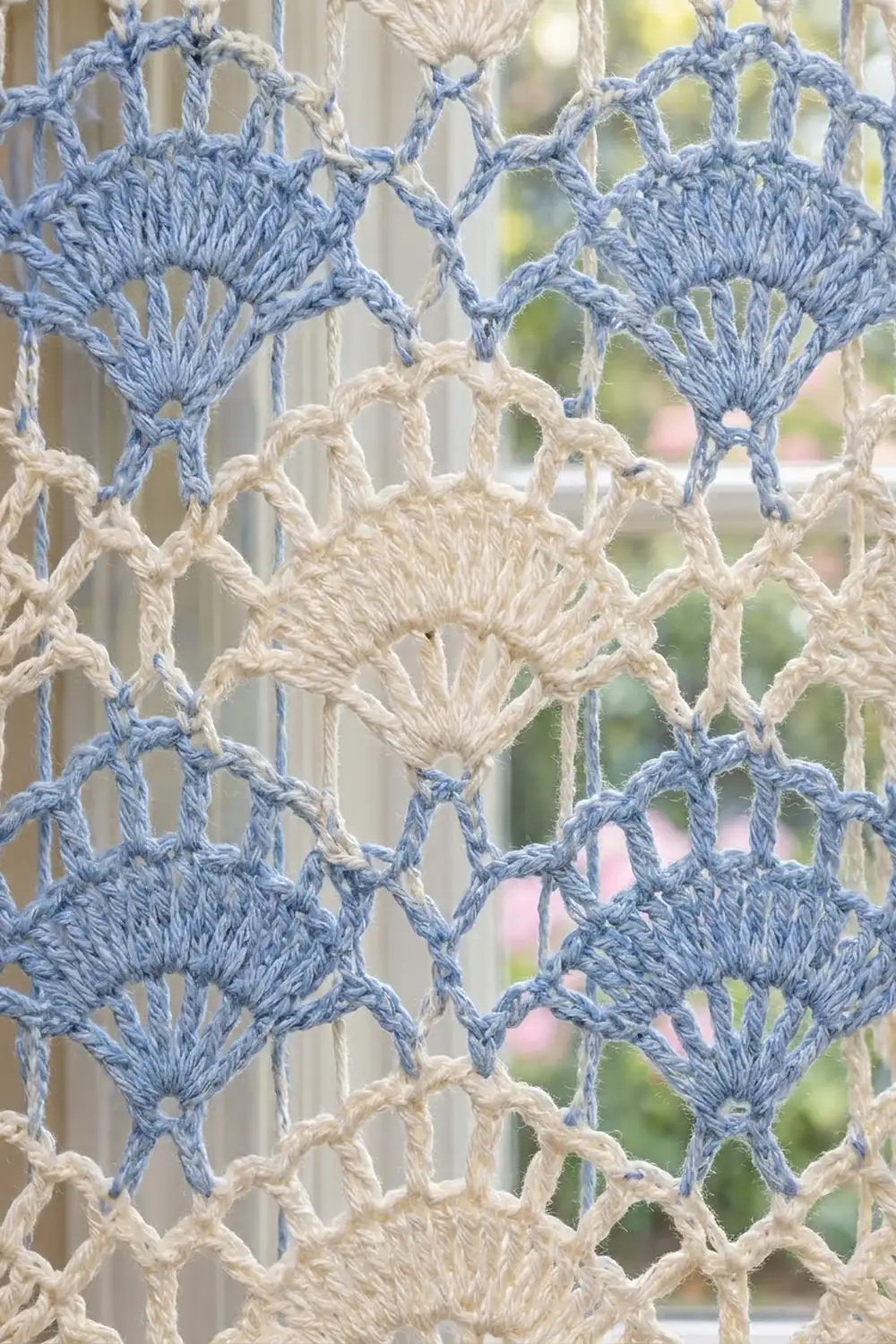
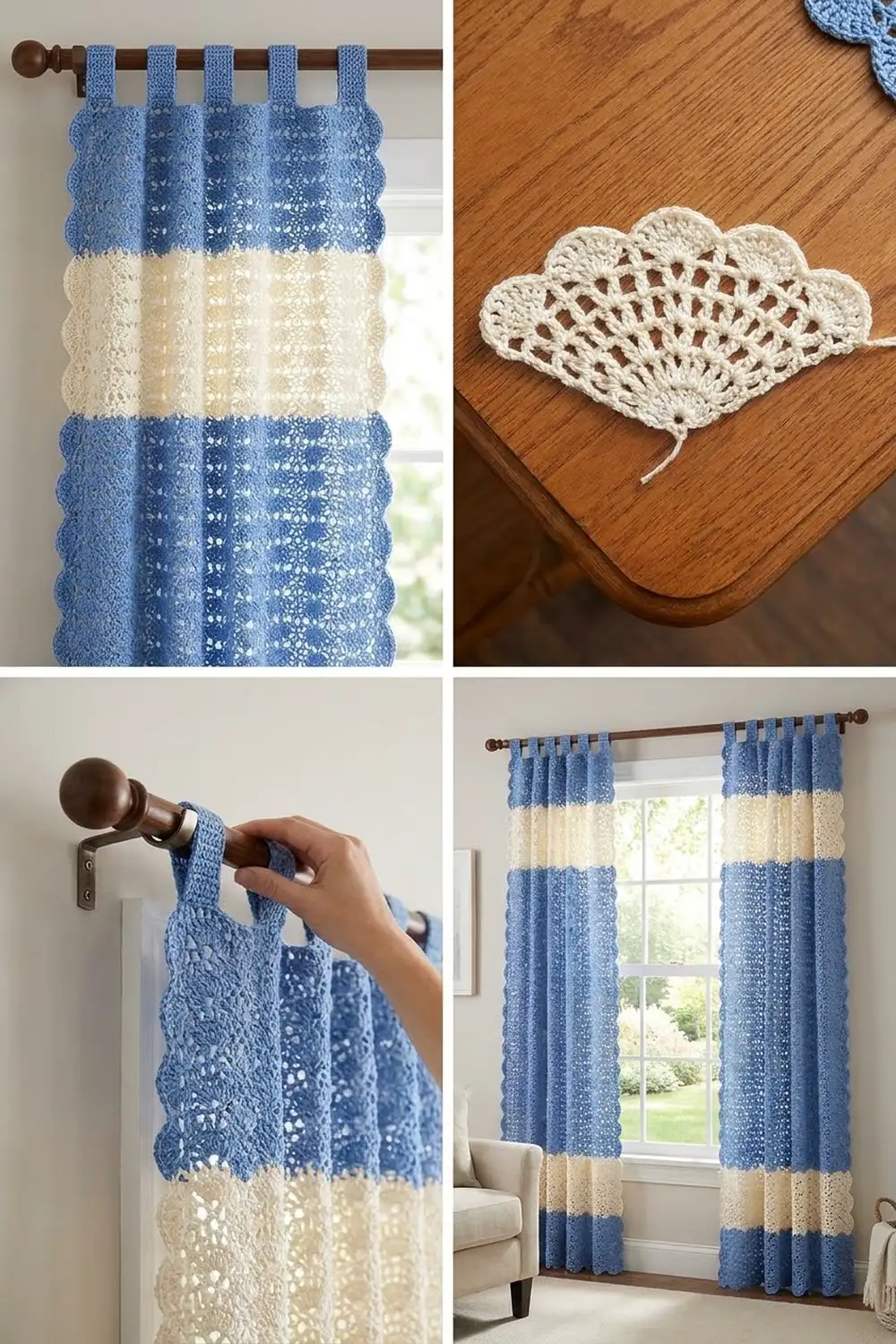
These lace curtain panels are covered in tiers of open fans. Each fan is a 9-double-crochet shell sitting on a light chain lattice. Every new tier is offset by half a fan from the one below, so the fabric looks like fish scales.
The colors repeat from bottom to top: two tiers of soft cornflower blue, then one tier of warm ivory. This gives the panels a cottage-style stripe that still lets plenty of light through.
All instructions use US crochet terms. Each finished panel measures about 37.3 in (94.7 cm) wide and 77 in (195.6 cm) from the top edge to the scalloped hem. The tab loops add about 2.5 in (6.4 cm) above that, so the total drop from the top of the rod is about 79.5 in (201.9 cm).
You make two matching panels, and each one is a single piece worked flat in rows from the bottom up. For each panel, you work a single crochet foundation row, then 50 tiers of fans, then a lattice row and a single crochet row to square off the top. After that you add a narrow side border and a scalloped hem, and finish with nine tabs that are sewn into rod loops. The panels are never joined to each other.
Finished Size and Construction
- Finished size (each panel): 37.3 in x 77 in (94.7 cm x 195.6 cm), not counting the tabs
- Skill level: Intermediate
- Terminology: US crochet terms
- Yarn weight: Worsted (#4) cotton
- Hook: 5.5 mm (US I-9)
- Number of pieces: 2 identical panels, each made in one piece
- Layout: One panel on each side of the window, both hung on one rod
- Piece size before border: 36.3 in x 76 in (92.2 cm x 193.0 cm)
- Border depth: 0.5 in (1.3 cm) on each side edge and 1 in (2.5 cm) at the hem
- Tabs: 9 per panel, each 1.7 in (4.3 cm) wide, folded into loops that rise 2.5 in (6.4 cm)
Materials
Choose a smooth worsted-weight cotton with about 180 m per 100 g. Cotton holds the fan shapes well after blocking and stretches less than acrylic over a long drop. Avoid fuzzy yarns, because they blur the lattice.
Yarn (enough for 2 panels):
- Color A, cornflower blue: 1,600 g (2,880 m)
- Color B, ivory: 800 g (1,440 m)
Each panel uses about half of each amount. These quantities include about 7% extra for swatching, tension differences, and weaving in ends.
Tools:
- 5.5 mm (US I-9) crochet hook
- Tapestry needle
- Locking stitch markers
- Measuring tape
- Blocking mats or a towel-covered carpet, plus rust-proof pins
- Spray bottle
Abbreviations (US Terms)
- ch: chain
- sc: single crochet
- dc: double crochet
- st(s): stitch(es)
- sp(s): space(s)
- rep: repeat
Special stitches
- Fan: 9 dc worked into the same stitch.
- Half fan: 5 dc worked into the same stitch. When a half fan starts a row, the ch 3 counts as the first dc.
- Tier: one lattice row plus one fan row. Tier 1 is the exception: it is the foundation sc row plus the first fan row.
Gauge and Checkpoints
Gauge (measured after blocking):
- 12 sc = 4 in (10.2 cm)
- One fan repeat (12 sts) = 4 in (10.2 cm)
- One tier = 1.5 in (3.8 cm)
- 4 sc rows = 1 in (2.5 cm)
Test swatch: Ch 38. Work Row 1, which gives 37 sc. Then follow the panel pattern below with 3 repeats instead of 9 until you have 4 tiers (8 rows). Pattern rows will have 31 sts, and Lattice B rows will have 33 sts. Block the swatch. It should measure 12.3 in (31.2 cm) wide and 6 in (15.2 cm) tall.
Panel checkpoints (measure flat, lightly smoothed):
- After Row 1: the 109 sc measure 36.3 in (92.2 cm) across
- After Row 20 (tier 10): 15 in (38.1 cm) tall
- After Row 50 (tier 25): 37.5 in (95.3 cm) tall
- After Row 100 (tier 50): 75 in (190.5 cm) tall
- After Row 102: 76 in (193.0 cm) tall
If your swatch is too big, go down half a hook size. If it’s too small, go up half a size. If only the height is off, add or remove tiers in groups of 3 so the color sequence stays the same. Each group of 3 tiers changes the length by 4.5 in (11.4 cm).
Panel Pattern (Make 2)
Color sequence: Tier 1 is blue. After that, any tier whose number divides evenly by 3 (3, 6, 9, and so on up to 48) is ivory, and every other tier is blue. That gives 34 blue tiers and 16 ivory tiers. Tier t is made of Rows 2t-1 and 2t.
Changing colors: Switch to the new color on the last yarn over of the last stitch of the row before the new tier starts. Carry the unused color loosely up the side edge. The border will cover it.
Foundation and Tier 1 (blue)
With blue, ch 110.
Row 1: Sc in the 2nd ch from the hook and in each ch across, turn. (109 sc)
Row 2 (Fan Row A): Ch 1, sc in the first sc. Skip 5 sc, fan in the next sc, skip 5 sc, sc in the next sc; rep from * across, turn. (9 fans + 10 sc = 91 sts)*
Pattern rows
Lattice A (work after every Fan Row A): Ch 3 (counts as dc). Ch 2, sc in the 3rd dc of the next fan, ch 3, sc in the 7th dc of the same fan, ch 2, dc in the next sc; rep from * across, turn. (10 dc + 9 ch-3 sps; 91 sts and chs)*
Fan Row B (work after Lattice A): Ch 3 (counts as dc), work 4 dc in the same st to make a half fan. Sc in the next ch-3 sp, fan in the next dc; rep from * 7 more times. Sc in the last ch-3 sp, then work 5 dc in the top of the turning ch for the second half fan, turn. (8 fans + 2 half fans + 9 sc = 91 sts)*
Lattice B (work after Fan Row B): Ch 1, sc in the first dc, ch 2, sc in the 3rd dc of the half fan, ch 2, dc in the next sc. Ch 2, sc in the 3rd dc of the next fan, ch 3, sc in the 7th dc of the same fan, ch 2, dc in the next sc; rep from * 7 more times. Ch 2, sc in the 3rd dc of the last half fan, ch 2, sc in the top of the turning ch, turn. (9 dc + 8 ch-3 sps; 93 sts and chs)*
Fan Row A (work after Lattice B): Ch 1, sc in the first sc, fan in the next dc. Sc in the next ch-3 sp, fan in the next dc; rep from * 7 more times. Sc in the last sc, turn. (9 fans + 10 sc = 91 sts)*
Working the panel
- Rows 3–4 (Tier 2, blue): Lattice A, then Fan Row B.
- Rows 5–6 (Tier 3, ivory): Lattice B, then Fan Row A.
- Rows 7–100: Keep alternating, following the color sequence. Odd rows are lattice rows and even rows are fan rows. Odd-numbered tiers end with Fan Row A, and even-numbered tiers end with Fan Row B.
Row 100 is a blue Fan Row B, because Tier 50 is even and does not divide by 3.
Top finishing (blue)
Row 101: Work Lattice B. (93 sts and chs)
Row 102 (conversion row): Ch 1, then work 1 sc in each sc, dc, and ch across. In each of the 8 ch-3 sps, also work 2 extra sc, so each ch-3 sp ends up holding 5 sc. (93 sc worked one per stitch or chain + 16 extra sc = 109 sc) Fasten off.
The panel now measures 36.3 in x 76 in (92.2 cm x 193.0 cm).
Make All Pieces
Make 2 identical panels. Each panel needs:
- 34 blue tiers and 16 ivory tiers
- Rows 101–102 in blue
- Border Row 1 in blue and Border Row 2 in ivory
- 9 blue tabs
Layout across the window, as seen from inside the room:
[ ROD ============================================ ]
[ Panel 1 ]   [ window glass ]   [ Panel 2 ]
  9 tabs                           9 tabs
  37.3 in                          37.3 in
The two panels are the same, so either one can hang on either side.
Border
Border gauge: 3 sc per 1 in (2.5 cm) along the edges, which matches the body’s sc gauge.
The border is worked in two rows, not rounds. Each row runs down one long side, across the hem, and up the other long side. The top edge is left free for the tabs.
Row 1 (blue): Join blue at the top right corner, at the end of Row 102.
- Work 228 sc evenly down the side. That is 3 sc per inch over the 76-in (193.0 cm) body.
- Ch 1 for the corner.
- Working into the free loops of the foundation chain, sc in each of the 109 loops.
- Ch 1 for the corner.
- Work 228 sc evenly up the second side, then turn.
Row 1 counts: 228 sc on each side, 109 sc across the bottom, and a ch-1 sp at each bottom corner. (565 sc + 2 corner ch-1 sps)
To space the side stitches evenly, place a marker every 10 tiers, which is every 15 in (38.1 cm). Each marked section gets 45 sc (5 sections x 45 = 225). Rows 101–102 at the top get the last 3 sc, for 228 in total.
Row 2 (ivory):
- Ch 1, then sc in each of the 228 side sc.
- Sc in the corner ch-1 sp.
- Along the bottom, sc in the first sc. *Skip 2 sc, 5 dc in the next sc, skip 2 sc, sc in the next sc; rep from * 17 more times.
- Sc in the next corner ch-1 sp.
- Sc in each of the 228 sc up the other side. Fasten off.
Row 2 counts: 228 sc on each side, 1 sc in each corner, and 18 scallops along the bottom (90 dc + 19 sc). (567 sts)
Why the math works: Each scallop uses 6 stitches of the row below: the sc, the 2 skipped stitches on each side, and the stitch holding the 5 dc. One more sc closes the last scallop. 6 x 18 + 1 = 109, which is exactly the foundation count, so each of the 18 scallops is 2 in (5.1 cm) wide. The side count of 228 comes straight from the 3-sc-per-inch gauge over the 76-in body.
Tabs and Joining the Tabs
The panels are never joined to each other. The only joining in this pattern is sewing each tab down into a rod loop.
Placement: Row 102 has 109 sc. Each tab uses 5 sts, with 8 sts between tabs: 9 x 5 + 8 x 8 = 109.
- Tab 1 is worked on sts 1–5.
- Each following tab starts 13 sts after the previous one, on sts 14, 27, 40, 53, 66, 79, 92, and 105.
- Tab 9 ends on st 109.
Each tab (blue): Join blue in the first st of the tab position.
Row 1: Ch 1, sc in the same st and in each of the next 4 sts, turn. (5 sc)
Rows 2–20: Ch 1, sc in each sc, turn. (5 sc)
The tab should measure 5 in (12.7 cm). Fasten off, leaving a 12-in (30.5 cm) tail for sewing.
Sewing: Fold the tab toward the back of the panel. Match its 5 last-row stitches to the same 5 stitches of Row 102, one stitch to one stitch. Whipstitch them together through the back loops only, so the seam doesn’t show from the front. Keep the stitches firm but not puckered. The finished seam should be the same width as the tab, 1.7 in (4.3 cm).
Size checkpoint: Each loop should rise 2.5 in (6.4 cm) and fit a rod up to 1.375 in (3.5 cm) thick. For a thicker rod, add 2 rows to every tab before sewing.
Final Blocking
- Weave in all ends along the stitch columns, not across the open lattice.
- Soak the panel in cool water for 15 minutes, then press the water out. Don’t wring it.
- Roll the panel in towels to remove extra moisture.
- Lay it flat and pin it out to 37.3 in (94.7 cm) wide and 77 in (195.6 cm) long.
- Pin the tip of each hem scallop. Open each fan so its 9 dc spread into an even arc.
- Straighten the lattice so each ch-3 sp sits centered over the fan below it.
- Leave it pinned until completely dry, then block the second panel to the same size.
Final Quality-Control Checklist
- Both panels measure 37.3 in x 77 in (94.7 cm x 195.6 cm).
- Each panel has 50 tiers in the order blue, blue, ivory, and the top two tiers are blue.
- Every fan has 9 dc, and every half fan has 5 dc.
- The hem has 18 even scallops.
- The 9 tabs are evenly spaced and sewn flat on the back.
- The carried yarn is hidden under the side border.
- The two panels hang at the same length.
Troubleshooting
- Fans cup: The lattice chains are too tight. Loosen them or go up a hook size.
- Fans ripple: The dc are too tall. Go down half a hook size.
- Wrong count in a fan row: Make sure each sc goes into a ch-3 sp, not into a lattice sc.
- Half fans lean outward: Work the half fan into the edge stitch only.
- Side border flares: There are too many sc. Rework it with exactly 45 sc per marked section.
- Panel too long: Remove tiers in groups of 3.
Care
Hand wash in cool water, or machine wash on a gentle cycle in a mesh bag. Reshape and dry flat, and never hang the panels while they are wet.
Final Notes
Every measurement in this pattern builds on the one before it:
- The 4-in (10.2 cm) fan repeat and the gauge of 3 sc per inch give 109 sts and 36.3 in (92.2 cm) of width.
- Fifty tiers of 1.5 in (3.8 cm) each, plus Rows 101–102, make a 76-in (193.0 cm) body.
- The 228-sc sides and the 18-scallop hem bring each panel to 37.3 in x 77 in (94.7 cm x 195.6 cm).
- The nine tabs add a 2.5-in (6.4 cm) rise above the top edge.
Check each stage against these numbers, and both panels will hang straight and match.
Happy crocheting!