

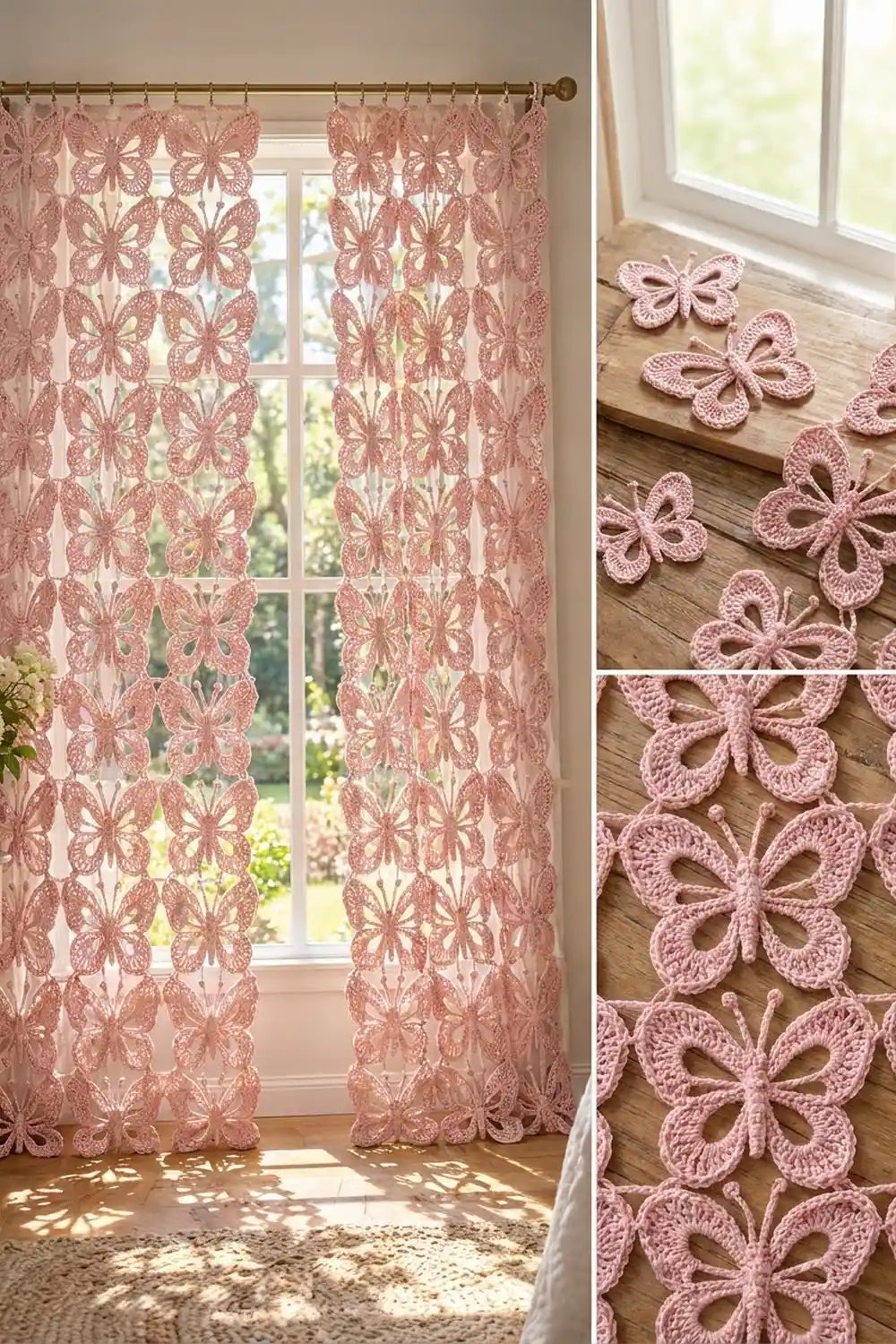
This curtain is a soft wall of butterflies. Each panel is made from openwork butterfly motifs in a single blush pink cotton. The motifs are joined at their wingtips, so light comes through the open wing centers and the gaps between butterflies.
Every butterfly has two large upper wings and two smaller lower wings, each with a teardrop-shaped open center. A band of tall stitches and a crisp single crochet edge frame each wing. A raised, ridged, rolled body runs down the middle, and two chain antennae end in round bobble tips.
The pattern uses US crochet terms. Each finished panel measures 18 in (45.7 cm) wide and 55.8 in (141.7 cm) long, plus hanging loops. The set shown is two matching panels.
You work each butterfly in four rounds from a center ring and join it to its neighbors on the last round. Then you sew on a rolled body, add antennae, and work a short single crochet heading across the top with loops for the rod.
Finished Size and Construction
- Finished panel size: 18 in x 55.8 in (45.7 cm x 141.7 cm), heading included
- Skill level: Intermediate
- Terminology: US crochet terms
- Yarn weight: DK (light worsted, #3) cotton
- Hook: 4.0 mm (G-6)
- Number of pieces: 66 butterfly motifs (33 per panel), each with a sewn-on rolled body
- Layout per panel: 3 motifs across x 11 motifs down
- Motif size: 6 in (15.2 cm) wide x 5 in (12.7 cm) tall, measured from picot tip to picot tip
- Size before border: 18 in x 55 in (45.7 cm x 139.7 cm)
- Border depth: top heading only, 0.8 in (2.0 cm), plus hanging loops of about 1.25 in (3.2 cm)
Materials
Choose a smooth mercerized or combed DK cotton. It shows the stitches clearly and hangs straight without stretching. Avoid fuzzy blends, which blur the open wing centers.
- Blush pink (one color): 500 g, about 1,150 m (ten 50 g balls of about 115 m each)
Each butterfly uses about 13 m (5.7 g), and each heading uses about 12 m, for a total of about 882 m across two panels. The quantity above includes a margin of roughly 15% for swatching and weaving in ends.
Tools:
- 4.0 mm (G-6) crochet hook
- Tapestry needle
- Stitch markers
- Rustproof pins and a blocking surface of 20 in x 58 in (50.8 cm x 147.3 cm), or block in sections
- Spray bottle and measuring tape
Abbreviations (US Terms)
- ch – chain
- sl st – slip stitch
- sc – single crochet
- hdc – half double crochet
- dc – double crochet
- tr – treble crochet
- BLO – back loop only
- st(s) – stitch(es)
- rep – repeat
Special stitch – Bobble: Yarn over, insert the hook in the stitch, yarn over and pull up a loop, yarn over and draw through 2 loops. Do this 3 more times in the same stitch (5 loops on hook). Yarn over and draw through all 5 loops.
Picot join: In place of a ch-3 picot, ch 1, sl st into the matching ch-3 picot of the finished neighbor, ch 1.
Gauge and Checkpoints
Basic gauge: 18 sc and 20 rows = 4 in (10.2 cm) with a 4.0 mm hook.
Motif gauge: One finished, blocked motif = 6 in (15.2 cm) wide x 5 in (12.7 cm) tall.
Make and block one complete motif before you start a panel. Check these points:
- After Round 2: Each upper wing is about 2.5 in (6.4 cm) long from the center ring.
- After Round 3: The motif is about 5.25 in (13.3 cm) wide.
- After Round 4: The motif is 6 in (15.2 cm) wide and 5 in (12.7 cm) tall.
If your motif is wider than 6.25 in (15.9 cm), go down a hook size. If it is narrower than 5.75 in (14.6 cm), go up a hook size. Small errors add up: if each motif is 0.25 in (0.6 cm) too tall, the panel ends up 2.75 in (7.0 cm) too long.
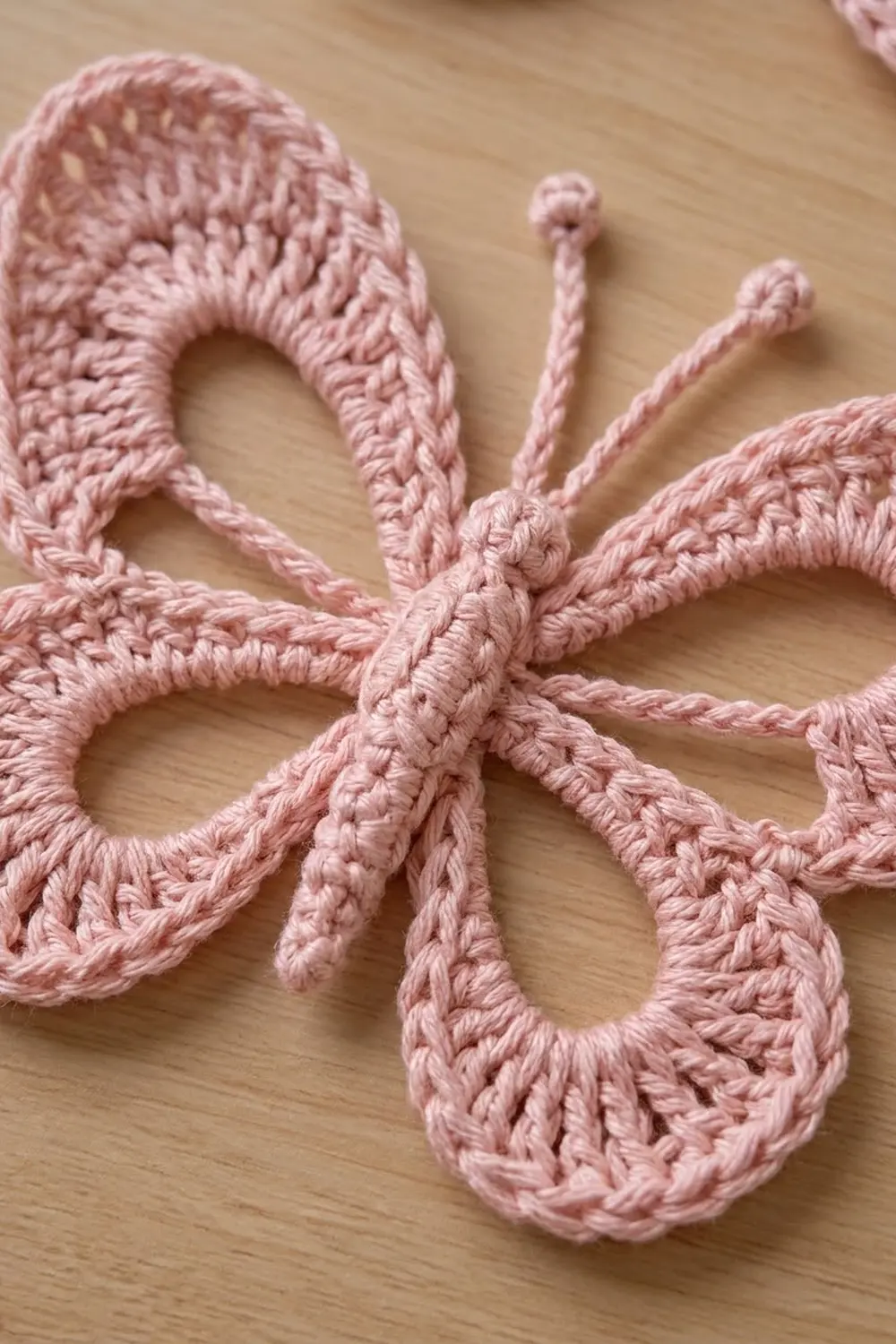
Butterfly Motif (Make 66)
The wings are labeled in the order you work them, seen from the front with the head at the top:
- Wing A – upper left
- Wing B – lower left
- Wing C – lower right
- Wing D – upper right
Work stitches into the chains of each loop, not around them. This keeps the loop size steady and opens up the teardrop centers.
Round 1: Make a magic ring. (Ch 22, sl st in ring) for Wing A, (ch 16, sl st in ring) for Wing B, (ch 16, sl st in ring) for Wing C, (ch 22, sl st in ring) for Wing D. Pull the ring tight. (4 loops: 22, 16, 16, 22 ch)
Round 2:
- Wing A: Sc in the first 2 ch, hdc in the next 2 ch, dc in the next 4 ch, 2 dc in each of the next 6 ch, dc in the next 4 ch, hdc in the next 2 ch, sc in the last 2 ch. Sl st in the ring. (28 sts)
- Wing B: Sc in the first 2 ch, hdc in the next 2 ch, dc in the next 2 ch, 2 dc in each of the next 4 ch, dc in the next 2 ch, hdc in the next 2 ch, sc in the last 2 ch. Sl st in the ring. (20 sts)
- Wing C: Work as Wing B. (20 sts)
- Wing D: Work as Wing A. (28 sts)
Round 2 total: 96 sts (28 + 20 + 20 + 28). The 4 sl sts into the ring are not counted.
Round 3: Work into the stitches of Round 2. Between wings, sl st in the center sl st.
- Wing A: Sc in the first 2 sts, hdc in the next 2, dc in the next 4, (2 tr in the next st, tr in the next st) 6 times, dc in the next 4, hdc in the next 2, sc in the last 2. Sl st in the center. (34 sts)
- Wing B: Sc in the first 2 sts, hdc in the next 2, (2 dc in the next st, dc in the next st) 6 times, hdc in the next 2, sc in the last 2. Sl st in the center. (26 sts)
- Wing C: Work as Wing B. (26 sts)
- Wing D: Work as Wing A. (34 sts)
Round 3 total: 120 sts (34 + 26 + 26 + 34). All 6 increases on each wing fall on the outer curve, which rounds out the wing shape.
Round 4 (edge and picots): Sc in every stitch of Round 3. Where a neighbor is already finished, work a picot join in place of the picot.
- Wing A: Sc in the next 10 sts, ch 3 (top picot), sc in the next 12 sts, ch 3 (side picot), sc in the next 12 sts. Sl st in the center. (34 sc, 2 picots)
- Wing B: Sc in the next 13 sts, ch 3 (bottom picot), sc in the next 13 sts. Sl st in the center. (26 sc, 1 picot)
- Wing C: Work as Wing B. (26 sc, 1 picot)
- Wing D: Sc in the next 12 sts, ch 3 (side picot), sc in the next 12 sts, ch 3 (top picot), sc in the next 10 sts. Sl st in the center. (34 sc, 2 picots)
Round 4 total: 120 sc and 6 picots. Fasten off, leaving a 12 in (30.5 cm) tail.
Rolled Body
Ch 6.
Row 1: Sc in the 2nd ch from the hook and in each ch across. (5 sc)
Rows 2–12: Ch 1, turn, sc in BLO of each st across. (5 sc)
Fasten off, leaving a 10 in (25.4 cm) tail. The strip is about 2.4 in (6.1 cm) long. Roll it lengthwise into a tube so the BLO ridges wrap around it like segments, then whipstitch the long edge closed. Center the tube over the magic ring from head to tail and sew it down through the sl sts between the wings.
Antennae
Join yarn with a sl st at the head end of the body. Ch 9, work a bobble in the 4th ch from the hook, then sl st in the next 5 ch back toward the head. Sl st into the head again and make the second antenna the same way. Fasten off. Each antenna is about 1.3 in (3.3 cm) long.
Make All Pieces
Make 66 blush pink butterfly motifs, 33 for each panel. Each motif gets 1 rolled body and 2 antennae.
Lay out each panel 3 motifs across and 11 motifs down:
Row 1:   [1]  [2]  [3]
Row 2:   [4]  [5]  [6]
Row 3:   [7]  [8]  [9]
 ...
Row 11:  [31] [32] [33]
All motifs face the same way, with the antennae pointing up toward the rod.
Joining
Join as you go on Round 4. Work Motif 1 in full. For each new motif, work Rounds 1–3, then use the picot join wherever a picot meets a finished neighbor:
- Wing A side picot joins the Wing D side picot of the motif to the left.
- Wing A top picot joins the Wing B bottom picot of the motif above.
- Wing D top picot joins the Wing C bottom picot of the motif above.
Work row by row, left to right, so the neighbors you need are always finished. A picot join takes the place of a picot, so it adds no width or length. Each panel has 22 side joins (2 per row x 11 rows) and 60 vertical joins (3 columns x 2 joins x 10 gaps), for 82 joins in all.
Keep the ch 1 on each side of each join relaxed. Tight joins pull the wingtips together and make the panel bow, and loose joins let the motifs sag.
Size checkpoint: After 3 rows, the panel measures 18 in (45.7 cm) wide and 15 in (38.1 cm) long. The fully joined panel measures 18 in x 55 in (45.7 cm x 139.7 cm).
Border: Top Heading
Only the top edge gets a border. The sides and bottom keep the butterfly outline.
Border gauge: 18 sc = 4 in (10.2 cm), or 4.5 sts per inch.
Top count per motif: 23 sts (5 sc in the Wing A top picot + ch 13 + 5 sc in the Wing D top picot).
Row 1: Join yarn in the Wing A top picot of the top-left motif. Ch 1, 5 sc in the same picot, ch 13, 5 sc in the Wing D top picot. Ch 6, 5 sc in the Wing A top picot of the next motif, ch 13, 5 sc in the Wing D top picot. Rep from * once more. (81 sts: 3 motifs x 23 = 69, plus 2 bridges x 6 ch = 12)*
The two ch-6 bridges are shown exactly here and are not part of any motif’s 23 stitches. Let the antennae sit in front of the ch-13 spans.
Row 2: Ch 1, turn, sc in each sc and each ch across. (81 sc)
Row 3: Ch 1, turn, sc in each st across. (81 sc)
Row 4 (hanging loops): Ch 1, turn. (Sc, ch 12, sc) in the first st. Sc in the next 19 sts, (sc, ch 12, sc) in the next st. Rep from * 3 more times. (81 sc worked 1 per existing st + 5 extra sc = 86 sc, plus 5 ch-12 loops)*
Fasten off.
Why the math works: At 4.5 sts per inch, 81 sts = 18 in (45.7 cm), which exactly matches the joined panel width, so the heading won’t gather or ruffle. At 5 rows per inch, 4 rows = 0.8 in (2.0 cm), which brings the panel to 55.8 in (141.7 cm). The loops fit a rod up to 0.75 in (1.9 cm) across, or you can hang them from clip rings.
Final Blocking
- Weave in all ends along the sc edges, not across the open wing centers.
- Soak the panel in cool water for 15 minutes. Gently press out the water without wringing.
- Roll the panel in a towel to remove excess moisture.
- Lay the panel flat and pin it to 18 in x 55.8 in (45.7 cm x 141.7 cm).
- Pin each wing tip so the teardrop centers open evenly.
- Pin the joins so the links sit straight between motifs.
- Let it dry completely before unpinning. Repeat with the second panel.
Final Quality-Control Checklist
- All 66 motifs measure 6 in x 5 in (15.2 cm x 12.7 cm).
- Every motif has 4 open teardrop wing centers.
- Each panel has 82 picot joins and no missed picots.
- Every body is centered and all antennae point up.
- Heading Rows 1–3 have 81 sts each, and Row 4 has 5 loops.
- Both panels measure 18 in x 55.8 in (45.7 cm x 141.7 cm).
- All ends are hidden and secure.
Troubleshooting
- Wing centers close up: You worked around the chain loop instead of into the chains. Redo Round 2.
- Wings cup: Your tr stitches are too tight. Loosen up, or use a hook one size larger for Round 3.
- Wings ruffle: Recount Round 3. It should have 34 sts on each upper wing and 26 on each lower wing.
- Panel leans: A join went into the wrong picot. Wing A should join Wing B above, and Wing D should join Wing C above.
- Heading pulls or ruffles: Make sure Row 1 has 81 sts, then check your border gauge.
Care
Hand wash in cool water with mild soap, lay flat to dry, and re-pin the wings if needed. Don’t hang the curtain while it’s wet, because the weight will stretch the joins.
Final Notes
One motif is 6 in x 5 in (15.2 cm x 12.7 cm). Three across and eleven down make 18 in x 55 in (45.7 cm x 139.7 cm). The 81-stitch heading matches that width and adds 0.8 in (2.0 cm), so each finished panel is 18 in x 55.8 in (45.7 cm x 141.7 cm). Check your first motif, keep your joins relaxed, and the butterflies will line up neatly.
Happy crocheting!