

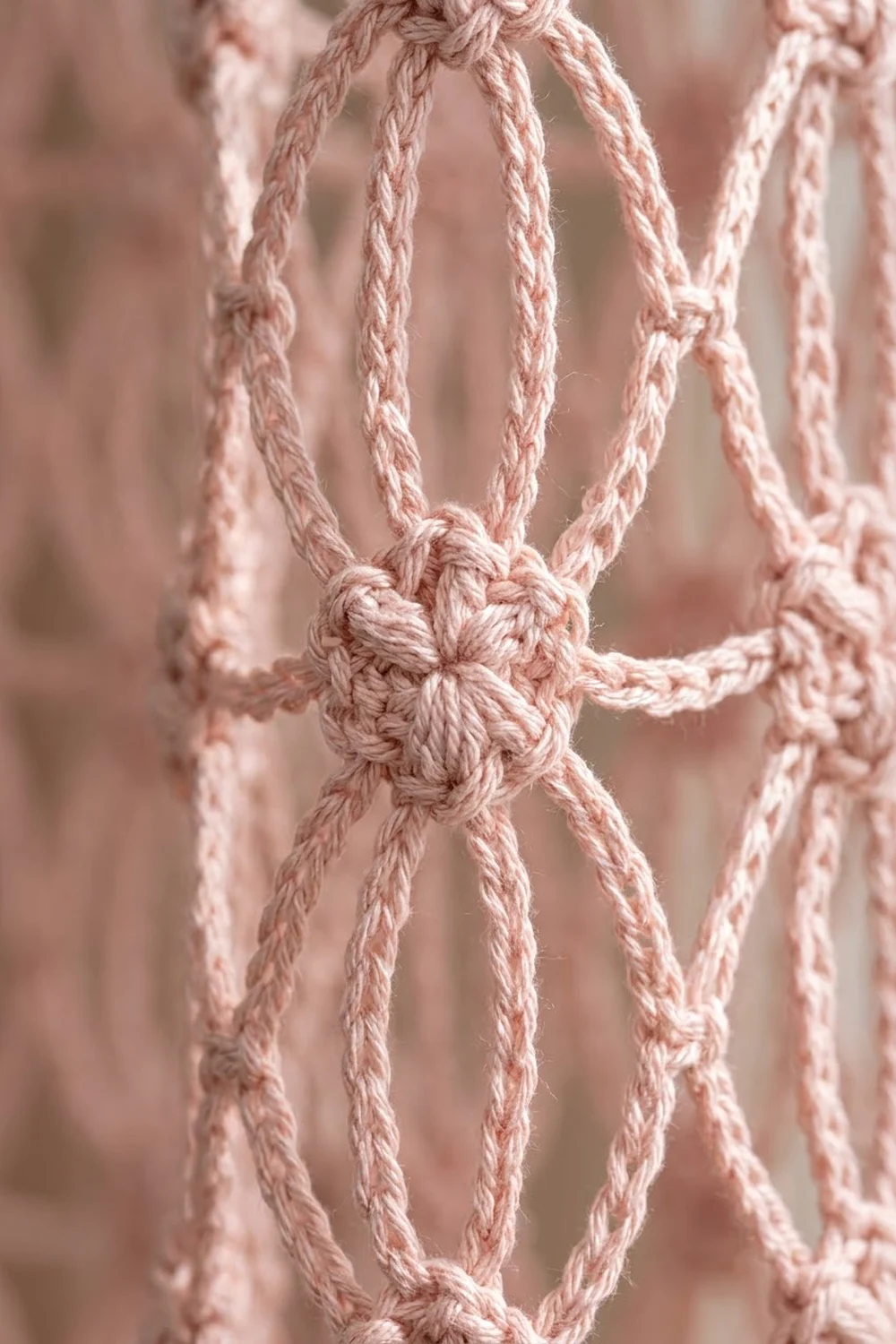
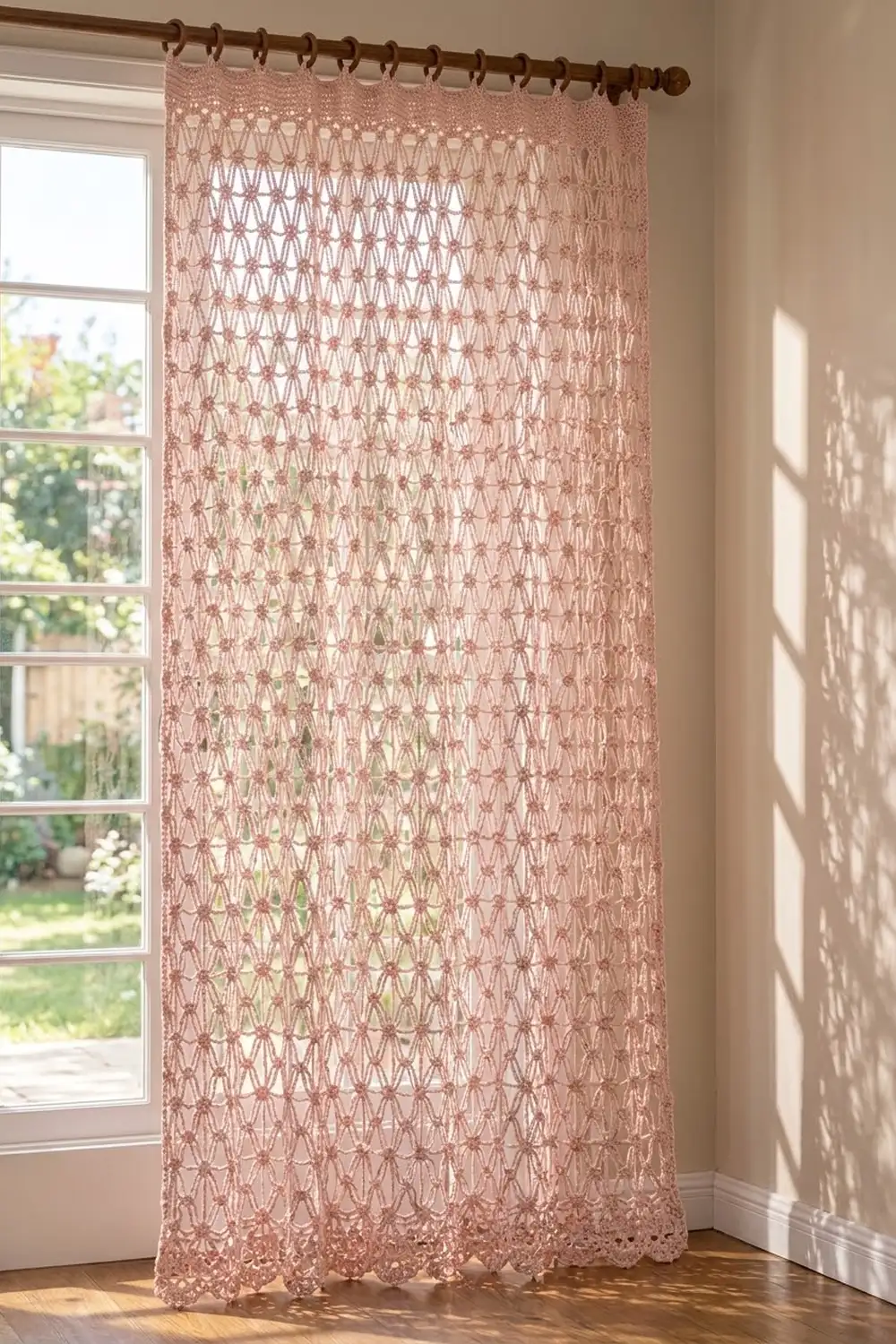
This curtain panel is an airy, pale blush pink lace made from long chain loops. The loops form tall, open ovals, and each place where four chains meet is held by a small, round puff knot. Light comes straight through the mesh, so the panel softens a window without blocking it.
The design is worked in one color, a soft dusty rose with a matte cotton finish. A solid single crochet band runs across the top and carries round hanging tabs for curtain rings. Across the bottom, a scalloped shell edge with chain picots gives the hem some weight, which helps the mesh hang straight.
The pattern uses US crochet terms. One finished panel measures 40 in (101.6 cm) wide by 84 in (213.4 cm) long, not counting the hanging tabs. The photographed window uses two identical panels hung side by side. They are separate pieces and are never joined, so just make the panel twice.
The panel is one piece, worked top-down in rows. You crochet the top band first, then the oval knot mesh, then the scalloped border straight off the last mesh row. The hanging tabs are added last along the foundation edge.
Finished Size and Construction
- Finished size: 40 in x 84 in (101.6 cm x 213.4 cm) per panel
- Skill level: Intermediate (simple repeats, long project)
- Terminology: US
- Yarn weight: DK / light worsted (weight 3) cotton
- Hook: 5.0 mm (H-8)
- Number of pieces: 1 panel (make 2 for a pair, as shown)
- Layout: single panel, no joining
- Piece size: 40 in x 84 in (101.6 cm x 213.4 cm)
- Size before border: 40 in x 82.25 in (101.6 cm x 208.9 cm)
- Border depth: 1.75 in (4.4 cm), bottom edge only
- Top band: 1 in (2.5 cm)
- Mesh: 65 rows, 81.25 in (206.4 cm)
Materials
Pick a smooth, tightly plied cotton or cotton blend. Plied cotton shows the chain loops clearly and doesn’t stretch much under its own weight. Avoid fuzzy or very slippery yarns, because the knots need some grip to hold their shape.
A pale, slightly heathered pink like the one shown hides small tension changes better than a stark bright shade. Buy every ball from the same dye lot, because a long panel shows color shifts clearly against window light.
- Blush Pink: 700 g, about 1,575 m per panel (1,400 g, about 3,150 m for a pair)
- 5.0 mm (H-8) crochet hook
- Tapestry needle
- Scissors
- Stitch markers (4 or more)
- Measuring tape
- Blocking pins and a large blocking surface, or a rod for hang-blocking
- 11 curtain rings per panel, about 2 in (5.1 cm) across
These quantities include a margin of about 10% for gauge swatches and tension differences.
Abbreviations (US Terms)
- ch – chain
- sc – single crochet
- tr – treble crochet
- sl st – slip stitch
- sk – skip
- sp(s) – space(s)
- st(s) – stitch(es)
- yo – yarn over
Special stitches
- Triple treble (trtr): Yo 4 times, insert hook in st, yo and pull up a loop (6 loops on hook). [Yo, pull through 2 loops] 5 times.
- Knot (kn): [Yo, insert hook in indicated ch-sp, yo, pull up a loop to ½ in (1.3 cm)] 3 times (7 loops on hook). Yo, pull through all 7 loops, then ch 1 firmly to lock. The knot wraps around the chain loop it’s worked into and gathers it, which makes the round node.
Gauge and Checkpoints
Gauge: 16 sc and 20 rows = 4 in (10.2 cm). One 8-st mesh repeat = 2 in (5.1 cm). One mesh row = 1.25 in (3.2 cm) of depth once blocked and hanging.
Test one piece first. Make a swatch before you start the panel. It uses the same row structure, just narrower.
- Ch 34. Work Rows 1–5 on 33 sc.
- Work Row 6 (4 ch-14 loops), then Rows 7–10 as given below. Your swatch will have 4 knots, then 3, then 4, then 3.
- Work border Rows 71–73. Row 71 gives 1 + (3 x 8) + 7 + 1 = 33 sc, and Row 72 makes 4 shells.
Block the swatch and pin it lightly by the top band so it hangs. It should measure 8 in (20.3 cm) wide by 9 in (22.9 cm) long, with 6.25 in (15.9 cm) of mesh.
Checkpoints on the panel:
- After Row 1: 161 sc, 40 in (101.6 cm) wide, laid flat without stretching.
- After Row 5: band is 1 in (2.5 cm) deep.
- After Row 37 (32 mesh rows): 41 in (104.1 cm) from the top, measured hanging.
- After Row 70: 82.25 in (208.9 cm).
- After Row 73: 84 in (213.4 cm).
Too big: go down to a 4.5 mm hook, or chain more firmly.
Too small: go up to a 5.5 mm hook.
If only the mesh is too short, adjust the knot height first by pulling up the knot loops a little longer. Keep the chain counts as written, because they set the width.
Top Band
Row 1: Ch 162, sc in 2nd ch from hook and in each ch across, turn. (161 sc)
Rows 2–5: Ch 1 (does not count as a st), sc in each sc across, turn. (161 sc)
The band is now 1 in (2.5 cm) deep. The count of 161 is 20 repeats of 8 sts plus 1 closing st, and that matches every row that follows.
Oval Knot Mesh
Keep your chains even and relaxed. Count every ch-14 twice for the first few rows, because one short loop pulls a whole column of ovals out of line.
Row 6 (first loop row): Ch 1, sc in first sc, *ch 14, sk 7 sc, sc in next sc; rep from * 19 more times, turn. (21 sc, 20 ch-14 loops)
Check: 1 + (20 x 8) = 161 sts used.
Row 7 (knot row): Ch 6 (counts as first trtr), ch 7, kn in first ch-14 sp, *ch 14, kn in next ch-14 sp; rep from * 18 more times, ch 7, trtr in last sc, turn. (2 trtr, 2 ch-7 half loops, 20 kn, 19 ch-14 loops)
Row 8 (full loop row): Ch 6 (counts as first trtr), ch 14, sk ch-7 half loop and first kn, kn in next ch-14 sp, *ch 14, kn in next ch-14 sp; rep from * 17 more times, ch 14, sk last kn and ch-7, trtr in top of turning ch, turn. (2 trtr, 19 kn, 20 ch-14 loops)
Rows 9–70: Repeat Rows 7 and 8 another 31 times, ending with an even (Row 8 type) row.
Every odd row ends with 20 knots. Every even row ends with 19 knots and 20 full loops. The total is 65 mesh rows (Rows 6–70).
How the shape forms: each knot is worked into the center of a loop from the row before. The new loops hang down between those knots, and loops from neighboring rows meet at each knot to form the tall ovals.
The trtr at each end drops the side edge by one mesh row. That keeps the sides level with the knots, so they don’t pull up.
Checkpoint: after Row 70 the panel is 82.25 in (208.9 cm) long when hanging. Place a marker every 10 rows to make counting easier. The weight of the lower rows stretches the upper ovals slightly, so always measure with the panel hanging, not lying flat.
Scalloped Border
The border is worked across the bottom edge only. The sides keep their trtr edge, and the top already has its band.
Border gauge: 161 sts across 40 in (101.6 cm), the same as the top band. Each scallop covers 8 sts, or 2 in (5.1 cm), so each scallop sits under one mesh loop.
Row 71 (trim row): Ch 1, sc in top of first trtr, *7 sc in next ch-14 sp, sc in next kn; rep from * 18 more times, 7 sc in last ch-14 sp, sc in top of turning ch, turn.
Count: (20 loops x 7 sc) + (19 knots x 1 sc) + (2 edge sts x 1 sc) = 140 + 19 + 2 = 161 sc.
Spread the 7 sc evenly along each loop so the trim row lies straight rather than wavy.
Row 72 (shell row): Ch 1, sc in first sc, *sk 3 sc, 9 tr in next sc, sk 3 sc, sc in next sc; rep from * 19 more times, turn. (20 shells of 9 tr, 21 sc; 201 sts)
Check: 1 + (20 x 8) = 161 sts used, with no leftovers.
Row 73 (picot edge): Ch 1, sl st in first sc, *sc in first tr of shell, [ch 3, sc in next tr] 8 times, sl st in next sc; rep from * 19 more times. Fasten off. (180 sc, 160 ch-3 sps, 21 sl st)
Why the math works: the top band, the mesh and the trim row all use 20 repeats of 8 sts plus 1 st. That puts 20 scallops directly under the 20 mesh loops. The hem stays the same width as the top band, so it won’t flare or pull in.
Hanging Tabs
Turn the panel upside down so the foundation edge of Row 1 faces up. Mark st 1, then every 16th st after it: sts 1, 17, 33, 49, 65, 81, 97, 113, 129, 145 and 161. That gives 11 tabs spaced 4 in (10.2 cm) apart.
Each tab: Join yarn with sl st in a marked st. Ch 16, sl st in same st, then work 20 sc into the ch-16 loop and sl st in the same st again. Fasten off. Each tab stands about 1.5 in (3.8 cm) tall.
The sc covering makes each tab firm enough to carry the weight of the panel without stretching. If your rings are larger than 2 in (5.1 cm), add 2 ch to the tab loop and 3 sc to its covering.
Final Blocking
- Weave in all ends along chain loops, splitting the plies so the ends can’t slip out.
- Soak the panel in cool water with a little wool wash for 15 minutes.
- Press the water out gently without wringing. Roll the panel in towels to remove more moisture.
- Lay it flat and pin the top band straight at 40 in (101.6 cm).
- Ease the mesh down until the ovals look even. Pin each scallop point along a straight line at 84 in (213.4 cm).
- Or, instead of pinning, thread the tabs onto a rod and hang-block the panel over towels. Smooth the knots into line with your fingers.
- Let it dry completely before hanging it at the window. Wet cotton is heavy, so check the length again once it’s dry.
Final Quality-Control Checklist
- The band has 161 sc and measures 40 in (101.6 cm).
- Odd mesh rows have 20 knots. Even rows have 19 knots and 20 full loops.
- Every knot is locked with its ch 1 and looks round, not loose.
- The side edges hang straight, with one trtr per row.
- The border has 20 even scallops, and the hem width matches the band.
- The 11 tabs are evenly spaced, 4 in (10.2 cm) apart.
- The panel is 84 in (213.4 cm) long without the tabs.
- If you’re making a pair, both panels match within 0.5 in (1.3 cm).
Troubleshooting
- Side edges curl up: you skipped a trtr or used a shorter stitch. Each row needs its trtr at both ends.
- Ovals lean to one side: a knot went into the wrong loop. Check that every knot sits in the center of a loop from the row before.
- Knots look flat: pull the 3 loops up a bit taller and keep the closing ch 1 firm.
- Mesh is narrower than the band: your chains are too tight. Loosen your chain tension, or use a hook one size larger for the chains only.
- Hem ruffles: your shells are too loose. Go down a hook size for Row 72 only.
- Hem pulls in: check Row 71. It should have exactly 7 sc per loop and 1 sc per knot.
- Panel is too long when hung: cotton stretches. Work 2 fewer mesh rows (one Row 7 and Row 8 pair) before the border, which takes off 2.5 in (6.4 cm).
- Panel is too short: add one or more Row 7 and Row 8 pairs before the border. Each pair adds 2.5 in (6.4 cm).
Care
Hand wash in cool water, roll in a towel, and dry flat or hanging over towels. Don’t tumble dry, because the long chain loops can snag and stretch.
Final Notes
Here’s the measurement chain:
- Each 8-st repeat is 2 in (5.1 cm), and 20 repeats plus 1 st make a 40 in (101.6 cm) band.
- The band is 1 in (2.5 cm) deep.
- 65 mesh rows of 1.25 in (3.2 cm) each add 81.25 in (206.4 cm).
- The 1.75 in (4.4 cm) scalloped border brings the panel to 84 in (213.4 cm).
If your swatch measures 8 in (20.3 cm) by 9 in (22.9 cm), the full panel will come out to size. Make a second panel to match the pair in the photo. Count the rows on both panels as you go, and use yarn from the same dye lot so they hang at the same length and shade.
Happy crocheting!