

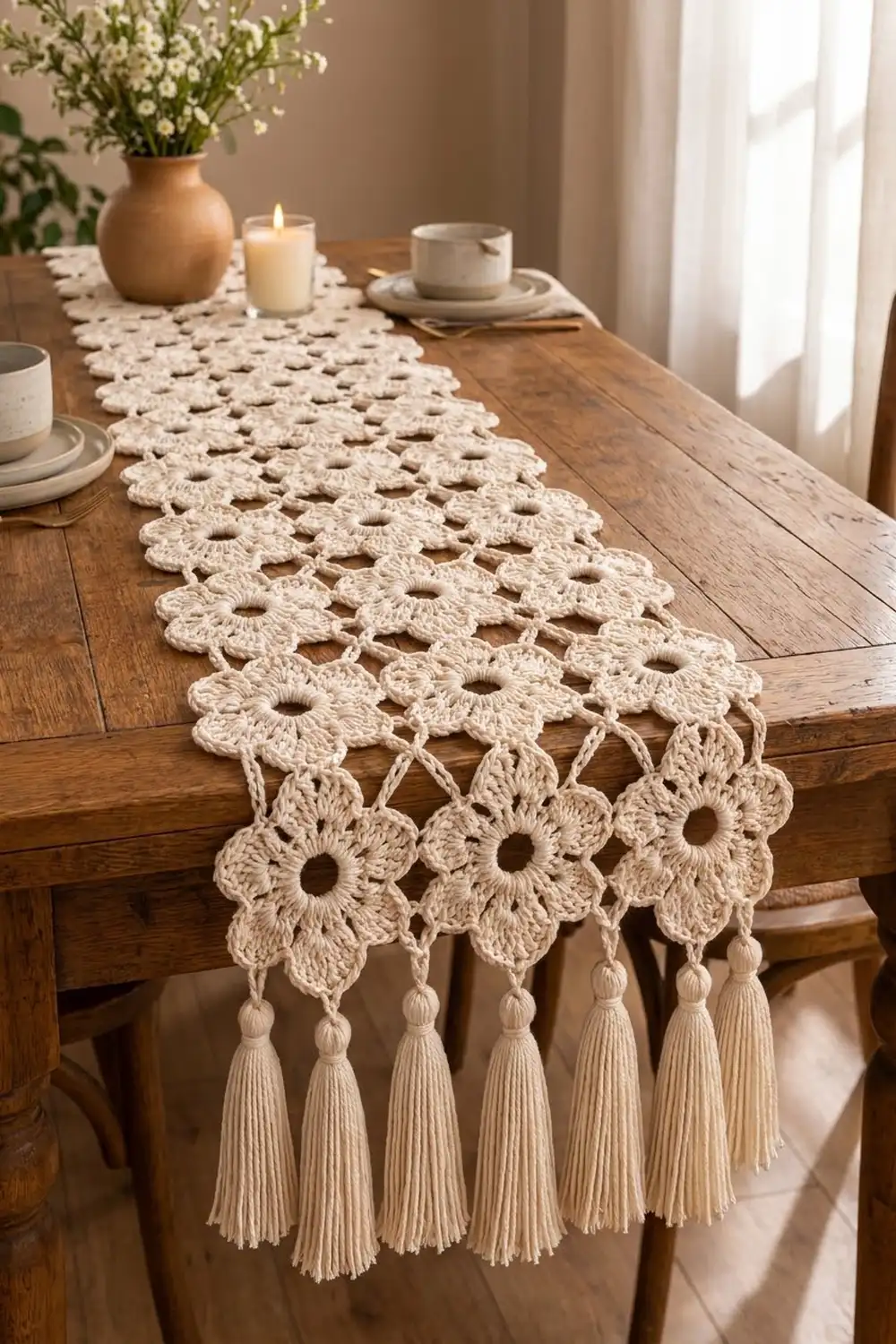
The Ivory Bloom Table Runner is a light, lacy runner made from six-petal flower motifs in a single shade of ivory cotton. Every flower has an open “porthole” center, and its rounded petals have a crisp single crochet edge. Because the flowers are joined only at their petal tips, small airy diamonds of tabletop show through the lace.
Thick, chunky tassels at both short ends add a relaxed boho finish. The runner looks good on a rustic wooden table, with a neutral centerpiece, or layered over linen.
This pattern uses US crochet terms. The finished runner measures 13.5 in (34.3 cm) wide by 50.7 in (128.8 cm) long without tassels, or 60.2 in (152.9 cm) long including the tassel fringe at both ends.
Construction is simple and repetitive. You make one complete motif, then join each of the other 38 motifs as you go during their last round, for a grid 3 motifs wide and 13 motifs long. There is no stitched border; the scalloped petals form the edge. Twelve tassels finish the short ends.
Finished Size and Construction
- Finished size: 13.5 in x 50.7 in (34.3 cm x 128.8 cm); 60.2 in (152.9 cm) long with tassels
- Skill level: Easy-Intermediate
- Terminology: US crochet terms
- Yarn weight: DK / light worsted (#3) cotton
- Hook: 4.0 mm (G-6)
- Number of pieces: 39 flower motifs, plus 12 tassels
- Layout: 3 motifs across x 13 motifs long
- Piece size: 4.5 in (11.4 cm) from tip to opposite tip (side to side); 3.9 in (9.9 cm) from top edge to bottom edge
- Size before border: 13.5 in x 50.7 in (34.3 cm x 128.8 cm)
- Border depth: no stitched border; the tassel fringe adds 4.75 in (12.1 cm) at each short end
Materials
Yarn: Use a smooth mercerized or combed cotton in DK weight, about 105 m (115 yd) per 50 g. Cotton holds the petal shape, blocks flat, and makes heavy tassels that hang straight. Avoid fuzzy or highly textured yarn, because it hides the openwork.
- Ivory / cream: 350 g, about 735 m (804 yd)
- Motifs: about 6 g each x 39 = 234 g
- Tassels and hanging chains: about 50 g
These quantities include a margin of roughly 20% for gauge differences and test pieces.
Tools:
– 4.0 mm (G-6) crochet hook
– Tapestry needle
– Sharp scissors
– Stiff card or tassel maker, 4 in (10.2 cm) tall
– Rust-proof pins and a blocking mat
– Spray bottle
– Measuring tape
Abbreviations (US Terms)
- ch – chain
- sl st – slip stitch
- sc – single crochet
- hdc – half double crochet
- dc – double crochet
- sp – space
- st(s) – stitch(es)
- rep – repeat
Special stitch: Tip Join. Work this in place of the ch 3 at a petal tip whenever that tip must attach to a neighboring motif: ch 1, remove the hook, insert it from the front into the neighbor’s ch-3 tip space, pick up the dropped loop and pull it through, then ch 1. The join counts as the tip space.
Gauge and Checkpoints
Make one complete motif and block it lightly before you start the others. The whole runner depends on this one measurement.
Motif gauge: 4.5 in (11.4 cm) from tip to opposite tip, measured across the 3 o’clock and 9 o’clock petals.
Checkpoints:
– After Round 1: ring is 1.25 in (3.2 cm) across, with a 0.75 in (1.9 cm) open center
– After Round 2: 1.75 in (4.4 cm) across
– After Round 3: 2.5 in (6.4 cm) across, measured loop to loop
– After Round 4: 4 in (10.2 cm) across
– After Round 5: 4.5 in (11.4 cm) from tip to tip
If the motif is too big: go down to a 3.75 mm hook. If it’s too small, go up to a 4.5 mm hook. A difference of 0.25 in (0.6 cm) per motif adds up to 0.75 in (1.9 cm) across the width and 3.25 in (8.3 cm) over the length, so adjust now instead of later.
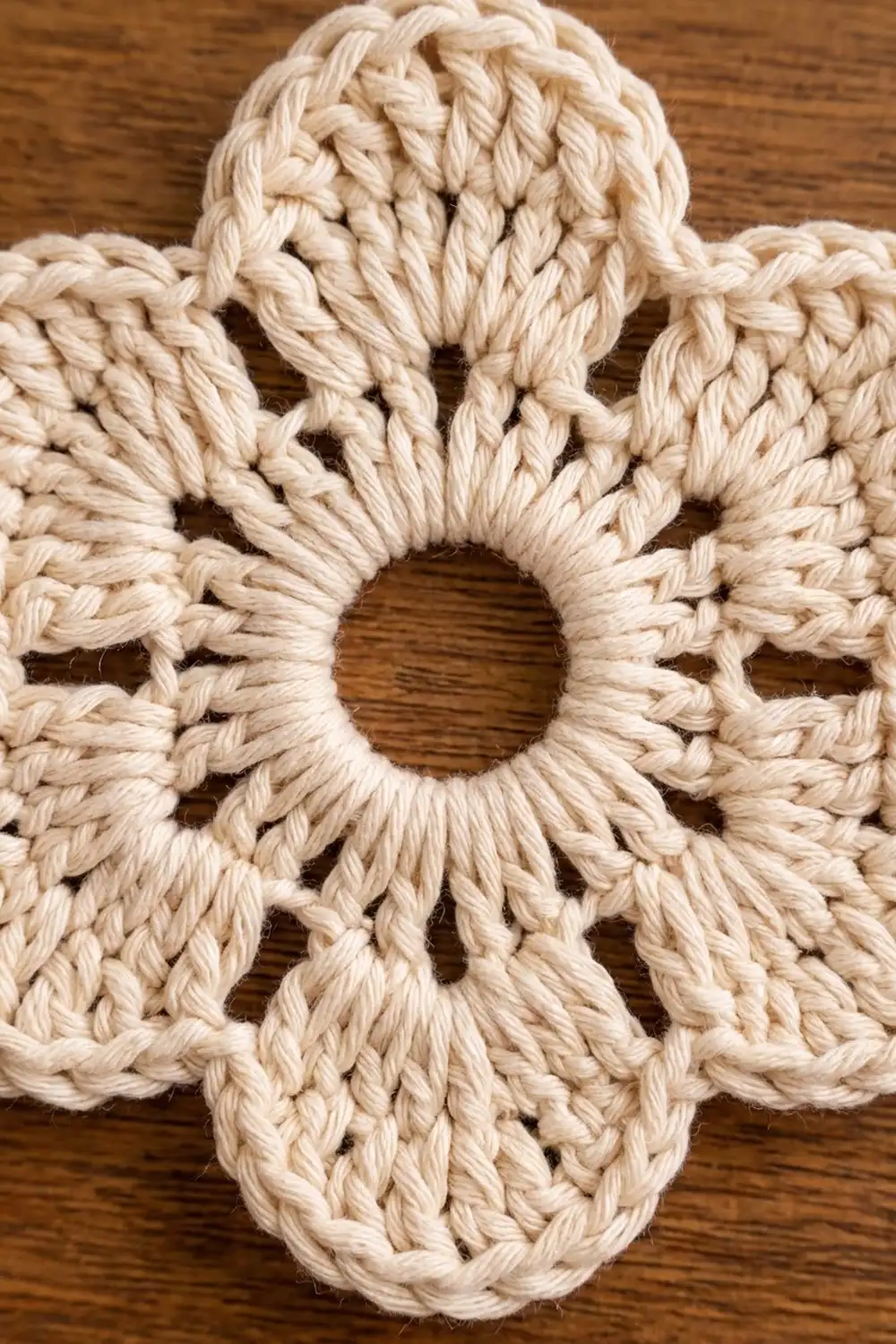
Flower Motif (Make 1 Complete, Then Join 38)
Round 1 (center ring): Ch 12, sl st into the first ch to form a ring. Ch 1, work 24 sc into the ring, sl st to the first sc. (24 sc)
Pack the stitches snugly so they cover the chain completely. This makes the firm, rolled ring around the open center.
Round 2: Ch 3 (counts as dc), dc in each sc around, sl st to the top of the ch-3. (24 dc)
Round 3: Ch 1, sc in the same st, ch 4, skip 3 dc, sc in next dc, ch 4, skip 3 dc; rep from * 4 more times, sl st to the first sc. (6 sc, 6 ch-4 sps)
This divides the circle into six equal sections, one per petal: 6 x 4 stitches = 24.
Round 4 (petals): Sl st into the first ch-4 sp. Ch 1, work (sc, hdc, 5 dc, hdc, sc) in the same sp and in each of the remaining 5 ch-4 sps. Sl st to the first sc. (6 petals of 9 sts = 54 sts)
Each petal comes from a single loop, so the base stays open and lacy and the top rounds out.
Round 5 (petal edge and tips): Ch 1. In each petal work: sc in sc, sc in hdc, sc in next dc, 2 sc in next dc, (sc, ch 3, sc) in center dc, 2 sc in next dc, sc in next dc, sc in hdc, sc in sc. Rep for all 6 petals, then sl st to the first sc. Fasten off and weave in the ends.
(Each petal: 1 + 1 + 1 + 2 + 2 + 2 + 1 + 1 + 1 = 12 sc plus 1 ch-3 tip sp. Total: 72 sc and 6 ch-3 tip sps)
This is a trim round. It works 9 stitches one-for-one into the 9 stitches of Round 4, then adds 3 extra sc (one at each 2-sc increase and one at the tip), for 9 + 3 = 12 sc per petal. Together with the ch-3 tip, this gives the smooth, rounded petal edge.
Orientation: Lay the motif with one petal pointing to 3 o’clock and one to 9 o’clock. The other four petals then point to about 1, 5, 7, and 11 o’clock. Every motif in the runner sits this way.
Make All Pieces
All 39 motifs are ivory. Motif 1 is made completely. Motifs 2 through 39 are worked through Round 4, then joined during Round 5.
Layout grid (3 across x 13 long):
Row 1:   1   2   3
Row 2:   4   5   6
Row 3:   7   8   9
Row 4:  10  11  12
Row 5:  13  14  15
Row 6:  16  17  18
Row 7:  19  20  21
Row 8:  22  23  24
Row 9:  25  26  27
Row 10: 28  29  30
Row 11: 31  32  33
Row 12: 34  35  36
Row 13: 37  38  39
Joining (Join-As-You-Go)
Every join happens at a petal tip. In Round 5, work a Tip Join in place of the ch 3 for each tip that touches an existing neighbor. Work the other tips as normal ch-3 tips.
Which tips join:
– Neighbor to the left: this motif’s 9 o’clock tip joins the left motif’s 3 o’clock tip.
– Neighbor above: this motif’s 11 o’clock tip joins the upper motif’s 7 o’clock tip, and its 1 o’clock tip joins the upper motif’s 5 o’clock tip.
By position:
– Motifs 2 and 3: 1 join each (left only)
– Left-column motifs (4, 7, 10 … 37): 2 joins each (above only)
– Middle and right-column motifs in Rows 2–13: 3 joins each (left plus 2 above)
Total joins: 26 horizontal (2 per row x 13 rows) + 72 vertical (3 motifs x 2 tips x 12 row gaps) = 98 tip joins.
Stitch logic: The Tip Join replaces the ch-3 tip one-for-one. Every petal still has 12 sc, so joined motifs measure the same as Motif 1. No stitches are added at seams.
Tension: Keep the ch 1 on each side of the join at the same size as your normal chains. If you pull them tight, the petals pucker; if they’re loose, the runner sags in the gaps. Before each join, lay the new motif flat beside its neighbor to check that it is facing the right way.
Why the size works: The 3 o’clock and 9 o’clock tips lie on the motif’s centerline, so side-by-side motifs sit exactly 4.5 in (11.4 cm) apart, center to center. The 1/11 and 5/7 o’clock tips sit 3.9 in (9.9 cm) apart top to bottom, which is the vertical spacing between rows.
Size checkpoint: After Row 3, the piece should be 13.5 in (34.3 cm) wide and 11.7 in (29.7 cm) long. Fix any difference now before going on.
Border (Edge Finish and Tassels)
The runner has no stitched border. The 12-sc scalloped petals are the finished edge, which keeps the open, airy look. The only finishing is the tassel fringe on the two short ends.
Border gauge (tassel fringe): Each tassel is 4 in (10.2 cm) long and hangs from a ch-5 link of 0.75 in (1.9 cm), so the fringe adds 4.75 in (12.1 cm) at each end.
Free tips per edge:
– Each short end: 3 motifs x 2 free tips (the 11 and 1 o’clock tips on Row 1, or the 7 and 5 o’clock tips on Row 13) = 6 tassel points
– Each long side: 13 motifs x 1 free tip (the 9 o’clock tips on the left column, or the 3 o’clock tips on the right column) = 13 free tips, left untrimmed
Make 12 tassels:
1. Wrap yarn 40 times around a 4 in (10.2 cm) card.
2. Slide a 12 in (30.5 cm) tie strand under the wraps at the top and knot it tightly.
3. Cut the wraps open at the bottom edge. Each strand is now 8 in (20.3 cm) long.
4. Wrap a separate strand firmly around the bundle 0.5 in (1.3 cm) below the top to form the head. Knot it and hide the ends inside.
5. Trim the bottom evenly to 4 in (10.2 cm).
Hanging chains: Join yarn with a sl st in a free tip ch-3 space at a short end. Ch 5, then sl st through the tassel’s top tie loop. Fasten off and secure both tie ends through the chain. Repeat for all 6 tips on each end.
Why the math works: 6 tips x 2 ends = 12 tassels, and each motif’s 2 free short-end tips get one tassel each. That spacing stays even and symmetrical across the 13.5 in (34.3 cm) width. Overall length: 50.7 + 4.75 + 4.75 = 60.2 in (152.9 cm).
Final Blocking
- Weave in all remaining ends along sc edges, not across open lace.
- Pin the runner to the mat at 13.5 in x 50.7 in (34.3 cm x 128.8 cm), starting with the four corners.
- Pin every free tip along the edges, then pin the center of each motif so the porthole stays round.
- Spray until the runner is damp all the way through, but not dripping.
- Smooth each petal into a rounded shape with your fingers.
- Let it dry completely, usually 12–24 hours.
- Unpin. Steam the tassels lightly and comb them straight with your fingers.
Final Quality-Control Checklist
- Every motif has 6 petals of 12 sc each, plus a tip.
- All 39 motifs face the same way (petals at 3 and 9 o’clock).
- All 98 tip joins are secure, with none missed or doubled.
- The open centers are round and about 0.75 in (1.9 cm) across.
- Width is 13.5 in (34.3 cm) and length is 50.7 in (128.8 cm) without tassels.
- There are 6 tassels on each short end, evenly spaced, each 4 in (10.2 cm) long.
- All ends are woven in and invisible from both sides.
Troubleshooting
Petals ruffle: Your Round 5 tension is too loose, or you added extra sc. Recount to 12 sc per petal.
Motif cups: Round 1 is too loose on the ring, or Round 2 is too tight. Recheck the 1.75 in (4.4 cm) checkpoint.
Center hole closes up: Use exactly 12 chains for the ring, and don’t pull the ring tight before working Round 1.
Gaps look uneven: Your Tip Join chains vary in size. Redo the uneven joins so both ch 1 stitches are relaxed and the same size.
Runner is too short: Your vertical spacing is off. Block the runner firmly lengthwise, or check the 3.9 in (9.9 cm) motif height.
Tassels splay: Tighten the neck wrap, and steam the tassels before trimming.
Care
Hand wash in cool water with mild detergent, roll in a towel to remove water, and dry flat, reshaping as you did when blocking. Don’t wring it, and don’t hang it while wet.
Final Notes
The measurement chain is short and reliable. One motif is 4.5 in (11.4 cm) from tip to tip and 3.9 in (9.9 cm) from top to bottom. Three across gives 13.5 in (34.3 cm), and thirteen down gives 50.7 in (128.8 cm). The Tip Join adds no stitches, so the joined runner matches your test motif. The 4.75 in (12.1 cm) tassel fringe at each end brings the total length to 60.2 in (152.9 cm). Check your first motif, keep the joins even, and the rest follows from the pattern.
Happy crocheting!