

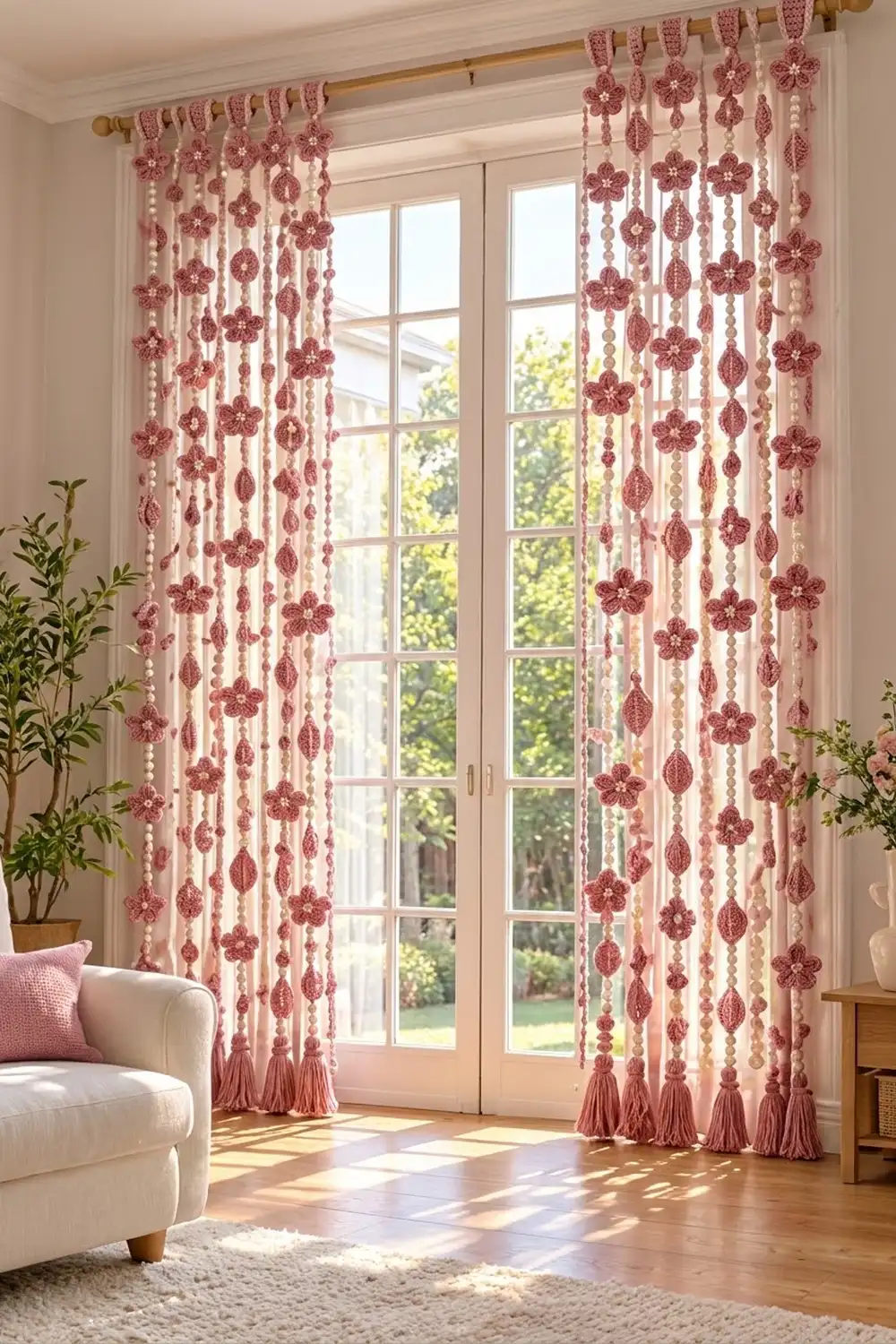
This romantic bead curtain is made of dusty rose crochet flowers and pointed leaves, strung with ivory pearls and finished with soft tassels. When light comes through, it reads as a lacy screen. Up close, every motif is outlined crisply and every flower has a small pearl center.
The design uses one yarn color, dusty rose, and ivory pearls in three sizes. The style is cottage-romantic and works across a window, a French door or a closet opening. The pattern uses US crochet terms throughout.
Each finished panel measures 42 in (106.7 cm) wide by 84 in (213.4 cm) long. The curtain shown has two matching panels, one on each side of the door.
Construction is simple and modular. You crochet small flowers and leaves, add pearl centers, and then thread the motifs and pearl runs onto beading cord to make vertical strands. Each strand gets a crocheted hanging loop at the top and a wrapped tassel at the bottom. There is no fabric to sew and no lining to add.
Finished Size and Construction
- Finished size (one panel): 42 in (106.7 cm) wide × 84 in (213.4 cm) long
- Skill level: Easy-intermediate
- Terminology: US crochet terms
- Yarn weight: DK (#3) cotton
- Hook: US 4.0 / E (3.5 mm)
- Number of pieces per panel: 126 flowers, 126 leaves, 14 hanging loops, 14 tassels
- Layout: 14 strands per panel, spaced 3 in (7.6 cm) apart, center to center
- Piece size: flower 2.75 in (7.0 cm); leaf 3.5 in (8.9 cm) long × 1.6 in (4.1 cm) wide
- Size before border: strand body 78.75 in (200.0 cm) long
- Border depth: 2 in (5.1 cm) top loop plus 3.25 in (8.3 cm) tassel
Materials
Yarn: Use a smooth, mercerized DK cotton or cotton blend. Cotton holds the petal shapes crisply and does not stretch much when it hangs. Avoid fuzzy acrylics, because they blur the outline rounds.
- Dusty rose: 1,150 g / approx. 2,760 m (about 23 balls of 50 g / 120 m) for two panels. One panel uses about 575 g / 1,380 m.
Pearls (two panels, ivory, with holes of at least 1 mm):
– 1,764 × 4 mm pearls (flower centers)
– 1,008 × 8 mm pearls
– 504 × 12 mm pearls
Tools:
– 3.5 mm (E) crochet hook
– Tapestry needle and a fine beading needle
– 1 mm nylon beading cord in clear or pink, 28 lengths of 100 in (254.0 cm)
– Strong thread in a matching color, for sewing on pearls
– Stitch markers
– A 3.5 in (8.9 cm) cardboard strip for the tassels
– Tape measure, scissors, blocking mats and pins
All yarn and pearl quantities include a margin of about 15%.
Abbreviations (US Terms)
- ch: chain
- sl st: slip stitch
- sc: single crochet
- hdc: half double crochet
- dc: double crochet
- tr: treble crochet
- st(s): stitch(es)
- sp: space
- RS / WS: right side / wrong side
Special technique: surface slip stitch. Hold the yarn behind the work. Insert the hook from the front through the fabric, pull up a loop, and draw it through the loop on the hook. Repeat to make a raised chain line on the surface.
Gauge and Checkpoints
Gauge: 18 sc and 20 rows = 4 in (10.2 cm) with a 3.5 mm hook. Exact gauge matters less than motif size, so test one flower and one leaf before you make any more.
Flower checkpoints:
– After Round 1: 0.75 in (1.9 cm) across
– After Round 2: 1.5 in (3.8 cm) across
– After Round 3: 2.4 in (6.1 cm) across
– After Round 4: 2.75 in (7.0 cm) across
Leaf checkpoints:
– After Round 1: 3.25 in (8.3 cm) × 1.4 in (3.6 cm)
– After Round 2: 3.5 in (8.9 cm) × 1.6 in (4.1 cm)
If your motifs are too big, go down a hook size. If they are too small, go up a hook size. A difference of 0.25 in (0.6 cm) per motif adds up to more than 4 in (10.2 cm) over a full strand, so fix it now.
Flower Motif (make 126 per panel)
Each flower has a flat circular center, five rounded petals and an outline edge. Join every round with a sl st to the first st. The ch 1 at the start of a round does not count as a stitch.
Round 1: Make a magic ring. Ch 1, then work 10 sc into the ring. Pull the ring closed and join. (10 sts)
Round 2: Ch 1, then work 2 sc in each st around. Join. (20 sts)
Round 3 (petals): Ch 1. Sc in next st, (hdc, 2 dc) in next st, (2 dc, hdc) in next st, sc in next st. Repeat from * 4 more times. Join. (40 sts: the 20 existing sts plus 20 added; 8 sts per petal)
Round 4 (outline): Sl st in sc, sc in hdc, 2 sc in each of next 4 dc, sc in hdc, sl st in sc. Repeat from * 4 more times. Join. (60 sts: the 40 existing sts plus 20 added; 12 per petal)
The two sl sts next to each other between petals pull in a clean notch, and the 2-sc increases round off each petal tip. Fasten off and weave in the ends.
Pearl center: Using the beading needle and matching thread, sew one 4 mm pearl to the middle of the flower. Sew six more in a ring over Round 1. (7 pearls per flower)
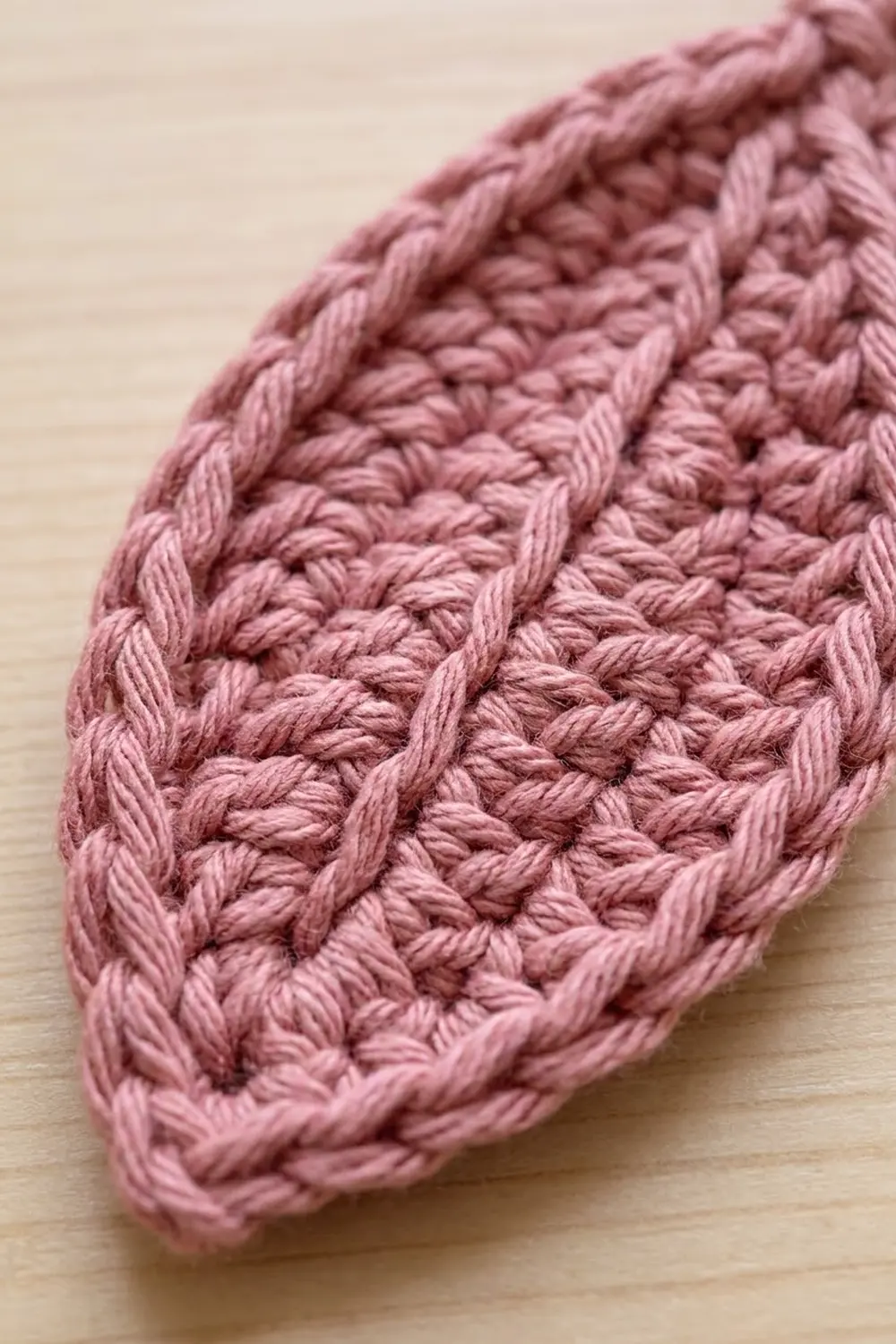
Leaf Motif (make 126 per panel)
The leaf is a pointed almond shape worked around both sides of a foundation chain.
Foundation: Ch 13.
Round 1: Work along the first side of the chain under one top loop only. Start with sc in 2nd ch from hook, then hdc in next ch, dc in next 2 ch, tr in next 4 ch, dc in next 2 ch and hdc in next ch. Work (sc, ch 2, sc) in the last ch to make the top tip. Rotate the leaf and work into the remaining free loops: hdc in next ch, dc in next 2 ch, tr in next 4 ch, dc in next 2 ch, hdc in next ch and sc in next ch. Ch 2 for the bottom tip and join to the first sc. (24 sts and 2 ch-2 tips; 11 sts on each side plus 2 tip sc)
Round 2 (outline): Ch 1. Sc in each st around. Work (sc, ch 2, sc) in each ch-2 tip. Join. (28 sts: the 24 existing sts plus 4 added at the tips, and 2 ch-2 tips)
Vein: With the RS facing, work 12 surface sl sts straight down the foundation line from tip to tip. This makes the raised center vein. Fasten off and weave in the ends.
Make All Pieces
Per panel, all in dusty rose:
– 126 flowers (about 252 g)
– 126 leaves (about 189 g)
– 14 hanging loops and 14 tassels (made in the Border section)
Pearl runs: Each run is 8 mm + 12 mm + 8 mm, about 1.25 in (3.2 cm) long once it is knotted. You need 252 runs per panel.
Layout grid (one panel, top to bottom). F = flower, L = leaf. Strands alternate A and B so that flowers sit beside leaves.
Strand:  A B A B A B A B A B A B A B
Rep 1:   F L F L F L F L F L F L F L
         L F L F L F L F L F L F L F
Rep 2:   F L F L F L F L F L F L F L
         L F L F L F L F L F L F L F
...continue to Rep 9...
Every strand has 9 flowers, 9 leaves and 18 pearl runs. That is 7 A strands and 7 B strands per panel.
Joining: Stringing the Strands
Method: Each strand is threaded onto one 100 in (254.0 cm) length of beading cord. Leave an 8 in (20.3 cm) tail at the top for the hanging loop.
Sequence, Strand A: Flower, then pearl run, then leaf, then pearl run. Repeat 9 times. Strand B follows the same sequence but starts with a leaf.
Flower path: Insert the needle through the 2 center sc at the tip of the top petal (sts 6–7 of that petal in Round 4). Run the cord on the WS under the Round 2 and Round 1 sts. Bring it out between the 2 sl sts in the bottom notch. The flower then hangs with one petal pointing up and a notch at the bottom.
Leaf path: Insert the needle through the top ch-2 tip. Run the cord on the WS under the foundation loops and bring it out through the bottom ch-2 tip.
Pearl runs: Tie an overhand knot snug against the bottom of the motif. Add the 8 mm, 12 mm and 8 mm pearls, then knot again under the last pearl.
Tension: Each motif should hang flat, with no puckering along the cord path and no slack loops of cord showing. If a motif cups, loosen the cord slightly under its stitches.
Size checkpoint: One repeat is 2.75 + 1.25 + 3.5 + 1.25 = 8.75 in (22.2 cm). Nine repeats give 78.75 in (200.0 cm). Measure after Repeat 1 and again after Repeat 5, which should be 43.75 in (111.1 cm). Leave an 8 in (20.3 cm) tail at the bottom for the tassel.
Border: Top Loops and Tassel Fringe
On this curtain, the “border” is the top edge of hanging loops and the bottom edge of tassels. Both use the same sc gauge as the motifs.
Hanging loop (14 per panel):
Foundation: Ch 24 and join with a sl st to the first ch to form a ring.
Round 1: Ch 1, then work 30 sc into the ring, enclosing the chain. Join. (30 sts, which crowd the chain enough to make a firm loop)
The finished loop is about 4.5 in (11.4 cm) around. That fits a rod up to 1.25 in (3.2 cm) in diameter, and the loop hangs 2 in (5.1 cm). Thread the strand’s top cord tail through 2 sc at the base of the loop. Tie a double knot against the first motif, then weave the tail back down through the first motif.
Tassel (14 per panel):
1. Wrap yarn 30 times around the 3.5 in (8.9 cm) card.
2. Slide a tie strand under the wraps at one edge and knot it tightly. Cut the wraps at the opposite edge.
3. Wrap the neck 6 times, 0.5 in (1.3 cm) below the top, and tie it off.
4. Trim the tassel to 3.25 in (8.3 cm).
5. Thread the bottom cord tail through the top of the tassel. Knot it under the last pearl run and bury the tail inside the tassel.
Counts per edge:
– Top edge: 14 strands × 1 loop = 14 loops, each in a 3 in (7.6 cm) lane.
– Bottom edge: 14 strands × 1 tassel = 14 tassels.
Why the math works:
– Width: 14 lanes × 3 in = 42 in (106.7 cm). Center the first loop 1.5 in (3.8 cm) from the panel edge.
– Length: 2 in loop + 78.75 in body + 3.25 in tassel = 84 in (213.4 cm).
Final Blocking
- Before assembly, wet-block the motifs in batches. Pin each flower to 2.75 in (7.0 cm), with the petals evenly spaced.
- Pin each leaf to 3.5 in × 1.6 in (8.9 cm × 4.1 cm), with both tips pointed.
- Let them dry completely, then sew on the pearls.
- After stringing, hang the panel on the rod and mist the motifs lightly.
- Let it hang for 24 hours so the motifs settle flat.
- Steam the tassels from a distance, comb the strands straight and trim them evenly.
Final Quality-Control Checklist
- Every flower measures 2.75 in (7.0 cm) and has 7 pearls.
- Every leaf measures 3.5 in (8.9 cm) and has a straight vein.
- Each strand has 9 flowers, 9 leaves and 18 pearl runs.
- Strands alternate A and B across the panel.
- Strand bodies all measure 78.75 in (200.0 cm).
- Loops are spaced 3 in (7.6 cm) apart, for a panel 42 in (106.7 cm) wide.
- Tassels are all 3.25 in (8.3 cm) and level across the bottom.
- All knots are tight and all tails are hidden.
Troubleshooting
- Petals ruffle: Your tension is loose in Round 3. Go down a hook size.
- Petal notches look shallow: Make sure both sl sts land in the sc sts of Round 3.
- Leaf curls: Work the foundation chain more loosely, or use a hook one size larger for the chain only.
- Pearls slide along the cord: Retie tighter knots, or add a second knot.
- Strands have different lengths: Measure each repeat as you string, and adjust the knot spacing around the pearl runs.
- Motifs twist when hanging: The cord is not centered in the motif. Re-thread it through the exact center stitches.
Care
Dust the curtain gently, or hand wash individual strands in cool water and hang them to dry. Do not tumble dry, and do not iron the pearls.
Final Notes
The measurement chain is short and reliable:
– The flower is 2.75 in (7.0 cm) and the leaf is 3.5 in (8.9 cm).
– Each pearl run is 1.25 in (3.2 cm), so one repeat is 8.75 in (22.2 cm).
– Nine repeats give a 78.75 in (200.0 cm) strand body.
– Adding the loop and tassel gives 84 in (213.4 cm).
– 14 strands at 3 in (7.6 cm) spacing give 42 in (106.7 cm) per panel.
If you check your first motifs carefully, every panel will hang evenly. Happy crocheting!