

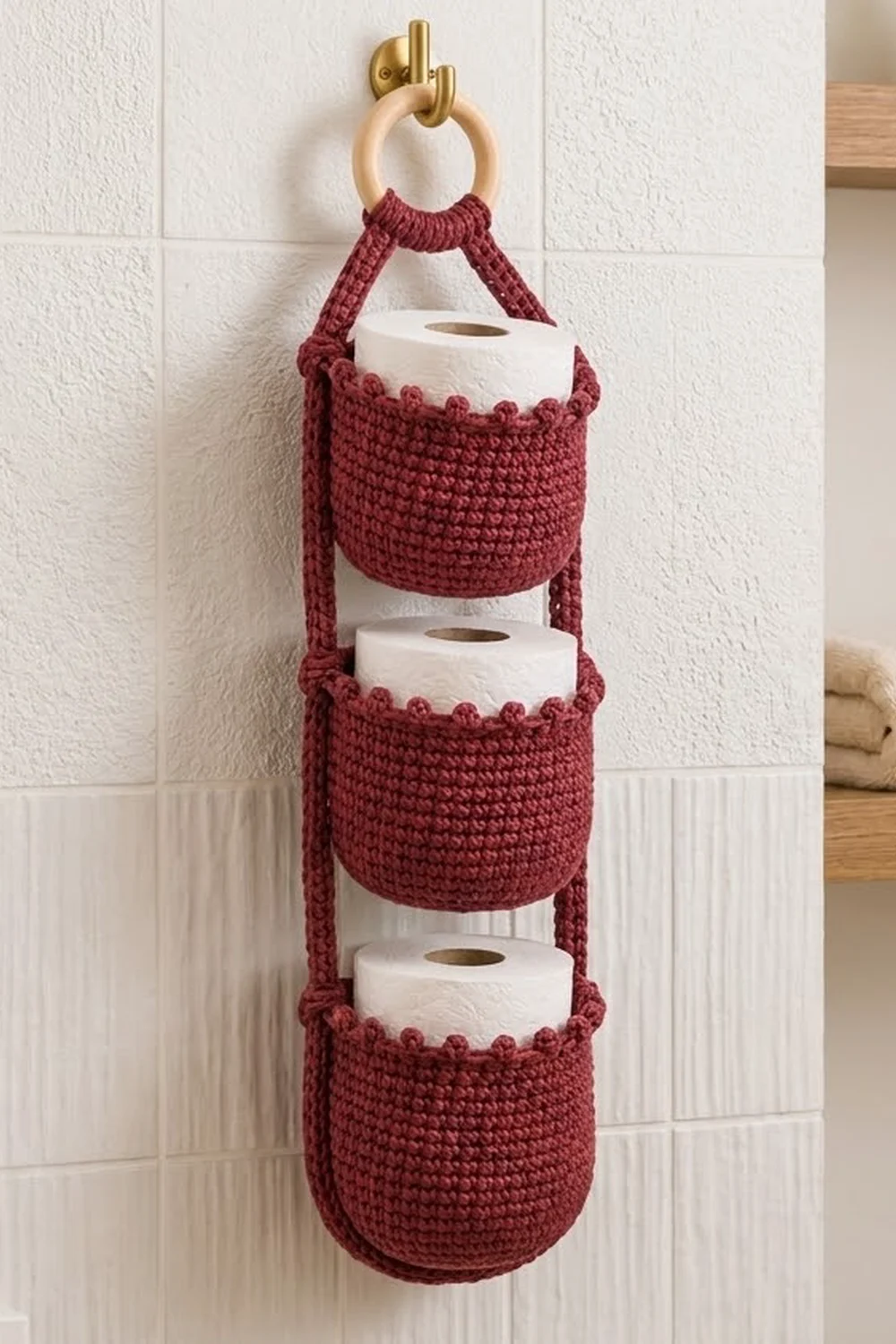
This hanging toilet paper holder keeps three spare rolls tidy and close at hand without taking up any floor or shelf space. Three round cup pockets hang one above the other on a single rope-textured strap, all gathered at the top on a natural wooden ring.
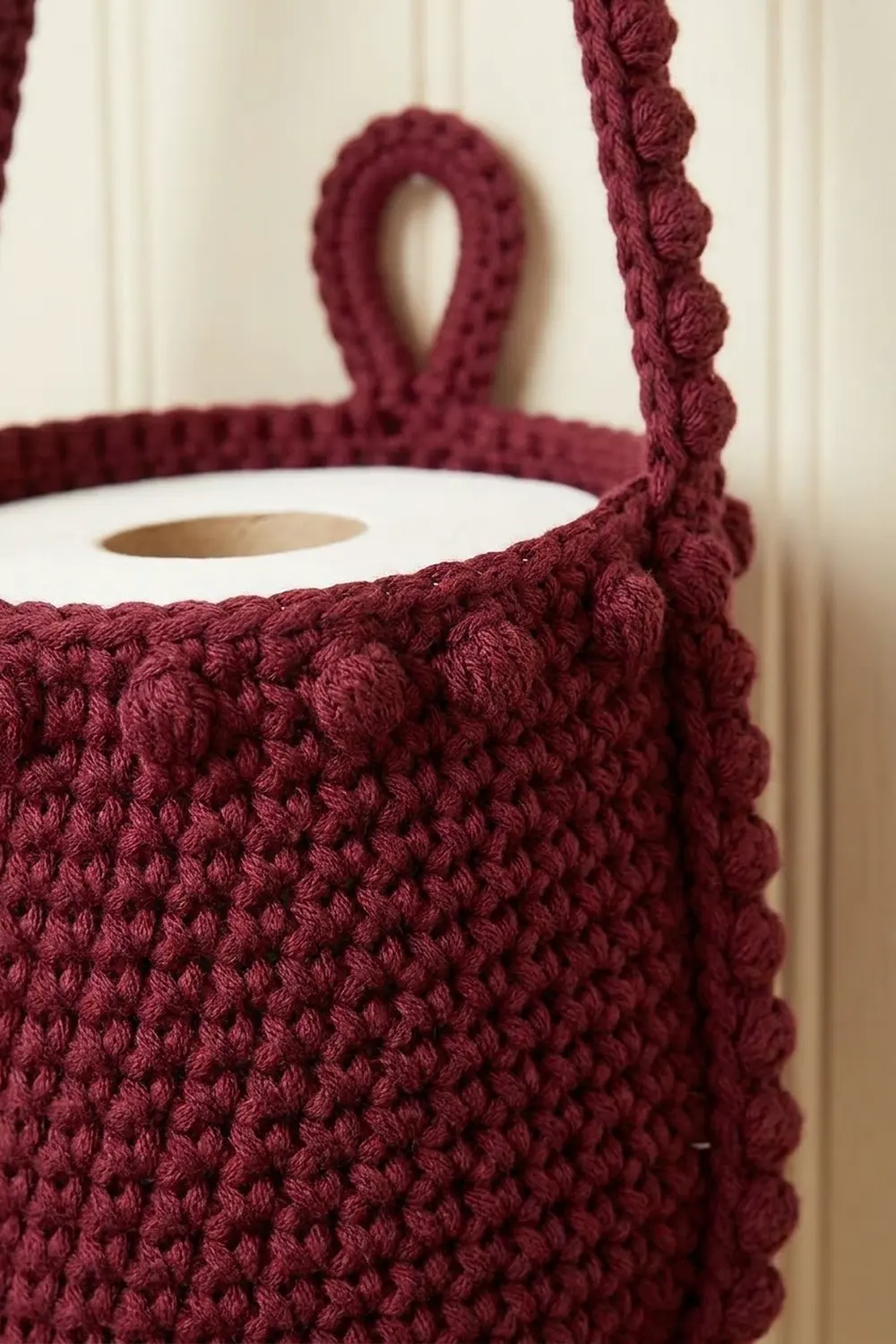
The sample is worked in one deep burgundy shade. Solid single crochet gives the pockets a firm, basket-like body, and a row of small bobbles along each rim adds a soft, beaded finish. The look is simple and a little boho, and it suits both modern and farmhouse bathrooms.
The pattern uses US crochet terms. The finished holder measures about 6.5 in (16.5 cm) wide and about 23 in (58.4 cm) long from the top of the ring to the bottom of the lowest pocket.
For construction, you make three identical pockets in joined rounds, starting from a flat circular base. Next you make one long, two-row strap. You sew the strap along the sides of all three pockets and under the bottom one, then wrap both ends over the ring. Finally, you work a crab stitch border along the free edges of the strap.
Finished Size and Construction
- Finished size: about 6.5 in (16.5 cm) wide x 23 in (58.4 cm) long, including the ring
- Skill level: Easy+ (confident beginner)
- Terminology: US crochet terms
- Yarn weight: Bulky (#5) cotton or cotton blend
- Hook: 5.0 mm (H-8)
- Number of pieces: 4 (3 pockets and 1 strap), plus 1 wooden ring
- Layout: 1 column of 3 pockets, stacked vertically
- Pocket size: base about 4.9 in (12.4 cm) across; wall about 3.2 in (8.1 cm) tall
- Strap size before border: 166 sts long, about 47.4 in (120.4 cm) x 0.5 in (1.3 cm)
- Border depth: about 1/8 in (0.3 cm) per edge, so the strap ends up about 5/8 in (1.6 cm) wide
Materials
Yarn: Use a smooth bulky cotton or cotton blend with good stitch definition. Cotton holds its shape well and handles bathroom humidity. Avoid very fuzzy or stretchy yarns, because the pockets will sag under the weight of the rolls.
- Burgundy: 250 g, about 330 m (361 yd)
The quantity includes a margin of roughly 20% for gauge swatching and differences in tension.
Tools:
- 5.0 mm (H-8) crochet hook
- 1 wooden macramé ring, 3 in (7.6 cm) outer diameter
- Tapestry needle
- 4 locking stitch markers
- Scissors
- Measuring tape
- 1 standard toilet paper roll, to test the fit
Abbreviations (US Terms)
- ch – chain
- sl st – slip stitch
- sc – single crochet
- dc – double crochet
- BLO – back loop only
- rev sc – reverse single crochet (crab stitch): work sc from left to right (right to left if you crochet left-handed)
- st(s) – stitch(es)
- rnd(s) – round(s)
- inc – 2 sc in the same st
Bobble: *Yarn over, insert hook in st, yarn over, pull up a loop, yarn over, pull through 2 loops; repeat from * 3 more times in the same st (5 loops on hook), yarn over, pull through all 5 loops. One bobble counts as 1 st.
Gauge and Checkpoints
Gauge: 14 sc and 15 rnds = 4 in (10.2 cm) in sc worked in joined rounds.
Before you make all four pieces, make one complete pocket and test it. This works better than a flat swatch, because the pocket is where size matters most.
Checkpoints:
- After Rnd 4 (24 sts): circle measures about 2.2 in (5.6 cm) across.
- After Rnd 9 (54 sts): base measures about 4.9 in (12.4 cm) across.
- After Rnd 21: wall measures about 3.2 in (8.1 cm) tall from the turning ridge to the top of the rim. A roll should slide in easily and stand about 0.8 in (2.0 cm) above the rim.
- Strap after Row 2: 166 sts measure about 47.4 in (120.4 cm).
If your pieces are too big: go down 0.5 mm in hook size. A loose pocket will feel floppy and the roll will lean.
If your pieces are too small: go up 0.5 mm in hook size. If the roll is a tight squeeze at Rnd 9, change the hook now rather than adding stitches, so the joining counts below stay correct.
Pocket (Make 3)
Work in joined rounds with the right side always facing you. Do not turn. The joining sl st and the ch 1 do not count as stitches. Make sure the round seam stays at the center back of the pocket.
Base
Rnd 1: Make a magic ring, ch 1, 6 sc in the ring, sl st to the first sc. (6 sts)
Rnd 2: Ch 1, inc in each st around, sl st to the first sc. (12 sts)
Rnd 3: Ch 1, sc 1, inc; repeat from * 6 times, sl st to join. (18 sts)
Rnd 4: Ch 1, sc 2, inc; repeat 6 times, join. (24 sts)
Rnd 5: Ch 1, sc 3, inc; repeat 6 times, join. (30 sts)
Rnd 6: Ch 1, sc 4, inc; repeat 6 times, join. (36 sts)
Rnd 7: Ch 1, sc 5, inc; repeat 6 times, join. (42 sts)
Rnd 8: Ch 1, sc 6, inc; repeat 6 times, join. (48 sts)
Rnd 9: Ch 1, sc 7, inc; repeat 6 times, join. (54 sts)
Check that the base lies flat and measures about 4.9 in (12.4 cm) across.
Wall
Rnd 10 (turning round): Ch 1, sc in the BLO of each st around, join. (54 sts)
The unworked front loops make a neat ridge where the base turns up into the wall.
Rnds 11–20: Ch 1, sc in each st around, join. (54 sts in each round)
That gives 10 plain rounds.
Rim
Rnd 21 (bobble rim): Ch 1, sc 2, bobble in next st; repeat from * 18 times, join to the first sc. (36 sc + 18 bobbles = 54 sts)
The bobbles sit on the top edge as round bumps about 0.9 in (2.3 cm) apart, matching the beaded rim in the photo. Fasten off and weave in the ends.
Mark the side lines: Lay the pocket flat with the round seam at the center back. Count from the first stitch of Rnd 21. Put a marker in st 14 (left side) and in st 41 (right side). There are 27 sts between them on each half. These two stitch columns run straight down the wall and are where the strap gets sewn on.
Strap (Make 1)
Row 1: Ch 167, sc in the 2nd ch from the hook and in each ch across. (166 sts)
Row 2: Ch 1, turn, sc in each st across. (166 sts)
Fasten off and leave a 12 in (30.5 cm) tail.
The foundation chain edge is the inner edge (Edge B). It gets sewn to the pockets. The top of Row 2 is the outer edge (Edge A).
Strap stitch map (count along Edge B from one end):
- Sts 1–6: ring wrap, 1.7 in (4.3 cm)
- Sts 7–24: left top triangle, 18 sts, 5.1 in (13.0 cm)
- Sts 25–36: top pocket, left side, 12 sts
- Sts 37–43: gap, 7 sts, 2.0 in (5.1 cm)
- Sts 44–55: middle pocket, left side, 12 sts
- Sts 56–62: gap, 7 sts
- Sts 63–74: bottom pocket, left side, 12 sts
- Sts 75–92: under the bottom pocket base, 18 sts
- Sts 93–104: bottom pocket, right side, 12 sts
- Sts 105–111: gap, 7 sts
- Sts 112–123: middle pocket, right side, 12 sts
- Sts 124–130: gap, 7 sts
- Sts 131–142: top pocket, right side, 12 sts
- Sts 143–160: right top triangle, 18 sts
- Sts 161–166: ring wrap, 6 sts
Each side adds up to 74 sts (6 + 18 + 12 + 7 + 12 + 7 + 12). Then 74 + 18 + 74 = 166.
Make All Pieces
- Burgundy: 3 pockets and 1 strap
Layout (front view):
        ( RING )
         /    \
        /      \
      |  POCKET 1 |
      |           |
      |  POCKET 2 |
      |           |
      |  POCKET 3 |
       \_________/
The strap forms the outer U shape and the triangle at the top. The pockets sit inside the U with their back halves facing the wall.
Joining
Method: Whipstitch with the tail or a fresh length of burgundy. Work with the right side facing and pass the needle through one loop of the foundation chain on Edge B and through one stitch of the pocket’s marked side column.
Stitch-to-stitch logic:
- Place marker-matched pins at strap sts 25, 44, 63, 93, 112, and 131. Lay the strap on a table in a U shape with Edge B on the inside, and check that it isn’t twisted.
- Top pocket: Sew strap sts 25–36 to the left side column (st 14 line), one strap st per wall round, working down from Rnd 21 to Rnd 10. That is 12 sts to 12 rounds. Sew sts 131–142 to the right side column (st 41 line) the same way.
- Middle pocket: Sew sts 44–55 to the left side and sts 112–123 to the right side.
- Bottom pocket: Sew sts 63–74 to the left side and sts 93–104 to the right side.
- Base: Sew sts 75–92 across the bottom pocket’s base along the straight line from the left side column, through the magic ring, to the right side column. Each half of that line crosses 9 base rounds, so 9 + 9 = 18 rounds match 18 strap sts.
- Leave the gap sts (37–43, 56–62, 105–111, 124–130) and the triangle sts (7–24, 143–160) free.
Tension advice: The 12 strap sts measure about 3.4 in (8.6 cm), and the 12 wall rounds measure about 3.2 in (8.1 cm). Ease the strap in a little as you go so it doesn’t ripple. Pull each whipstitch snug, but not tight enough to pucker the wall.
Ring: Fold strap sts 1–6 over the lower part of the ring toward the back and whipstitch them to sts 7–12. Repeat with sts 161–166. The two ends should sit side by side at the bottom of the ring.
Join the yarn at the ring next to the strap ends. Work 20 sc over the ring, covering the folded ends and stitching through the strap where it touches the ring. Fasten off.
Size checkpoint: Hang the holder. The top pocket rim should be about 4.5 in (11.4 cm) below the ring. The gaps between pockets should measure about 2.0 in (5.1 cm), and the total length should be about 23 in (58.4 cm).
Border
Border gauge: 1 rev sc per strap st. Crab stitch takes up about the same length as sc, so the strap length doesn’t change.
Border, outer edge (Edge A): Join the yarn in strap st 7, right next to the ring cover. Ch 1, rev sc in each st from st 7 to st 160. Fasten off. (154 rev sc: 68 on the left side, 18 under the base, 68 on the right side)
Border, inner edge (Edge B), free sections only:
- Left triangle, sts 7–24: 18 rev sc
- Left gaps, sts 37–43 and 56–62: 7 rev sc each
- Right gaps, sts 105–111 and 124–130: 7 rev sc each
- Right triangle, sts 143–160: 18 rev sc
That is 32 rev sc per side, 64 in total. Fasten off each section and weave in the ends.
Total border: 154 + 64 = 218 rev sc.
Why the math works: The strap has 166 sts. The 12 ring-wrap sts are hidden under the ring cover, so the outer edge gets 166 – 12 = 154. On the inner edge, only the free sections get a border, because the sewn sections are hidden against the pockets. There are no corners. Every border stitch goes into exactly one strap stitch, so the strap keeps the length and fit you checked during joining.
Final Blocking
- Fill each pocket with a toilet paper roll.
- Lightly mist the pockets and strap with water until damp, but not soaked.
- Lay the holder flat on a towel and straighten the strap into an even U shape.
- Shape each pocket into a round cup around its roll. Pinch the bobbles upward so they sit on top of the rim.
- Pin the triangle sections so the top pocket hangs centered under the ring.
- Let it dry completely with the rolls in place, then remove them.
Final Quality-Control Checklist
- Each pocket has 54 sts at the rim with 18 evenly spaced bobbles.
- All three pockets are the same height, about 3.2 in (8.1 cm).
- The round seams sit at the center back, against the wall.
- The strap isn’t twisted anywhere along the U.
- Each pocket side has 12 strap sts sewn on, and the base has 18.
- The gaps measure about 2.0 in (5.1 cm) and are all equal.
- Both strap ends are hidden under the 20 sc ring cover.
- The outer border has 154 rev sc, and the inner border has 64.
- All ends are woven in securely.
Troubleshooting
The base cups up instead of lying flat: Your tension is tight on the increase rounds. Go up 0.5 mm in hook size for Rnds 1–9 only.
The base ruffles: Check your counts, since you may have extra increases. Each base round adds exactly 6 sts.
The roll doesn’t fit: The base is too small. Change hook size; don’t add increase rounds, or the strap base count will no longer match.
The bobbles lean inward: Push them outward and up while blocking, and make sure you close each bobble firmly.
The pockets tilt forward: The side seams are too loose or are off the st 14/st 41 lines. Re-sew them along the marked columns.
The strap ripples next to a pocket: Ease the 12 strap sts more evenly across the 12 wall rounds.
The holder hangs crooked: The two triangle sections aren’t even. Recount sts 7–24 and 143–160.
Care
Hand wash in cool water with mild soap, gently press out the water, and dry flat with rolls inside the pockets to keep their shape. Don’t tumble dry.
Final Notes
The measurement chain is short and exact: 14 sc to 4 in (10.2 cm) gives a 54-st base of 4.9 in (12.4 cm), which fits one roll. Twelve wall rounds give a 3.2 in (8.1 cm) pocket. The strap is 166 sts: 6 + 18 + 12 + 7 + 12 + 7 + 12 on each side, plus 18 under the base. The border adds one rev sc per free strap stitch. If your first pocket passes the checkpoints, the rest of the project will fit together the same way.
Happy crocheting!