

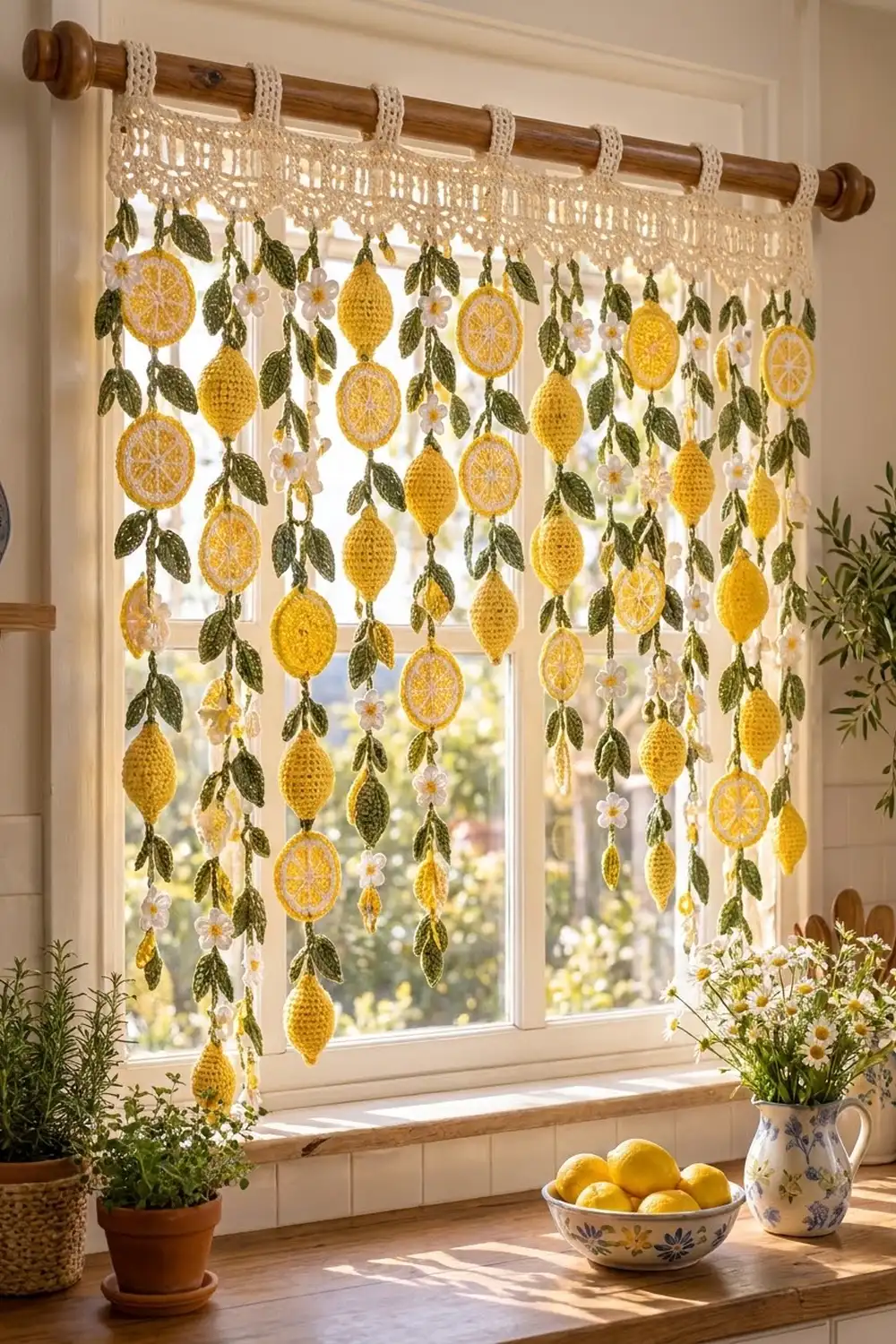
This curtain brings an Italian kitchen feel to a sunny window. A cream lace header band hangs from a rod, and twelve olive-green stems drop down from its scalloped edge. Each stem carries lemon slices, plump stuffed lemons, leaf pairs and little white flowers.
The palette is simple: lemon yellow, white, olive green and cream. The slices have white spokes and a white pith ring, and the whole lemons are textured single crochet. The lace header ties everything together with a soft cottage look.
The pattern uses US crochet terms. The finished curtain measures about 36 in (91.4 cm) wide and 39.25 in (99.7 cm) long, not counting the rod tabs.
You make the small motifs first, then assemble twelve strands on chain-cord stems. The header band is worked top-down in filet mesh. Its scallop row joins each strand as you go, and a final border adds the rod tabs.
Finished Size and Construction
- Finished size: 36 in (91.4 cm) wide x 39.25 in (99.7 cm) long
- Skill level: Intermediate
- Terminology: US
- Yarn weight: DK (light, #3) cotton
- Hooks: 3.5 mm (E-4) for most pieces; 3.0 mm (C/D) for the lemons
- Number of pieces: 1 header band and 12 strands (made from 36 slices, 36 lemons, 144 leaves, 72 flowers and 12 cords)
- Layout: 12 strands across, 3 in (7.6 cm) apart
- Strand length: 35 in (88.9 cm)
- Header depth before border: 4 in (10.2 cm) to the scallop points
- Border depth: 0.25 in (0.6 cm), plus tabs
Materials
Choose a smooth DK cotton, either mercerized or matte. Cotton holds the slice shape, keeps the stitches crisp and doesn’t stretch much under the weight of the strands. The meters below assume about 2.2 m per gram.
- Lemon yellow: 350 g (770 m)
- Olive green: 275 g (605 m)
- Cream: 150 g (330 m)
- White: 100 g (220 m)
These amounts include about 15 percent extra for gauge swatches and differences in tension.
Tools:
– 3.5 mm (E-4) and 3.0 mm (C/D) hooks
– Polyester fiberfill, about 60 g
– Tapestry needle
– Locking stitch markers
– Tape measure and scissors
– Blocking mats, rust-proof pins and a spray bottle
Abbreviations (US Terms)
- ch – chain
- sl st – slip stitch
- sc – single crochet
- hdc – half double crochet
- dc – double crochet
- inc – 2 sc in the same stitch
- dec – sc 2 together
- MR – magic ring
- sk – skip
- sp – space
- st(s) – stitch(es)
- RS / WS – right side / wrong side
Special stitches:
– Surface slip stitch: Hold the working yarn behind the piece. Insert the hook from front to back, pull up a loop and draw it through the loop on the hook. Repeat to “draw” a line on the surface.
– Filet space (Sp): ch 2, sk 2, dc in next st.
– Filet block (Bl): dc in next 3 sts. When working over a space, work 2 dc in the ch-2 sp and 1 dc in the next dc.
Gauge and Checkpoints
Test one of each piece before making the full set.
- Filet gauge (3.5 mm): 20 sts and 8 rows of dc = 4 in (10.2 cm). That’s 5 sts and 2 rows per inch.
- Sc gauge (3.5 mm): 20 sc and 22 rows = 4 in (10.2 cm).
- Cord gauge: 10 ch = 2 in (5.1 cm) after slip stitching back along the chain.
Checkpoints:
– Lemon slice after Round 3: 2 in (5.1 cm) across. Finished: 2.75 in (7.0 cm).
– Lemon: 2.75 in (7.0 cm) tall x 1.75 in (4.4 cm) wide.
– Leaf: 2 in (5.1 cm) long x 1 in (2.5 cm) wide.
– Flower: 1.25 in (3.2 cm) across.
If your pieces are too big, go down a hook size. If they are too small, go up a hook size. Fix the slice first, because the strand spacing depends on its width.
Lemon Slice (make 36)
Use the 3.5 mm hook.
Round 1 (white): MR, ch 1, 8 sc in ring, sl st to first sc. (8 sc) Fasten off.
Round 2 (yellow): Join yellow in any sc. Ch 3 (counts as dc), dc in same st, 2 dc in each remaining sc, sl st to top of ch-3. (16 dc)
Round 3: Ch 3 (counts as dc), 2 dc in next st, *dc in next st, 2 dc in next st; repeat from * 6 more times, sl st to top of ch-3. (24 dc) Fasten off.
Round 4 (white): Join white in any st. Ch 1, *sc in next 2 sts, 2 sc in next st; repeat from * 7 more times, sl st to first sc. (32 sc) Fasten off.
Round 5 (yellow): Join yellow. Ch 1, *sc in next 3 sts, 2 sc in next st; repeat from * 7 more times, sl st to first sc. (40 sc) Fasten off, leaving a 12 in (30.5 cm) tail.
Spokes: With white, surface slip stitch 8 straight lines from the center out to Round 4. Place one line above each increase of Round 3. Work 2 surface sl sts per round, for 4 per spoke. This divides the yellow into 8 even wedges.
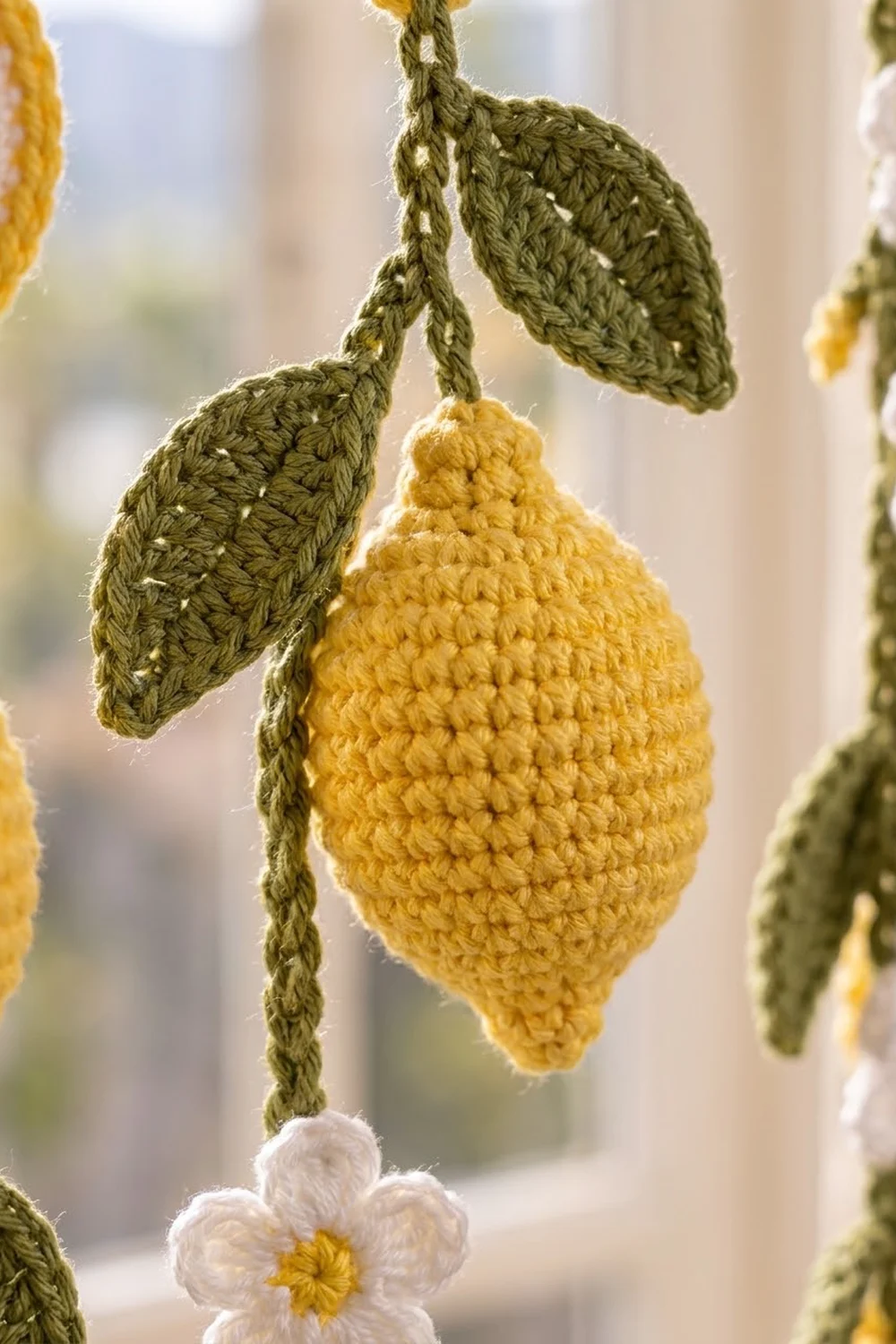
Lemon (make 36)
Use the 3.0 mm hook and yellow. Work in a continuous spiral and mark the first st of each round.
Round 1: MR, 4 sc in ring. (4)
Round 2: (sc, inc) 2 times. (6)
Round 3: (sc, inc) 3 times. (9)
Round 4: (sc 2, inc) 3 times. (12)
Round 5: (sc, inc) 6 times. (18)
Round 6: (sc 2, inc) 6 times. (24)
Rounds 7–10: Sc in each st. (24)
Round 11: (sc 2, dec) 6 times. (18)
Round 12: (sc, dec) 6 times. (12) Stuff firmly.
Round 13: (sc 2, dec) 3 times. (9)
Round 14: (sc, dec) 3 times. (6) Add more stuffing if needed.
Round 15: (sc, dec) 2 times. (4)
Fasten off, close the opening and leave a 10 in (25.4 cm) tail. The narrow 4-stitch ends form the pointed tips.
Leaf (make 144)
Use the 3.5 mm hook and green.
Ch 10. Starting in the 2nd ch from the hook, work: sl st, sc, hdc, dc in next 3 ch, hdc, sc. In the last ch, work (sc, ch 2, sc) for the tip. Turn the piece and work along the other side of the chain: sc, hdc, dc in next 3 ch, hdc, sc, sl st in the last ch. (18 sts plus the ch-2 tip)
The foundation chain stays raised as the center vein. Leave a 6 in (15.2 cm) tail at the base.
Flower (make 72)
Round 1 (yellow): MR, ch 1, 5 sc in ring, sl st to first sc. (5 sc) Fasten off.
Round 2 (white): Join white in any sc. *(Ch 2, 2 dc, ch 2, sl st) in same sc, sl st in next sc; repeat from * 4 more times. (5 petals) Leave a 6 in (15.2 cm) tail.
Stem Cord (make 12)
Use green and the 3.5 mm hook. Ch 8 and sl st in the first ch to form the top ring. Ch 175, turn, and sl st in the back bump of each ch up to the ring. (175 sl sts) The cord measures 35 in (88.9 cm).
Strand Assembly
Measure every position from the base of the top ring and mark it.
- A node is 2 leaves sewn by their bases on either side of the cord, with 1 flower sewn over the join.
- Sew each slice flat, with the cord running behind it.
- Sew each lemon to the cord through both tips.
Strand A, Repeat 1:
– Node at 2 in (5.1 cm)
– Slice from 3 in (7.6 cm) to 5.75 in (14.6 cm)
– Node at 7.75 in (19.7 cm)
– Lemon from 8.75 in (22.2 cm) to 11.5 in (29.2 cm)
For Repeat 2, add 11.5 in (29.2 cm) to every position. For Repeat 3, add 23 in (58.4 cm). The last lemon ends at 34.5 in (87.6 cm). Tuck the final 0.5 in (1.3 cm) of cord into its tip.
Strand B: Use the same positions, but swap the slices and lemons. This staggers them from strand to strand.
Make All Pieces
- Yellow: 36 slice centers and rims, 36 lemons, 72 flower centers
- White: 36 slice centers, pith rings and spokes, 72 sets of flower petals
- Green: 144 leaves, 12 cords
- Assembled: 6 of Strand A, 6 of Strand B
Layout (left to right, viewed from the RS):
Strand:  1  2  3  4  5  6  7  8  9  10 11 12
Type:    A  B  A  B  A  B  A  B  A  B  A  B
Top:     S  L  S  L  S  L  S  L  S  L  S  L
S = slice first, L = lemon first.
Header Band
Use cream and the 3.5 mm hook. The band is worked top-down.
Row 1: Ch 183, dc in the 4th ch from the hook and in each ch across. (181 dc; the 3 skipped ch count as the first dc) Check the width: 36 in (91.4 cm).
Row 2: Ch 5 (counts as dc + ch 2), turn, sk 2, dc in next st, *ch 2, sk 2, dc in next st; repeat from * across. (60 Sp; 181 sts counting each ch-2 as 2)
Row 3: Ch 3, turn. Work (Sp, Bl, Bl, Bl, Sp) 12 times. (24 Sp, 36 Bl; 181 sts)
Row 4: Ch 3, turn. Work (Sp, Sp, Bl, Sp, Sp) 12 times. (48 Sp, 12 Bl; 181 sts)
Row 5: Ch 5, turn. Work Sp across. (60 Sp; 181 sts)
Row 6: Ch 3 (counts as dc), turn, *2 dc in ch-2 sp, dc in next dc; repeat from * across. (181 dc) Check the depth: 3 in (7.6 cm).
Row 7: Ch 1, turn, sc in first dc, *ch 4, sk 4, sc in next st; repeat from * 35 more times. (37 sc and 36 ch-4 loops; 1 + 36 x 5 = 181)
Each 15-stitch section holds one 5-square motif and three ch-4 loops. Group the loops into 12 sets of 3, called Loops A, B and C.
Joining
The scallop row attaches the strands while it forms the edge, so the stitch counts and strand spacing stay in line.
Row 8 (joining row): Ch 1, turn. In each set of 3 loops, work:
- Loop A: 4 sc.
- Loop B: 3 dc, ch 1. Insert the hook from front to back through the top ring of the next strand and sl st. Ch 1, then work 3 dc in the same loop.
- Loop C: 4 sc.
Count: 12 x 14 = 168 sts plus 12 joined points. Fasten off.
Stitch logic: Strand 1 hangs from Loop B of set 1, Strand 2 from Loop B of set 2, and so on. Each strand hangs centered under one of the Row 4 triangles.
Tension: Keep each ring flat and untwisted, with the slices facing RS. Don’t pull the sl st tight, or the point will pucker.
Checkpoint: The strands sit 3 in (7.6 cm) apart. The first and last strands sit about 1.5 in (3.8 cm) from the edges. The header measures 4 in (10.2 cm) deep at the points.
Border
Border gauge: 5 sc per inch along every edge.
Border Row 1: With RS facing, join cream at the right edge just above Row 7. Work 15 sc up the side (5 sc over every 2 dc row ends). Ch 1 at the corner. Sc in each of the 181 foundation loops along the top edge. Ch 1 at the corner, then work 15 sc down the left side. (15 + 181 + 15 = 211 sc, plus 2 corner ch-1)
Tabs (make 12): Number the 181 top sc from right to left. Tab 1 starts at sc 6, and each tab after that starts 15 sc later: sc 6, 21, 36 and so on, up to sc 171. Join in the starting sc, ch 1, sc in the same st and the next 5. (6 sc) Work 21 more rows of 6 sc. (22 rows: 4 in / 10.2 cm long and 1.2 in / 3.0 cm wide) Fold each tab to the WS and whipstitch it to the back of Row 1.
Why the math works:
– 181 = 12 x 15 + 1. The filet motifs, scallop sets, strands and tabs all sit on the same 15-stitch grid, so each tab hangs directly above a strand.
– Each side has 15 sc over 3 in (7.6 cm) at 5 sc per inch, so the sides lie flat.
– 5 sc are left free at each end (sc 1–5 and 177–181), so both ends match.
Final Blocking
- Weave in all remaining ends.
- Pin the header RS up to 36 in x 4 in (91.4 cm x 10.2 cm), with a pin at each scallop point.
- Mist it until damp and let it dry fully.
- Mist the slices, leaves and flowers and let them dry flat. Don’t block the lemons.
- Hang the curtain for 24 hours so the strands straighten under their own weight.
Final Quality-Control Checklist
- The header is 36 in (91.4 cm) wide, and Row 1 has 181 sts.
- There are 12 triangles, 12 scallop points and 12 tabs, all lined up.
- Every slice has 40 sts in Round 5 and 8 even spokes.
- The strands are 35 in (88.9 cm) long and alternate A and B.
- The lemons are firmly stuffed, with neat tips.
- All seams are hidden on the WS.
Troubleshooting
- Slice cups: Round 3 is too tight. Go up 0.5 mm.
- Slice ruffles: Go down 0.5 mm, or work Round 5 with the 3.0 mm hook.
- Header narrower than 36 in (91.4 cm): Remake it with a looser foundation chain or a larger hook.
- Strands twist: Re-sew the slices so the cord runs straight behind them, then hang the curtain to block.
- Points pucker: Loosen the joining sl st.
- Tabs too tight on the rod: Add 2 rows to each tab.
Care
Hand wash in cool water with mild soap, roll in a towel and dry flat. Then hang the curtain so the strands return to full length.
Final Notes
The measurements build on each other. The 2.75 in (7.0 cm) slice sets the 3 in (7.6 cm) strand spacing. Twelve 15-stitch repeats at 5 sts per inch make the 36 in (91.4 cm) header. The 35 in (88.9 cm) strands plus the 4.25 in (10.8 cm) bordered header give the 39.25 in (99.7 cm) length. Check each measurement as you go, and the curtain will hang straight and even.
Happy crocheting!