

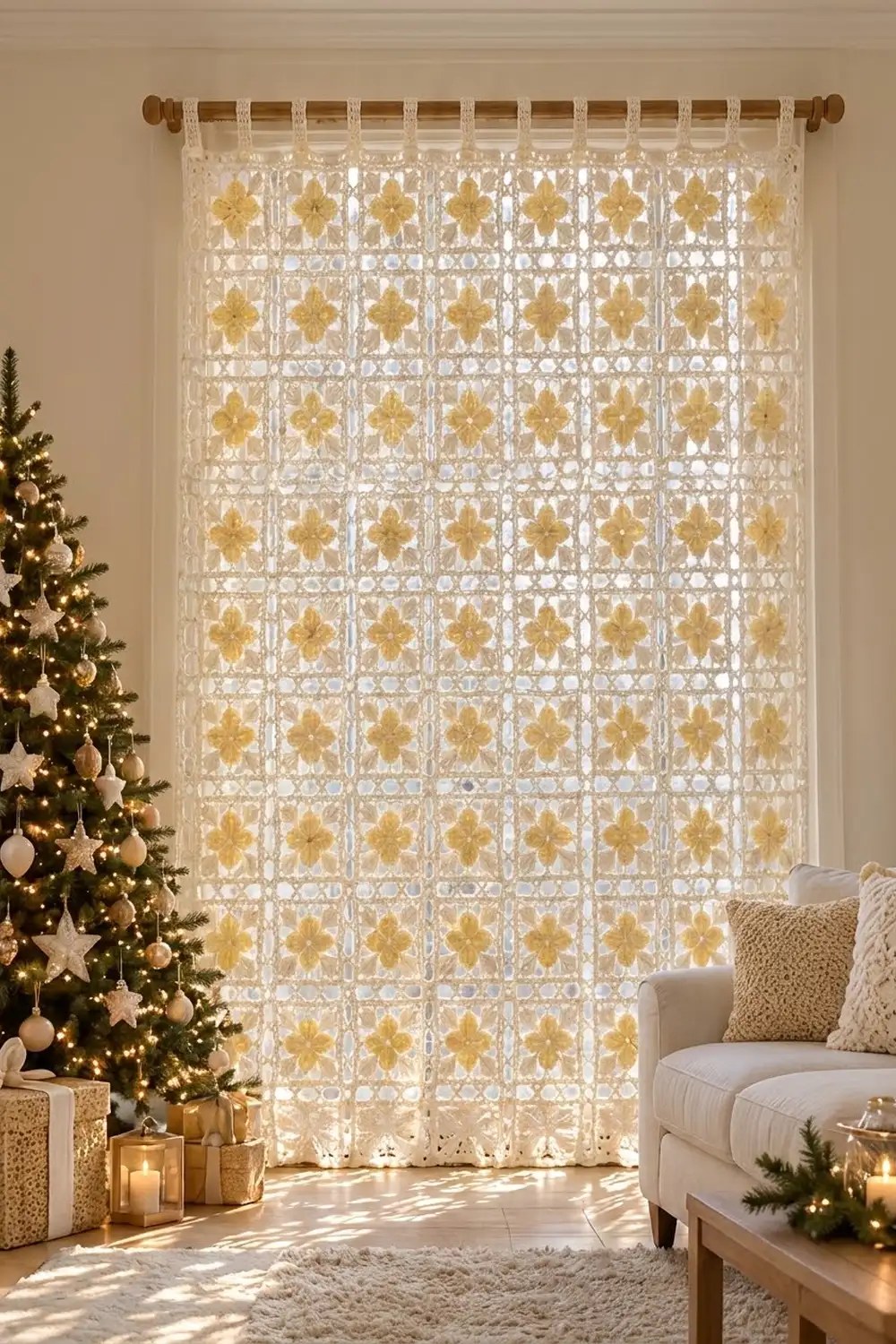
This curtain is a soft wall of lace. Each cream square has an open, airy layout, and a plump butter-yellow flower sits in the middle. When light comes through the window, the mesh glows and the flowers seem to float.
Only two colors are used. Cream is for the lace squares, border, and hanging tabs, and pale butter yellow is for the flowers. The look is calm and vintage, so the curtain works in any season.
The pattern uses US crochet terms. Without the tabs, the finished curtain measures 50 x 62 in (127.0 x 157.5 cm). It is made of 80 lace squares, each 6 in (15.2 cm), joined 8 across and 10 down. A 3-round border and 9 hanging tabs finish it.
Here’s how it goes together. You crochet each square in the round, make a separate 4-petal flower, and sew it to the center. Then you join the squares stitch-to-stitch, add the border, and sew on the tabs.
Finished Size and Construction
- Finished size: 50 x 62 in (127.0 x 157.5 cm), not counting the tabs
- Skill level: Intermediate
- Terminology: US crochet terms
- Yarn weight: DK (#3) cotton or cotton blend
- Hook: 4.0 mm (G-6)
- Number of pieces: 80 lace squares, 80 flowers, 9 tabs
- Layout: 8 squares wide x 10 squares tall
- Piece size: 6 x 6 in (15.2 x 15.2 cm)
- Size before border: 48 x 60 in (121.9 x 152.4 cm)
- Border depth: 1 in (2.5 cm) on every side
Materials
Choose a smooth mercerized or combed DK cotton. Cotton holds lace shapes, blocks crisply, and stands up to sunlight better than acrylic. Avoid fuzzy yarns, because they blur the open spaces.
- Cream (main color): 850 g, about 2,040 m (2,230 yd)
- Butter yellow (flowers): 200 g, about 480 m (525 yd)
These amounts assume a DK cotton of about 120 m per 50 g. They include a margin of about 10% for swatching, joining, and weaving in ends.
Tools:
- 4.0 mm (G-6) crochet hook
- Tapestry needle
- Locking stitch markers
- Rust-proof pins and blocking mats or a large towel
- Spray bottle
- Measuring tape
Abbreviations (US Terms)
- ch: chain
- sl st: slip stitch
- sc: single crochet
- hdc: half double crochet
- dc: double crochet
- tr: treble crochet
- sk: skip
- sp: space
- st(s): stitch(es)
- WS: wrong side
Special stitches:
- 3-dc cluster (cl): [Yarn over, insert hook in st, pull up a loop, yarn over, pull through 2 loops] 3 times in the same st. Yarn over and pull through all 4 loops.
- Beginning cluster (beg cl): Ch 2, then work a 2-dc cluster in the same st.
- 3-tr cluster (tr-cl): [Yarn over twice, insert hook, pull up a loop, (yarn over, pull through 2 loops) twice] 3 times in the same sp. Yarn over and pull through all 4 loops.
- Leaf: (sc, hdc, 2 dc, ch 2, 2 dc, hdc, sc) in the same sp.
Gauge and Checkpoints
Before anything else, make one complete square and one flower. Block the square, let it dry, and measure it. It should be 6 x 6 in (15.2 x 15.2 cm), with 23 sc per side counting both corner stitches.
Checkpoints for one square:
- After Round 3: about 3.5 in (8.9 cm) across, tip to tip
- After Round 5: about 5 in (12.7 cm) square
- After Round 6: about 5.6 in (14.2 cm) square
- After Round 7: 6 in (15.2 cm) square, blocked
The flower should measure about 2.75 in (7.0 cm) from petal tip to petal tip.
If your square is too big, use a hook 0.5 mm smaller. If it is too small, use one 0.5 mm larger. Small errors add up over 80 squares. A square just 0.25 in (0.6 cm) too large makes the curtain 2 in (5.1 cm) wider and 2.5 in (6.4 cm) longer.
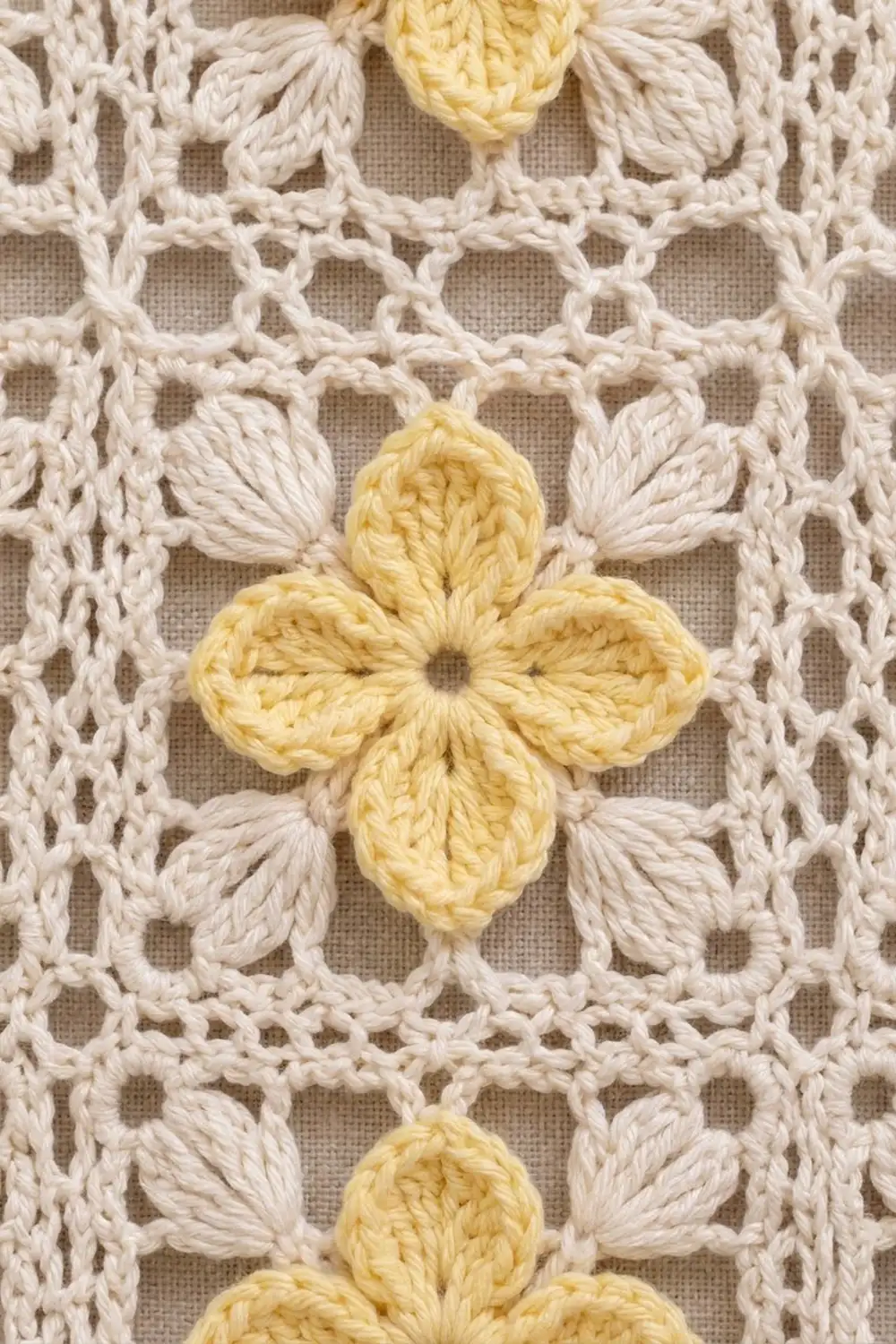
Lace Square (Make 80)
Use cream. Work in the round with the right side facing, and don’t turn.
Round 1: Make a magic ring. Ch 3 (counts as dc), then work 15 dc in the ring. Sl st to the top of the ch-3. Pull the ring closed but leave a small center hole. (16 dc)
Round 2: Work a beg cl in the same st, ch 4, sk next st, cl in next st, ch 4, sk next st 7 times. Sl st to the top of the beg cl. (8 clusters, 8 ch-4 sps)
Round 3: Sl st into the first ch-4 sp, ch 1, and work a leaf in the same sp. Work a leaf in each remaining ch-4 sp. Sl st to the first sc. (8 leaves: 64 sts and 8 ch-2 tip sps)
The leaves form an eight-pointed flower. Four will point to the side centers and four to the corners.
Round 4: Sl st in the next hdc and 2 dc, then sl st into the ch-2 tip sp. Ch 1, sc in the same sp, ch 6, (tr-cl, ch 5, tr-cl) in the next tip sp, ch 6. Sc in the next tip sp, ch 6, (tr-cl, ch 5, tr-cl) in the next tip sp, ch 6 3 times. Sl st to the first sc. (4 sc, 8 tr-cl, 8 ch-6 sps, 4 ch-5 corner sps)
The tr-cl pairs make the leafy corner fans. The ch-6 loops make the open windows along each side.
Round 5: Ch 3 (counts as dc), 6 dc in the next ch-6 sp, dc in the top of the next tr-cl, (2 dc, ch 2, 2 dc) in the corner ch-5 sp, dc in the next tr-cl, 6 dc in the next ch-6 sp. Dc in the next sc, 6 dc in the next ch-6 sp, dc in the next tr-cl, (2 dc, ch 2, 2 dc) in the corner sp, dc in the next tr-cl, 6 dc in the next ch-6 sp 3 times. Sl st to the top of the ch-3. (76 dc: 19 per side between corner ch-2 sps, plus 4 corner ch-2 sps)
Each side has 15 dc worked into the stitches and spaces below (1 tr-cl + 6 + 1 sc + 6 + 1 tr-cl). Add 2 corner dc at each end: 15 + 2 + 2 = 19.
Round 6: Sl st in each dc to the next corner ch-2 sp, then sl st into that sp. Ch 5 (counts as dc and ch 2) and dc in the same sp. [Ch 1, sk 1 dc, dc in next dc] 9 times, ch 1, sk 1 dc, (dc, ch 2, dc) in the corner sp 3 times. [Ch 1, sk 1 dc, dc in next dc] 9 times, ch 1, sk 1 dc. Sl st to the 3rd ch of the ch-5. (44 dc and 40 ch-1 sps. Each side has 21 sts: 11 dc, including both corner dc, and 10 ch-1 sps. Plus 4 corner ch-2 sps.)
This mesh round makes the open grid frame between the squares.
Round 7: Ch 1. Along each side, work 1 sc in each dc and 1 sc in each ch-1 sp. Work 1 sc in each corner ch-2 sp. Sl st to the first sc and fasten off. (88 sc)
Each side has 23 sc counting both corners (21 + 2). To check: 4 sides x 22 (each corner counted once) = 88. Mark each corner sc with a stitch marker.
Flower (Make 80)
Use butter yellow.
Round 1: Make a magic ring. Ch 1, then work 8 sc in the ring. Sl st to the first sc. Leave a small center hole. (8 sc)
Round 2: Ch 1, sc in next st, ch 3, sk next st 4 times. Sl st to the first sc. (4 sc, 4 ch-3 sps)
Round 3: Sl st into the first ch-3 sp. In each ch-3 sp, work (sc, hdc, 2 dc, tr, ch 1, tr, 2 dc, hdc, sc). Sl st to the first sc. Fasten off and leave a 12 in (30.5 cm) tail. (4 petals of 10 sts each = 40 sts, plus 4 ch-1 tips)
Attach: Center the flower over the square’s ring, with the petals pointing at the four side leaves. Use the tail to sew through each Round 2 sc and each petal base. Keep the stitches small and hidden on the WS. Leave the petal tips free so they stay raised.
Make All Pieces
- Cream lace squares: 80
- Yellow flowers: 80, one sewn on each square
- Cream tabs: 9 (made after the border)
All the squares are identical. Each “S” in the grid below is one square with a flower.
ROW 1:  S S S S S S S S
ROW 2:  S S S S S S S S
ROW 3:  S S S S S S S S
ROW 4:  S S S S S S S S
ROW 5:  S S S S S S S S
ROW 6:  S S S S S S S S
ROW 7:  S S S S S S S S
ROW 8:  S S S S S S S S
ROW 9:  S S S S S S S S
ROW 10: S S S S S S S S
Block every square to 6 x 6 in (15.2 x 15.2 cm) before joining.
Joining
Method: Slip stitch join through the back loops, worked from the WS in cream.
Hold two squares right sides together. Start at a marked corner sc. Sl st through the back loops of both squares in every st across: 23 sl sts, corner to corner, one stitch to one stitch. Don’t add any extra stitches at the seam.
Order:
- Join the 8 squares of Row 1 into a strip. Chain 1 across each gap to move to the next pair without fastening off.
- Make 10 strips the same way.
- Join the strips along their long edges, matching every seam and corner.
Tension: Join loosely. The seam should stretch as much as the squares do. If it puckers, go up one hook size for joining only.
Size checkpoint: The joined panel should measure 48 x 60 in (121.9 x 152.4 cm), which is 8 x 6 in across by 10 x 6 in down.
Border
Border gauge: Work at the same tension as Round 7, so 23 sc covers 6 in (15.2 cm).
Starting counts: The top and bottom each have 8 squares x 23 sc = 184 sts. The left and right sides each have 10 squares x 23 sc = 230 sts. These counts already include each square’s own corner sc. At each seam, work one sc into each of the two joined corner sts.
Round 1: With the right side facing, join cream in the top-left corner sc. Ch 1 and work (sc, ch 2, sc) in the same st. Sc in each st across the top, then work (sc, ch 2, sc) in the top-right corner st. Repeat around the other sides and sl st to the first sc.
Count: Each of the 4 outer corner sts becomes 2 sc. That gives 182 + 2 = 184 sc on the top and bottom and 228 + 2 = 230 sc on each side, counted between corner ch-2 sps. Total: 828 sc and 4 corner ch-2 sps.
Round 2: Sl st into the corner ch-2 sp. Ch 5 (counts as dc and ch 2) and dc in the same sp. [Ch 1, sk 1 sc, dc in next sc] across to the next corner, (dc, ch 2, dc) in the corner sp around. Sl st to the 3rd ch of the ch-5.
Count: The top and bottom each get 92 repeats: 92 dc and 92 ch-1 sps, plus 2 corner dc = 186 sts. Each side gets 115 repeats: 115 dc and 115 ch-1 sps, plus 2 corner dc = 232 sts.
Round 3: Sl st into the corner sp and ch 1. Work (sc, ch 3, sc, ch 3, sc) in each corner sp and (sc, ch 3, sc) in each ch-1 sp. Sl st to the first sc and fasten off. (92 picot groups on the top and bottom, 115 on each side, plus 4 corner groups)
Why the math works: Round 2 is a 2-stitch repeat. Both 184 and 230 are even, so every side ends exactly at a corner. Because 23 is odd, each edge needs an even number of squares, and that is why the layout is 8 x 10.
The three rounds add about 0.25 in (0.6 cm), 0.5 in (1.3 cm), and 0.25 in (0.6 cm), for a 1 in (2.5 cm) border. The curtain grows from 48 x 60 in (121.9 x 152.4 cm) to 50 x 62 in (127.0 x 157.5 cm).
Hanging Tabs (Make 9)
With cream, ch 9.
Row 1: Sc in the 2nd ch from the hook and in each ch across. Turn. (8 sc)
Rows 2–20: Ch 1, sc in each st across. Turn. (8 sc)
Fasten off and leave a long tail. Each tab is about 2 in (5.1 cm) wide and 5 in (12.7 cm) long.
Fold each tab in half to make a 2.5 in (6.4 cm) loop. Sew both ends to the WS of the top border. Place one tab at each top corner and one over each of the 7 vertical seams, so they sit 6 in (15.2 cm) apart, center to center.
Final Blocking
- Weave in all ends along the seams.
- Lay the curtain flat, right side up, on mats or towels.
- Spray it evenly until damp but not dripping.
- Pin the outer corners to 50 x 62 in (127.0 x 157.5 cm).
- Pin along each seam so it runs straight.
- Pin out the border picots and open up the mesh spaces.
- Lift the flower petals gently with your fingers.
- Let it dry completely, for at least 24 hours.
Final Quality-Control Checklist
- Every square measures 6 in (15.2 cm) with 23 sc per side.
- All 80 flowers are centered, with petals pointing to the side centers.
- The seams are straight and don’t pucker.
- The panel measured 48 x 60 in (121.9 x 152.4 cm) before the border.
- The border has 92 repeats on the top and bottom and 115 on each side.
- The finished curtain measures 50 x 62 in (127.0 x 157.5 cm).
- All nine tabs are evenly spaced and secure.
- No yarn ends show on the right side.
Troubleshooting
The Round 3 leaves ruffle. The ch-4 spaces are too tight. Chain more loosely, or chain 5 instead. The stitch counts stay the same.
The square isn’t square. In Round 4, check that the tr-cl pairs sit in the corner leaf tips and the sc sits in the side leaf tips.
Round 6 comes out uneven. Recount Round 5. You need exactly 19 dc between corners.
The border ripples. Redo Round 1 with a hook 0.5 mm smaller.
The border pulls in. Use a hook 0.5 mm larger for Rounds 1 and 2.
Care
Hand wash in cool water with mild detergent, then roll the curtain in a towel to press out the water. Dry flat, reshaping it to 50 x 62 in (127.0 x 157.5 cm).
Final Notes
Here’s the full measurement chain. One square is 6 in (15.2 cm), with 23 sc per side. Eight squares across and ten down make a 48 x 60 in (121.9 x 152.4 cm) panel, with 184 and 230 border stitches. The 1 in (2.5 cm) border brings the curtain to 50 x 62 in (127.0 x 157.5 cm).
Check your first square carefully and block as you go. If the first square is right, the rest of the curtain will be too.
Happy crocheting!