

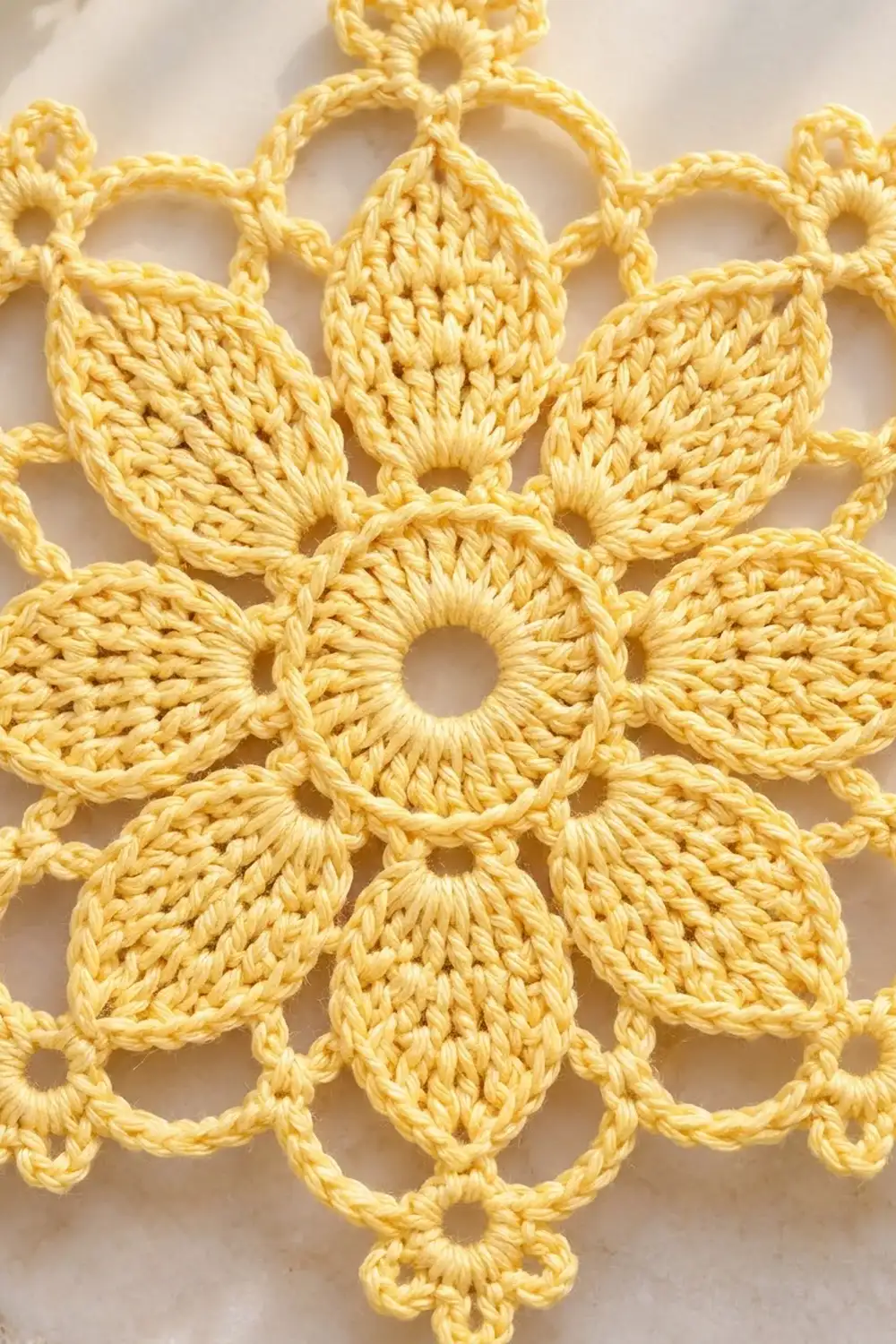
The Buttercup Sunburst is a small lace doily worked in one soft butter-yellow cotton. It starts with a solid round center around a small open eye. Eight pointed, leaf-shaped petals radiate from that center. A lacy edge of chain arches, with a ring-and-picot trefoil at each petal tip, frames the flower.
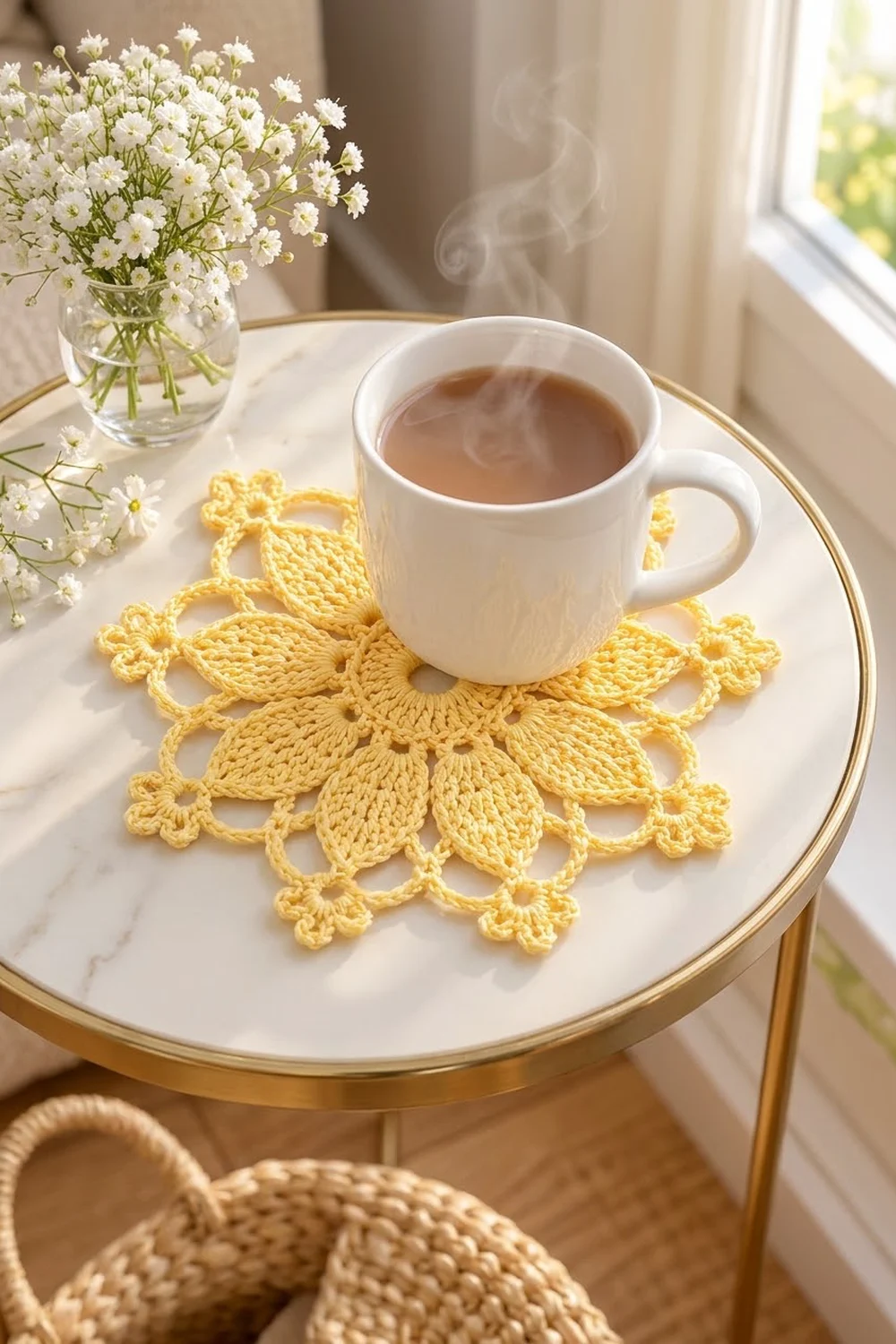
The look is light, fresh, and a little vintage. You can use it as a coaster, a dresser doily, a sachet topper, or a spring table accent, and it lies flat with a clean eight-point outline. The petal stitches line up in tidy ridges that run out from the center, so each petal clearly reads as a leaf. The open arches between the tips let the surface underneath show through.
This pattern uses US crochet terms. After blocking, the finished motif measures about 6.5 in (16.5 cm) across, from one trefoil tip to the opposite trefoil tip.
The doily is made as one single piece in eight joined rounds. Rounds 1–2 build the solid center. Rounds 3–6 shape all eight petals at the same time, with one single crochet “spoke” between each pair of petals. Rounds 7–8 form the border: first chain arches from tip to tip, then a single crochet cover with a trefoil picot cluster at each petal point. You use only one color and fasten off only once, at the very end.
Finished Size and Construction
- Finished size: 6.5 in (16.5 cm) across, trefoil tip to trefoil tip
- Skill level: Easy-intermediate
- Terminology: US crochet terms
- Yarn weight: Sport weight (#2) mercerized cotton
- Hook: 3.0 mm (US C/2 or D/3)
- Number of pieces: 1 single motif, no joining
- Layout: Round flower with 8 petals and 8 trefoil points
- Center size (after Round 2): 2 in (5.1 cm) across
- Size before border (after Round 6): 5 in (12.7 cm) across the petal tips
- Border depth: 0.75 in (1.9 cm) on every side
Materials
Yarn: Choose a smooth, mercerized cotton in sport weight. Mercerized cotton shows each stitch clearly and holds the petal points and picots well after blocking. Avoid fuzzy or very splitty yarns, because the small rings and picots will lose their shape. A pale, warm yellow shows the petal ridges best, but any light solid color works.
- Butter yellow: 15 g, about 55 yd (50 m)
These amounts include extra for a gauge test and for weaving in ends. The motif itself uses about 11–12 g.
Tools:
- 3.0 mm crochet hook
- Tapestry needle
- Scissors
- Stitch marker
- Rustproof pins and a foam blocking mat
- Spray bottle with clean water
- Ruler or measuring tape
Abbreviations (US Terms)
- ch – chain
- sl st – slip stitch
- sc – single crochet
- hdc – half double crochet
- dc – double crochet
- tr – treble crochet
- sp(s) – space(s)
- st(s) – stitch(es)
- sk – skip
- rep – repeat
Special stitch – Trefoil: Ch 5, then sl st in the 5th ch from the hook to make a small ring. (Ch 4, sl st in the ring) 3 times. This gives one base ring with three small picot loops fanning out from it, like a tiny three-leaf flower. The Trefoil does not count as a stitch in the round.
Beginning ch 3 counts as the first dc in Rounds 1–2. In all other rounds, the beginning ch 1 does not count as a stitch.
Gauge and Checkpoints
Work Rounds 1–2 as your gauge test. Pressed lightly flat, they should measure 2 in (5.1 cm) across. A chain of 10 should measure about 2 in (5.1 cm). If both numbers match, the rest of the doily will follow the checkpoints below.
At each stage, lay the piece flat without stretching it and measure:
- After Round 2: 2 in (5.1 cm)
- After Round 4: 3 in (7.6 cm)
- After Round 5: 3.75 in (9.5 cm)
- After Round 6: 5 in (12.7 cm), petal tip to petal tip
- After Round 7: 5.5 in (14.0 cm), across the arches
- After Round 8 (blocked): 6.5 in (16.5 cm), trefoil tip to trefoil tip
If your center is too big by more than 1/4 in (0.6 cm), go down a hook size to 2.75 mm. If it is too small, go up to 3.25 mm. Check the length of your 10-chain too. Loose chains make floppy arches, and tight chains make the border cup.
Before blocking, the piece often measures a little smaller than the checkpoints. That is normal, and blocking will open the lace to full size. If you are more than 1/4 in (0.6 cm) off at Round 4, change hooks and start again. Small errors at the center grow with every round.
Center
Round 1: Ch 6, then sl st in the first ch to make a ring. Ch 3 (counts as dc), 15 dc in the ring. Join with a sl st to the top of the beginning ch-3. (16 dc)
The ring leaves an open eye about 3/8 in (1.0 cm) wide in the middle. You can pull the starting tail gently to close it a little, but keep the hole visible.
Round 2: Ch 3 (counts as dc), dc in the same st, then 2 dc in each st around. Join to the top of the beginning ch-3. (32 dc)
Checkpoint: 2 in (5.1 cm) across. The center should be flat and solid. Put a stitch marker in the join so you can find it easily in Round 3.
Petals
The petals are worked in rounds. Each petal grows from its own group of stitches, and one sc between petals keeps them apart.
Round 3: Ch 1, sc in the same st as the join. Ch 3, sk 3 sts. Sc in the next st, ch 3, sk 3 sts; rep from * 6 more times. Join to the first sc. (8 sc, 8 ch-3 sps)*
This round divides the 32 stitches into 8 groups of 4, one group per petal: 8 × 4 = 32. Each group is 1 sc plus 3 skipped stitches bridged by a ch-3.
Round 4: Ch 1, sc in the same sc as the join. 5 dc in the next ch-3 sp. Sc in the next sc, 5 dc in the next ch-3 sp; rep from * 6 more times. Join to the first sc. (8 sc + 40 dc = 48 sts)*
Each petal now has a narrow base of 5 dc. Checkpoint: 3 in (7.6 cm).
Round 5: Ch 1, sc in the same sc as the join. Dc in the next dc, 2 dc in each of the next 3 dc, dc in the next dc. Sc in the next sc, dc in the next dc, 2 dc in each of the next 3 dc, dc in the next dc; rep from * 6 more times. Join to the first sc. (8 sc + 64 dc = 72 sts)*
Each petal now has 8 dc (1 + 6 + 1). This is the widest part of the leaf. Checkpoint: 3.75 in (9.5 cm).
Round 6: Ch 1, sc in the same sc as the join. Hdc in the next dc, dc in the next dc, tr in each of the next 2 dc, ch 2, tr in each of the next 2 dc, dc in the next dc, hdc in the next dc, sc in the next sc; rep from * 7 more times, ending the last rep at . Join to the first sc. (8 sc + 16 hdc + 16 dc + 32 tr = 72 sts, plus 8 ch-2 tip sps)*
Each petal has 2 hdc + 2 dc + 4 tr = 8 sts, plus the ch-2 point. 8 petals × 8 sts = 64, plus 8 sc = 72 sts. The stitches climb from hdc up to tr and back down, so each petal narrows to a sharp point at the ch-2 space. The posts of the dc and tr stitches all point outward and form the ridged, leaf-vein texture. The short sc spokes leave a small gap between neighboring petals near their bases.
Keep your tr stitches the same height on both sides of each ch-2. If one side is taller, the petal leans and the point drifts off center. Pull each loop up to full height before you yarn over.
Checkpoint: 5 in (12.7 cm) across opposite petal tips. Each petal is about 1.5 in (3.8 cm) long, from the edge of the center to its point. Do not fasten off.
Border
The border has two rounds. Border gauge: 12 sc cover one ch-10 arch, and one uncovered arch spans about 2 in (5.1 cm). For counting, treat each of the 8 “sides” of the doily as one arch, running from one petal tip to the next.
Round 7 (arch round): Sl st in the next hdc, the next dc, and both tr, then sl st in the ch-2 tip sp. Ch 1, sc in the same ch-2 sp. Ch 10. Sc in the next ch-2 tip sp, ch 10; rep from * 6 more times. Join to the first sc. (8 sc, 8 ch-10 arches)*
Each side has 1 sc at the tip + 10 ch = 11 sts. 8 sides × 11 = 88 sts in all (8 sc + 80 ch). The arches sit outside the petals and float over the gaps between them. Checkpoint: 5.5 in (14.0 cm) across the arches.
Round 8 (trim round): Ch 1. *(Sc, Trefoil, sc) in the next sc, 12 sc in the next ch-10 arch; rep from * 7 more times. Join to the first sc. Fasten off.
Each side has 2 sc in the tip sc + 12 sc in the arch = 14 sc, plus 1 Trefoil. Counted as a trim round: 8 sc worked one into each existing tip sc + 8 extra sc added at the tips + 96 sc worked into the arches = 112 sc, plus 8 Trefoils. Check: 8 sides × 14 sc = 112 sc.
When you work the Trefoil, keep the ch-5 ring snug, but chain the three ch-4 loops at an even, relaxed tension. Turn the work slightly so each picot fans out from the ring, then work the closing sc back into the same tip sc.
Why the math works: A 10-ch arch needs about 1.2 sc per chain to lie flat, so 12 sc fill it without ruffling or pulling tight. The 2 sc at each tip spread the base of the Trefoil, so the cluster points straight out from the petal tip. Every side has exactly the same count, so all 8 points stay even and the outline stays balanced. The Trefoil sticks out about 0.6 in (1.5 cm) past the arch, and the covered arch makes up the rest of the 0.75 in (1.9 cm) border depth. 5 in + (2 × 0.75 in) = 6.5 in (16.5 cm).
Final Blocking
- Weave in both ends along the back of the center and petal stitches. Leave 6 in (15.2 cm) tails while weaving, then trim close.
- Soak the doily in cool water for 10 minutes. Press the water out gently in a towel. Do not wring.
- Lay it face up on a blocking mat. Pin the center flat first, keeping the eye open and round.
- Pin each petal point outward so opposite tips sit 5 in (12.7 cm) apart. Pin in opposite pairs to keep the flower centered.
- Pin each Trefoil base ring outward so opposite trefoil tips measure 6.5 in (16.5 cm).
- Ease each arch into a smooth, even curve. Put a pin in each of the 3 picot loops of every Trefoil to open them.
- Mist with water if needed. Let it dry completely before you remove the pins.
Final Quality-Control Checklist
- The center has 32 dc and a visible open eye.
- There are 8 petals, each with 8 sts and a ch-2 point.
- Each petal ends in a clear point, not a rounded tip.
- There are 8 arches with 12 sc each, 112 sc in all.
- There are 8 Trefoils, each with a base ring and 3 picots.
- The finished doily measures 6.5 in (16.5 cm) across and lies flat.
- All ends are woven in and invisible from the front.
Troubleshooting
The center cups or ripples. Check that Round 2 has exactly 32 dc. Cupping means the hook is too small or your tension is tight. Ripples mean you have extra stitches.
The petals overlap or curl. Make sure each sc between petals goes into the sc of the round below, not into a dc. Blocking will flatten a slight curl.
The petal tips are rounded. Keep the ch-2 at each tip loose, and pin the point firmly while blocking.
One petal is wider than the others. Count Round 5 again. Each petal needs exactly 8 dc.
The border ruffles. Use 11 sc per arch instead of 12, or tighten your chains slightly. Your new total becomes 8 × 13 = 104 sc.
The border pulls the petals inward. Your chains are too tight. Go up a hook size for Round 7 only.
The Trefoils twist. Work all 3 picots into the same base ring, and pin each picot open when blocking.
The center eye has closed up. Loosen the starting tail before weaving it in, and pin the eye open with a pencil-sized object while it dries.
Care
Hand wash in cool water with mild soap, roll it in a towel, and dry it flat, pinning the points again if needed. A warm iron through a pressing cloth will freshen the shape.
Final Notes
The size of the whole doily depends on a short chain of measurements. A 2 in (5.1 cm) center supports eight 8-stitch petals that reach 5 in (12.7 cm) across. Eight ch-10 arches bring it to 5.5 in (14.0 cm), and the 12-sc covers with Trefoils finish it at 6.5 in (16.5 cm). Check each stage as you go, and the Buttercup Sunburst will block into a crisp, even eight-point flower. It makes a lovely small gift on its own or as a set of matching coasters.
Happy crocheting!