

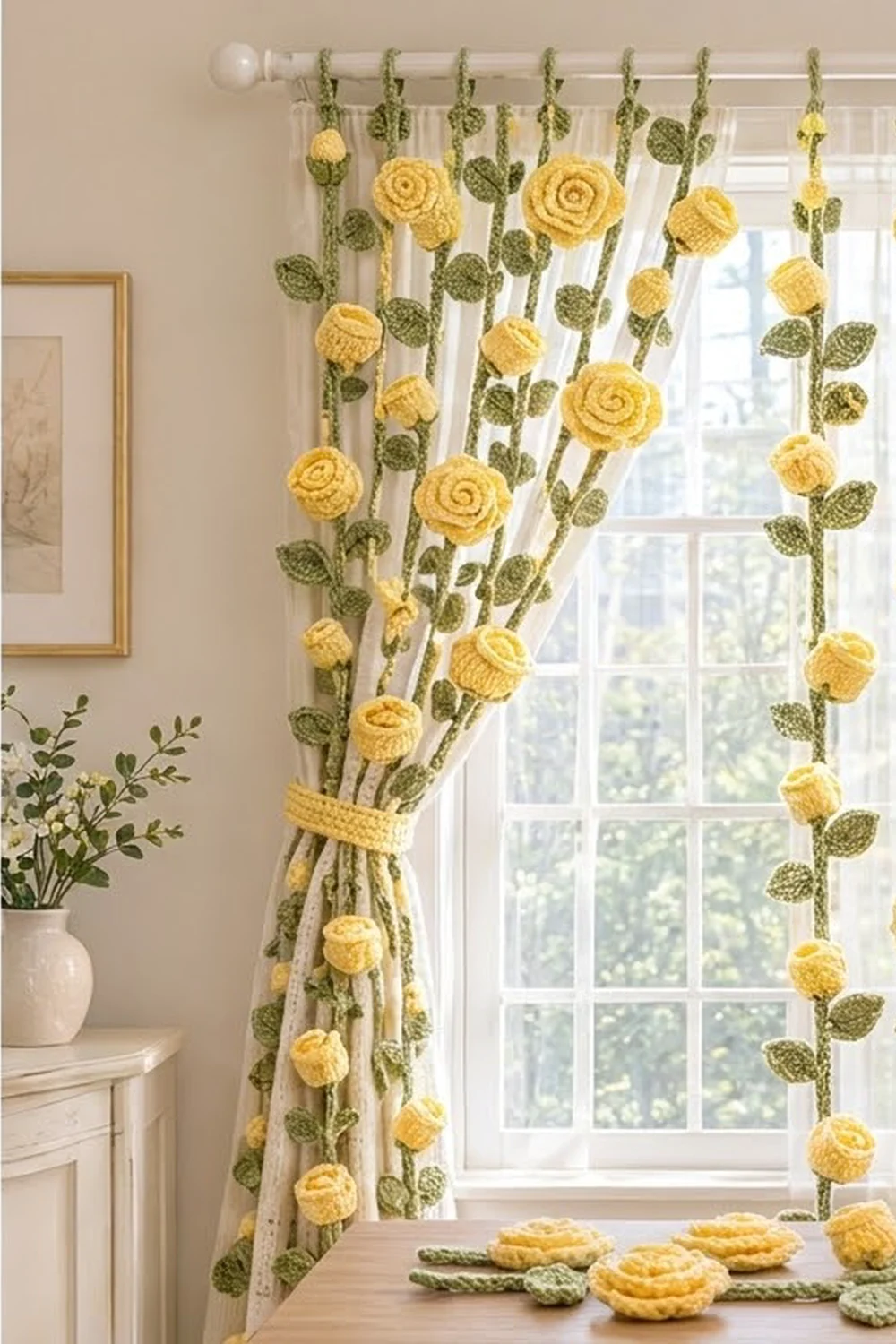
This curtain is a see-through column of rose vines. Twelve sage-green cords hang from a rod, and each one carries butter-yellow rolled roses, cupped rosebuds and pointed leaves. Light passes between the strands, so the window stays bright.
The palette uses just two colors: butter yellow for the flowers and tieback, and sage green for the cords and leaves. The style is cottage-vintage and suits a window, closet opening or doorway.
The pattern uses US crochet terms. The finished panel is 36 in (91.4 cm) wide. Each strand hangs 74.5 in (189.2 cm) from the rod. The matching tieback measures 20.5 in x 2.5 in (52.1 cm x 6.4 cm).
You make 12 cords with hanging loops, 48 roses, 48 buds and 144 leaves, then sew everything on at counted stitch positions. A bordered tieback finishes the set.
Finished Size and Construction
- Panel size: 36 in (91.4 cm) wide x 74.5 in (189.2 cm) long
- Skill level: Easy to intermediate
- Terminology: US crochet terms
- Yarn weight: Worsted (#4) cotton or cotton blend
- Hook: 4.0 mm (G-6)
- Number of pieces: 253 (12 cords, 48 roses, 48 buds, 144 leaves, 1 tieback)
- Layout: 12 strands spaced 3 in (7.6 cm) apart, with 8 flower positions on each strand
- Piece sizes: rose 3 in (7.6 cm) across; bud 1.5 in (3.8 cm) tall x 1 in (2.5 cm) wide; leaf 2 in (5.1 cm) x 1 in (2.5 cm)
- Size before border: cord 72 in (182.9 cm); tieback 20 in x 2 in (50.8 cm x 5.1 cm)
- Border depth: the hanging loop adds 2.5 in (6.4 cm) of drop; the tieback edging adds 0.25 in (0.6 cm) per side
Materials
Use a smooth worsted cotton. It holds the petals crisply and stretches less than acrylic under the weight of the flowers. The amounts below assume about 200 yd (183 m) per 100 g.
- Butter yellow: 560 g, about 1,120 yd (1,024.1 m), for roses, buds and tieback
- Sage green: 320 g, about 640 yd (585.2 m), for cords and leaves
Tools: 4.0 mm (G-6) hook, bent-tip tapestry needle, 10 locking stitch markers, tape measure, scissors, pins, blocking mat, spray bottle.
These quantities include a margin of about 15% for swatches, sewing tails and differences in tension.
Abbreviations (US Terms)
- ch – chain
- sl st – slip stitch
- sc – single crochet
- hdc – half double crochet
- dc – double crochet
- tr – treble crochet
- sk – skip
- sp – space
- st(s) – stitch(es)
- rep – repeat
V-st: (dc, ch 1, dc) in the same stitch.
Back-bump sc: work the sc into the bump on the back of the chain. This gives the cord a neat braided look on both faces.
Gauge and Checkpoints
Gauge: 16 sc and 16 rows = 4 in (10.2 cm).
Cord gauge: 4 back-bump sc = 1 in (2.5 cm), measured relaxed.
Make one of each piece first and check:
- A 40-st test cord measures 10 in (25.4 cm).
- Rose Row 1 measures 11.5 in (29.2 cm), and the rolled rose is 3 in (7.6 cm) across.
- The flat bud rectangle measures 3 in x 1.5 in (7.6 cm x 3.8 cm).
- A leaf is 2 in (5.1 cm) long.
Too big: go down 0.5 mm. Too small: go up 0.5 mm. Never change the stitch counts. Flower positions are counted in stitches, so the spacing stays even even if your gauge is slightly off.

Cord (Make 12, Green)
Ch 289.
Row 1: Sc in back bump of 2nd ch from hook and each ch across. (288 sc)
Checkpoint: 72 in (182.9 cm). Do not fasten off; the hanging loop is worked from this end (see Border).
The last sc you made is stitch 1, the top of the strand. Place markers at stitches 24, 60, 96, 132, 168, 204, 240 and 276. The markers are 36 stitches, or 9 in (22.9 cm), apart. The first sits 6 in (15.2 cm) below the top and the last sits 69 in (175.3 cm) down, which leaves 3 in (7.6 cm) of cord below it.
Rolled Rose (Make 48, Yellow)
Ch 38.
Row 1: V-st in 5th ch from hook, *sk 2 ch, V-st in next ch; rep from * across. Turn. (12 V-sts)
After the first V-st, 33 chains remain. That gives 11 repeats of 3 chains, so the last V-st lands in the first chain.
Checkpoint: 11.5 in (29.2 cm).
Row 2: Ch 2 (does not count). Work each petal into the ch-1 sp of a V-st. After each petal, sl st in the sp before the next V-st.
- Petals 1–4: 5 dc each (20 sts)
- Petals 5–8: 7 dc each (28 sts)
- Petals 9–12: (2 dc, 5 tr, 2 dc) each (36 sts)
After Petal 12, sl st in top of the beginning ch-4. (84 petal sts + 11 sl sts between petals + 1 closing sl st)
Fasten off and leave a 14 in (35.6 cm) tail.
Rolling: Starting at Petal 1, roll the first two turns tightly to make the spiral center. Then roll more loosely so the larger petals open in layers. Keep the Row 1 edge level as the base. Sew back and forth through all the layers of the base 4–5 times, and keep the tail for attaching.
Checkpoint: 3 in (7.6 cm) across, with three rings of scalloped petals.
Rosebud (Make 48, Yellow)
Ch 13.
Row 1: Sc in 2nd ch from hook and each ch across. Turn. (12 sc)
Rows 2–6: Ch 1, sc in each st. Turn. (12 sc)
Checkpoint: 3 in x 1.5 in (7.6 cm x 3.8 cm). Fasten off and leave a 12 in (30.5 cm) tail.
Rolling: Roll the rectangle from one short end. The 1.5 in (3.8 cm) height becomes the height of the bud, and the cup is about 1 in (2.5 cm) wide. Roll the last half turn loosely so the edge flares. Sew the bottom closed, then stitch the outer edge flat against the roll.
Leaf (Make 144, Green)
Ch 9.
First side: Sc in 2nd ch from hook, hdc in next ch, dc in next 3 ch, hdc in next ch, sc in next ch. (7 sts)
Tip: (sc, ch 2, sc) in last ch.
Second side: Work along the opposite side of the foundation chain: sc in next ch, hdc in next ch, dc in next 3 ch, hdc in next ch, sc in next ch. (7 sts)
Sl st in first sc. (16 sts + ch-2 tip)
Fasten off and leave a 10 in (25.4 cm) tail. The foundation chain forms the center vein.
Checkpoint: 2 in (5.1 cm) long, 1 in (2.5 cm) wide, with a pointed tip.
Make All Pieces
- Green: 12 cords, 144 leaves
- Yellow: 48 roses, 48 buds, 1 tieback
Each strand gets 4 roses, 4 buds and 12 leaves: a pair of leaves under each rose and one leaf under each bud. Odd-numbered strands start with a rose and even-numbered strands start with a bud, which staggers the flowers across the panel.
Layout grid (R = rose, B = bud; columns are strands, rows are marker positions):
Pos  st#   1  2  3  4  5  6  7  8  9 10 11 12
1     24   R  B  R  B  R  B  R  B  R  B  R  B
2     60   B  R  B  R  B  R  B  R  B  R  B  R
3     96   R  B  R  B  R  B  R  B  R  B  R  B
4    132   B  R  B  R  B  R  B  R  B  R  B  R
5    168   R  B  R  B  R  B  R  B  R  B  R  B
6    204   B  R  B  R  B  R  B  R  B  R  B  R
7    240   R  B  R  B  R  B  R  B  R  B  R  B
8    276   B  R  B  R  B  R  B  R  B  R  B  R
Joining
Whipstitch each piece to the front of its cord using that piece’s own tail.
Stitch-to-stitch logic:
- Rose: center the base over the marked stitch and sew through that stitch plus 1 above and 1 below. That covers 3 stitches, or 0.75 in (1.9 cm).
- Rose leaves: count 6 stitches below the marker, 1.5 in (3.8 cm). Sew one leaf to each side of that stitch, angled upward.
- Bud: sew the base to the marked stitch and the stitch below it, open top facing up.
- Bud leaf: count 4 stitches below the marker, 1 in (2.5 cm). Sew one leaf there, alternating left and right from bud to bud.
Tension: keep the whipstitches snug but not tight enough to bunch the cord. After each piece, check that the markers are still 36 stitches, or 9 in (22.9 cm), apart. Weave each tail 1 in (2.5 cm) through the cord in both directions.
Size checkpoint: a finished strand laid flat still measures 72 in (182.9 cm). Hanging, it may stretch to about 74 in (188.0 cm).
Border
Here the border has two parts: the hanging loop on each cord and the edging round on the tieback.
Border gauge: 4 sc = 1 in (2.5 cm).
Top Hanging Loop (each cord)
Continue from stitch 1.
Step 1: Ch 20, sl st in stitch 1 to form a loop. (20 ch)
Step 2: Ch 1, sc in each ch around. Sl st in first sc. (20 sc)
Fasten off.
Why the math works: 20 sc at 4 per inch equals the 5 in (12.7 cm) chain, so the loop neither ruffles nor tightens. It fits rods up to 1.25 in (3.2 cm) across, which have a circumference of about 3.9 in (9.9 cm). Folded over the rod, the loop adds 2.5 in (6.4 cm), for a total drop of 74.5 in (189.2 cm). Space the strands 3 in (7.6 cm) apart. Strands 1 and 12 then sit 33 in (83.8 cm) apart center to center, and the panel is 36 in (91.4 cm) wide.
Tieback (Make 1, Yellow)
Ch 81.
Row 1: Sc in 2nd ch from hook and each ch across. Turn. (80 sc)
Rows 2–8: Ch 1, sc in each st. Turn. (80 sc)
Checkpoint: 20 in x 2 in (50.8 cm x 5.1 cm).
Edging round: Ch 1. Sc in each st across Row 8 (80 sc), ch 1. Sc in each row end down the short side (8 sc), ch 1. Sc in each foundation ch (80 sc), ch 1. Sc in each row end up the other short side (8 sc), ch 1. Sl st in first sc. (176 sc + 4 corner ch-1 sps)
Per-side counts: 80 sc on each long side and 8 sc on each short side. The corners get a ch-1 only, with no extra sc.
Ties: Join yarn in the 4th sc of one short side. Ch 40, sl st in 2nd ch from hook and each ch back. (39 sl sts) Repeat on the other short side.
Why the math works: 80 sc at 4 per inch is 20 in (50.8 cm), and 8 rows at 4 per inch is 2 in (5.1 cm). Working one sc per stitch or row end adds 0.25 in (0.6 cm) per side without cupping. The finished band is 20.5 in x 2.5 in (52.1 cm x 6.4 cm).
Final Blocking
- Mist the roses, open the outer petals with your fingers and dry them face up.
- Pin each leaf flat at the tip and base, mist and let dry.
- Mist the buds and ease the flared edges outward.
- Pin the tieback to 20.5 in x 2.5 in (52.1 cm x 6.4 cm), mist and let it dry fully.
- Hang the strands, mist the cords lightly and let them settle for 24 hours.
- Never iron or steam the flowers.
Final Quality-Control Checklist
- 12 strands, each with 4 roses, 4 buds and 12 leaves
- Flowers at stitches 24, 60, 96, 132, 168, 204, 240 and 276
- Odd strands start with a rose, even strands with a bud
- Roses are 3 in (7.6 cm) across, with tight centers
- Leaf pairs sit 1.5 in (3.8 cm) below roses; single leaves sit 1 in (2.5 cm) below buds
- Every loop has 20 sc and slides freely on the rod
- Strands hang evenly at 74.5 in (189.2 cm)
- Tieback is 20.5 in x 2.5 in (52.1 cm x 6.4 cm) with two 10 in (25.4 cm) ties
- No tails visible on the front
Troubleshooting
Rose is floppy: roll the first two petals tighter and add more stitches through the base.
Rose is too big: if Row 1 is over 11.5 in (29.2 cm), go down a hook size.
Cord twists: work into the back bump, and block the strand hanging with a light weight at the bottom.
Strands hang unevenly: recount the 288 cord stitches and 20 loop stitches. Loose sewing can also stretch a strand.
Leaves curl: pin and mist. Check that the tip is exactly (sc, ch 2, sc).
Buds unroll: sew the outer edge down along its full height.
Care
Hand wash in cool water with mild soap, roll in a towel and dry flat, then reshape the roses. Dust now and then with a soft brush.
Final Notes
The measurement chain: 4 sc per inch gives a 288-sc cord of 72 in (182.9 cm). The 20-sc loop adds 2.5 in (6.4 cm), for a 74.5 in (189.2 cm) drop. Flowers sit 36 stitches, or 9 in (22.9 cm), apart. Twelve strands at 3 in (7.6 cm) spacing make a 36 in (91.4 cm) panel. The 80-sc tieback edges out to 20.5 in x 2.5 in (52.1 cm x 6.4 cm). Check your gauge once and count carefully, and every rose lands where it belongs.
Happy crocheting!