

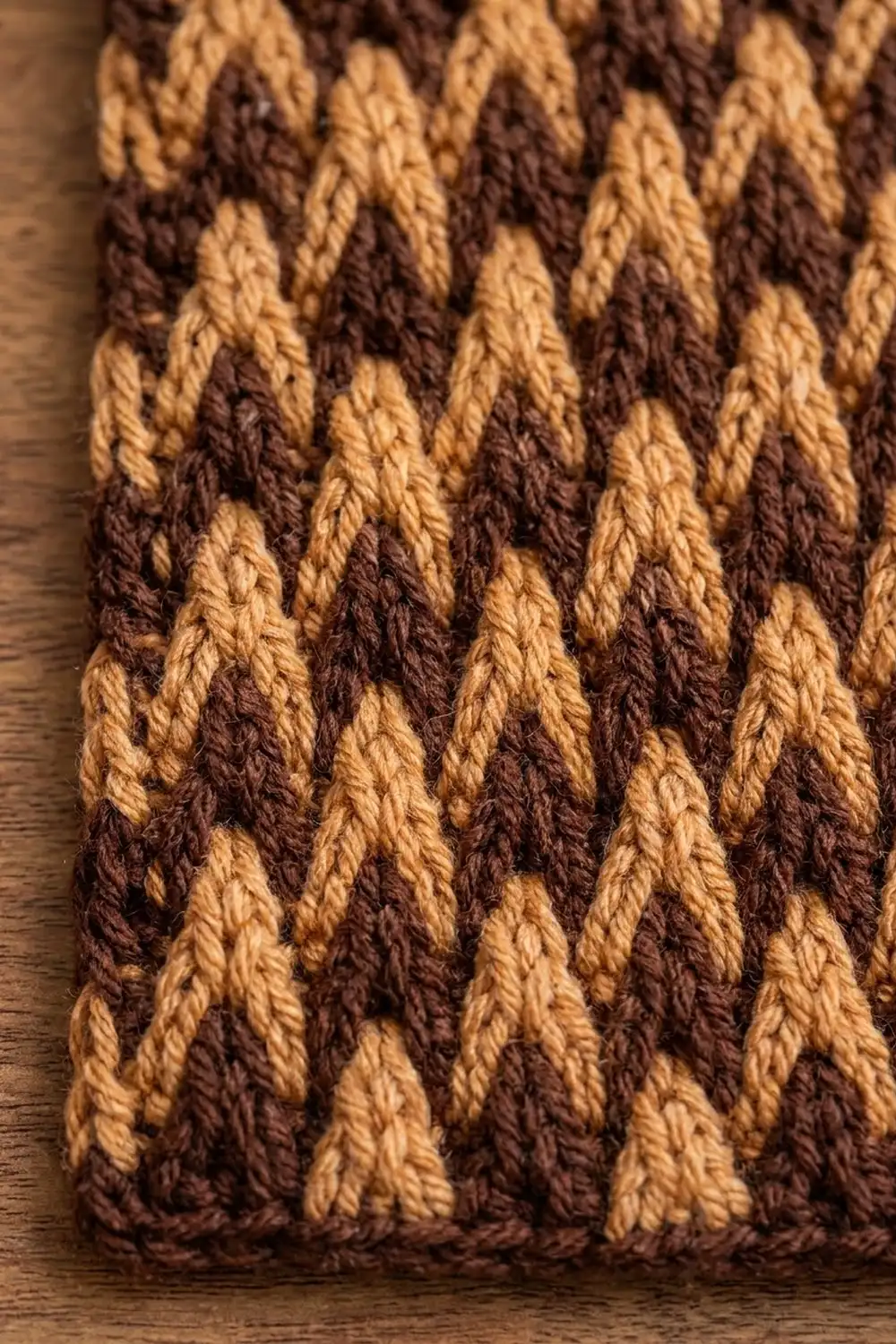
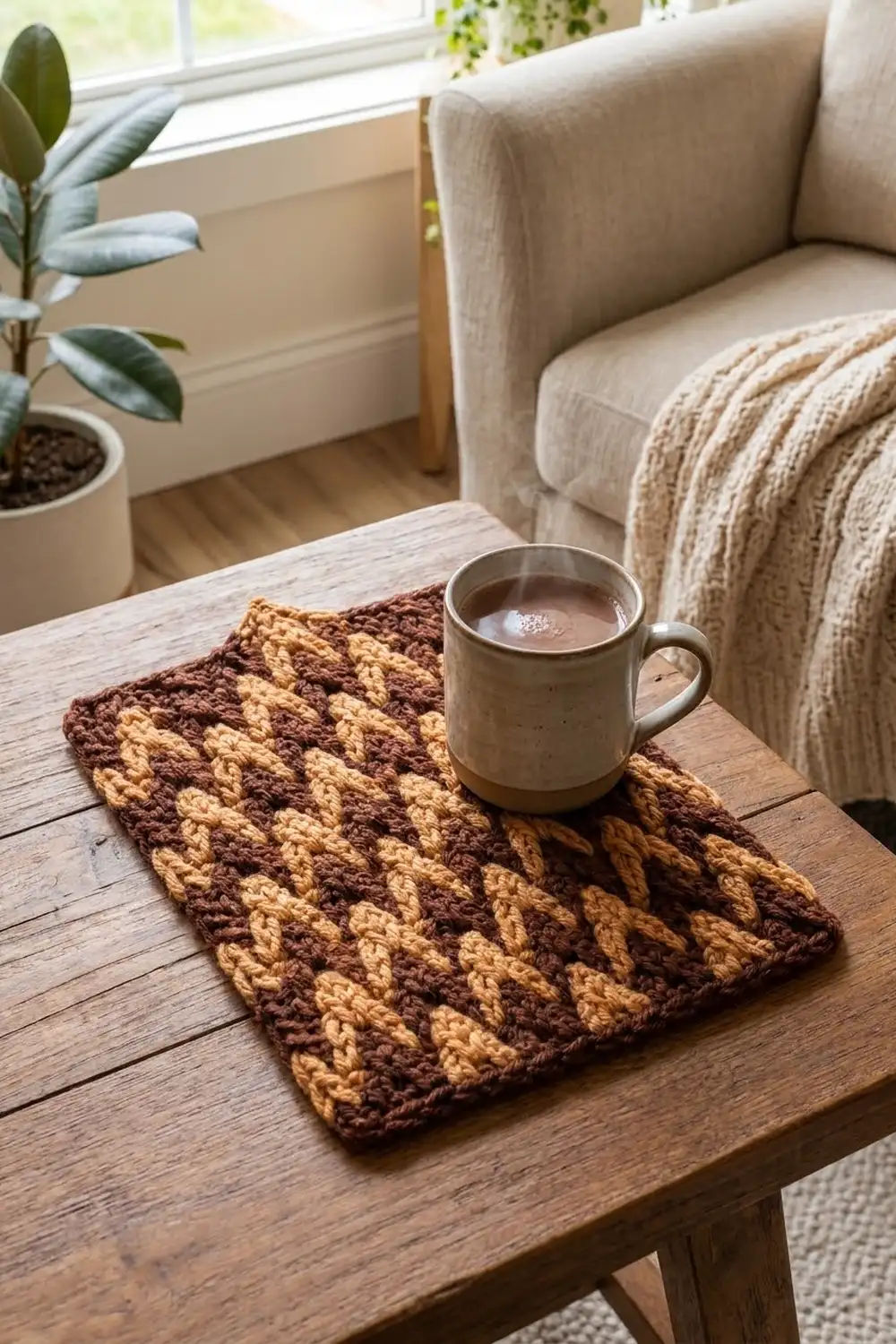
The Caramel Arrow Stitch Panel is a single flat rectangle covered in rows of upward-pointing arrows. Golden caramel arrows sit on a deep chocolate brown background. Every stitch is a center single crochet, so the fabric looks almost knitted: each stitch forms a small V, and the Vs stack into crisp chevron shapes.
The design uses two colors. Chocolate (Color B) is used for the background, the edge stitches, the border and the tab. Caramel (Color A) is used for the arrows. The style is warm, rustic and tidy. The panel can be a sample panel, a thick hot pad, a small wall piece or a test before you use the stitch on something larger.
This pattern uses US crochet terms. The finished panel measures 9.5 x 11.5 inches (24.1 x 29.2 cm) including the border. A 1-inch (2.5 cm) pointed tab at the top center brings the overall height to 12.5 inches (31.8 cm).
Construction is simple and linear. You work a foundation row in Chocolate, then 40 colorwork rows from an 8-stitch, 8-row arrow repeat, then one plain Chocolate row. Every row is worked with the right side facing, so the Vs always point the same way. Two rounds of single crochet border enclose the yarn tails, and a small triangle tab is worked off the top edge.
Finished Size and Construction
- Finished size: 9.5 x 11.5 inches (24.1 x 29.2 cm), plus a 1-inch (2.5 cm) tab
- Skill level: Intermediate (tapestry color changes, center single crochet)
- Terminology: US crochet terms
- Yarn weight: Worsted (#4)
- Hook: 5.5 mm (US I-9)
- Number of pieces: 1 (single panel, no joining)
- Layout: Portrait rectangle, 4 arrow repeats wide and 5 repeats tall
- Panel size before border: 34 sts x 42 rows = 8.5 x 10.5 inches (21.6 x 26.7 cm)
- Border depth: 2 rounds = 0.5 inch (1.3 cm) on each side
Materials
Choose a smooth worsted yarn with good stitch definition. Wool, wool blends and soft acrylics all work. Avoid fuzzy or highly textured yarns, because they blur the Vs and soften the arrow points. If the panel will be used as a hot pad, choose 100% wool or cotton, not acrylic.
- Color B, Chocolate brown: 70 g, about 128 m (140 yd)
- Color A, Caramel / golden tan: 45 g, about 82 m (90 yd)
The quantities include a margin of about 20%. This covers the gauge swatch, the 6-inch (15.2 cm) tails at each row end and the strand carried inside the tapestry fabric.
Tools:
- 5.5 mm (US I-9) crochet hook
- Tapestry needle
- Scissors
- Stitch markers (2 or 3)
- Tape measure or ruler
- Blocking mat and rust-proof pins
- Spray bottle
Abbreviations (US Terms)
- ch – chain
- sc – single crochet
- csc – center single crochet (see below)
- sc2tog – single crochet 2 together
- sl st – slip stitch
- st(s) – stitch(es)
- rep – repeat
- RS – right side
- A – Caramel
- B – Chocolate
Special stitch – center single crochet (csc), also called waistcoat stitch:
- Look at the front of the stitch below. You will see a V made of two vertical legs.
- Insert your hook from front to back through the center of that V, between the two legs and below the top loops.
- Yarn over and pull up a loop.
- Yarn over and pull through both loops on the hook.
Tapestry color change:
- Work the last stitch in the old color until 2 loops remain on the hook.
- Drop the old color, yarn over with the new color and pull through.
- Carry the unused color along the top of the row below and work over it, so it stays hidden inside the stitches.
Written color notation: “A2, B3” means work 2 csc in Caramel, then 3 csc in Chocolate.
Gauge and Checkpoints
Gauge: 16 csc and 16 rows = 4 inches (10.2 cm) in the colorwork pattern, after blocking.
Center single crochet tends to be tight, so the hook is deliberately larger than the yarn label suggests.
Make a test piece first:
- Chain 19 and work 1 row of sc (18 sts).
- Work 16 rows of the colorwork pattern: 1 edge st, 16 pattern sts, 1 edge st.
- Measure across the middle 16 sts and up the 16 colorwork rows.
The pattern relies on a square gauge of 4 sts and 4 rows per inch. That is what lets the border place exactly 1 sc in each row end.
Checkpoints:
- After Row 1: the 34 sc measure 8.5 inches (21.6 cm) wide.
- After Row 9 (one full arrow repeat): the panel is 2.25 inches (5.7 cm) tall.
- After Row 25 (three repeats): the panel is 6.25 inches (15.9 cm) tall.
- After Row 42: the panel is 8.5 x 10.5 inches (21.6 x 26.7 cm).
- After the border: the panel is 9.5 x 11.5 inches (24.1 x 29.2 cm).
If your piece is too big, go down a hook size to 5.0 mm (US H-8).
If it is too small or stiff, go up a hook size to 6.0 mm (US J-10).
If the width is right but the rows are too short, pull each new loop up slightly taller before you finish the stitch.
Do not change the stitch count. The arrow repeat needs exactly 34 sts.
Arrow Repeat
Each colorwork row has 34 sts: 1 edge stitch in B, four 8-st repeats (32 sts), then 1 edge stitch in B. Work each row from right to left, in the order written.
- Pattern Row 1: A2, B3, A2, B1
- Pattern Row 2: B1, A2, B1, A2, B2
- Pattern Row 3: B2, A3, B3
- Pattern Row 4: B3, A1, B4
- Pattern Row 5: B1, A2, B1, A2, B2
- Pattern Row 6: A2, B3, A2, B1
- Pattern Row 7: A1, B5, A2
- Pattern Row 8: B7, A1
Rows 1–4 build one arrow centered on the 4th st of each repeat. It starts with wide legs, then narrower legs, then a 3-st body, then a 1-st point.
Rows 5–8 build a second arrow centered on the 8th st, offset by half a repeat. The two sets of arrows nest together, so the brown background also reads as arrows between the caramel ones.
Panel Instructions
Every row is worked with the RS facing, so you fasten off both colors at the end of each row and rejoin at the right edge. Leave 6-inch (15.2 cm) tails each time. You do not need to weave these in, because the first border round encloses them.
Row 1 (foundation, RS): With B, ch 35. Sc in the 2nd ch from the hook and in each ch across. Fasten off. (34 sc)
Mark this side as the RS. The panel should measure 8.5 inches (21.6 cm) wide.
Row 2 (RS):
- With the RS facing, join B in the first sc at the right edge.
- Hold A along the top of the row so it is carried inside the stitches.
- Ch 1 (does not count as a st).
- Csc in the first st with B (edge st).
- Work Pattern Row 1 four times across the next 32 sts.
- Csc in the last st with B (edge st).
- Fasten off both colors.
(34 csc: 1 B edge + 32 pattern + 1 B edge)
Rows 3–9 (RS): Rejoin both colors at the right edge for each row. Ch 1, then csc with B in the edge st. Work the next pattern row, from Pattern Row 2 through Pattern Row 8, four times across. Csc with B in the last st. Fasten off both colors at the end of each row. (34 csc in each row)
The first arrow repeat is complete, and the panel is 2.25 inches (5.7 cm) tall.
Rows 10–41 (RS): Work Pattern Rows 1–8 four more times in the same way. (34 csc in each row)
You now have 40 colorwork rows, which is 5 full arrow repeats. The panel is 10.25 inches (26.0 cm) tall.
Row 42 (RS): Join B only at the right edge. Ch 1, then csc in each st across. Do not fasten off. (34 csc)
The panel measures 8.5 x 10.5 inches (21.6 x 26.7 cm). Count the arrows: there should be 8 arrow columns across (4 centered plus 4 offset) and 10 tiers of arrows from bottom to top.
Border
Border gauge: Each round of sc adds 0.25 inch (0.6 cm) to every side. Along the sides, 1 sc per row end matches the row gauge of 4 rows per inch, so the edges stay flat.
Corners: Each corner is 3 sc worked into one stitch. The middle sc of the 3 is the corner stitch. Each per-side count below includes both corner stitches of that side.
Round 1: Keep working with B from the end of Row 42.
- Top left corner: Ch 1, then work 3 sc in the last st of Row 42.
- Left side: Sc in each row end from Row 41 down to Row 2, working over all the tails as you go. (40 sc)
- Bottom left corner: Work 3 sc in the free loop of the foundation ch at the corner.
- Bottom edge: Sc in each of the next 32 free loops. (32 sc)
- Bottom right corner: Work 3 sc in the last free loop.
- Right side: Sc in each row end from Row 2 up to Row 41, working over the tails. (40 sc)
- Top right corner: Work 3 sc in the first st of Row 42.
- Top edge: Sc in each of the next 32 sts. (32 sc) Sl st to the first sc.
Round 1 counts, including corners:
- Top and bottom: 36 sc each (1 corner + 1 + 32 + 1 + 1 corner)
- Left and right: 44 sc each (1 corner + 1 + 40 + 1 + 1 corner)
- Total: 34 + 34 + 40 + 40 + 8 extra corner sc = 156 sc
Trim the tails flush after this round.
Round 2: Ch 1. Sc in each st around, working 3 sc in each corner stitch (the middle sc of each 3-sc group). Sl st to the first sc. Fasten off. (164 sc)
Round 2 counts, including corners:
- Top and bottom: 38 sc each
- Left and right: 46 sc each
- Check: 38 + 38 + 46 + 46 − 4 shared corners = 164 sc
Why the math works:
- The panel is 34 sts wide and 42 rows tall.
- Round 1 places 1 sc in each top and bottom stitch and 1 sc in each of the 40 inner row ends.
- The corner groups cover the row ends of Rows 1 and 42.
- Each round adds exactly 2 sc per side, through the corners only.
- Two rounds at 0.25 inch (0.6 cm) each add 0.5 inch (1.3 cm) per side.
- So 8.5 x 10.5 inches becomes 9.5 x 11.5 inches (24.1 x 29.2 cm).
Pointed Tab
The tab sits on the 6 center sts of the top edge. The top side has 38 sts including the corners, which splits as 16 + 6 + 16 = 38.
Start at the top right corner stitch and count it as st 1. Count to st 17 and place a marker there.
Tab Row 1 (RS): Join B in the marked st. Ch 1, then sc in the same st and in the next 5 sts. Turn. (6 sc)
Tab Row 2: Ch 1, sc2tog, sc in the next 2 sts, sc2tog. Turn. (4 sc)
Tab Row 3: Ch 1, sc2tog twice. Turn. (2 sc)
Tab Row 4: Ch 1, sc2tog. (1 sc)
Fasten off and weave in the ends. The tab is 1 inch (2.5 cm) tall and 1.5 inches (3.8 cm) wide at the base, forming a small point at the top center.
Final Blocking
- Weave in the starting tail, the tab tails and any loose ends not trimmed in Round 1.
- Lay the panel RS up on a blocking mat.
- Mist it evenly with water until damp, not soaked.
- Pin the four corners to 9.5 x 11.5 inches (24.1 x 29.2 cm).
- Add pins every 2 inches (5.1 cm) along each side, keeping the edges straight.
- Pin the tab tip straight up and centered.
- Gently pat the arrows so the columns of Vs run vertically.
- Let it dry completely, at least 12 hours, before unpinning.
Final Quality-Control Checklist
- Every colorwork row has 34 sts, with B edge sts at both ends.
- All arrows point upward, with the Vs facing the same way on every row.
- The carried strand does not show between stitches.
- There are 5 arrow repeats from bottom to top (40 colorwork rows).
- Border Round 1 has 156 sc, and Round 2 has 164 sc.
- All tails are hidden inside the border.
- The tab is centered, with 16 border sts on each side.
- The finished size is 9.5 x 11.5 inches (24.1 x 29.2 cm), plus the 1-inch (2.5 cm) tab.
Troubleshooting
The fabric is stiff and curls. Center single crochet is dense. Go up a hook size and keep the carried strand relaxed.
The arrows look slanted. Your hook is going into the wrong spot. Make sure it goes through the center of the V, not between two stitches.
Caramel shows through the brown. The carried yarn is sitting too high. Hold it flat along the top of the row below and work over it.
The arrows are misaligned. Count each row: 1 edge st, 32 pattern sts, 1 edge st. If the count is off, redo the row.
The sides ripple after the border. Your rows are taller than 4 rows per inch. Skip 1 row end every 8 rows on both sides in Round 1, and keep the same skips on both sides so the counts match.
The sides pull in. Your rows are shorter than 4 rows per inch. Add 1 extra sc every 8 row ends, matching on both sides.
The tab leans. Recount the 16 sts on each side of the tab before you join.
Care
Hand wash in cool water with a mild wool wash, press out the water in a towel and dry flat. Re-block to 9.5 x 11.5 inches (24.1 x 29.2 cm) if needed.
Final Notes
The measurement chain is simple:
- A square gauge of 4 sts and 4 rows per inch turns 34 sts x 42 rows into an 8.5 x 10.5-inch (21.6 x 26.7 cm) panel.
- Two border rounds add 0.5 inch (1.3 cm) per side, for a finished size of 9.5 x 11.5 inches (24.1 x 29.2 cm).
- The 1-inch (2.5 cm) tab brings the overall height to 12.5 inches (31.8 cm).
Check your gauge first and count every row, and the arrows will line up.
Happy crocheting!