
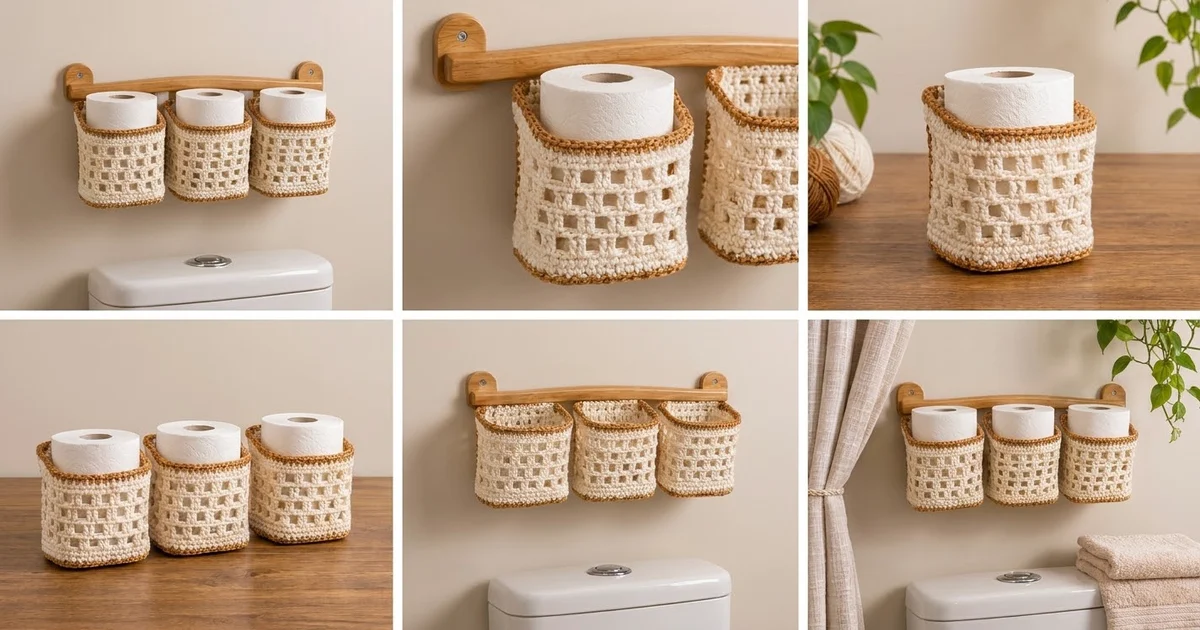
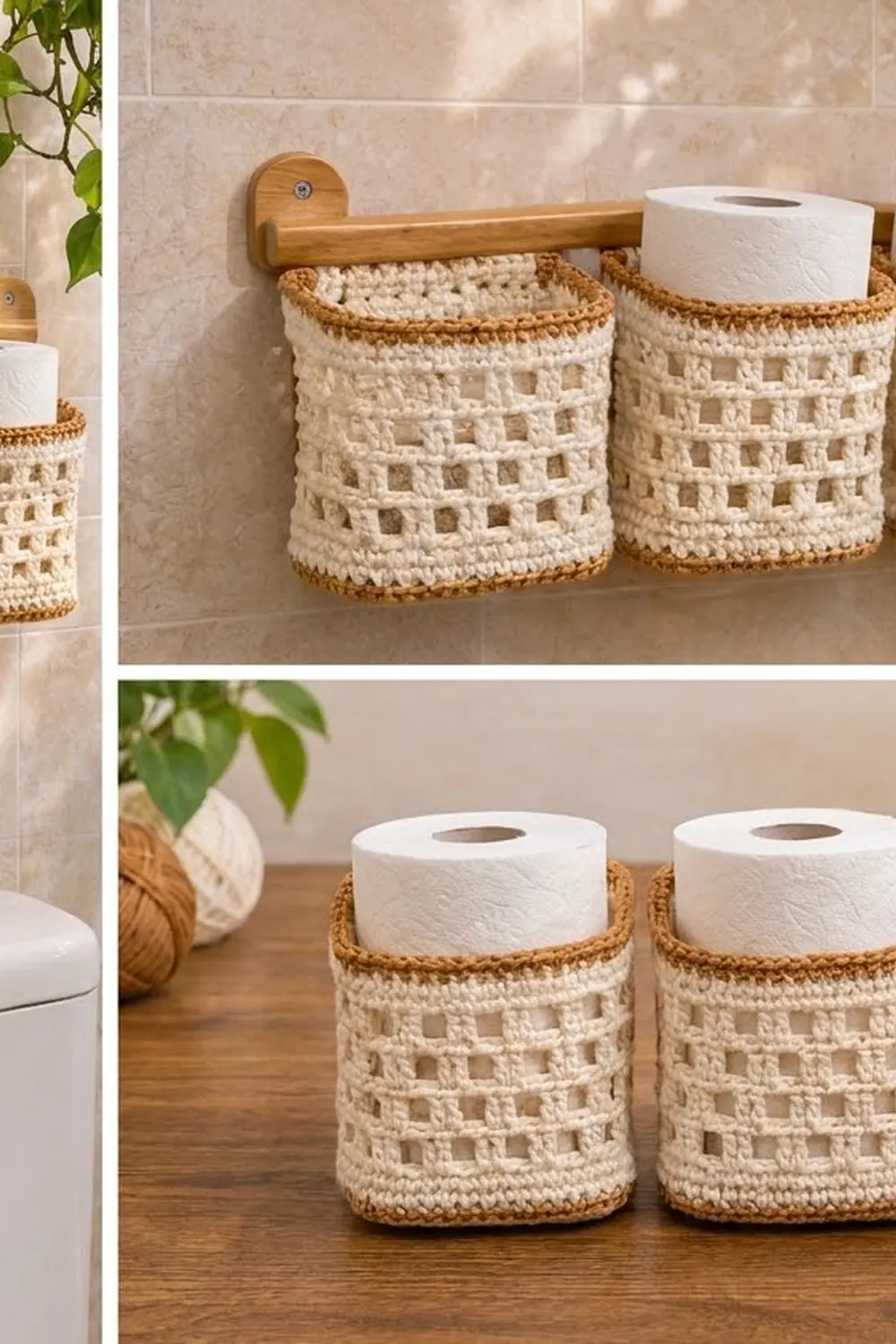
This set of three small hanging baskets turns spare toilet rolls into a tidy little display. Each basket holds one standing roll, and the three hang side by side from a simple wooden rail above the tank or beside the sink.
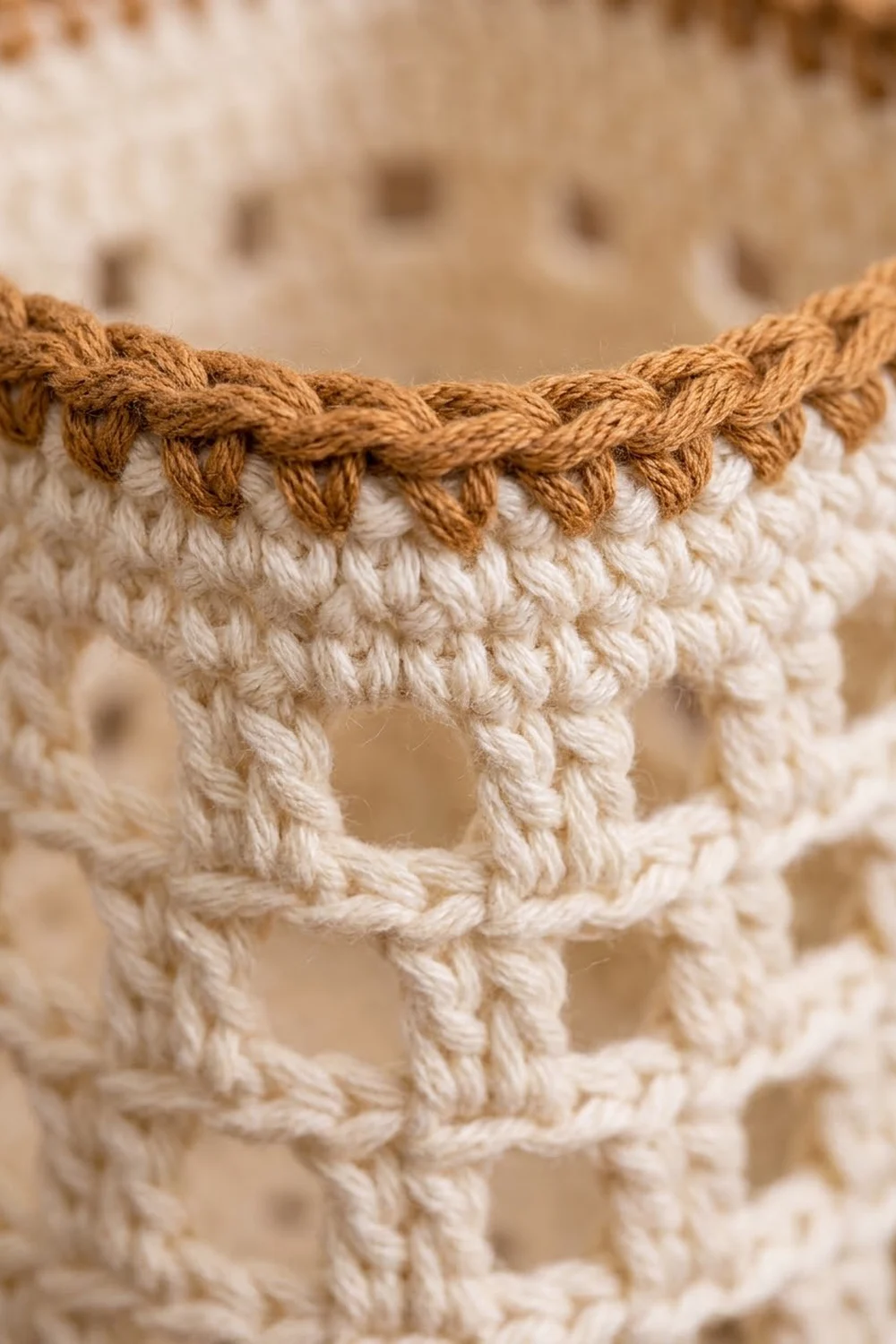
The baskets are worked in soft cream cotton with a grid of square filet windows. A caramel-brown crab-stitch rim finishes the top edge, and a fine caramel slip-stitch line outlines the base. Together they look warm, natural and a little Scandinavian.
All instructions use US crochet terms. Each finished basket measures 5.7 in (14.5 cm) wide, 4.0 in (10.2 cm) deep and 4.4 in (11.2 cm) tall. A trio hung with 0.5 in (1.3 cm) gaps spans 18.1 in (46.0 cm).
Construction is simple. You crochet a flat rectangular base in rows, then work the walls in joined rounds straight up from the base edge. Filet rounds alternate with single-crochet rounds, and a two-round caramel border finishes the rim. Two cream straps are sewn inside the back wall to hang each basket. The three baskets are never seamed together.
Finished Size and Construction
- Finished size (one basket): 5.7 in (14.5 cm) wide x 4.0 in (10.2 cm) deep x 4.4 in (11.2 cm) tall
- Skill level: Easy-intermediate
- Terminology: US
- Yarn weight: Worsted (#4) cotton
- Hook: 5.0 mm (H-8)
- Number of pieces: 3 identical baskets, plus 2 hanging straps per basket
- Layout: 3 baskets in a single row on one rail, not joined
- Piece size: base 5.7 x 4.0 in (14.5 x 10.2 cm)
- Height before border: 4.0 in (10.2 cm)
- Border depth: 0.4 in (1.0 cm)
Materials
Choose a firm, smooth 100% cotton or cotton-blend worsted yarn of about 156 m per 100 g. Cotton holds the square shape and the crisp windows much better than acrylic, which tends to sag. Avoid fuzzy or very loosely plied yarns, because they blur the filet grid.
- Cream (main color): 180 g, approx. 280 m
- Caramel brown (border): 35 g, approx. 55 m
These quantities make all three baskets and six straps, and they include a margin of about 15% for swatching and joining.
Tools:
– 5.0 mm (H-8) crochet hook
– Tapestry needle
– 4 stitch markers
– Scissors
– Measuring tape
– Spray bottle and pins for blocking
– A wooden rail at least 19 in (48.3 cm) long
Abbreviations (US Terms)
- ch – chain
- sl st – slip stitch
- sc – single crochet
- dc – double crochet
- BLO – back loop only
- sk – skip
- sp – space
- st(s) – stitch(es)
- rev sc – reverse single crochet (crab stitch)
Reverse single crochet (rev sc): With the right side facing, work from left to right. Insert the hook into the next stitch to the right, yarn over, pull up a loop, then yarn over and draw through both loops. This makes the twisted, rope-like rim.
Surface slip stitch: Hold the working yarn behind the fabric. Insert the hook from front to back through the fabric (or under a free loop), pull up a loop and draw it through the loop on the hook.
Gauge and Checkpoints
Gauge: 14 sc x 16 rows = 4 in (10.2 cm). In the filet pattern, one filet round plus one sc round measures 0.75 in (1.9 cm) tall.
Make one complete basket before you start the others. The base is a good built-in gauge swatch, and checking the sizes as you go saves you from frogging a whole basket.
Checkpoints:
– After the base (Row 16): 5.7 x 4.0 in (14.5 x 10.2 cm)
– After Rnd 4: walls 0.75 in (1.9 cm) tall
– After Rnd 8: walls 2.25 in (5.7 cm) tall
– After Rnd 13: walls 4.0 in (10.2 cm) tall
– After the border: total height 4.4 in (11.2 cm)
If the base is too big: go down to a 4.5 mm hook. If it is more than 0.25 in (0.6 cm) too wide, the roll will tip over inside the basket.
If the base is too small: go up to a 5.5 mm hook. A standard roll is about 4.2 in (10.7 cm) across and needs the full 4.0 in (10.2 cm) depth, plus the stretch of the walls.
If the height is off: dc height varies a lot between crocheters. Adjust your dc only (pull up a shorter or taller loop) and leave the stitch counts alone.
Base
With cream, ch 21.
Row 1: Sc in the 2nd ch from the hook and in each ch across, turn. (20 sc)
Rows 2–16: Ch 1, sc in each st across, turn. (20 sc in each row)
Do not fasten off. Check that the base measures 5.7 x 4.0 in (14.5 x 10.2 cm).
Walls
Work in joined rounds with the right side facing and do not turn. Place a marker in the first stitch of each round.
Rnd 1 (edging, sets the round count): Ch 1. Sc in each of the 20 sts of Row 16. Sc in each of the 16 row ends down the short side. Sc in the free loop of each of the 20 foundation chains. Sc in each of the 16 row ends up the second short side. Sl st to the first sc. (72 sc: 20 + 16 + 20 + 16)
Mark the 4 corners. No corner increases are needed, because the corners are meant to fold upward.
Rnd 2 (turning round): Ch 1, sc in BLO of each st around, sl st to the first sc. (72 sc)
The walls now stand up. The unused front loops of Rnd 1 stay on the outside and become the base for the caramel line later.
Rnds 3–4: Ch 1, sc in each st around, sl st to the first sc. (72 sc each)
Check: the walls are 0.75 in (1.9 cm) tall. This is the solid band at the bottom.
Rnd 5 (filet): Ch 3 (counts as dc), dc in the next st, ch 2, sk 2. Dc in each of the next 2 sts, ch 2, sk 2; repeat from * around. Sl st to the top of the ch-3. (18 two-dc blocks + 18 ch-2 sps = 72 sts)*
Because the round starts at a corner, each long side gets exactly 5 blocks and 5 windows (20 sts), and each short side gets 4 blocks and 4 windows (16 sts).
Rnd 6 (solid bar): Ch 1. Sc in each dc, and work 2 sc in each ch-2 sp. Sl st to the first sc. (36 sc in dc + 36 sc in spaces = 72 sc)
Rnd 7: Repeat Rnd 5, placing each 2-dc block over the 2 sc that sit above the previous blocks. (72 sts)
Rnd 8: Repeat Rnd 6. (72 sc)
Check: the walls are 2.25 in (5.7 cm) tall.
Rnd 9: Repeat Rnd 5. (72 sts)
Rnd 10: Repeat Rnd 6. (72 sc)
Rnd 11: Repeat Rnd 5. (72 sts)
Rnd 12: Repeat Rnd 6. (72 sc)
Rnd 13: Ch 1, sc in each st around, sl st to the first sc. (72 sc)
Fasten off cream. Check: the walls are 4.0 in (10.2 cm) tall. That is 3 bottom sc rounds at 0.75 in (1.9 cm), 4 filet rounds at 2.0 in (5.1 cm), and 5 sc rounds at 1.25 in (3.2 cm).
Lining the blocks up over each other every time is what gives the straight vertical columns of windows. The solid sc rounds between them make the thicker horizontal bars.
Hanging Straps (make 2 per basket)
With cream, ch 5.
Row 1: Sc in the 2nd ch from the hook and in each ch across, turn. (4 sc)
Rows 2–20: Ch 1, sc in each st across, turn. (4 sc in each row)
Fasten off, leaving a 12 in (30.5 cm) tail. Each strap measures 1.1 x 5 in (2.8 x 12.7 cm).
Make All Pieces
Make three baskets in total, all from the same instructions.
| Piece | Qty | Cream | Caramel |
|---|---|---|---|
| Basket | 3 | approx. 50 g each | approx. 9 g each |
| Strap | 6 | approx. 3 g each | — |
Layout on the rail (seen from the front, with 0.5 in (1.3 cm) gaps between baskets):
[========== wooden rail, 19 in / 48.3 cm ==========]
   [Basket 1]   [Basket 2]   [Basket 3]
    5.7 in   0.5   5.7 in  0.5   5.7 in
Total span: 3 x 5.7 in + 2 x 0.5 in = 18.1 in (46.0 cm).
Joining (Hanging the Baskets)
The baskets are not joined to one another. Each one hangs on its own, so you can lift any basket off to refill it.
Method: Turn a basket inside out or look inside it. Place one strap on the inside of the back long wall, 1 in (2.5 cm) in from each back corner. Overlap the strap end down the wall by 1 in (2.5 cm), roughly the depth of Rnds 12–13.
Stitch-to-stitch logic: Whipstitch all 4 sts of the strap’s last row to 4 consecutive sc of Rnd 12, then stitch both long edges of the strap down through Rnd 13. Work through the back loops only so nothing shows on the outside.
Loop the free end of the strap over the rail, bring it down behind the back wall, and whipstitch the 4 foundation loops to the outside of the back wall just below the rim. This is hidden from the front.
Tension: Sew firmly but don’t pull the stitches tight. Puckering here tilts the rim forward.
Size check: Once all three baskets are hung, the rims should sit level, at the same height, with even 0.5 in (1.3 cm) gaps between them.
Tip: if you want removable baskets, sew a cream button to the outside of the back wall and use a gap between stitches near the strap end as a buttonhole.
Border
Each basket gets its own border, so the stitch count for each round is simply one basket’s 72 stitches. No stitches are added for seams.
Border gauge: 14 sts = 4 in (10.2 cm), the same as the body. The border holds 72 sts around a 72-st rim, so it sits flat without ruffling or cupping.
Top rim, Rnd 14: Join caramel in the first sc of Rnd 13 at a back corner. Ch 1, sc in each st around, sl st to the first sc. (72 sc: 20 per long side, 16 per short side)
Top rim, Rnd 15: Ch 1, rev sc in each st around, sl st to the first st. (72 rev sc: 20 per long side, 16 per short side) Fasten off.
Bottom line: With the basket upright and right side facing, join caramel to any free front loop of Rnd 1. Work a surface sl st in each free front loop around. (72 sl st: 20 per long side, 16 per short side) Fasten off and join invisibly to the first stitch.
Why the math works: Each long side has 20 sts and each short side has 16, giving 20 + 16 + 20 + 16 = 72. The corner stitches are already counted inside those side numbers. Every border round works 1 st into each existing st, so the totals never change. The border adds 0.4 in (1.0 cm) of height and no width.
Final Blocking
- Weave in all ends inside the basket, along the solid sc rounds.
- Mist each basket with water until it is evenly damp, not soaked.
- Stuff the basket firmly with a toilet roll wrapped in a plastic bag, or a block of folded towels cut to 5.7 x 4.0 in (14.5 x 10.2 cm).
- Square up the windows with your fingers so the columns run straight up.
- Pinch the four corners so they stay softly rounded, and press the caramel rim flat so it sits level.
- Let the baskets dry completely on the stuffing, about 24 hours.
- Remove the stuffing and hang the baskets.
Final Quality-Control Checklist
- Each basket has 72 sts in every round.
- 5 windows across each long side, 4 across each short side.
- The window columns are straight and vertical, not spiraling.
- The base measures 5.7 x 4.0 in (14.5 x 10.2 cm).
- Total height is 4.4 in (11.2 cm).
- The caramel rim lies flat with an even rope texture.
- The caramel bottom line follows the base fold all the way around.
- The straps are hidden, secure, and placed 1 in (2.5 cm) from the back corners.
- All three baskets match in size within 0.25 in (0.6 cm).
Troubleshooting
Window columns lean to one side: the joining seam is drifting. Always start each filet round in the same marked stitch, and place the ch-3 directly over the first sc.
Walls flare outward: your dc are too loose. Go down a hook size for the filet rounds only.
Walls pull inward: your sc rounds are too tight. Loosen up or go up half a hook size for the sc rounds.
Base corners won’t stand up: you didn’t work Rnd 2 in the back loops only. Redo it in BLO.
Rim ruffles: you added stitches in Rnd 14. Recount to exactly 72.
Crab stitch looks flat: work it a little looser and twist the hook as you pull through.
Basket tips forward on the rail: move the straps closer to the back corners or shorten the strap overlap.
Care
Hand wash in cool water with mild soap, reshape, and dry flat over a roll-sized form. Avoid the tumble dryer, which can shrink cotton unevenly.
Final Notes
The measurement chain is short and easy to check:
- Gauge: 14 sc x 16 rows = 4 in (10.2 cm)
- Base: 20 sts x 16 rows = 5.7 x 4.0 in (14.5 x 10.2 cm)
- 72-st rounds: 5 windows per long side, 4 per short side
- Walls: 4.0 in (10.2 cm)
- Border: 0.4 in (1.0 cm), for a 4.4 in (11.2 cm) basket
- Three baskets on the rail: 18.1 in (46.0 cm)
Check your first basket at every checkpoint and the other two will come out matching.
Happy crocheting!