

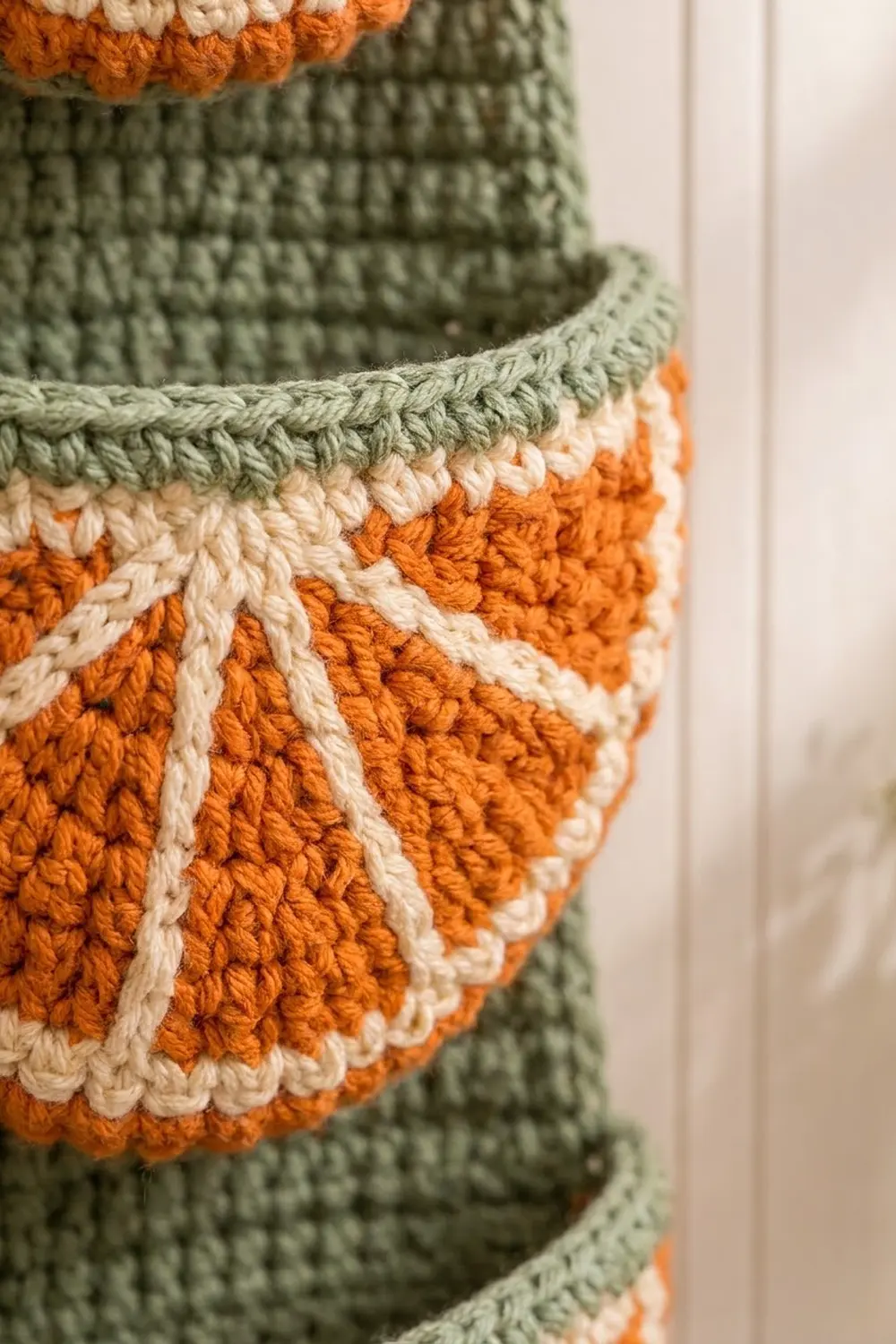
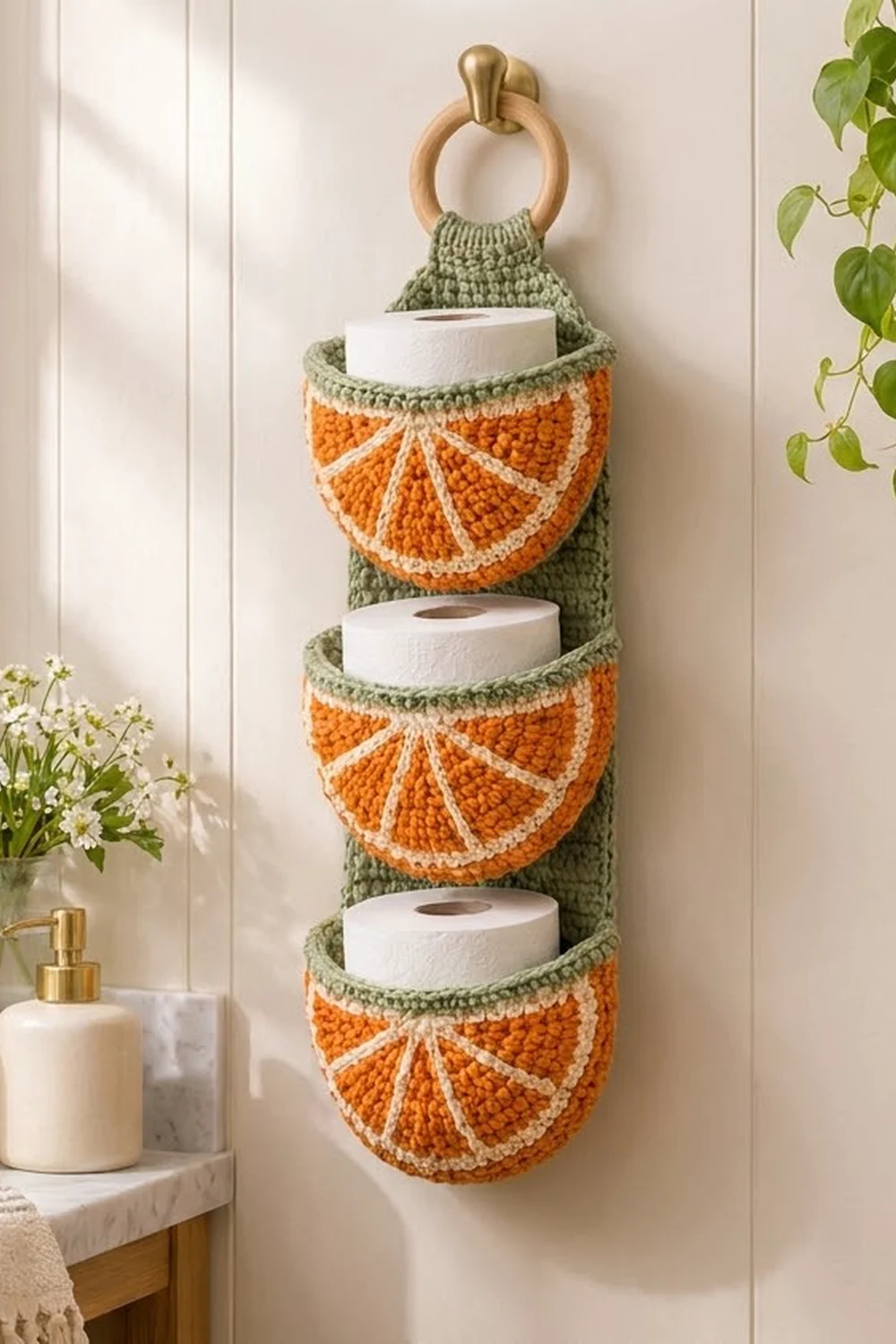
This hanging holder has a sage green backing panel with three orange-slice pockets stacked down the front. Each pocket holds one standing toilet roll. The pocket fronts are bright orange half circles with a cream rind and five cream segment lines. A sage gusset and rim give each pocket its depth.
The panel narrows at the top into a tab that wraps around a wooden ring, so the holder hangs from a towel hook or wall knob. Firm single crochet holds its shape even with all three pockets full.
This pattern uses US crochet terms. The finished holder is 7 in (17.8 cm) wide and about 19.75 in (50.2 cm) long as it hangs, not counting the ring. Each pocket front is 6.75 in (17.1 cm) wide and 3.75 in (9.5 cm) tall.
First you crochet a flat panel in rows, taper it into a tab and add a two-round border. Then you make three pockets: a half circle in turned rows, a cream rind row, cream segment lines, a sage gusset and a rim. Last, you sew the pockets onto the panel.
Finished Size and Construction
- Finished size: 7 in (17.8 cm) x 21.75 in (55.2 cm) flat; about 19.75 in (50.2 cm) hanging
- Skill level: Easy-intermediate
- Terminology: US
- Yarn weight: Worsted (#4) cotton or cotton blend
- Hook: 5.0 mm (H-8)
- Number of pieces: 4 (1 backing panel + 3 pockets)
- Layout: 3 pockets in 1 vertical column
- Pocket size: 6.75 in (17.1 cm) wide x 3.75 in (9.5 cm) tall; gusset depth 3.5 in (8.9 cm)
- Panel size before border: 6 in (15.2 cm) x 20.75 in (52.7 cm)
- Border depth: 0.5 in (1.3 cm) per side
Materials
Use a worsted weight cotton or cotton blend with about 170 m per 100 g. Cotton keeps its shape and stays smooth in a humid bathroom. Acrylic also works, but the pockets will be softer.
- Sage green: 250 g (425 m)
- Orange: 60 g (102 m)
- Cream: 20 g (34 m)
Tools:
- 5.0 mm (H-8) crochet hook
- Wooden ring, 4 in (10.2 cm) across
- Tapestry needle
- 6 locking stitch markers
- Straight pins
- Measuring tape and scissors
All the yarn amounts include a margin of about 15 to 20 percent for swatching and seaming.
Abbreviations (US Terms)
- ch – chain
- sc – single crochet
- sc2tog – single crochet 2 together
- inc – 2 sc in the same stitch
- sl st – slip stitch
- BLO – back loop only
- st(s) – stitch(es)
- rnd – round
Surface slip stitch: Hold the yarn behind the work. Insert the hook from front to back in a gap, yarn over and pull a loop to the front. Insert the hook in the next gap along your line, yarn over and pull the loop through the fabric and the loop on the hook. Make each stitch about one row long.
Gauge and Checkpoints
Gauge: 16 sc and 18 rows = 4 in (10.2 cm).
Four sc measure 1 in (2.5 cm) across, and one row is about 0.22 in (0.6 cm) tall. Every measurement in this pattern comes from these two numbers.
Make one pocket front first and use it as your test piece:
- After Row 7: straight edge about 3 in (7.6 cm)
- After Row 14: straight edge about 6.25 in (15.9 cm)
- After Row 15: straight edge about 6.75 in (17.1 cm)
If it comes out too big, go down 0.5 mm in hook size. If it’s too small, go up 0.5 mm. If the half circle ruffles, your tension is too loose. If it cups, your tension is too tight.
Pocket (Make 3)
The pocket front is a half circle worked in turned rows. The ch 1 at the start of each row does not count as a stitch.
Orange half circle
With orange, make a magic ring.
- Row 1: Ch 1, 3 sc in ring. Pull the ring snug. (3 sts)
- Row 2: Ch 1, turn, inc in each st. (6 sts)
- Row 3: Ch 1, turn, [sc 1, inc] 3 times. (9 sts)
- Row 4: Ch 1, turn, [sc 2, inc] 3 times. (12 sts)
- Row 5: Ch 1, turn, [sc 3, inc] 3 times. (15 sts)
- Row 6: Ch 1, turn, [sc 4, inc] 3 times. (18 sts)
- Row 7: Ch 1, turn, [sc 5, inc] 3 times. (21 sts)
- Rows 8–14: Work as before, with one more sc before each inc on every row. Each row has 3 times its row number in stitches: Row 8 has 24 sts and Row 14 has 42 sts.
To keep the curve round, shift the increases a few stitches on alternate rows so they don’t stack into points. Fasten off.
Cream rind
- Row 15: Join cream in the first st of Row 14. Ch 1, [sc 13, inc] 3 times. (45 sts)
Fasten off. The straight edge now measures 6.75 in (17.1 cm).
Segment lines
Turn the front right side up with the straight edge at the top. Count the 42 sts of Row 14 from one corner and place markers in the gaps after sts 7, 14, 21, 28 and 35. These mark 6 equal wedges of 7 sts each.
With cream, surface slip stitch a line from the center ring out to each marker, about 13 sl sts per line, and stop just below the rind. That gives 5 lines. Weave in the ends on the wrong side.
Sage gusset
The gusset is worked only along the curved edge.
- Row 16: Join sage in the first st of Row 15. Ch 1, sc in BLO of each st across. (45 sts)
Working in the back loop makes the gusset stand up behind the front and leaves a thin sage ridge outside the rind.
- Rows 17–31: Ch 1, turn, sc in each st. (45 sts)
That’s 16 gusset rows, about 3.5 in (8.9 cm) deep. Don’t fasten off.
Rim
The rim goes across the pocket opening: along one gusset end, across the straight edge of the front, and along the other gusset end.
- Rim Row 1: Ch 1, rotate so you’re working along the gusset end. Work 14 sc evenly across its 16 row ends. Across the straight edge of the front, work 13 sc evenly to the ring, 1 sc in the ring, and 13 sc evenly to the other corner. Then work 14 sc evenly across the other gusset end. (14 + 27 + 14 = 55 sts)
- Rim Row 2: Ch 1, turn, sc in each st. (55 sts)
Fasten off and leave a sage tail of 60 in (152.4 cm) for sewing. The pocket is 6.75 in (17.1 cm) wide and 3.75 in (9.5 cm) tall.
Backing Panel
Work the panel in sage from the bottom up.
- Foundation: Ch 25.
- Row 1: Sc in 2nd ch from hook and in each ch across. (24 sts)
- Rows 2–70: Ch 1, turn, sc in each st. (24 sts)
Checkpoint: 6 in (15.2 cm) wide and 15.5 in (39.4 cm) long.
Taper
- Row 71: Ch 1, turn, sc2tog, sc to last 2 sts, sc2tog. (22 sts)
- Rows 72–78: Repeat Row 71. Each row has 2 fewer sts than the row before: Row 72 has 20 sts and Row 78 has 8 sts.
The taper is 8 rows, about 1.75 in (4.4 cm) tall.
Tab
- Rows 79–94: Ch 1, turn, sc in each st. (8 sts)
The tab is 2 in (5.1 cm) wide and 3.5 in (8.9 cm) long. Don’t fasten off.
Checkpoint: 6 in (15.2 cm) wide and 20.75 in (52.7 cm) long.
Make All Pieces
- Pockets: 3. Each one uses about 20 g orange, 6 g cream and 50 g sage.
- Backing panel: 1, about 100 g sage, including the border.
Layout from top to bottom:
        [ tab + ring ]
       /    taper     \
   | Pocket 1: rim at Row 70 |
   |   sage gap, 8 rows      |
   | Pocket 2: rim at Row 45 |
   |   sage gap, 8 rows      |
   | Pocket 3: rim at Row 20 |
   |_____ bottom border _____|
Border
Work the border in sage before you sew on the pockets.
Border gauge: 4 sc per 1 in (2.5 cm) along every edge.
Rnd 1: Keep going from the end of Row 94. Ch 1 and work:
- Tab top: 3 sc in first st, sc in next 6, 3 sc in last st. (12 sts, corners included)
- Tab side: 14 sc evenly across 16 row ends.
- Taper side: 10 sc across 8 row ends (1 in each, plus 1 extra in the 2nd and 6th).
- Long side: 62 sc evenly across 70 row ends.
- Bottom: 3 sc in first foundation ch, sc in next 22, 3 sc in last ch. (28 sts, corners included)
- Other long side: 62 sc.
- Other taper side: 10 sc.
- Other tab side: 14 sc.
Join with a sl st. (12 + 14 + 10 + 62 + 28 + 62 + 10 + 14 = 212 sts)
Rnd 2: Ch 1, sc in each st, with 3 sc in the center st of each of the 4 corners. Join. (212 worked 1 per st + 8 added = 220 sts)
Stitches per side after Rnd 2: tab top 16, tab sides 14 each, taper sides 10 each, long sides 62 each, bottom 32.
Why the math works: The long side is 15.5 in (39.4 cm), and 15.5 x 4 = 62. The tab side is 3.5 in (8.9 cm), and 3.5 x 4 = 14. The taper edge is a slant about 2.75 in (7.0 cm) long, so 10 sts keep it flat. The bottom and the tab top get 1 sc per stitch plus 2 extra at each corner. Rnd 2 adds only 2 sts at each corner.
Fasten off. The panel is now 7 in (17.8 cm) by 21.75 in (55.2 cm).
Joining
Method: Whipstitch through both layers with the sage tail.
Placement: Mark Rows 20, 45 and 70 on the panel. Line up the top of each rim with one of these rows. The rims are 25 rows apart, about 5.5 in (14.0 cm). Each pocket is about 17 rows tall, so 8 rows, about 1.75 in (4.4 cm), of sage show between pockets.
Stitch-to-stitch logic: Pin the 45 sts of the last gusset row to the panel in a half circle. Its ends meet the marked row just inside the border. Pin the 14 sts at each end of the rim straight down from the marked row. Work 1 whipstitch into each pocket stitch and into the panel just behind it. Leave the top of the pocket open.
Tension: Make each stitch just snug enough to close the seam. If you pull too hard, the panel puckers.
Size checkpoint: With all three pockets sewn on, the panel should lie flat and still measure 7 in (17.8 cm) wide.
Hanging tab: Thread the tab through the ring from front to back. Fold it down 2 in (5.1 cm) and sew its edge to the back of the panel.
Final Blocking
- Spray the holder until it is damp.
- Lay it flat on a blocking mat with the pockets facing up.
- Pin the panel to 7 in (17.8 cm) wide, keeping the sides straight.
- Ease each pocket front into an even half circle 6.75 in (17.1 cm) across.
- Stuff a rolled hand towel into each pocket so it dries open.
- Let it dry completely before you hang it.
Final Quality-Control Checklist
- Row 14 has 42 orange sts and Row 15 has 45 cream sts.
- Each pocket front has 5 evenly spaced cream lines.
- Each gusset is 45 sts by 16 rows.
- Each rim has 55 sts.
- The panel goes from 24 sts down to 8 sts.
- The border has 212 sts in Rnd 1 and 220 sts in Rnd 2.
- The rims are level and 25 rows apart.
- Each pocket holds a roll about 4.5 in (11.4 cm) across.
Troubleshooting
Ruffled half circle: Go down a hook size.
Cupped half circle: Go up a hook size, or check that you didn’t skip an inc.
Puckered segment lines: Make your surface slip stitches longer.
Gusset leans outward: Redo Row 16 in BLO.
Roll doesn’t fit: Add 2 gusset rows, then work 15 sc on each gusset end (57 sts total in the rim).
Panel sags: Add a second line of whipstitch along each gusset.
Care
Hand wash in cool water with mild soap. Roll it in a towel to remove water, then dry it flat with something inside the pockets.
Final Notes
Everything follows from the gauge of 16 sc and 18 rows to 4 in (10.2 cm). That gauge gives a pocket front 6.75 in (17.1 cm) wide, a gusset 3.5 in (8.9 cm) deep and a pocket 3.75 in (9.5 cm) tall. The panel is 24 sts by 94 rows, or 6 in (15.2 cm) by 20.75 in (52.7 cm). The border brings it to 7 in (17.8 cm) by 21.75 in (55.2 cm), and it hangs about 19.75 in (50.2 cm) long.
Check your test pocket first, and the rest will come together.
Happy crocheting!