

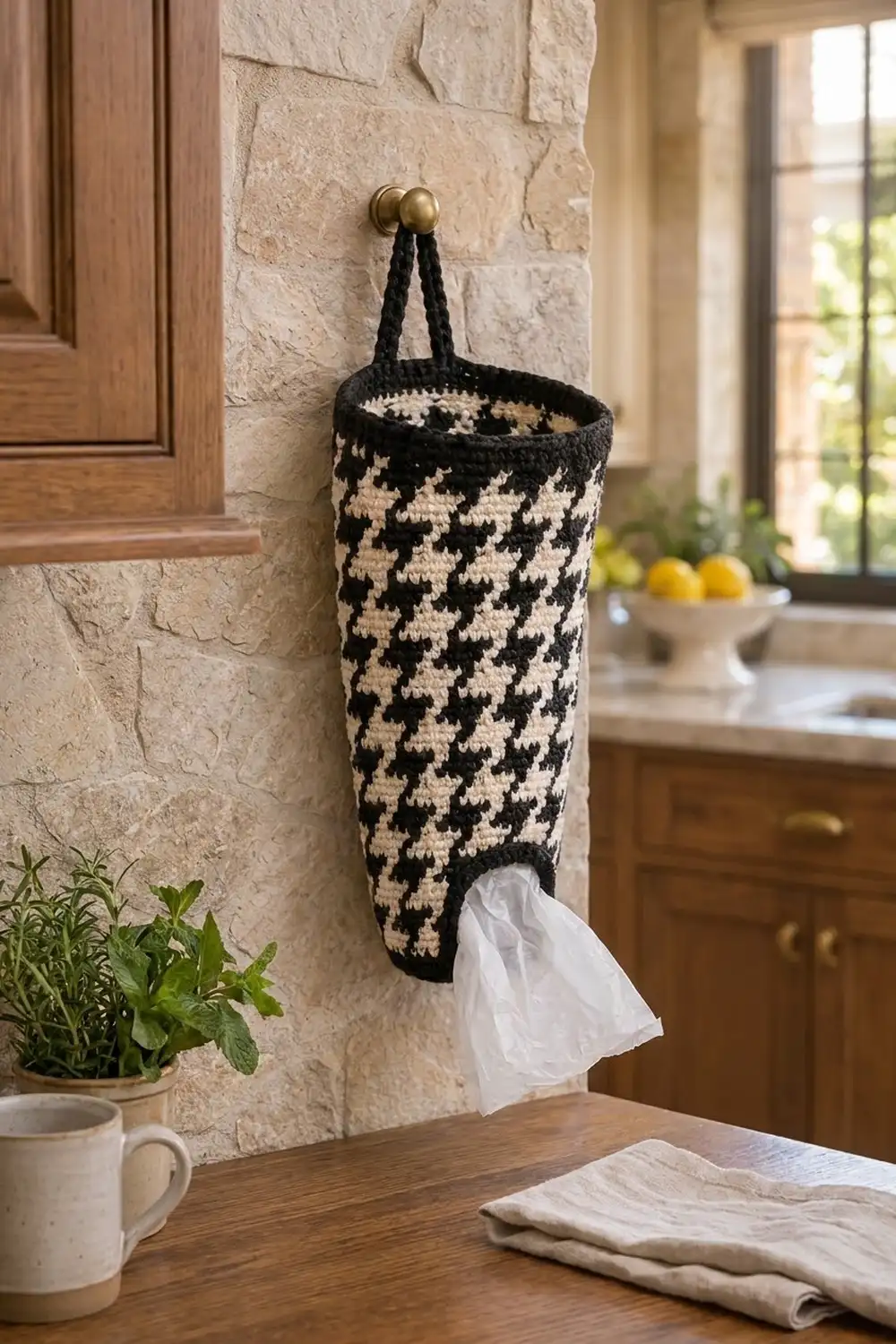
This hanging bag holder keeps plastic grocery bags tidy and looks smart on a kitchen wall. The body is a tapered tube in black and cream houndstooth. It sits on a solid black oval base and finishes with a black rim and a corded black hanging loop. You stuff bags in through the wide top and pull them out one at a time through a round, black-edged hole near the bottom front.
The style is crisp and timeless. The small houndstooth “teeth” come from a 4-stitch, 4-round tapestry crochet chart. The black details (base, bottom band, rim, hole edging and loop) give the piece a clean outline. All instructions use US crochet terms.
Without the loop, the holder is 15.5 in (39.4 cm) tall. With the loop, it is 18.5 in (47.0 cm) tall. It measures 14 in (35.6 cm) around at the bottom and 20 in (50.8 cm) around at the top.
The holder is worked in one seamless piece. You crochet an oval base in rounds and turn it upward with a back-loop round. Then you work the body in continuous spiral rounds of tapestry single crochet. A chain bridge makes the dispenser slit, and six increase rounds widen the tube toward the top. A black rim, hole edging and loop finish it.
Finished Size and Construction
- Finished size: 15.5 in (39.4 cm) tall, plus a 3 in (7.6 cm) loop
- Skill level: Intermediate (tapestry crochet in rounds)
- Terminology: US
- Yarn weight: Worsted (#4), cotton or cotton blend
- Hook: 4.0 mm (G-6)
- Number of pieces: 1, worked seamlessly
- Layout: Oval base, tapered tube, dispenser hole on the front, loop at the back of the rim
- Piece size: Bottom is 56 sts, 14 in (35.6 cm) around and about 4.5 in (11.4 cm) across. Top is 80 sts, 20 in (50.8 cm) around and about 6.4 in (16.3 cm) across.
- Size before border: 14.5 in (36.8 cm) tall after Body Rnd 58
- Border depth: 1 in (2.5 cm) rim; 2-round hole edging
Materials
Choose a smooth, firm worsted cotton or cotton blend. Cotton holds its shape when the holder is full of bags, and it shows the houndstooth sharply. Avoid fuzzy or heathered yarns, which blur the small teeth.
- Color A, Black: 110 g / 210 m (230 yd)
- Color B, Cream: 80 g / 150 m (164 yd)
These quantities include a margin of about 15 percent. Tapestry crochet carries the unused color inside every stitch, so it uses more yarn than plain single crochet.
Colorway tip: For a softer look, swap the black for dark chocolate brown. Use the same amounts and keep cream as Color B. Strong contrast is what makes houndstooth readable, so avoid pairing two mid-tones.
Tools:
– 4.0 mm (G-6) crochet hook
– Stitch markers (at least 2)
– Tapestry needle
– Scissors
– Measuring tape
– Spray bottle for blocking
Abbreviations (US Terms)
- ch – chain
- sc – single crochet
- inc – 2 sc in the same stitch
- BLO – back loop only
- sl st – slip stitch
- st(s) – stitch(es)
- rnd(s) – round(s)
- A / B – black / cream
Tapestry sc: Lay the unused color along the tops of the previous round’s stitches and work each sc over it, so the strand is hidden inside. To change color, work the last sc before the change until 2 loops are left on the hook. Then yarn over with the new color and pull through. Keep the carried strand relaxed, not tight.
Gauge and Checkpoints
Gauge: 16 sts and 16 rnds = 4 in (10.2 cm) in tapestry sc worked in the round.
Check your gauge on the base first. Rnds 1–6 work up quickly, and they set the bottom circumference for the whole holder. Then measure again a few rounds into the body, because tapestry stitches are often a little tighter than plain ones.
Checkpoints:
1. After the base (Rnd 6): 56 sts; about 5.5 in (14.0 cm) long and 3 in (7.6 cm) wide.
2. After Body Rnd 14: 3.5 in (8.9 cm) tall from the base edge. The 56 sts still measure 14 in (35.6 cm) around.
3. After Body Rnd 30: 7.5 in (19.1 cm) tall. The 64 sts measure 16 in (40.6 cm) around.
4. After Body Rnd 58: 14.5 in (36.8 cm) tall. The 80 sts measure 20 in (50.8 cm) around.
5. After the rim: 15.5 in (39.4 cm) tall.
Too big? Go down to a 3.75 mm (F-5) hook. Too small? Go up to a 4.5 mm (7) hook. If your stitch gauge matches but your rounds are a little short, follow the round counts anyway. The chart is counted in rounds, not inches, so a slightly shorter holder still works.
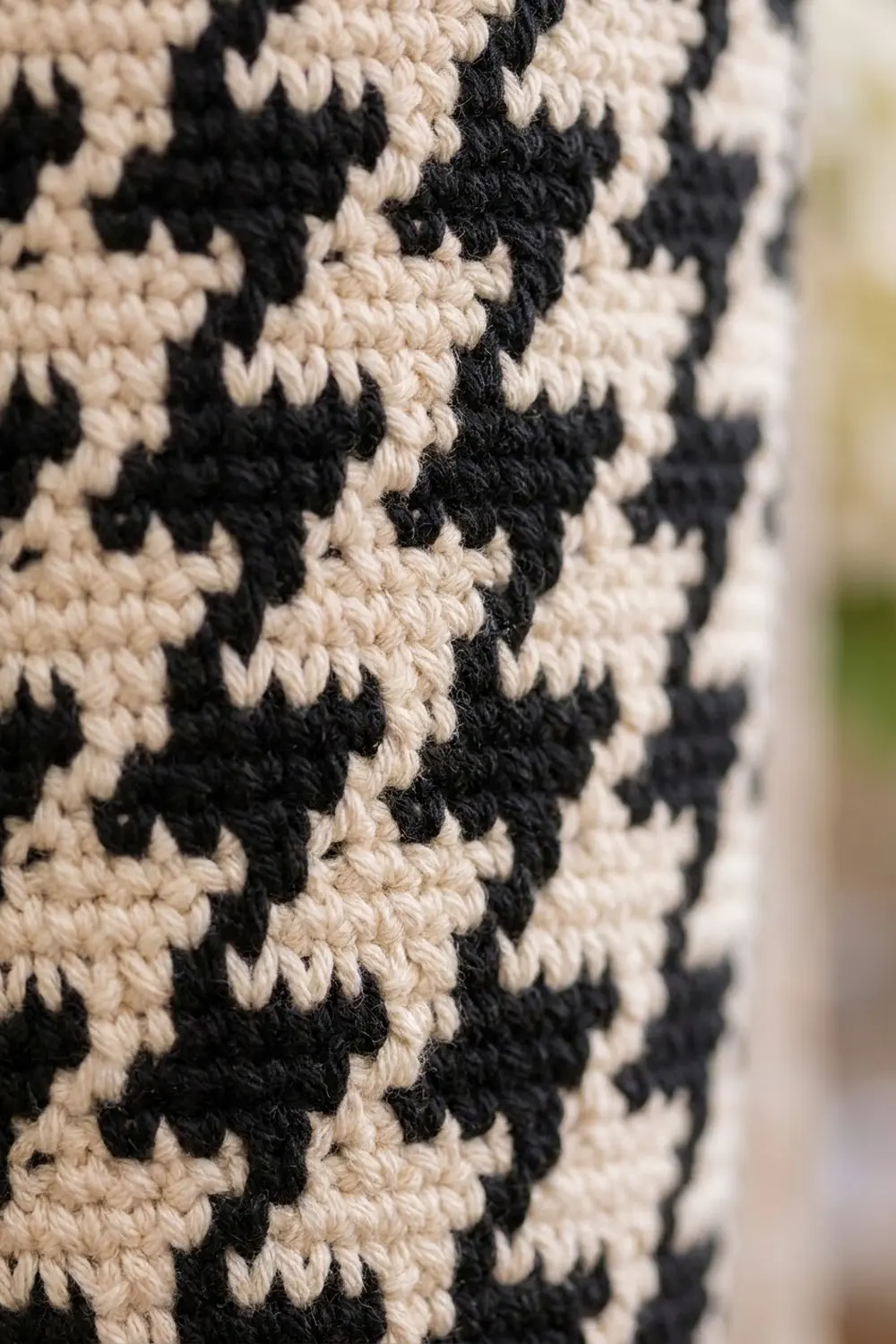
Houndstooth Chart
The chart is 4 sts wide and 4 rnds tall. Repeat each line all the way around.
- Chart Rnd 1: A, A, A, A (solid black)
- Chart Rnd 2: A, A, A, B
- Chart Rnd 3: B, B, B, B (solid cream)
- Chart Rnd 4: B, A, B, B
Stacked, these rounds make the jagged, diagonal tooth shape. Chart Rnds 1 and 3 are solid colors, so every increase is placed on a Chart Rnd 1. That way, the extra stitches never interrupt the two-color part of the pattern.
Base
Work with A only, in spiral rounds. Move the marker up at the start of each round.
Ch 13.
Rnd 1: 3 sc in 2nd ch from hook, sc in next 10 ch, 3 sc in last ch. Rotate the work and sc in the bottom loops of the next 10 ch. (26 sts: 3 per end, 10 per side)
Rnd 2: [2 sc in each of next 3 sts, sc in next 10 sts] twice. (32 sts: 6 per end)
Rnd 3: [(sc in next st, inc) 3 times, sc in next 10 sts] twice. (38 sts: 9 per end)
Rnd 4: [(sc in next 2 sts, inc) 3 times, sc in next 10 sts] twice. (44 sts: 12 per end)
Rnd 5: [(sc in next 3 sts, inc) 3 times, sc in next 10 sts] twice. (50 sts: 15 per end)
Rnd 6: [(sc in next 4 sts, inc) 3 times, sc in next 10 sts] twice. (56 sts: 18 per end)
Check: the base measures 5.5 in (14.0 cm) by 3 in (7.6 cm) lying flat.
Body
Body Rnd 1: With A, sc BLO in each st around. (56 sts) The unused front loops make a neat ridge that turns the base upward.
Body Rnd 2: With A, sc in each st around. Start carrying B in this round. (56 sts)
Put a second marker in the middle of one long side of the base. This side is the front. The round starts at one end of the oval, on the side of the holder.
Body Rnds 3–7: Work Chart Rnds 1, 2, 3, 4, 1. (56 sts each round)
Body Rnd 8 (slit round, Chart Rnd 2): Work 22 sts in pattern. With A, ch 12 and skip the next 12 sts. Work the last 22 sts in pattern, counting the chains as stitches so the chart stays in place. (22 + 12 + 22 = 56 sts) The 12 skipped sts should be centered on the front marker. If they aren’t, add a few sc before this round to move the round start, and keep the count at 56.
Body Rnd 9 (Chart Rnd 3): Work in pattern in each st and each ch. (56 sts)
Body Rnds 10–14: Work Chart Rnds 4, 1, 2, 3, 4. (56 sts each round)
Increase rounds: Keep following the chart in order. Body Rnds 15, 23, 31, 39, 47 and 55 all fall on Chart Rnd 1 (solid A). Work them as increase rounds:
- Rnd 15: [sc in next 13 sts, inc] 4 times. (60 sts)
- Rnd 23: [sc in next 14 sts, inc] 4 times. (64 sts)
- Rnd 31: [sc in next 15 sts, inc] 4 times. (68 sts)
- Rnd 39: [sc in next 16 sts, inc] 4 times. (72 sts)
- Rnd 47: [sc in next 17 sts, inc] 4 times. (76 sts)
- Rnd 55: [sc in next 18 sts, inc] 4 times. (80 sts)
Work every other round from 16 to 58 even, following the chart. Each total stays a multiple of 4, so the repeat always fits evenly around. Each increase moves the next columns over by one stitch. Because the increases are worked on solid black rounds, the shift only shows as a small offset at the 4 increase points.
Body Rnd 58 is Chart Rnd 4. It completes the 14th full chart repeat (Body Rnds 3–58 = 56 rounds). Cut B, leaving a 6 in (15.2 cm) tail. Check: 14.5 in (36.8 cm) tall, 80 sts.
Border
The rim and hole edging use the body gauge: 16 sts and 16 rnds = 4 in (10.2 cm).
Top Rim
Rim Rnds 1–4 (Body Rnds 59–62): With A only, sc in each st around. (80 sts each round)
Finish the last round with an invisible join, then fasten off.
Why the math works: The rim has 1 sc in each of the 80 sts and no increases. That keeps the top at 20 in (50.8 cm) around, the same as Body Rnd 58. Four rounds at 4 rnds per inch add exactly 1 in (2.5 cm), for a total height of 15.5 in (39.4 cm).
Dispenser Hole Edging
Edging Rnd 1: With A, join at one corner of the slit. Work 12 sc into the 12 skipped sts of Body Rnd 7 along the bottom edge and 2 sc into the side gap. Then work 12 sc into the underside of the ch-12 along the top edge and 2 sc into the other side gap. (28 sts: 12 bottom, 2 side, 12 top, 2 side)
Edging Rnd 2: Sc in each st around; join with a sl st. (28 sts) Fasten off.
Why the math works: Each long edge gets 1 sc per skipped stitch or chain, so neither edge stretches or gathers. The 2 sc at each end turn the corners smoothly. At 4 sts per inch, 28 sts make a ring 7 in (17.8 cm) around. This opens into a round hole about 2.2 in (5.6 cm) across.
Hanging Loop
Find the center back of the rim, opposite the dispenser hole. With A, join in the st 2 sts to the right of center back. Ch 24, skip the next 3 rim sts, and sl st in the following st. Work 32 sc into the ch-24 space, covering the chain completely. Sl st in the starting rim st and fasten off.
The tightly packed sc make a firm, cord-like loop about 3 in (7.6 cm) tall. Anchoring it over 5 rim sts spreads the weight of a full holder.
Final Blocking
- Weave in all ends on the inside, through stitches of the same color.
- Mist the holder lightly with water until it is damp, not wet.
- Stuff it firmly with plastic bags or a rolled towel so it holds its tapered shape.
- Smooth the rim into an even circle about 6.4 in (16.3 cm) across.
- Press the dispenser hole into a circle with your fingers. A small jar lid pushed into the opening helps.
- Stand the holder on a table so the base dries flat.
- Let it dry completely (at least 24 hours) before hanging.
Final Quality-Control Checklist
- The base has 56 sts, lies flat, is oval, and has a clean ridge where the body starts.
- Stitch counts are 56, 60, 64, 68, 72, 76 and 80 sts at the rounds given.
- The houndstooth teeth point the same way all around.
- No carried strands show on the outside.
- The dispenser hole is centered on the front, edged with 28 sts, and opens about 2.2 in (5.6 cm).
- The rim is 4 rounds, 1 in (2.5 cm) deep, with an invisible join.
- The loop sits at center back and is firmly anchored.
- The holder is 15.5 in (39.4 cm) tall, or 18.5 in (47.0 cm) including the loop.
Troubleshooting
Cream shows through the black. Keep the carried strand slightly toward the back of your work, and tug it gently after each color change.
The body puckers. The carried yarn is too tight. Stretch each round slightly before you go on.
The teeth look blurry. Use a smoother yarn, or go down a hook size for firmer stitches.
Bags won’t come out of the hole easily. On Body Rnd 8, ch 14 and skip 14 sts instead. Work 22 + 14 + 20 sts on that round (56 total), and edge the hole with 32 sts: 14 bottom, 2 side, 14 top, 2 side.
The base cups. Your increases are too tight. Go up a hook size for the base only.
The pattern jogs at the round start. This is normal in spiral tapestry crochet. Hang the holder with the jog toward the wall or the side.
Care
Hand wash in cool water with mild soap and press the water out in a towel. Dry flat, stuffed into shape, and do not wring or tumble dry.
Final Notes
Here is how the measurements build up. The 56-st base sets a 14 in (35.6 cm) bottom. Six increase rounds of 4 sts each widen the tube to 80 sts, or 20 in (50.8 cm) around. The bottom band and 56 chart rounds bring the body to 14.5 in (36.8 cm). The 4-round rim adds 1 in (2.5 cm), for a finished height of 15.5 in (39.4 cm), and the loop adds 3 in (7.6 cm). If your base matches gauge, the rest of the holder will come out to size.
Happy crocheting!