

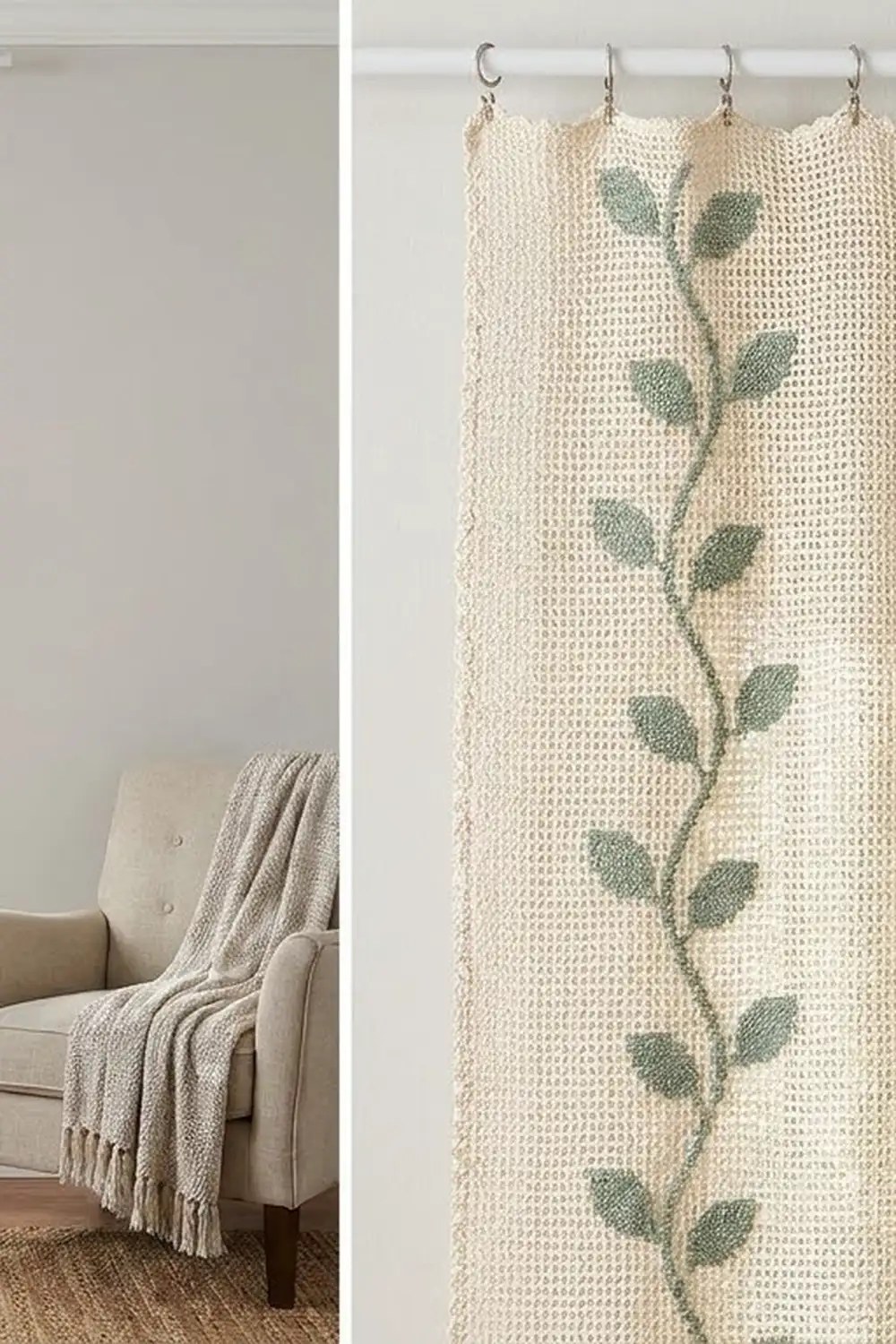
The Climbing Ivy Filet Curtain Panel is a long, airy window panel worked in classic filet mesh. Three wavy green vines run the full length of a soft cream grid, and each vine has leaves that alternate from side to side. A row of small scallops finishes the hem.
There are only two colors: a warm cream for the mesh and a muted sage green for the vines. Light passes through the open squares, so the leaves seem to float against the window. The style is cottage and botanical without being fussy.
This pattern uses US crochet terms. One finished panel measures 29 in (73.7 cm) wide and 79 in (200.7 cm) long after the border and blocking. To dress a window as a pair, make a second identical panel. The two panels hang separately and are never joined.
You work the panel flat in one piece from the top down. First comes a firm solid header band for the hooks. Then you work the mesh rows and place green filled blocks by following a 16-row vine chart, using intarsia bobbins. A scalloped hem row and a single crochet edging finish the panel.
Finished Size and Construction
- Finished size: 29 in x 79 in (73.7 cm x 200.7 cm)
- Skill level: Intermediate
- Terminology: US crochet terms
- Yarn weight: DK (#3), cotton or cotton blend
- Hook: 4.5 mm (US 7)
- Number of pieces: 1 panel (make a second for a pair; no joining)
- Layout: 57 blocks wide x 156 rows long, with 3 vines
- Panel size before border: 28.5 in x 78 in (72.4 cm x 198.1 cm)
- Border depth: 0.25 in (0.6 cm) on the sides and top; 0.75 in (1.9 cm) scallops plus 0.25 in (0.6 cm) of edging at the hem
Materials
Choose a smooth DK cotton or cotton blend in a light color. Cotton keeps the mesh crisp and holds its blocked shape well. Avoid fuzzy or very stretchy yarns, because a long hanging panel will drop if the fiber is too elastic.
Yarn (one panel):
- Cream (main color): 750 g, about 1,725 m
- Sage green (vines): 150 g, about 345 m
Double these amounts for a pair. The quantities include a margin of about 10 percent for swatching and intarsia tails.
Tools:
- 4.5 mm (US 7) crochet hook
- 6 yarn bobbins (3 cream, 3 green)
- Tapestry needle
- Stitch markers (at least 6)
- Measuring tape
- Blocking mats or a large clean surface, rust-proof pins, and a spray bottle
Abbreviations (US Terms)
- ch: chain
- sc: single crochet
- dc: double crochet
- sl st: slip stitch
- sk: skip
- sp: space
- st(s): stitch(es)
- RS / WS: right side / wrong side
- rep: repeat
Special stitches:
- Open block (cream): ch 2, sk the next 2 sts or the ch-2 sp, dc in the next dc.
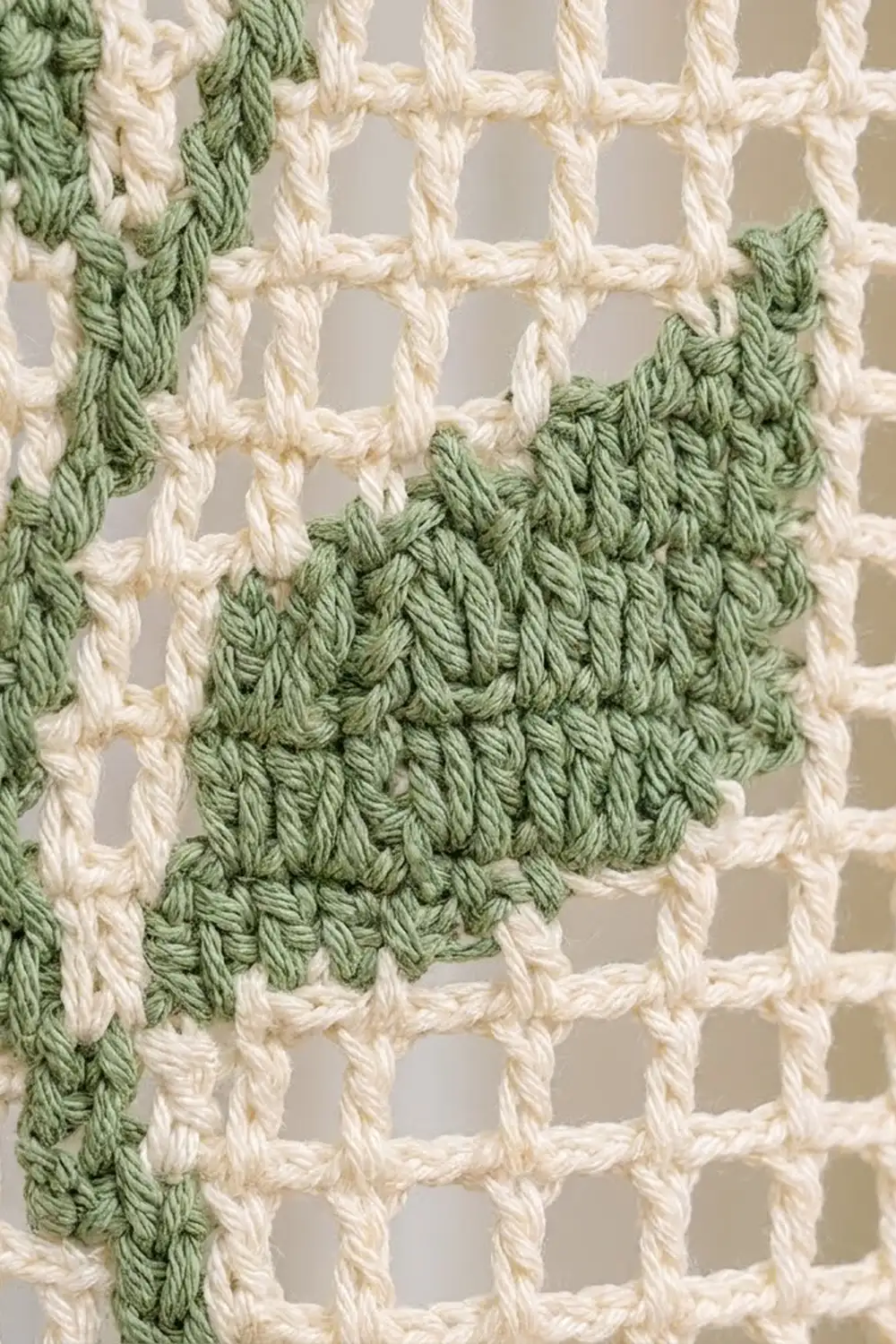
- Filled block (green): 2 dc in the next ch-2 sp (or dc in each of the next 2 dc), then dc in the next dc. Work all 3 of these sts in green.
Every block is 3 sts. Each row has 1 starting dc (the turning chain) plus 57 blocks, so 3 x 57 + 1 = 172 sts.
Color changes: Change color on the last yarn over of the stitch before the new color. Drop the old strand on the WS and pick it up again on the next row. Never carry a strand across open mesh, because it will show.
Gauge and Checkpoints
Gauge: 10 blocks and 10 rows = 5 in (12.7 cm) in filet mesh, after blocking. That is 2 blocks and 2 rows per inch, or 6 sts per inch.
Test first: Ch 42 and work Row 1 as below (40 sts including the turning ch, which makes 13 blocks). Work 12 mesh rows and fill a few blocks in green. Block the swatch and measure 10 blocks by 10 rows in the center.
- If 10 blocks measure more than 5 in (12.7 cm), go down a hook size.
- If they measure less, go up a hook size.
- If the width is right but the rows are too short, pull the dc loops up slightly taller. If the rows are too tall, keep the loops lower.
Checkpoints (measured flat, before blocking):
- After Row 4 (header): 2 in (5.1 cm) deep, 28.5 in (72.4 cm) wide
- After Row 23 (first vine repeat): 11.5 in (29.2 cm) long
- After Row 87 (fifth repeat): 43.5 in (110.5 cm) long
- After Row 151 (last repeat): 75.5 in (191.8 cm) long
- After Row 156: 78 in (198.1 cm) long
Panel Layout
The 57 blocks are laid out like this, counted from either edge:
- Blocks 1–6: cream margin, 3 in (7.6 cm)
- Blocks 7–13: Vine 1 zone, 3.5 in (8.9 cm)
- Blocks 14–25: cream gap, 6 in (15.2 cm)
- Blocks 26–32: Vine 2 zone
- Blocks 33–44: cream gap
- Blocks 45–51: Vine 3 zone
- Blocks 52–57: cream margin
Check: 6 + 7 + 12 + 7 + 12 + 7 + 6 = 57 blocks. The layout is symmetric, so the zones fall in the same place whichever edge you start from. On Row 7, place a marker at the start of each vine zone.
Header and Plain Mesh
With cream, ch 174.
Row 1 (RS): Dc in 4th ch from hook and in each ch across. Turn. (172 sts; the skipped ch-3 counts as the first dc)
Rows 2–4: Ch 3 (counts as dc), dc in each st across, working the last dc in the top of the turning ch. Turn. (172 sts)
These four solid rows form the 2 in (5.1 cm) header band that the curtain hooks pass through.
Row 5 (RS): Ch 5 (counts as dc + ch 2), sk next 2 dc, dc in next dc; *ch 2, sk next 2 dc, dc in next dc; rep from * 55 more times, working the last dc in the top of the turning ch. Turn. (57 open blocks, 172 sts)
Rows 6–7: Ch 5 (counts as dc + ch 2), dc in next dc; *ch 2, dc in next dc; rep from * across, working the last dc in the 3rd ch of the turning ch-5. Turn. (57 open blocks)
The Vine Chart
Each vine is 7 blocks wide and repeats every 16 rows, which is 8 in (20.3 cm). The chart is shown as the panel hangs, top line first. Because you work from the top down, chart Row 1 is the first vine row you crochet.
X = filled green block, . = open cream block. Columns run 1 to 7, left to right.
Chart  1:  . . . X X X .
Chart  2:  . . . X X X X
Chart  3:  . . . X X X .
Chart  4:  . . . X X . .
Chart  5:  . . . X . . .
Chart  6:  . . . . X . .
Chart  7:  . . . . X . .
Chart  8:  . . . X . . .
Chart  9:  . X X X . . .
Chart 10:  X X X X . . .
Chart 11:  . X X X . . .
Chart 12:  . . X X . . .
Chart 13:  . . . X . . .
Chart 14:  . . X . . . .
Chart 15:  . . X . . . .
Chart 16:  . . . X . . .
The stem sits in column 4 and swings one block to each side to make the wave. The leaves are 4 rows tall and 2 to 4 blocks wide. They grow from the stem and point outward, on the right in Chart 1–4 and on the left in Chart 9–12. In every chart row the green blocks touch each other, so each vine needs only one green bobbin per row.
Green blocks per repeat: 3+4+3+2+1+1+1+1+3+4+3+2+1+1+1+1 = 32 blocks per vine.
Reading direction: Odd chart rows fall on WS panel rows (8, 10, 12, and so on). Read them left to right. Even chart rows fall on RS panel rows. Read them right to left. Following this rule makes all three vines lean the same way.
Vine Section
Before Row 8, wind 3 cream bobbins and 3 green bobbins. The main cream ball works the first margin. Each gap and the far margin get their own cream bobbin, and each vine zone gets its own green bobbin.
Rows 8–23 (first repeat): Ch 5 (counts as dc + ch 2), dc in next dc to make block 1. Work blocks 2–57 following the layout. In each vine zone, work the 7 blocks from the matching chart row, with open blocks in cream and filled blocks in green. Turn. (172 sts every row: 1 turning-ch dc + 57 blocks)
When a filled block sits under an open block, ch 2, sk the next 2 dc and dc in the next dc. When an open block sits under a filled block, work 2 dc in the ch-2 sp, then dc in the next dc.
Rows 24–151: Rep chart Rows 1–16 eight more times. (9 repeats in total, 144 rows, 72 in / 182.9 cm)
Check: 7 + 144 = 151 rows. Each vine now has 9 x 32 = 288 green blocks, or 864 across the panel.
Cut the green bobbins and the extra cream bobbins, leaving 6 in (15.2 cm) tails. Continue with the main cream ball only.
Rows 152–156: Work as Row 6. (57 open blocks)
The panel now has 156 rows and measures 78 in (198.1 cm) long and 28.5 in (72.4 cm) wide. Do not fasten off.
Border
Border gauge: Along the sides, work 2 sc per row end. That is 4 sc per inch, which matches 2 rows per inch. Along the top, work 1 sc per st, or 6 sc per inch, which matches the stitch gauge. Because the edging matches the panel’s own gauge, the edges stay flat without ruffling or pulling in.
Round 1, scallop hem (worked as a row across the bottom): Ch 1, turn. Sc in first dc; *5 dc in next ch-2 sp, sc in next dc, 2 sc in next ch-2 sp, sc in next dc; rep from * 27 more times; 5 dc in last ch-2 sp, sc in 3rd ch of turning ch. (29 scallops, 259 sts)
Why the math works: Each repeat covers 2 blocks, so 28 repeats use 56 blocks and the final scallop uses block 57. Stitch count: 1 + (28 x 9) + 5 + 1 = 259. There is a scallop at each end, so the hem is symmetric. Each scallop is about 0.75 in (1.9 cm) deep.
Round 2, edging: Ch 1. Do not turn. Rotate the panel to work up the side.
- First side: 1 sc in the end of the scallop row, then 2 sc in each row end up to the top (156 rows x 2 = 312). (313 sc)
- Top: Work across the opposite side of the foundation ch (172 sts, counting the base of the turning ch). Work 3 sc in the first st (corner), sc in each of the next 170 sts, and 3 sc in the last st (corner). (176 sc including both corners)
- Second side: 2 sc in each of the 156 row ends, then 1 sc in the end of the scallop row. (313 sc)
Sl st in the first sc of the scallop row. Fasten off. (802 sc in Round 2)
The top count works because 172 sts = 170 between the corners + 2 corner sts, and each corner st takes 3 sc: 170 + 6 = 176. The sc round adds about 0.25 in (0.6 cm) to each side and to the top.
Weave in all ends inside filled green blocks or along the solid header, never across open squares.
Final Blocking
- Soak the panel in cool water with a little mild soap for 15 minutes.
- Gently press out the water, then roll the panel in towels to remove more. Do not wring it.
- Lay it flat on mats or a clean sheet. Pin the top edge straight at 29 in (73.7 cm) wide.
- Pin the sides straight down to a total length of 79 in (200.7 cm). Check the width every 10 in (25.4 cm).
- Lay a ruler along a column of blocks to square the mesh. Each block should be close to 0.5 in (1.3 cm) square.
- Pin each scallop into a neat rounded curve.
- Let the panel dry completely, then unpin.
Final Quality-Control Checklist
- The panel measures 29 in x 79 in (73.7 cm x 200.7 cm).
- Every row has 57 blocks, with none gained or lost at the edges.
- All three vines start on Row 8 and end on Row 151.
- On every vine, the leaves on each side point the same way.
- No green strands show across open squares.
- There are 29 scallops, with one at each corner.
- The side edges hang straight with no waves.
- All ends are woven in securely.
Troubleshooting
The panel narrows or widens. You are missing or adding a block at the edges. Count the 172 sts every few rows, and make sure you count the turning ch-5 as a dc.
The vines lean in different directions. Some chart rows were read the wrong way. Read odd chart rows left to right and even chart rows right to left.
Green shows through cream areas. A strand was carried instead of dropped. Use a separate bobbin for each section.
The mesh squares are tall rectangles. Your dc is too tall for your chains. Make the ch-2 slightly looser or the dc loops shorter.
The bobbins tangle. Turn clockwise on one row and counterclockwise on the next so the strands untwist.
The sides ripple after the border. You have too many sc per row end. Keep to exactly 2.
Care
Hand wash in cool water and dry flat, reshaping the mesh while it is damp. Do not tumble dry or hang the panel while wet, because the weight of the water will stretch it.
Final Notes
Each block is 0.5 in (1.3 cm) square, so the 57 blocks across make 28.5 in (72.4 cm) and the 156 rows make 78 in (198.1 cm). The vine repeat is 16 rows, or 8 in (20.3 cm), and 9 repeats fill 72 in (182.9 cm). The scallop hem and sc edging bring the panel to 29 in x 79 in (73.7 cm x 200.7 cm).
Check your gauge, count your blocks, and let the vines grow row by row. Happy crocheting!