

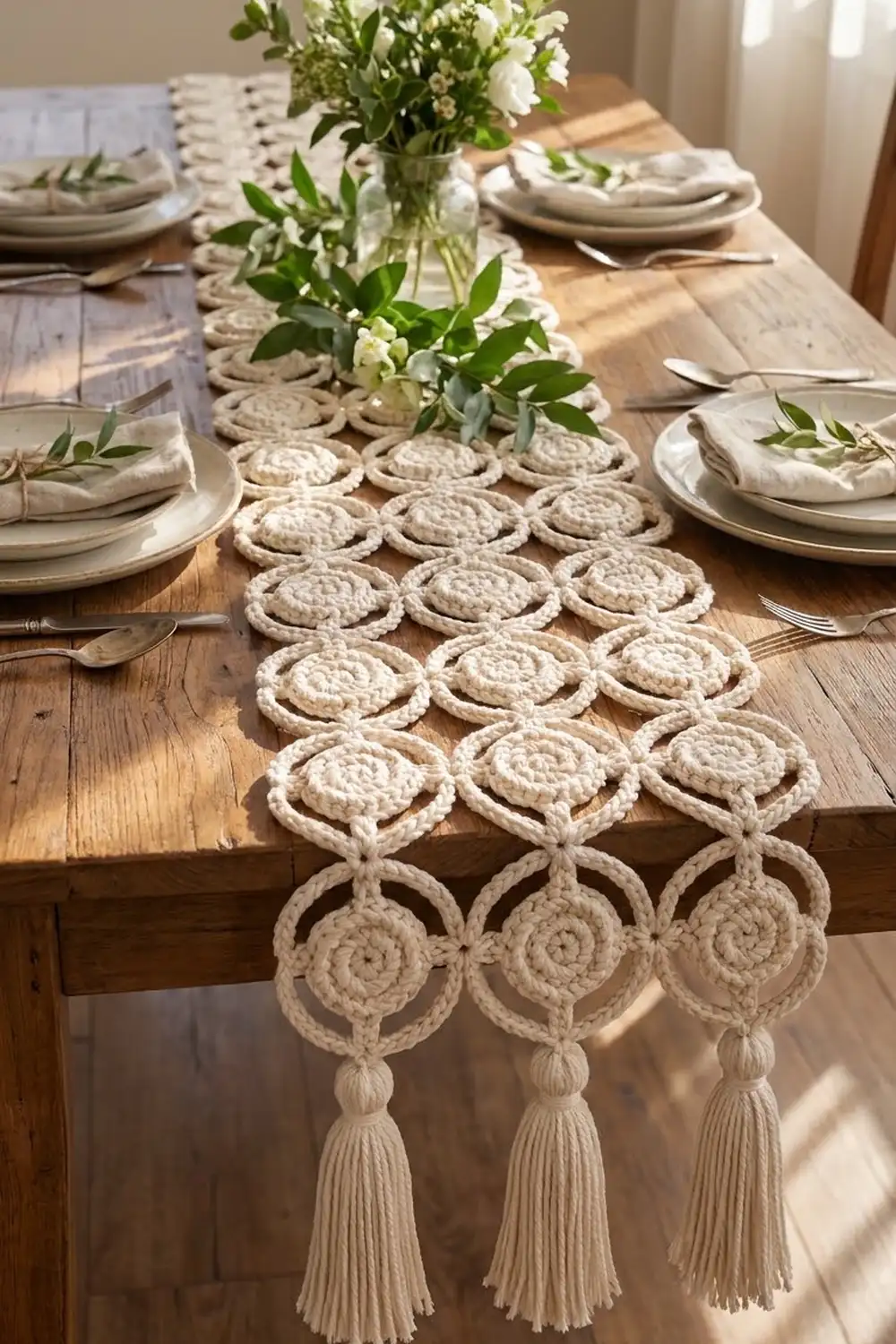
This runner is built from small, sturdy rosettes. Each motif is a tightly coiled spiral disc with four airy chain petals around it. Joined into a grid, the petals of neighboring motifs form a chain of overlapping circles. Each column ends in a soft tassel that hangs over the table edge.
The whole runner is one color: warm cream, or any natural ivory. Using a single shade lets the texture do the work. Thick, twisted cotton cord makes each single crochet look braided, and the open loops keep the piece light and graphic. It suits farmhouse, boho, and Scandinavian tables equally well.
The pattern uses US crochet terms. The finished runner, after the edge round, measures 13.75 in x 54.25 in (34.9 cm x 137.8 cm). Tassels add about 6.75 in (17.1 cm) at each end.
Construction overview: you crochet 36 rosette motifs and join them as you go at the petal tips, in a layout 3 wide by 12 long. A slip-stitch edge round firms up the scalloped outline. Last come the chain tassel hangers and six tassels.
Finished Size and Construction
- Finished size: 13.75 in x 54.25 in (34.9 cm x 137.8 cm), not counting tassels
- Skill level: Intermediate (join-as-you-go)
- Terminology: US
- Yarn weight: #5 Bulky, cotton or cotton cord
- Hook: 6.0 mm (US J-10)
- Number of pieces: 36 motifs, all joined into one runner
- Layout: 3 motifs wide x 12 motifs long
- Piece size: 4.5 in (11.4 cm) from junction to junction; 6 3/8 in (16.2 cm) diagonally from tip to tip; center disc 3 in (7.6 cm)
- Size before border: 13.5 in x 54 in (34.3 cm x 137.2 cm)
- Border depth: about 1/8 in (0.3 cm) on every side
Materials
Yarn advice: Pick a smooth, twisted bulky cotton or a soft cotton cord of about 110 m per 100 g. Twisted plies show off the coiled-rope texture. Cotton also holds the open loops flat after blocking. Avoid fuzzy or very stretchy yarns, because the petals will droop.
- Cream / Ivory (only color): 350 g, about 385 m (420 yd)
- Motifs: about 230 m (252 yd)
- Edge round and tassel hangers: about 22 m (24 yd)
- Six tassels: about 66 m (72 yd)
These quantities include a margin of roughly 15% for gauge swatches, tails, and yarn-to-yarn differences.
Tools:
- 6.0 mm (US J-10) crochet hook
- Locking stitch markers
- Tapestry needle
- Scissors
- A 5 in (12.7 cm) piece of stiff card for the tassels
- Blocking mats, rustproof pins, and a spray bottle
- Measuring tape
Abbreviations (US Terms)
- ch – chain
- sc – single crochet
- sl st – slip stitch
- st(s) – stitch(es)
- inc – 2 sc in the same st
- MR – magic ring
- JAYG – join-as-you-go
Special stitch – Tip Join: Ch 8. Remove the hook and insert it from front to back through the tip chain (the 8th ch) of the waiting petal on the motif you are joining to. Pick up your dropped loop and pull it through; this counts as 1 join sl st. Ch 8 more. The petal still has 16 ch (8 + 8). The join sl st is extra and never gets worked into later.
Gauge and Checkpoints
Make one full motif before anything else and block it lightly.
Gauge: Rounds 1–4 make a disc 3 in (7.6 cm) across. For chains, 7 ch = 2 in (5.1 cm).
Disc checkpoints (diameter):
- Round 1: 0.75 in (1.9 cm)
- Round 2: 1.5 in (3.8 cm)
- Round 3: 2.25 in (5.7 cm)
- Round 4: 3 in (7.6 cm)
Motif checkpoint: Pin the four petal tips out into a square. Opposite tips should be 6 3/8 in (16.2 cm) apart diagonally, which places neighboring junctions 4.5 in (11.4 cm) apart.
If the disc is too big, go down 0.5 mm. If it’s too small, go up 0.5 mm. If the disc measures right but the petals fall short or overshoot the square, change only the chain tension (or switch hooks just for the chains). Don’t change the chain count, because the edge round depends on it.
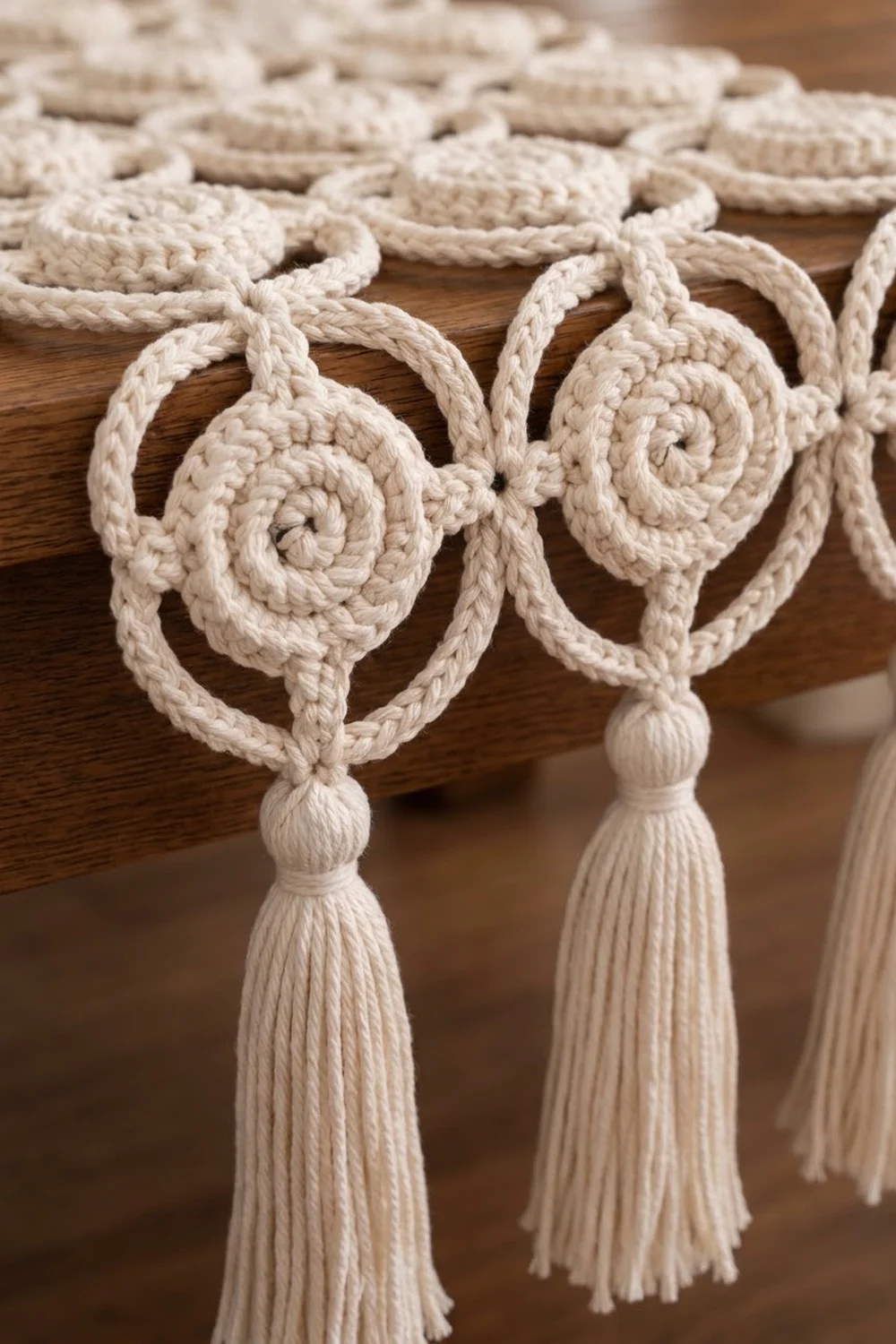
Motif (make 36)
Work in a continuous spiral. Don’t join rounds. Place a marker in the first st of each round and move it up as you go. Leaving the rounds unjoined is what creates the coiled-rope look.
Round 1: Make an MR, then work 6 sc into the ring. Pull the ring closed. (6 sts)
Round 2: Inc in each st around. (12 sts)
Round 3: Sc in next st, inc in next st; repeat from * around. (18 sts)*
Round 4: Sc in next 2 sts, inc in next st; repeat from * around. (24 sts)*
To smooth the step at the end of the spiral, sl st in the next st. That sl st sits in the first st of Round 5’s sequence, so don’t count it separately: start Round 5 by working “sl st in next 4 sts” for the first group only.
Checkpoint: The disc should be 3 in (7.6 cm) across and lie flat.
Round 5 (petal round, conversion): Sl st in next 5 sts, ch 16, sl st in next st; repeat from * 3 more times.
Count: 24 sl sts (1 in each existing st) + 4 ch-16 petals (64 ch added).*
Each petal is anchored between 2 neighboring sts, so it bows into a rounded teardrop. Between any two petals, 6 disc sl sts are exposed. Fasten off, leaving a 6 in (15.2 cm) tail, and weave it in through the back of the disc.
Orient the motif so the petals point diagonally: NE, SE, SW, and NW.
Join-As-You-Go Rules
Make Motif 1 in full. Every later motif is identical through Round 4. In Round 5, any petal whose tip lands on an existing junction gets the Tip Join in place of ch 16.
- Row 1, Column 1: No joins.
- Row 1, Columns 2–3: Join the NW petal to the left motif’s NE tip and the SW petal to the left motif’s SE tip.
- Rows 2–12, Column 1: Join the SW petal to the NW tip of the motif below, and the SE petal to the junction above the right-hand side of the motif below.
- Rows 2–12, Columns 2–3: Join the SW and SE petals to the junctions below, and the NW petal to the left motif’s NE tip.
Always sl st into the tip ch of the first petal made at that junction. Interior junctions end up with 4 tips at one knot point. Junctions along the edges have 2 tips, and the 4 outer corner tips stay free.
Make All Pieces
- Cream / Ivory: 36 motifs, all joined as they’re made
Layout (M = one motif; columns 1–3, rows 1–12 from the tassel end up):
Row 12:  M  M  M
Row 11:  M  M  M
Row 10:  M  M  M
Row 9:   M  M  M
Row 8:   M  M  M
Row 7:   M  M  M
Row 6:   M  M  M
Row 5:   M  M  M
Row 4:   M  M  M
Row 3:   M  M  M
Row 2:   M  M  M
Row 1:   M  M  M   <- tassel end
Joining
Method: JAYG at the petal tips, using the Tip Join described above. Work row by row, left to right.
Stitch-to-stitch logic: Every petal has exactly 16 ch, split into two halves of 8 ch with the tip in the middle. A joining petal adds only its 1 join sl st, and nothing ever gets worked into that sl st. Joining therefore never changes the stitch count of any petal.
Junction count check:
- 22 interior junctions with 4 tips each = 88 tips
- 22 long-edge junctions with 2 tips each = 44 tips
- 4 short-edge junctions with 2 tips each = 8 tips
- 4 free corner tips = 4 tips
Total: 144 tips, which matches 36 motifs x 4 petals.
Tension advice: Don’t pull the join loop tight. Keep it the same size as a normal chain so the knot point stays round and the petals don’t pucker. If a junction twists, check that the hook went through the tip ch from front to back.
Size checkpoint (unblocked, lying flat):
- One row of 3 motifs: 13.5 in (34.3 cm) wide
- After 4 rows: 18 in (45.7 cm)
- After 8 rows: 36 in (91.4 cm)
- After 12 rows: 54 in (137.2 cm)
Border (Slip-Stitch Firming Edge)
The border is a single slip-stitch round that follows the scalloped outline. It steadies the open loops without hiding them.
Border gauge: 1 sl st in every ch and every disc st along the path. Adds about 1/8 in (0.3 cm) per side.
Per-motif side count: Each edge motif shows an outer petal half (8 ch), then 6 exposed disc sts, then the next outer petal half (8 ch). 8 + 6 + 8 = 22 sts per motif per side. The petal tip is ch 8 of its half, so it’s already included; no separate corner stitch exists.
Round 1: Join yarn with a sl st in any exposed disc st on a long side. Working along the outline, sl st into each ch of the outer petal halves and each exposed disc sl st. When you reach a junction, move straight from the tip ch of one petal to the first ch of the next petal half. Don’t work into the join sl st.
- Each long side: 12 motifs x 22 = 264 sl sts
- Each short side: 3 motifs x 22 = 66 sl sts
- Round total: 264 + 264 + 66 + 66 = 660 sl sts
At each outer corner tip, keep going around the free petal: its first half belongs to one side and its second half to the next side.
Finish with an invisible join and weave in the end.
Why the math works: Every edge motif shows the same 8 + 6 + 8 stitches, whatever its position. Each corner petal’s two halves are split between two sides and counted once each. Junction sl sts are skipped. Because nothing is added or doubled at seams or corners, the edge sits flat without ruffling or cupping.
Tassel Hangers and Tassels
Hangers (3 per end): For each motif on the end row, join yarn with a sl st in its SW tip, ch 20, and sl st in its SE tip. Fasten off. The tassel’s weight pulls the chain into a V that drops about 1.75 in (4.4 cm) below the tips.
Tassels (make 6):
- Wrap yarn 40 times around the 5 in (12.7 cm) card.
- Thread a 10 in (25.4 cm) tie under the wraps at the top, knot it tightly, and leave long ends.
- Cut the wraps at the bottom.
- Wrap a separate strand 5 times tightly around the tassel 3/4 in (1.9 cm) below the top to form the head, then knot and bury the ends inside.
- Tie the tassel to the center of a hanger chain, between ch 10 and ch 11.
- Trim the tassel ends level at 5 in (12.7 cm).
For tassels at one end only, make 3 hangers and 3 tassels.
Final Blocking
- Lay the runner flat on blocking mats, right side up.
- Mist it until it’s evenly damp but not soaked.
- Pin the four corners out to 13.75 in x 54.25 in (34.9 cm x 137.8 cm).
- Pin every junction on a 4.5 in (11.4 cm) grid, working out from the center.
- Shape each petal into a smooth round curve with your fingers. Pin only at the tips.
- Press each disc flat with your palm.
- Comb the tassels straight and leave them hanging off the mat edge.
- Let it dry completely (12–24 hours) before you unpin.
Final Quality-Control Checklist
- All 36 discs measure 3 in (7.6 cm).
- Every petal has 16 ch, and joined petals have 1 extra join sl st.
- Interior junctions have 4 tips, edge junctions 2, and the 4 corners are free.
- The runner is 13.75 in x 54.25 in (34.9 cm x 137.8 cm).
- The edge round has 660 sl sts, with no ruffles or tight spots.
- All tails are woven in through the backs of the discs.
- Tassels are even at 5 in (12.7 cm) and centered on their hangers.
Troubleshooting
- Disc cups into a bowl: Your tension is too tight on the increases. Go up 0.5 mm or loosen up.
- Disc ruffles: You have too many sts or a loose hook. Recount the rounds (6/12/18/24) and go down 0.5 mm.
- Petals don’t reach the junctions: Your chains are too tight. Chain more loosely or use a larger hook for the chains only.
- Junctions bunch up: The join sl st was pulled tight. Remake it at normal chain size.
- Edge round waves: You probably worked into a join sl st. Recount to 22 per motif.
- Runner leans diagonally: Check that every NW petal joined to the left motif’s NE tip.
Care
Hand wash in cool water with mild soap, press out the water in a towel, and dry flat, reshaping the petals. Comb the tassels while they’re damp.
Final Notes
Here is the measurement chain:
- A 3 in (7.6 cm) disc with four 16-ch petals gives a 4.5 in (11.4 cm) motif.
- 3 x 12 motifs give 13.5 in x 54 in (34.3 cm x 137.2 cm).
- The 660-stitch edge round brings that to 13.75 in x 54.25 in (34.9 cm x 137.8 cm).
- The tassels add 6.75 in (17.1 cm) per end.
Check the first disc and the first motif carefully, and the rest of the runner will fall into place.
Happy crocheting!